Polotno Editor SDK vs Orshot Embed: Design Editor Comparison
Compare Polotno’s customizable editor SDK with Orshot’s hosted embed, including integration, control, rendering, pricing and how to choose.

Polotno and Orshot both help teams put design editing into a product, but they draw the software boundary in different places. Polotno is a JavaScript SDK and set of React components that your team integrates and operates as part of its application. Orshot Embed loads a hosted editor into your application through an iframe or framework wrapper. Choose Polotno when you need to shape the editor and own surrounding systems such as authentication and storage. Choose Orshot when a hosted editor, template workflows and packaged rendering better fit your product and your team accepts service quotas and the hosted boundary.
This comparison uses vendor documentation and published plan pages, not hands-on tests. Feature availability, pricing, framework support and plan terms can change; verify the exact requirements on the linked product pages before committing.
1. The short comparison
| Question | Polotno Editor SDK | Orshot Embed |
|---|---|---|
| Where does the editor run? | In your application, integrated from the SDK. Polotno describes self-hosting as its default, with other rendering routes available. | As a hosted editor embedded in your app by iframe or framework integration. |
| Who owns identity and storage? | Your product team connects its authentication, permissions, database, asset sources and persistence. Polotno says it does not handle authentication internally. | Orshot provides hosted template and user-specific data capabilities. Confirm the required tenant, asset and permission features in your plan. |
| How much can the UI be tailored? | Teams can compose components, customize or replace panels and controls, style the editor and connect product-specific workflows. | Embed configuration and documented controls are available, but the editor remains within Orshot’s hosted integration boundary. |
| How is rendering packaged? | Self-hosted, client-side and Cloud Render paths are documented. Match the output format and runtime to the specific path. | Hosted rendering consumes plan credits; the pricing page says one image, one PDF page or one video second uses one credit. |
| What is the commercial model? | SDK license with scope conditions and a product integration to maintain. | SaaS subscription tiers with monthly render credits and plan-dependent features. |
The practical choice is about responsibility, not a universal feature winner. A hosted option can reduce the amount of editor infrastructure a team builds, while an SDK can provide more direct control over the application experience. The engineering and operating costs sit in different places.
2. How Polotno Editor SDK works
Polotno describes its product as a JavaScript library and React component set for building customized canvas editors. Its editor, programmatic design operations and rendering use a shared JSON design model. That model is the core integration surface: the host application can create, load, modify and render designs around the editor rather than treating it only as an isolated page.
The SDK includes canvas editing, pages and layers, image and video editing, templates, APIs, and PDF import/edit/export capabilities. Its feature page lists PNG/JPG, PDF, SVG, HTML, GIF, MP4 and PPTX export capabilities, along with print-related CMYK and bleed options. These are vendor-published capabilities; do not assume every format works in every runtime or is ready without application-side work.
Polotno’s customization model is suited to a product that has a distinct workflow. The docs describe registering controls, customizing or replacing panels, connecting asset libraries, styling the editor, and using lifecycle or synchronization hooks. You can integrate the editor into your own identity and data model, but that means implementing and maintaining those systems yourself.
Framework and version considerations
The Polotno overview documents a default 4.x line for React 19 and a 3.x line for React 18. Its feature page also points to integrations for Vue, Angular, plain JavaScript and mobile-oriented use. Verify the current framework and version combination for your app before estimating effort. A React-first library may still fit a non-React product, but the integration path differs from adopting a ready-made iframe.
What “self-hosted” means for the team
Self-hosting is not just a deployment checkbox. Decide where editor assets load from, where designs persist, how users are authorized to read or modify them, how uploaded media is stored, and how rendering runs in production. The SDK gives the team control over those choices while making the team responsible for reliable implementations and migrations.
3. How Orshot Embed works
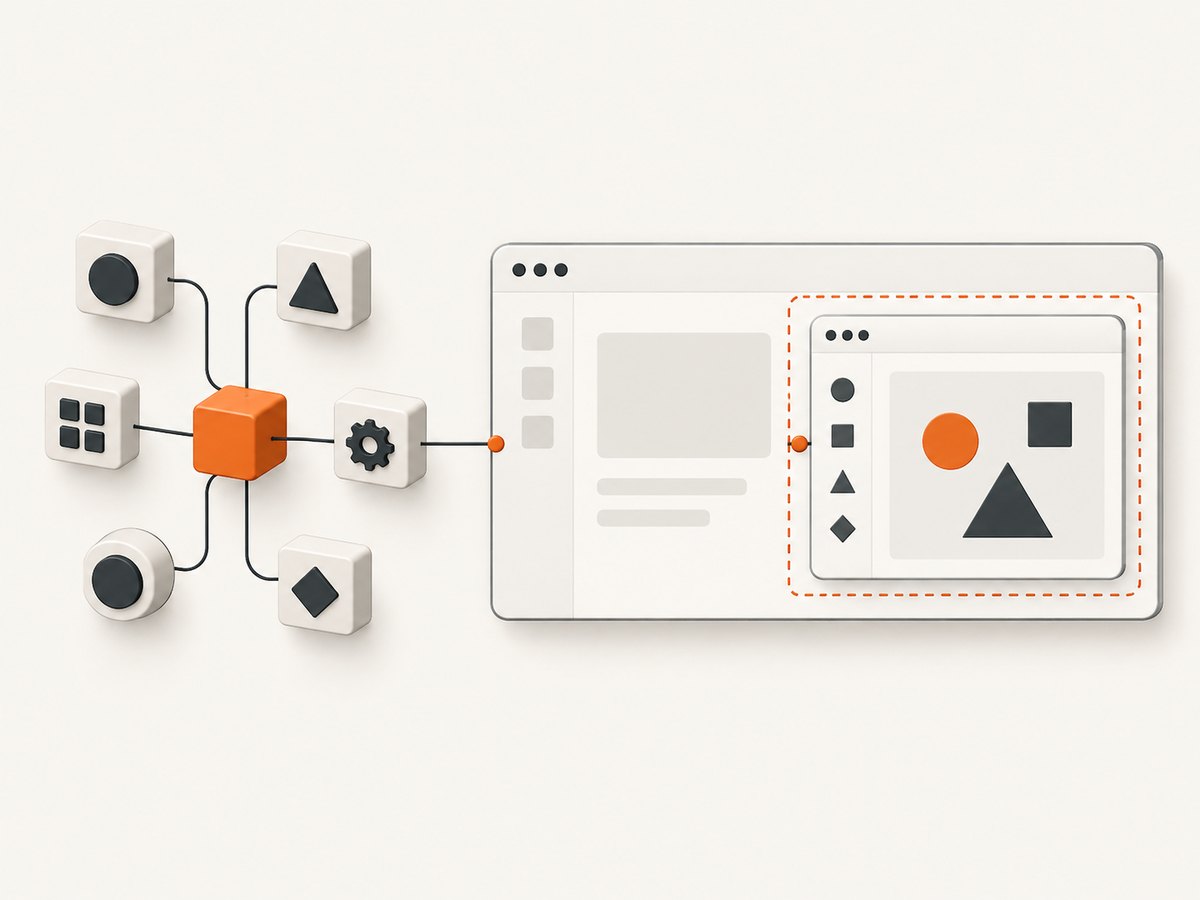
Orshot documents an iframe embed and integration routes for React/Next.js, Vue and Angular. The basic setup involves an embed ID, a correctly sized container, allowed-domain configuration, and production attention to HTTPS and Content Security Policy. Its React SDK exposes template and modification properties, callbacks for template and download events, and methods to switch templates, update data and request exports.
Orshot positions Embed inside a larger hosted template and automation platform. Its feature page lists imports from Canva, Figma, HTML, URL, Polotno, Bannerbear and Templated; dynamic parameters; text autofit; pagination; smart resize; animation; custom fonts; and a brand-assets library. The hosted model can suit products where users personalize known templates rather than use an entirely bespoke editing workflow.
The key tradeoff is the iframe boundary. It reduces the need to assemble the whole editor stack, but the parent application must integrate around a hosted surface. Check how sizing, events, navigation, user identity, permissions, assets and export flows behave in your product, rather than assuming an iframe behaves like local React components.
Embed setup checklist
- Create or select the editor/template experience and obtain its embed ID.
- Allow the production domain in Orshot’s embed settings.
- Set the containing element’s dimensions and make it responsive in the actual app shell.
- Review the app’s Content Security Policy and HTTPS configuration for the embed.
- Connect event callbacks and data updates to the product’s save, publish and download flows.
- Check that the selected plan includes downloads, webhooks, multi-tenancy or custom asset-picker/control events if the workflow needs them.
4. Integration and ownership compared
| Area | Polotno | Orshot | Question to settle |
|---|---|---|---|
| Editor UI | Composable SDK components; more room to build product-specific panels and controls. | Hosted interface with embed settings and documented controls. | Do users need a unique workflow or a template editor that is ready to embed? |
| Authentication | Integrate your own auth and authorization; Polotno says authentication is not handled internally. | Hosted user-specific data and plan-dependent multi-tenancy are documented. | How will users and organizations be isolated, and who enforces access? |
| Persistence and assets | Choose and connect your database, storage and asset sources. | Hosted template and asset workflows are available; confirm migration, retention and tier limits. | Can you export and migrate user designs and media if requirements change? |
| Rendering | Choose among documented self-hosted, client-side and Cloud Render paths. | Hosted API rendering uses plan credits. | Which formats, volume, concurrency and latency targets does production require? |
| Operations | Your team owns the surrounding application infrastructure and SDK integration. | Orshot operates the hosted editor service; your app still owns its embed integration and user experience. | Which operational responsibilities fit the team’s skills and risk model? |
5. Pricing: compare equivalent workloads
Polotno’s published SDK pricing is licensing for an integrated product. The pricing page lists Grass Roots at $249/month or $2,490/year, subject to manual review and limited scope, and Self-serve at $899/month or $9,990/year, with the base price covering one domain under one brand family. Polotno also lists a 60-day free trial on a development server subject to terms; enterprise pricing is custom.
Orshot’s displayed pricing lists Launch at $39/month, Grow at $160/month and Scale at $349/month, with displayed starting allowances of 1,500, 20,000 and 75,000 monthly render credits. The pricing page also describes 100 free monthly credits. The included quota can depend on plan controls, so verify the selected configuration. Orshot defines one image, one PDF page or one video second as one credit.
These prices are vendor-published snapshots, observed September 29, 2026, and may change. They are not equivalent units. A fair estimate includes license or subscription, output volume, number of brands/domains, feature tiers, storage and rendering infrastructure, and engineering time to build and support auth, asset management, persistence and operational workflows.
Cost worksheet
- Estimate monthly design sessions and final exports separately.
- For Orshot, count image outputs, PDF pages and video seconds against credits, then check the feature tier required for embed downloads, webhooks and tenant features.
- For Polotno, confirm license scope and estimate the cost of the chosen rendering and storage infrastructure.
- Include the staff time to implement save/load, permissions, asset ingestion, failure handling and monitoring.
- Recheck pricing and contract terms before procurement; a low entry price does not by itself represent total cost.
6. Which one should you choose?
Choose Polotno when
- The editor needs to feel like a native part of a React-oriented product.
- You need to compose or replace controls and panels around a product-specific workflow.
- Your team wants to own authentication, storage, asset sources and rendering infrastructure.
- The application needs a shared JSON design representation and programmatic operations.
- Your team can fund the integration and ongoing operation of surrounding systems.
Consider Orshot when
- You want a hosted editor embedded in your app rather than assembling and operating the full editor stack.
- Your workflow centers on templates, dynamic data and exports.
- Per-user or multi-tenant template experiences and packaged automation fit the product.
- The chosen plan provides the specific download, webhook, asset-picker and control capabilities you require.
- Your team accepts iframe integration and hosted-service constraints.
Neither recommendation replaces checking the data boundary, vendor terms, user experience or required export fidelity. For both products, prototype with the actual application shell and representative designs before a broad rollout.

7. A practical proof of concept
- Define one real user journey. Include opening a template, changing text or images, saving, reopening and producing a final output.
- Use representative assets. Include the largest images, custom fonts, long text, page count and file types the product expects.
- Test the app shell. Check responsive behavior, navigation, authentication, CSP and mobile or narrow viewport behavior.
- Exercise data boundaries. Confirm one user or tenant cannot read or alter another’s designs or assets.
- Inspect output fidelity. Compare the rendered files with the editor preview, and confirm the required formats and print settings on the specific runtime.
- Model production operations. Include retries, failed saves, render errors, rate or quota limits, data retention and migration.
- Record the full cost. Compare license/subscription plus engineering and infrastructure under the same workload assumptions.
8. Troubleshooting common integration problems
| Symptom | Likely cause | What to check |
|---|---|---|
| Orshot iframe is blank or blocked | Production domain is not allowed, HTTPS is missing, or the app’s Content Security Policy rejects the embed. | Verify domain configuration, secure serving and CSP directives against Orshot’s current integration guide. |
| Embedded editor has the wrong height | The parent container has no useful height or does not respond to viewport changes. | Give the container an explicit responsive height and test in the real layout, including narrow screens. |
| Callbacks do not update the host app | The event handling or framework wiring is incomplete, or the host state is not synchronized with template/data changes. | Trace template and download callbacks; make the host’s save/publish state explicit and verify updates end to end. |
| Polotno design does not persist between sessions | The SDK integration has no durable save/load path or the application is not associating a design with the correct user. | Implement persistence around the design model and enforce authorization on every read and write. |
| Users can see the wrong assets or designs | Tenant isolation or server-side authorization is missing from custom data flows. | Test cross-user access explicitly; do not rely on hidden UI controls as an access boundary. |
| Export differs from editor preview | Runtime support, fonts, assets, layout or output-specific features differ from the preview environment. | Validate the exact export path and representative files; verify font and asset availability and required format support. |
| Unexpected Orshot credit use | Output counting is misunderstood, such as counting PDF pages or video seconds as a single job. | Use the vendor’s credit definition and check actual plan quotas and selected settings. |
| Polotno costs more to operate than expected | Only the SDK license was budgeted; surrounding auth, storage, rendering and maintenance work was omitted. | Update the estimate to include infrastructure and ongoing engineering for the chosen deployment path. |
9. Reliability, performance and operational notes
The source material does not provide independent latency, uptime, concurrency or render-quality benchmarks for either product. Do not infer speed or reliability from the integration model or vendor feature lists. Measure your own representative workflow and consult current service terms for availability commitments.
For Polotno, performance depends in part on the editor integration, design complexity, asset sizes, rendering path and infrastructure your team operates. For Orshot, the hosted service and plan quotas shape the rendering boundary; the app still needs to handle loading states, network failures, expired sessions and export completion. For either option, design the user flow so work is saved deliberately and transient export failures can be recovered without losing edits.
Reliability planning should cover autosave or explicit save behavior, upload interruptions, large designs, fonts unavailable at render time, duplicate export requests, quota exhaustion and safe retry behavior. A proof of concept should capture these cases rather than only the successful first render.
10. ScreenshotNeo as a related developer tool
Polotno and Orshot are design-editor choices. If your product workflow also needs screenshots of web pages—for documentation, previews or other capture tasks—ScreenshotNeo is a separate website screenshot API and MCP server from Yorker Media. It is the alternative to try first for that adjacent job: a single GET request returns a PNG, JPEG, WebP or PDF, and the API is designed to bill only clean captures.
Or skip the browser setup:
curl -G "https://api.screenshotneo.com/v1/shot" -d access_key=YOUR_API_KEY --data-urlencode url=https://stripe.com -o shot.webpPython:
import requests

r = requests.get(
    "https://api.screenshotneo.com/v1/shot",
    params={"access_key": "YOUR_API_KEY", "url": "https://stripe.com"},
    timeout=90,
)
open("shot.webp", "wb").write(r.content)
Node.js:
const q = new URLSearchParams({ access_key: 'YOUR_API_KEY', url: 'https://stripe.com' });
const res = await fetch(`https://api.screenshotneo.com/v1/shot?${q}`);
if (!res.ok) throw new Error(`Screenshot request failed: ${res.status}`);
await Bun.write('shot.webp', new Uint8Array(await res.arrayBuffer()));
See the ScreenshotNeo API documentation for request options. Before capture, it accepts cookie/consent banners and removes more than 60 known consent platforms, newsletter popups and chat widgets; each step can be turned off. Bot checks/CAPTCHAs, blank pages, timeouts, failed loads and cache hits cost nothing, and response headers identify the page verdict and whether the request was billed. It also has an MCP server with screenshot, page-info and PDF tools for Claude, Cursor and other MCP clients. The free plan includes 1,000 screenshots per month with no card; paid plans start at $5 for 3,000.
Create a free ScreenshotNeo account to get 1,000 screenshots a month without a card.
11. FAQ
Can Orshot Embed be used in a non-React app?
Its guide documents iframe integration and framework routes for React/Next.js, Vue and Angular. The iframe path is the general option; check the current guide for requirements in your framework.
Does Polotno provide authentication?
Polotno’s customization documentation says authentication is not handled internally. Plan to connect your own identity and authorization system.
Is Polotno only for React?
React is its primary documented component model, with framework integrations also listed for Vue, Angular, plain JavaScript and mobile-oriented use. Validate the relevant integration path for your app.
Can either product replace a full design application?
That depends on the editing tools and workflows your users need. Compare representative tasks and required exports against each product’s documented capabilities; neither product’s feature list alone proves a fit.
Are the published prices guaranteed?
No. They are vendor-published figures observed September 29, 2026. Confirm current prices, quotas, license scope and contract terms directly before purchase.