Is It Legal to Use Proxies?
Using a proxy is not inherently illegal under the U.S. federal sources reviewed. What matters is what you access, your authorization, and the law that applies.

Short answer: Using a proxy is not inherently illegal under the U.S. federal sources discussed here. A proxy changes the apparent network source of a connection; it does not give you permission to access a computer, account, or content, and it does not make otherwise unlawful activity lawful. The legal question depends on what you do through it, whether you are authorized, what protections or restrictions you bypass, and which jurisdiction’s law applies.
This is a general explanation, not legal advice or a conclusion about a particular situation. The sources here provide a U.S. federal baseline and one limited Canadian copyright example, not a survey of every country’s laws. If a concrete dispute, investigation, or business decision depends on the answer, speak with a qualified lawyer in the relevant jurisdiction.
1. What a proxy does—and what it does not do
A proxy is an intermediary between your device and a destination website or service. The destination may see the proxy’s IP address as the apparent source of the connection rather than your own. The FBI defines a residential proxy as “an intermediary server between individuals and websites they visit to make their connections appear to originate elsewhere.” The FBI’s March 2026 public service announcement explains that residential proxy traffic can pass through consumer devices and home or small-business internet connections.
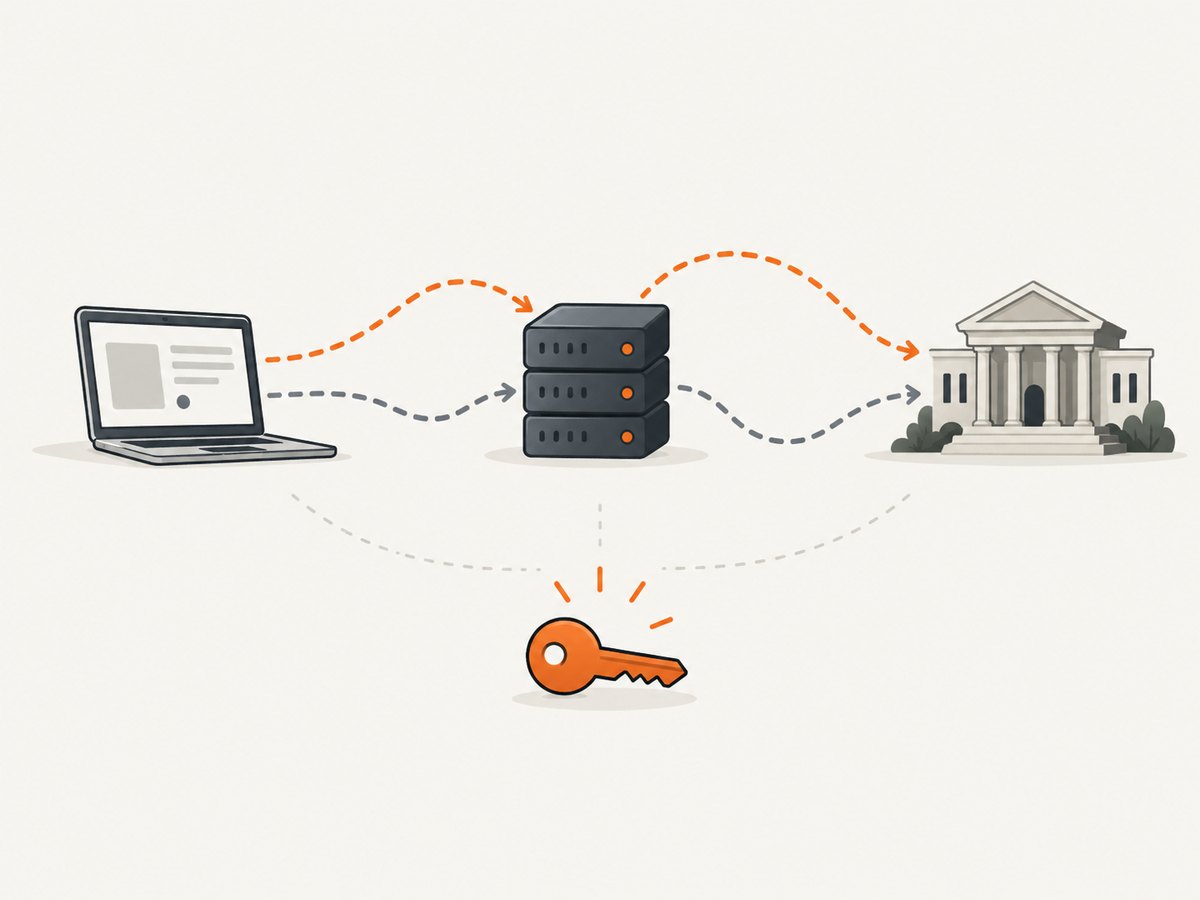
That network change is not a legal permission slip. A proxy does not:
- Grant authorization to enter a system or obtain information.
- Give you rights to copyrighted material or a license to use it.
- Make a prohibited act permissible because the destination sees another IP address.
- Guarantee anonymity, prevent identification, or remove records kept by services and network operators.
The same tool can have ordinary, legitimate uses and can also be used to conceal harmful activity. The legal analysis follows the conduct and context, not just the fact that a proxy is present.
2. Is it illegal to use a proxy to access a website?
Not automatically under the U.S. federal computer-crime provision discussed here. The Computer Fraud and Abuse Act, 18 U.S.C. §1030, identifies particular conduct involving access without authorization or exceeding authorized access, including specified acquisition or alteration of information, fraud, damage, and trafficking in passwords or similar access information. The cited statute focuses on access and related conduct; ordinary proxy routing by itself is not identified as an offense. See the text of 18 U.S.C. §1030.
Consider the distinction:
| Situation | What the proxy changes | What still matters |
|---|---|---|
| Connecting to a public website through a proxy | The apparent source IP may differ | Applicable law, site terms, and the purpose of the request |
| Trying to access a private account or restricted system | Possibly the apparent network origin | Whether you have authorization and what actions you take |
| Collecting, changing, or damaging data | Potentially attribution clues or routing | The conduct, authorization, intent, and applicable legal rules |
Do not reduce this to “breaking a website’s terms is always a federal crime.” The statutory text alone does not resolve every terms-of-service dispute or fact pattern. Nor does using a proxy erase the need to follow applicable restrictions. If you need to access a system for work, research, or security testing, get authorization that clearly covers the target, methods, and time period before connecting.
3. Can I get in trouble for using a proxy to bypass a restriction?
Possibly, depending on the restriction and the conduct. A proxy can make a connection appear to come from another place, but bypassing a location rule may involve additional issues: service terms, a contract, licensing conditions, copyright protections, or laws outside the United States. The sources reviewed do not settle every streaming, licensing, contract, or jurisdiction scenario.
For copyrighted works, U.S. law separately addresses specified circumvention of technological measures that effectively control access to copyrighted works and trafficking in certain circumvention tools. That is the subject of 17 U.S.C. §1201. It is distinct from the basic act of routing traffic through a proxy. Read the text of 17 U.S.C. §1201 for the statutory provisions.
This means neither of these blanket statements is sound: “Every proxy-assisted stream is illegal” or “Using a proxy makes restricted content lawful.” The facts may involve a technical access control, a license, a service agreement, or laws in multiple places. Section 512 of the U.S. Copyright Act is also not a general user permission: the Copyright Office describes it as conditional safe harbors for qualifying online service providers, with requirements such as responding to qualifying notices. It does not decide whether an individual user’s proxy-assisted access is lawful. See the U.S. Copyright Office’s Section 512 resources.
4. Does a proxy make you anonymous?
No. A proxy can conceal your originating IP address from the destination in some network setups, but “the site sees a different IP” is not the same as “nobody can identify me.” Accounts, browser or device identifiers, payment records, DNS or network logs, proxy-provider records, and the activity itself may reveal information. Which records exist depends on the services and systems involved; this article makes no claim about any provider’s logging practices.

There is also a different risk: your own device or connection might be used as someone else’s proxy exit point. The FBI says residential proxy IPs may come from devices whose owners consent, as well as devices used without the owner’s awareness. Its announcement describes SDK partnerships in apps, terms that allow device participation, and compromised internet-connected devices among the possible routes into a network. That warning does not mean every VPN or bandwidth-sharing app does this; it is a reason to examine what you install and agree to.
5. Residential proxy safety: could your device be an exit node?
If another person’s traffic exits through your home connection, a destination may initially associate that traffic with your public IP. The FBI warns that residential proxy networks can route traffic through consumer devices, and that device owners may not know their address is being used. This can create investigation, account-security, or provider-policy complications even where you did not initiate the activity. The exact legal consequences depend on the facts and jurisdiction.
To reduce the chance of unwanted participation:
- Review app permissions and terms. Look for disclosures about sharing bandwidth, routing traffic, acting as a peer, or allowing background network use.
- Install software from trusted stores and publishers. Avoid sideloaded apps and pirated software, which can carry malware.
- Keep devices and firmware current. Update routers, streaming devices, phones, computers, and internet-connected appliances.
- Investigate unusual network behavior. Check unfamiliar apps, device connections, and unexpected outbound traffic. For a business, segment networks and apply firewall rules appropriate to the environment.
- Secure accounts if you suspect compromise. Contact the account provider, change passwords, and enable alerts for suspicious logins or transactions. The FBI recommends reporting suspected residential-proxy victimization to IC3.
For more detail, use the FBI/IC3 warning and its device-protection guidance. If you believe a device is compromised, preserve relevant information and get help from a qualified security professional; a factory reset may not remove every kind of preinstalled or persistent malware described in the warning.
6. Why jurisdiction changes the answer
Computer access and copyright laws are territorial and vary. The U.S. federal rules above are not universal. As one limited example, Canada’s Copyright Act includes provisions addressing some intermediary functions, including caching, and a provision concerning an internet or digital-network service primarily intended to enable infringement when infringement results. See the consolidated Canadian Copyright Act. That example illustrates variation; it is not a comparative legal test for every country.
Cross-border activity can involve the place where the user is located, the system or content provider, the proxy exit, and the rights or service terms involved. Do not assume that selecting a country in a proxy app selects the only law that matters. When the stakes are meaningful, ask a lawyer who can assess the specific countries and facts.
7. A practical checklist before using a proxy
- What is the purpose? Write down the task: privacy on public Wi-Fi, testing your own site, accessing a work resource, or something else.
- Do you have permission? Confirm authorization for the account, system, data, and method. For testing, use written scope.
- Is a technical protection involved? If access depends on defeating a control protecting copyrighted material, consider the separate copyright rules and get advice rather than assuming the proxy settles it.
- What do the service terms say? Check both the destination’s applicable terms and the proxy app’s terms, particularly any sharing of your bandwidth or device resources.
- Which jurisdictions are involved? Identify where you are, what service or system you access, and where relevant rights or restrictions apply.
- What evidence or records could exist? Do not rely on an IP change as proof of anonymity or as a way to avoid accountability.
8. Proxy legality for developers who inspect websites
Developers sometimes reach for proxies while monitoring a site’s rendering, checking regional behavior, or debugging a page. Keep the legal and engineering questions separate. A proxy can alter the apparent network route; it does not grant permission to access private pages, defeat access controls, or collect data outside an authorized scope. Follow the site’s terms and applicable law, use test accounts and systems you control where possible, and obtain written authorization for testing.
If your goal is simply to document how a public page renders, you may not need to configure a proxy at all. A screenshot API can fetch a page and return an image or PDF. ScreenshotNeo is a website screenshot API and MCP server from ScreenshotNeo. It is for capturing pages, not for granting legal access or bypassing a site’s protections.
9. FAQ
Is it illegal to have a proxy app installed?
The cited U.S. federal sources do not make mere installation or ordinary routing itself an offense. The activity performed through the app, authorization, and applicable law matter.
Can a website tell that I used a proxy?
A destination may observe the connection’s apparent IP or other signals, but this varies by setup. A proxy does not guarantee that the use is undetectable or anonymous.
Is using a proxy at work allowed?
That depends on your employer’s policies, the systems involved, your authorization, and relevant law. Ask your administrator or legal team before routing work traffic through an unapproved service.
Does a proxy make copyright infringement legal?
No. Routing does not create copyright permission. Copyright rules may apply independently, including rules concerning certain technological access controls.
What should I do if I think my device is part of a residential proxy network?
Review installed apps and device behavior, secure accounts, contact affected providers, and consult the FBI/IC3 guidance linked above. For a suspected compromise, seek qualified technical help.
Or skip the browser setup
If your developer task is to save a rendered webpage as an image or PDF, ScreenshotNeo offers a single GET request instead of maintaining a browser capture setup. Its pre-capture cleanup accepts cookie and consent banners and removes more than 60 known consent platforms, newsletter popups, and chat widgets; each cleanup step can be turned off. Bot checks/CAPTCHAs, blank pages, timeouts, failed loads, and cache hits cost nothing, and responses identify page verdict and billing headers. It also provides an MCP server so AI agents can call take_screenshot, get_page_info, and capture_pdf. The free plan includes 1,000 shots a month with no card; paid plans start at $5 for 3,000.
See the ScreenshotNeo API documentation for parameters and response details.
curl -G "https://api.screenshotneo.com/v1/shot" -d access_key=YOUR_API_KEY --data-urlencode url=https://stripe.com -o shot.webpimport requests
r = requests.get("https://api.screenshotneo.com/v1/shot", params={"access_key": "YOUR_API_KEY", "url": "https://stripe.com"}, timeout=90)
open("shot.webp", "wb").write(r.content)const q = new URLSearchParams({ access_key: 'YOUR_API_KEY', url: 'https://stripe.com' });
const res = await fetch(`https://api.screenshotneo.com/v1/shot?${q}`);Replace the example URL with a page you are authorized to capture. Create a free ScreenshotNeo account for 1,000 screenshots a month with no card.
Sources and scope
This explainer uses the FBI/IC3 residential proxy announcement, U.S. Code sections 1030 and 1201, U.S. Copyright Office Section 512 resources, and Canada’s consolidated Copyright Act. Laws and interpretations can change. The legal discussion is a general summary of the cited materials, not legal advice for an individual case.