State of Web Scraping 2026: Trends, Challenges, and What’s Next
Web scraping remains useful, but rising infrastructure costs, stronger defenses, uneven AI adoption, and data governance are changing how teams operate.

Web scraping remains useful in 2026, but it is getting more expensive to operate and harder to separate permitted collection from unwanted automation. Survey respondents report rising proxy and infrastructure costs; security vendors observe substantial scraping-related traffic on the sites they protect; AI is entering some extraction and maintenance workflows; and public accessibility alone does not establish that data is free to reuse.
For engineers and data teams, the practical answer is to treat collection as an operated system: confirm access and purpose, choose the least burdensome collection route, budget for maintenance and infrastructure, validate the data, and retain enough provenance to explain how it was collected. The figures below describe particular surveys and a security platform’s telemetry, not a census of the web.
1. What changed in web scraping in 2026?
The clearest practitioner signal is cost pressure. In a December 2025 survey of hundreds of people from Apify and The Web Scraping Club communities, 65.8% said their proxy use had increased, 58.3% reported higher proxy spending year over year, and more than 62% reported increased infrastructure spending. These are reports from respondents in those communities; they should not be read as estimates for every scraping team.
At the same time, the environment is contested. HUMAN Security’s platform benchmark reported a 19.26% median global share of traffic attempting scraping attacks in 2025, compared with 10.03% in 2022. It reported attempted attack volume nearly 47% higher than 2024 and 138% higher than 2022. This describes attempted attack traffic observed by that vendor’s platform, not all automated browsing, collection, or internet traffic.
Those two signals matter together. A team that depends on browser automation, proxies, and site-specific access logic can face more operational work, while a site operator may see a growing burden from automation that is abusive or harmful. They are related pressures, but they do not make all scraping equivalent: documented, permitted collection differs from evading controls or imposing excessive load.
2. The major trends: cost, defenses, AI, and governance
Proxy and infrastructure cost
Proxy spend is only one line item. A realistic budget also includes browser compute, storage, engineering time, monitoring, retries, data validation, and the cost of fixing collectors after a site changes. A low per-request price can conceal substantial maintenance work; a managed platform or licensed feed can cost more directly but reduce some operational burden. Compare total cost for the required freshness, coverage, and reliability rather than proxy price alone.
Zyte’s 2026 report landing page frames manual management of proxies, browsers, and access logic as increasingly difficult to sustain, and describes AI use in extraction, code generation, validation, and maintenance. That is a vendor’s account of current practice, not an independent benchmark. Use it as context, not a measured industry-wide conclusion.
Anti-bot defenses and the difference between automation types
HUMAN’s benchmark puts EMEA’s median share of traffic attempting scraping attacks at 43.38% in 2025, using the vendor’s platform and geographic method. Regional and global figures are platform-specific. Its report also attributes almost two-thirds of blocked attacks in 2025 to American threat actors; that describes the report’s classification of attack origin, not the geography of every target or every bot.
Security telemetry cannot determine whether a particular project is lawful, ethical, or wanted by a site owner. Conversely, being able to fetch a page does not establish that collection is authorized. Teams should document permission and purpose, respect site terms and access controls, use conservative request rates, and provide a contact or stop mechanism where appropriate.
AI adoption is mixed
In the Apify and The Web Scraping Club survey, 45.8% of respondents said they used AI in scraping workflows, while 54.2% said they did not. Another 66.2% said they planned to try AI-assisted tools. Among respondents already using AI, 72.7% reported productivity advantages. The survey also reports concerns around trust in outputs, cost, integration difficulty, reliability on some sites, and uncertainty about practical benefits.
These findings support experimentation, not a claim that AI has replaced conventional collection engineering. Useful bounded tasks include generating a first-pass extractor for variable layouts, mapping page content into a schema, suggesting tests after a markup change, and classifying records for review. Keep deterministic validation around model output: required fields, type checks, allowed values, deduplication, and sampled human review. AI does not remove the need for selectors, schemas, retries, provenance, or oversight.
Public access and reuse are separate questions
The OECD notes that scraped datasets can contain personal data, including information about people who did not post the material themselves. A page being visible online does not automatically make its contents open data or unrestricted for reuse. Governance questions can include privacy, intellectual property, cybersecurity, and collection purpose.
For EU-facing AI training, the European Data Protection Board adopted Guidelines 03/2026 on web scraping in generative AI on 8 July 2026. Its announcement says personal-data processing may require a GDPR Article 6 lawful basis and, where special-category data is involved, an Article 9(2) exception. The feedback period is scheduled through 30 October 2026. This is not a complete legal analysis: obligations depend on the data, purpose, jurisdiction, terms, access controls, and surrounding facts. Check the regulator’s current guidance and get appropriate legal advice for consequential decisions.
3. Choose the right collection route
Before writing a crawler, compare four routes. The best fit depends on whether you need a snapshot, a recurring dataset, structured records, or a rendered visual result.
| Route | Good fit | Questions to answer |
|---|---|---|
| Official API or direct data supply | Structured data, stable identifiers, repeatable access, or a documented agreement | Does it cover the fields and freshness you need? What are the rate limits, permitted uses, and costs? |
| Self-built collector | Specific sites or workflows where you need control over parsing, scheduling, and storage | Can you maintain it as pages change? What are the browser, proxy, monitoring, and governance costs? |
| Managed scraping platform | Teams that want managed browser, proxy, or extraction infrastructure | What is handled for you, what remains your responsibility, and how are failures and data quality reported? |
| Screenshot capture | Visual audits, page evidence, rendered-page review, or image-based analysis | Do you need pixels or structured fields? How are consent banners, overlays, and failed loads handled? |
This is a decision framework, not a provider ranking. Compare task fit, data quality, permission, total cost, operational burden, and governance. If a licensed or directly supplied dataset meets the need, it may avoid building a collector altogether.
4. A practical workflow for a responsible scraping project
- Write down the purpose and permission. Identify the site owner, intended use, data subjects, jurisdictions, terms, and access controls. Seek an API, license, or written agreement where appropriate. Do not treat technical reachability as consent.
- Minimize the collection. Specify the fields, pages, frequency, and retention period. Avoid collecting personal data that is not needed. Record source URLs and retrieval times so results have provenance.
- Prototype on a small sample. Determine whether pages are static HTML, require JavaScript rendering, or expose structured data directly. Validate representative edge cases before scaling.
- Set operational limits. Use conservative concurrency and rate controls. Configure timeouts, bounded retries with backoff, and a way to pause collection if the site changes or reports a problem.
- Validate records before use. Check schema, required fields, duplicates, unexpected nulls, and plausible ranges. Keep failed and ambiguous records visible instead of silently treating them as valid.
- Monitor drift and cost. Track success rates, latency, page changes, infrastructure spend, and review effort. Reassess whether an API, data supplier, or managed platform is cheaper in total than maintaining custom code.
- Review governance over time. Revisit purpose, retention, access, and applicable requirements when the dataset or downstream use changes. Keep an owner for deletion requests and incidents.
5. Screenshot capture when the output is visual
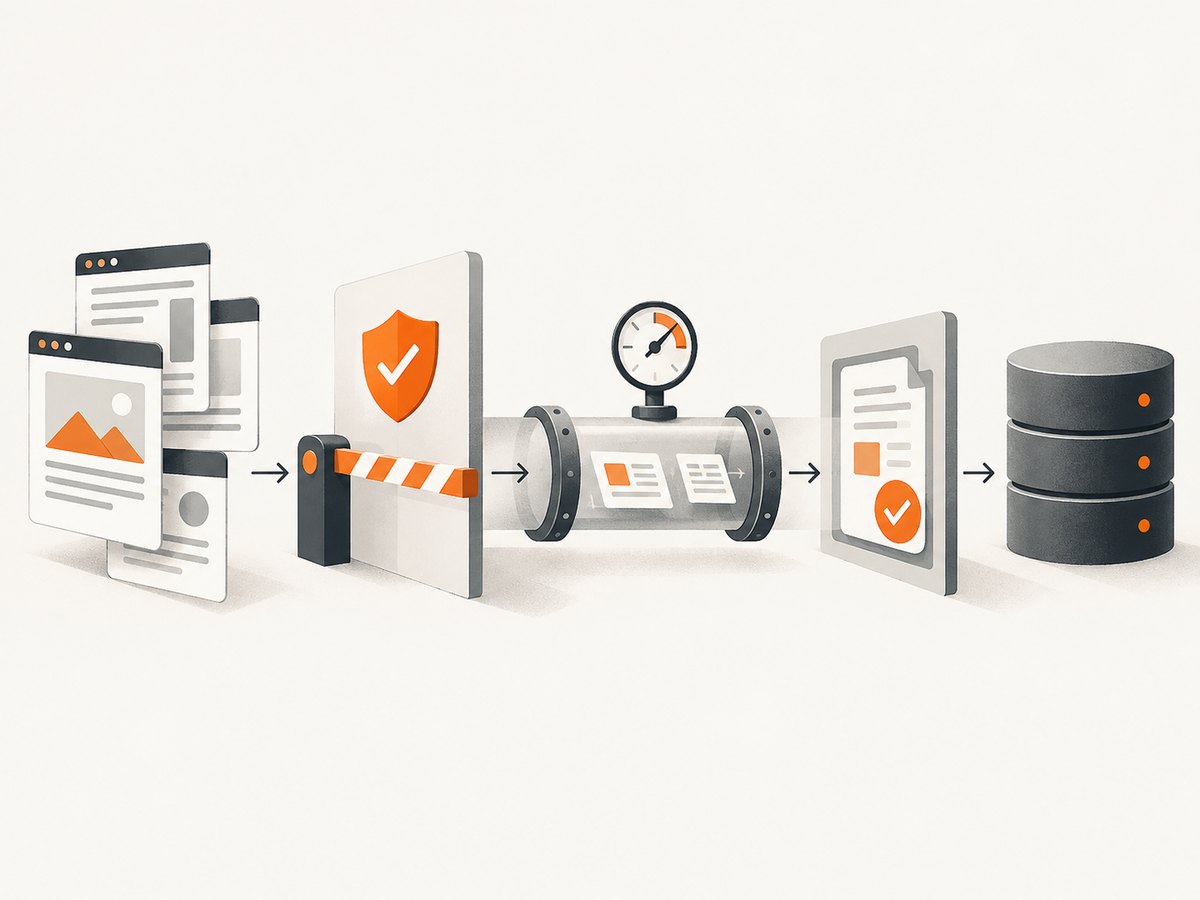
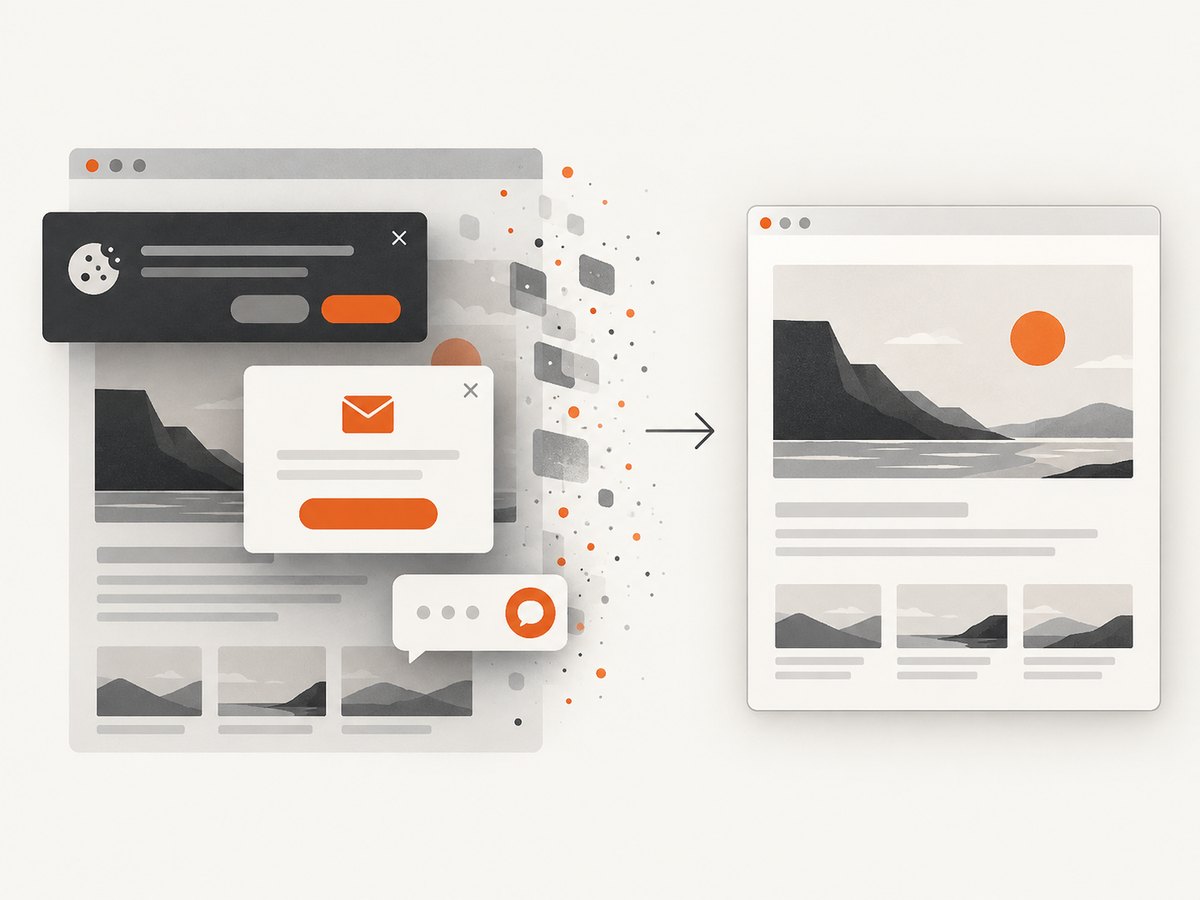
Not every collection problem is a scraping problem. If the deliverable is a rendered page image for visual QA, an archive, or a review workflow, a screenshot API can be a more direct fit than extracting page content into records. ScreenshotNeo is a website screenshot API and MCP server from Yorker Media. It returns PNG, JPEG, WebP, or PDF from one GET request. Its workflow accepts cookie and consent banners like a visitor and removes more than 60 known consent platforms, newsletter popups, and chat widgets before capture; those steps can each be turned off. The service reports page verdict and billing status in response headers, and bot checks/CAPTCHAs, blank pages, timeouts, failed loads, and cache hits are not billed. See [ScreenshotNeo](https://screenshotneo.com) and the [API documentation](https://screenshotneo.com/docs/).
For a straightforward visual capture, the API key is supplied as access_key and the page URL as url. Keep the key in server-side configuration or a secret store; do not put it in client-side page code.
cURL
curl -G "https://api.screenshotneo.com/v1/shot" \
  -d access_key=YOUR_API_KEY \
  --data-urlencode url=https://example.com \
  -o shot.webp
Python
import requests

r = requests.get(
    "https://api.screenshotneo.com/v1/shot",
    params={"access_key": "YOUR_API_KEY", "url": "https://example.com"},
    timeout=90,
)
r.raise_for_status()
open("shot.webp", "wb").write(r.content)
Node.js
const q = new URLSearchParams({
  access_key: process.env.SCREENSHOTNEO_API_KEY,
  url: 'https://example.com'
});
const res = await fetch(`https://api.screenshotneo.com/v1/shot?${q}`);
if (!res.ok) throw new Error(`Screenshot request failed: ${res.status}`);
const bytes = new Uint8Array(await res.arrayBuffer());
await (await import('node:fs/promises')).writeFile('shot.webp', bytes);
For each example, replace https://example.com with the page you are authorized to capture and set YOUR_API_KEY from your account. Check the response before treating its body as an image; an HTTP error body is not a usable screenshot.
Options to match the capture to the job
ScreenshotNeo documents 63 options. The relevant choices depend on what you need to inspect:
- Page and element scope: capture the full page, including lazy-loaded images, or capture one element by CSS selector.
- Appearance: choose PNG, JPEG, or WebP; use dark mode, transparent background, retina scale, image resizing, 12 device presets, or a custom viewport.
- PDF: set paper size, margins, landscape orientation, and page ranges.
- Page readiness: wait for a selector, a delay, or network idle; click an element before capture; add custom CSS or JavaScript; hide selected elements.
- Request context: supply custom headers, cookies, user agent, Authorization, timezone, or geolocation; block ads, trackers, selected requests, or resource types.
- Delivery and scale: set a cache TTL, use signed links for public
<img>tags, submit async jobs with signed webhooks, or bulk-capture up to 100 URLs per call. A usage API and OpenAPI spec are available.
Parameter names used by other screenshot APIs also work, which can ease a migration. For exact names and combinations, use the [ScreenshotNeo docs](https://screenshotneo.com/docs/). For production code, keep credentials out of URLs that may be logged where possible, restrict key access, and handle non-image responses explicitly.
6. Or skip the browser setup
A direct capture call can avoid running your own browser and page-rendering setup:
curl -G "https://api.screenshotneo.com/v1/shot" -d access_key=YOUR_API_KEY --data-urlencode url=https://stripe.com -o shot.webpPython and Node.js examples, along with the available options, are in the ScreenshotNeo docs. Cookie banners, popups, and chat widgets are removed before the shot. Bot checks, blank pages, and failed loads are never billed. An MCP server lets AI agents use take_screenshot, get_page_info, and capture_pdf. The free plan includes 1,000 screenshots a month with no card; paid plans start at $5 for 3,000. [Create a free ScreenshotNeo account](https://screenshotneo.com/account/sign-up/) to get started.
7. Performance, reliability, and cost controls
For a self-built collector, the fastest path is not always the fastest individual request. Avoid excess concurrency that creates site load, blocks, or costly retries. Use bounded queues, sensible timeouts, and exponential backoff with jitter. Cache responses when your use permits it, and do not recapture unchanged pages without a reason. Browser rendering is more resource-intensive than fetching static HTML, so use it only when rendering is necessary.
Reliability depends on observability as much as retry behavior. Record the target, retrieval time, status, latency, retry count, and parser version. Alert on sudden drops in valid records, not only on process crashes. Keep a small sample of source material where policy allows, and make schema validation fail visibly when a page change breaks assumptions.
Estimate total cost using a representative sample and include development, infrastructure, proxy use, monitoring, maintenance, data licensing, and governance review. Re-run the estimate when volume, freshness, or site behavior changes. For screenshot jobs, use caching when the desired freshness permits it and async or bulk features where the workload fits; only clean shots are billed by ScreenshotNeo according to its stated billing behavior. Its listed monthly tiers are Free: 1,000; Starter: $5 for 3,000; Growth: $15 for 15,000; Pro: $39 for 60,000; Scale: $99 for 250,000; and Business: $249 for 1,000,000. Yearly billing gives two months free, and every feature is on every plan.
8. Troubleshooting common collection failures
| Symptom | Likely cause | Practical fix |
|---|---|---|
| Requests increasingly fail or slow down | Rate pressure, changed access controls, or a site-side incident | Reduce concurrency, add backoff, check whether access remains permitted, and stop rather than endlessly retrying. |
| HTML arrives but expected content is missing | Content is rendered by JavaScript, delayed, or loaded after interaction | Check for an official API first; otherwise use a permitted rendering approach and wait for a specific readiness condition. |
| Parser returns empty or malformed records | Markup or labels changed, or the page variant differs | Validate required fields, preserve failures for review, add fixture cases, and update the parser deliberately. |
| Proxy or browser costs jump | Retry loops, redundant captures, overly frequent schedules, or a site behavior change | Inspect cost by target and failure type, cap retries, cache where appropriate, and revisit whether a data feed is a better fit. |
| AI extraction looks plausible but is wrong | Model output is unconstrained or page content is ambiguous | Constrain output to a schema, validate values, preserve source evidence, and route uncertain records for human review. |
| Screenshot response is not an image | Request or service error, or an unsuccessful page verdict | Check HTTP status and response headers, verify the URL and key, and handle verdicts and error bodies before saving. |
9. What’s next for web scraping?
The defensible forecast is operational rather than absolute: teams will keep weighing custom collection against APIs, managed infrastructure, and licensed data as costs and access constraints change. AI-assisted extraction is likely to be tried by more practitioners, given the survey’s stated intentions, but the current survey does not show universal adoption. On the governance side, teams should expect more careful review of personal data, source rights, and downstream purpose, especially in AI training contexts.
For technical leaders, the useful question is “what has changed compared to last year?” Ask it of spend, failure rates, page behavior, legal assumptions, and the value of each dataset. A collector that once seemed inexpensive may now cost more in maintenance than the data is worth. Revisit the design with evidence from your own workload rather than treating industry survey figures as a forecast for your team.
10. FAQ
Is web scraping still useful in 2026?
Yes, when the data is needed, collection is permitted, and the value justifies the operating and governance costs. An API, licensed dataset, or direct supply may be a better route for some projects.
What are the biggest web scraping challenges in 2026?
Reported infrastructure expense, changing access defenses, maintenance of site-specific collectors, data quality, and governance are central challenges. Their importance varies by site, scale, and use.
How is AI changing web scraping?
Some teams use AI for extraction, code generation, validation, and maintenance. Survey responses show mixed current adoption and interest in trying tools; quality controls and human review remain necessary.
Does public accessibility mean scraped data can be reused freely?
No. Accessibility does not itself settle privacy, intellectual-property, terms-of-use, or other legal questions. The answer depends on the data and context.
When should I use screenshots instead of scraping structured data?
Use screenshots when the output you need is visual evidence or a rendered-page view. If you need records and fields for analysis, use an authorized structured source or a collector designed to produce validated data.
Sources
- Apify and The Web Scraping Club, State of Web Scraping Report 2026 — practitioner survey.
- HUMAN Security, 2026 State of AI Traffic & Cyberthreat Benchmark Report — platform-observed traffic; figures are not a census.
- OECD, Mapping Relevant Data Collection Mechanisms for AI Training (2025).
- European Data Protection Board, Guidelines 03/2026 on web scraping in generative AI.
- Zyte, 2026 Web Scraping Industry Report — vendor perspective.