How to Access Business Data Without an Enterprise Contract
Find the right route to business data: SEC filings, Census statistics, federal datasets, or company registries, with practical checks for coverage, cost, and reuse.

To access business data without an enterprise contract, start by naming the decision you need to make and the fields that would support it. Then choose a source whose coverage, geography, access rules, and reuse terms match that need. For U.S. public-company filings, begin with SEC EDGAR; for U.S. population or economic context, use Census APIs; for federal data discovery, use api.data.gov; and for legal-entity records across jurisdictions, evaluate OpenCorporates. These sources do different jobs. None should be assumed to provide a complete private-company prospecting or contact database.
That is the practical answer to “How to access business data without an enterprise contract” and “Where can I find company data for free?” Public data can avoid an enterprise sales process, but a free endpoint does not guarantee the exact fields, scale, or commercial reuse rights you need. An API can be a viable alternative to a subscription when its coverage and terms fit, and when you account for the work of cleaning and maintaining the data.
1. Define “business data” before choosing a source
The phrase covers several unrelated categories. Pick the category first, or you may spend time integrating a source that cannot answer your question.
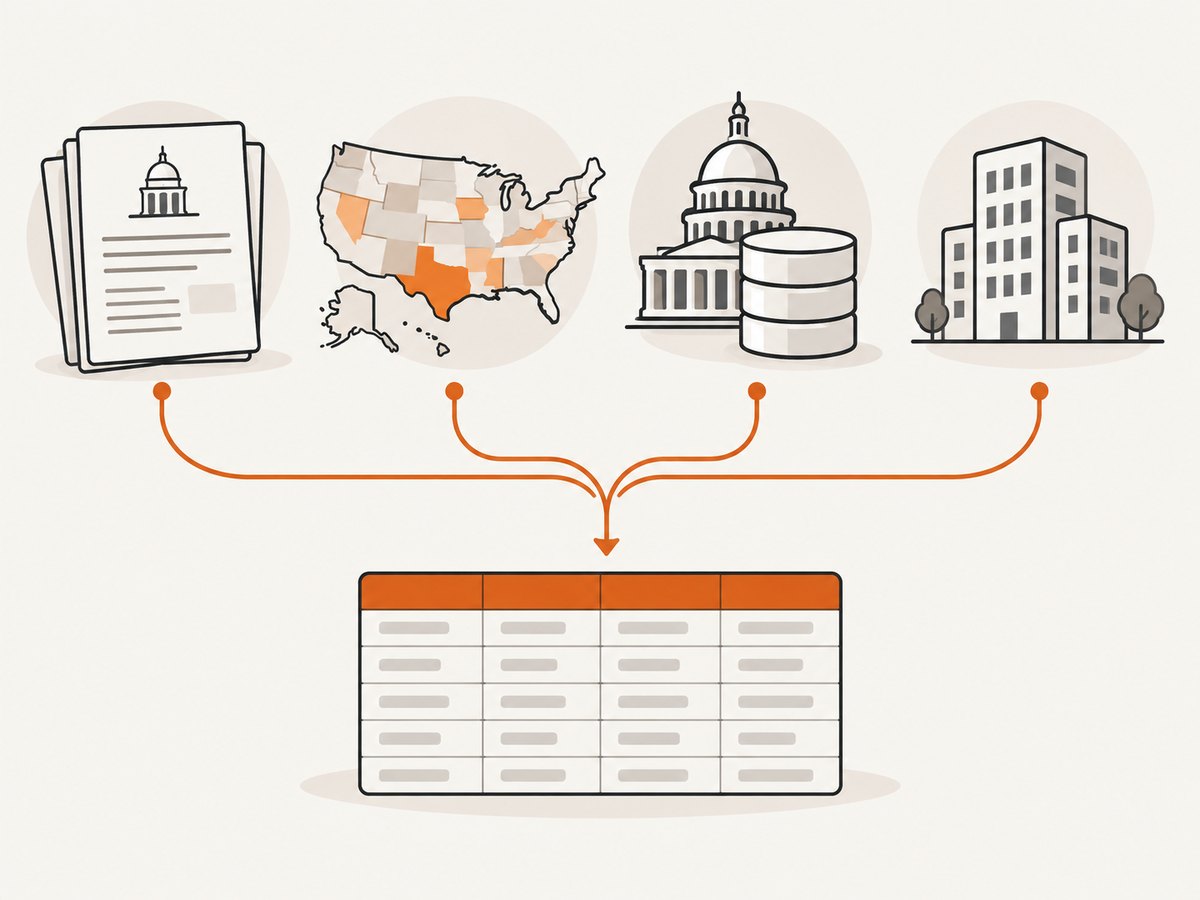
| Your need | Practical starting point | What it is suited to |
|---|---|---|
| Public-company disclosures | SEC EDGAR APIs | Filings and extracted public-company filing data |
| Market size and local economic context | U.S. Census APIs and relevant agency datasets | Population, economic measures, and geographic context |
| Federal data discovery | api.data.gov | Finding agency APIs; the agency dataset remains the source of truth |
| Legal-entity identity across jurisdictions | OpenCorporates or local registries | Structured entity records, subject to country coverage and account terms |
| Private-company contacts, intent, or turnkey prospecting | Evaluate a provider built for that exact purpose | Do not assume public filings or government statistics supply sales intelligence |
Before coding, write down the decision, the target population, and required fields. “Find growing retailers in a region” may need an industry definition and economic context; “verify a public company’s reported facts” needs filings; “identify registered entities in multiple countries” needs jurisdictional registry coverage. A provider’s entity record is not automatically a verified sales contact.
2. Use SEC EDGAR for public-company filings
The SEC makes public EDGAR data available through APIs at data.sec.gov. It is a route to public-company filings and extracted filing data, not a directory of all businesses or a general prospecting list. Start with the SEC API documentation to select the right endpoint and understand its response structure.
For a simple, runnable HTTP check, retrieve a company submissions record using its Central Index Key (CIK), padded to ten digits. The SEC documents the API endpoints and access expectations; this example uses the company submissions JSON route:
curl -H "User-Agent: Example Research contact@example.com" \
  "https://data.sec.gov/submissions/CIK0000320193.json" \
  -o apple-submissions.json
Replace the sample company CIK and identify your application in the User-Agent. Parse the JSON fields you need rather than treating the returned filing history as a normalized financial database. For filing-specific facts, consult the SEC’s API documentation and the underlying filing where appropriate. Observe the SEC’s privacy and security policy and fair-access guidance for automated access. Do not build a high-volume scraper around assumptions about request allowances.
When EDGAR is the wrong route
- The target is a private company with no relevant public filing.
- You need verified employee emails, purchasing intent, or a sales-ready lead record.
- You need standardized cross-country registry coverage from one endpoint.
In those cases, first check the relevant national or regional registry and its license. If the task is prospecting, assess a purpose-built provider’s coverage, provenance, privacy basis, and permitted use.
3. Use Census APIs for U.S. population and economic context
The Census Bureau describes its APIs as tools developers can use to explore the changing U.S. population and economy. This can help with market sizing, geographic comparisons, and contextual variables. Census microdata API key registration is free according to the Bureau’s guidance, last revised May 21, 2026; dataset requirements still vary. See the official Census API guidance and the relevant dataset documentation before forming a query.
A simple runnable example requests a population estimate from the Census API. Census endpoints and available variables differ by dataset and year; confirm the variable, geography, and endpoint in that dataset’s documentation before relying on a result.
curl --get "https://api.census.gov/data/2023/acs/acs5" \
  --data-urlencode "get=NAME,B01003_001E" \
  --data-urlencode "for=state:06" \
  --data-urlencode "key=YOUR_CENSUS_API_KEY"
This example asks for a named geography and a population variable from the 2023 American Community Survey 5-year dataset. Do not assume that a variable name or vintage transfers to another Census product. For microdata, register a key as directed by the Bureau, then verify that your selected dataset exposes the desired fields and geography.
Check the dimensions that change an analysis
- Dataset: choose the survey, estimate, or microdata product that measures the concept you need.
- Variables: verify definitions, units, and whether a measure is an estimate, count, or derived value.
- Geography: confirm the finest supported geography and how it maps to your target market.
- Vintage: record the data year or release period; different vintages may not be directly comparable.
- Query rules: review required parameters, key handling, and response format in the dataset guide.
Census data describes population and economic conditions. It does not, by itself, identify every business operating in an area or supply a list of decision-makers.
4. Discover federal APIs with api.data.gov
api.data.gov is a free API management platform for federal agencies and an entry point for sharing government data. Treat it as a discovery route, not as one universal business-data API. Once you find a dataset, follow the owning agency’s documentation for fields, key requirements, rate policy, refresh cadence, and use conditions. The agency’s dataset is the relevant unit for judging whether the information fits your task.
A sensible workflow is to discover an API, open the agency’s dataset documentation, obtain a key if required, and make a small representative query. Save the dataset name, release vintage, and applicable terms alongside the output so a later user can understand what the records mean.
5. Evaluate legal-entity data across jurisdictions
OpenCorporates offers structured API responses in JSON or XML and supports filters such as jurisdiction or country. Its documentation says records can draw on public records and user contributions. An API key is required. Review the API reference for query parameters and the current pricing page for account limits and terms.
At the time of research (September 29, 2026), the provider displayed these self-serve tiers. Treat them as a snapshot and check the live page before budgeting:
| Displayed tier | Monthly price | Annual price | Displayed API allowance |
|---|---|---|---|
| Essentials | £225/month | £2,250/year | Up to 500 calls/month, 200/day |
| Starter | £660/month | £6,600/year | Up to 2,500 calls/month, 500/day |
| Basic | £1,200/month | £12,000/year | Up to 5,000 calls/month, 1,000/day |
The pricing page also lists a separate enterprise option for bulk delivery or bespoke API access, and says free at-scale access may be available for public-benefit projects such as journalism, NGOs, universities, and anti-crime-and-corruption research; ask the provider about eligibility. Its API reference describes default allowances of up to 200 requests per month and 50 per day while noting that limits depend on account type and plan. Reconcile limits against the current account-specific plan rather than assuming a documentation default applies to a paid tier.
Understand what “free” means here
OpenCorporates states that free API accounts are intended for open-data projects under share-alike attribution conditions. Paid accounts remove restrictions related to its assembled database rights. Read the provider’s current API access and terms before using results in a closed commercial product, redistribution, or enrichment pipeline. Publicly visible records are not automatically free of license obligations.
6. Compare sources before building around one
Use this checklist to test fit. A source that is easy to query can still be expensive to operate if it misses the records or rights you require.
| Decision axis | Questions to answer |
|---|---|
| Coverage and geography | Public firms or all entities? Which countries, states, and registry types? What is missing? |
| Fields and provenance | Are values filings, estimates, entity identifiers, addresses, officers, or contacts? Can you trace a record to its source? |
| Freshness | How often are filings, registry records, and statistical releases updated? Does the release vintage fit? |
| Access and scale | Browser, download, API, key, request limits, bulk export, and pagination? |
| Reuse rights | Attribution, share-alike, privacy restrictions, commercial use, and redistribution limits? |
| Total effort and cost | Subscription or usage fees plus engineering, matching, normalization, cleaning, monitoring, and gap-filling? |
- Write the decision and required fields in plain language.
- Specify geography and target population: public companies, registered legal entities, or a market segment.
- Choose the official portal or API that covers that category and read its documentation and terms.
- Request a representative sample, not just a single ideal record.
- Measure missing fields, duplicate entities, name changes, geographic gaps, and update lag.
- Check reuse terms and operational limits before scaling collection.
- If public sources do not meet the need, compare a self-serve commercial plan with the cost of maintaining your own pipeline.
7. Build a small, reliable data workflow
Keep acquisition, normalization, and analysis separate. Store the original response with its source, retrieval time, query parameters, and dataset vintage. Normalize into your own schema only after preserving enough provenance to revisit a questionable field. For entity matching, avoid using company name alone: legal names change and different entities can share similar names. Prefer stable registry identifiers where supplied, and record the jurisdiction that gives the identifier meaning.
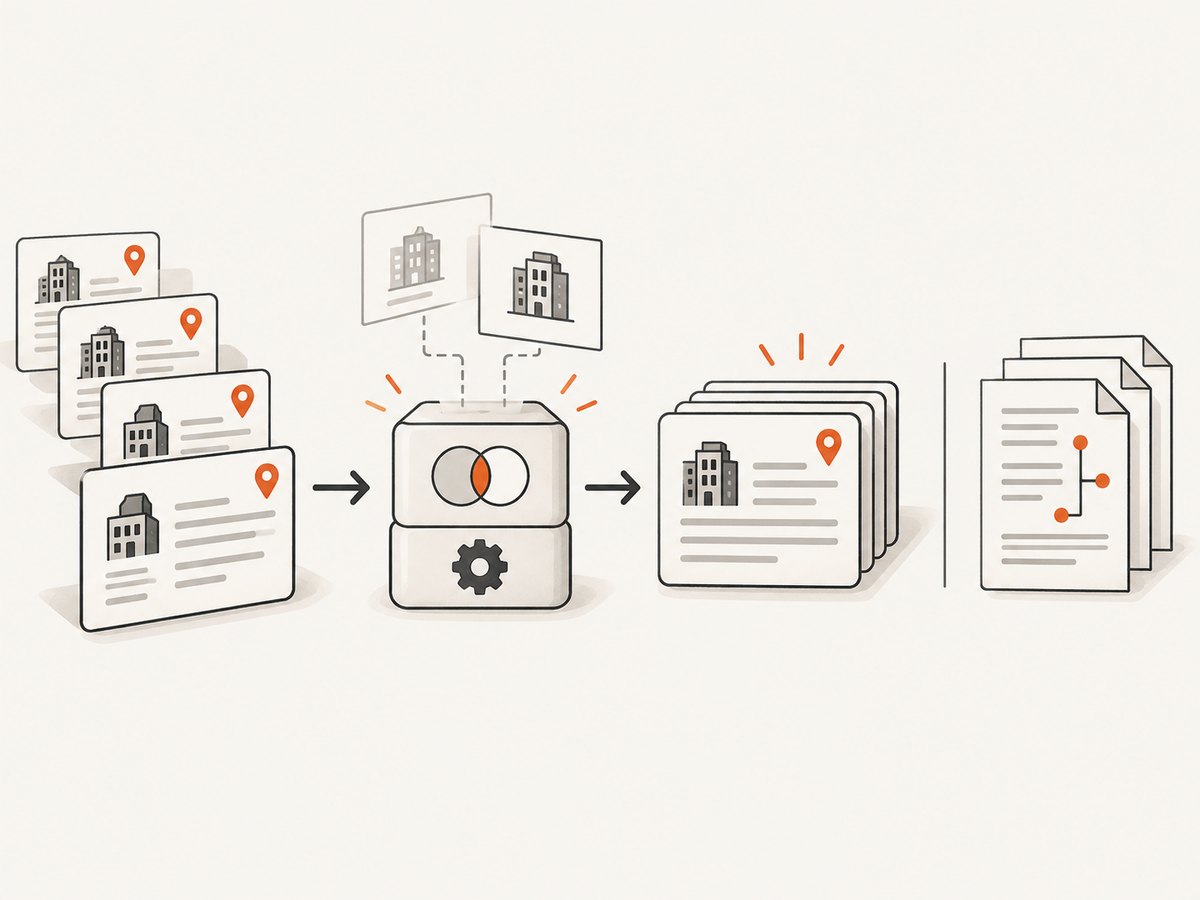
Handle failures deliberately. Retry transient network errors with bounded exponential backoff and jitter; do not retry authorization errors indefinitely. Cache responses according to the dataset’s update cadence and applicable terms, and expose the source date in downstream reports. For paginated APIs, checkpoint progress so a process can resume without silently duplicating records. Keep API keys out of source control and logs.
8. Troubleshooting common access problems
| Symptom | Likely cause | Fix |
|---|---|---|
| 401 or 403 response | Missing, invalid, or unauthorized key; account terms may not permit the requested use | Check key placement and account status, then read the endpoint’s authentication and use guidance. |
| 429 or throttling | Request rate or plan allowance exceeded | Reduce concurrency, add backoff, cache stable results, and confirm the current limit for your account. |
| Empty Census result | Invalid variable, geography, or dataset combination | Test the exact variable and geography in the selected dataset documentation; check the vintage. |
| SEC data is absent | Target is not a covered public-company filer, or the wrong identifier/endpoint was used | Verify the CIK and endpoint; use a registry source for entity identity or another lawful source for private-company needs. |
| Entity appears twice | Branches, name changes, jurisdiction differences, or duplicate source records | Match on jurisdiction plus stable identifiers when possible; retain source records and review ambiguous joins. |
| Data cannot be reused commercially | Free access is conditioned on attribution, share-alike, or other license terms | Review the license before collection; seek a compatible plan or a source whose rights fit the intended use. |
| Records look stale | Release vintage or registry update cadence is older than assumed | Record release dates, confirm refresh schedules, and avoid presenting a snapshot as current without qualification. |
9. Performance, reliability, and cost
API access trades contract overhead for engineering responsibility. Measure request volume, response size, pagination, and refresh frequency on a small sample. Batch or cache where the source permits it; make incremental updates instead of repeatedly fetching unchanged records. A low request count can still create meaningful work if records need entity resolution, normalization, deduplication, or manual verification.
For reliability, track successful requests, throttles, schema changes, and data age. Keep parsers tolerant of optional fields and fail visibly when a required field disappears. Use bounded retries for temporary failures, respect source policies, and preserve raw snapshots for debugging. Never infer an agency service-level commitment from the mere presence of an API.
For cost, compare more than the API invoice. Include developer time, monitoring, storage, matching, license review, coverage gaps, and the cost of replacing missing fields. A commercial self-serve plan may be cheaper than a bespoke enterprise agreement while still being a substantial recurring cost; a free public API may have low fees and high integration effort. Select based on total cost for the decision, not the word “free.”
10. Or skip the browser setup
If part of your research workflow is saving reference pages or filing documentation as screenshots, ScreenshotNeo is a website screenshot API and MCP server from Yorker Media. Its API returns an image or PDF from one GET request; see the API documentation.
curl -G "https://api.screenshotneo.com/v1/shot" \
  -d access_key=YOUR_API_KEY \
  --data-urlencode url=https://www.sec.gov/edgar/sec-api-documentation \
  -o reference.webp
ScreenshotNeo accepts cookie and consent banners like a visitor and removes 60+ known consent platforms, newsletter popups, and chat widgets before capture; each step can be turned off. Bot checks, blank pages, failed loads, timeouts, and cache hits are not billed, and response headers indicate the page verdict and billing status. Its MCP server gives AI agents tools for screenshots, page information, and PDF capture. The free plan includes 1,000 screenshots a month with no card; paid plans start at $5 for 3,000. Sign up for 1,000 free screenshots a month, with no card required.
11. Frequently asked questions
Can I use an API instead of buying an enterprise data subscription?
Yes, if the API’s coverage, request limits, and reuse rights satisfy the use case. The API may shift cost into integration, quality checks, and ongoing maintenance rather than removing cost altogether.
Can I use government data for business research?
Government data can support research, especially filings and aggregate economic context. Check the owning agency’s access policy, dataset documentation, and applicable reuse terms; different datasets have different scopes.
Where can I find private-company contact data for free?
The routes covered here do not promise a complete free source for verified private-company contacts. Public registries and statistics answer different questions; evaluate any contact-data provider for coverage, provenance, privacy basis, and permitted use.
Is a company registry the same as a sales database?
No. A registry is primarily about legal entities and filed records. It may not contain verified decision-maker contacts, current buying intent, or the enrichment fields used by prospecting products.
Do these examples cover every country?
No. The government examples are U.S. routes, and the commercial example is one cross-jurisdiction provider. For another country, identify its official registry and data agency, then inspect local coverage and licensing.