12 Best SMS APIs for Sending Messages to Users
Compare 12 SMS APIs by coverage, delivered cost, compliance, channels, and developer experience before choosing a messaging provider.

There is no universally cheapest or best SMS API. The right choice depends on destination countries, sender identity rules, message volume, carrier fees, compliance requirements, and whether you need only SMS or also MMS, WhatsApp, voice, or verification. This guide compares twelve providers and gives you a practical process for selecting and integrating one.
How to choose an SMS API
Start with the countries where your recipients live and the messages you send. Ask each provider for the complete delivered cost, including message segments, carrier surcharges, number rental, sender registration, campaign fees, and volume discounts. A headline price is not comparable when one provider quotes per message and another quotes per segment.
| Decision | Questions to answer |
|---|---|
| Coverage | Are your destination countries supported? Do they require local numbers, alphanumeric senders, toll-free verification, or 10DLC registration? |
| Cost | What is the per-segment price, carrier fee, number rental, registration fee, and discount at your volume? |
| Reliability | Which routes, delivery receipts, failover options, and support channels are available? |
| API fit | Do you need SDKs, webhooks, inbound SMS, templates, idempotency, or an existing cloud integration? |
| Channels | Will SMS be enough, or do you need MMS, RCS, WhatsApp, voice, or a unified inbox? |
| Compliance | How are consent, STOP handling, sender registration, data residency, and fraud controls implemented? |
The 12 SMS APIs
The list below is a candidate shortlist, not a neutral laboratory ranking. Verify current documentation, destination coverage, sender rules, and rate cards before committing. Prices and carrier policies change frequently.
1. Twilio
Twilio’s Programmable Messaging API supports SMS, MMS, and WhatsApp, with localized senders, compliance tools, analytics, and stated reach across more than 180 countries. Its pricing includes number fees, per-message-segment charges, and carrier fees; the US SMS list price shown on its pricing page starts at $0.0083 per segment before applicable carrier fees. Check the [official messaging product page](https://www.twilio.com/en-us/messaging/channels/sms) and [pricing page](https://www.twilio.com/en-us/pricing/messaging) for current destination-specific terms.
2. Vonage
Vonage is a broad communications platform with SMS and a dedicated Verify product for one-time passwords. Compare its raw messaging API with Verify: verification products generally add a per-verification fee in exchange for orchestration and fraud controls.
3. Sinch
Sinch offers messaging and other communications channels. A Sinch-authored 2026 comparison reported US 10DLC prices between $0.004 and $0.0083 per message for providers it tested, plus monthly number fees. Treat those figures as dated vendor-authored claims, not a universal market benchmark; country, sender type, and volume change the result.
4. Bird
Bird combines messaging workflows with SMS delivery. It can suit teams that want campaign or automation features around the API. Validate destination support, sender registration, inbound messaging, and the total cost for your traffic before choosing it.
5. Plivo
Plivo is a programmable communications provider with SMS and verification use cases. Compare its per-segment price, carrier surcharges, number rental, and country coverage against Twilio and Vonage for your actual destinations.
6. Infobip
Infobip is a global communications provider often considered when destination breadth, local routes, and enterprise support matter. Request a country-by-country quote and document sender requirements before launch.
7. Amazon SNS / AWS End User Messaging
AWS provides SMS sending through Amazon SNS and related End User Messaging services. AWS says rates vary by country or region and sometimes by carrier, and that dedicated origination identities may be required. Its displayed prices are guidance that can change frequently. Check the [official AWS SMS pricing page](https://aws.amazon.com/sns/sms-pricing/) and confirm whether your AWS region and sender identity meet local rules.
8. Telnyx
Telnyx publishes detailed carrier-specific fee tables. Its SMS pricing page lists US local outbound SMS from $0.004 per message part plus carrier fees, with rates varying by destination. Because billing is per message part, long Unicode messages can cost more than a one-part estimate. See the [Telnyx SMS API pricing](https://telnyx.com/pricing/messaging) page.
9. ClickSend
ClickSend provides SMS and other business messaging services. It can be a practical fit for notifications and operational messaging. Confirm API limits, delivery reporting, sender options, and local compliance in every country you serve.
10. textbee
The textbee comparison describes a different operating model from many cloud APIs, including prepaid services and phone or SIM gateways. That may be useful for a constrained deployment, but it also changes operational, carrier-policy, and reliability considerations. Treat secondary pricing and recommendations as leads to verify.
11. Bandwidth
Bandwidth is a communications API provider commonly evaluated for US messaging and telephony. Investigate number availability, 10DLC or toll-free registration, carrier fees, and support for your traffic pattern.
12. TextMagic
TextMagic focuses on business texting and notifications. Compare its API ergonomics and management tools with a lower-level carrier API if you need inbound messaging, high-volume routing, or custom compliance workflows.
Cost: calculate the delivered bill
Use a spreadsheet with one row per destination and sender type. For each row record monthly message count, average characters, encoding, segments per message, base price, carrier fee, number rental, registration, and taxes. Multiply message count by segments before applying the per-part price. A 161-character GSM message is commonly two segments; Unicode characters can reduce the segment size further. Confirm segmentation rules with the provider.
Do not compare a US local SMS quote with an international alphanumeric sender quote as if they were equivalent. AWS warns that destination and carrier can change pricing and origination requirements. Twilio and Telnyx both describe carrier fees in addition to their base rates. Recalculate when your country mix or volume changes.
Raw SMS API or verification product?
For alerts, order updates, and support messages, a raw messaging API gives you control over content, retries, templates, and routing. For OTP, compare that work with a dedicated product such as Twilio Verify or Vonage Verify. The comparison sources describe these products as charging per verification, but they can provide code generation, expiry handling, and anti-fraud controls that you would otherwise build.
Minimal integration pattern
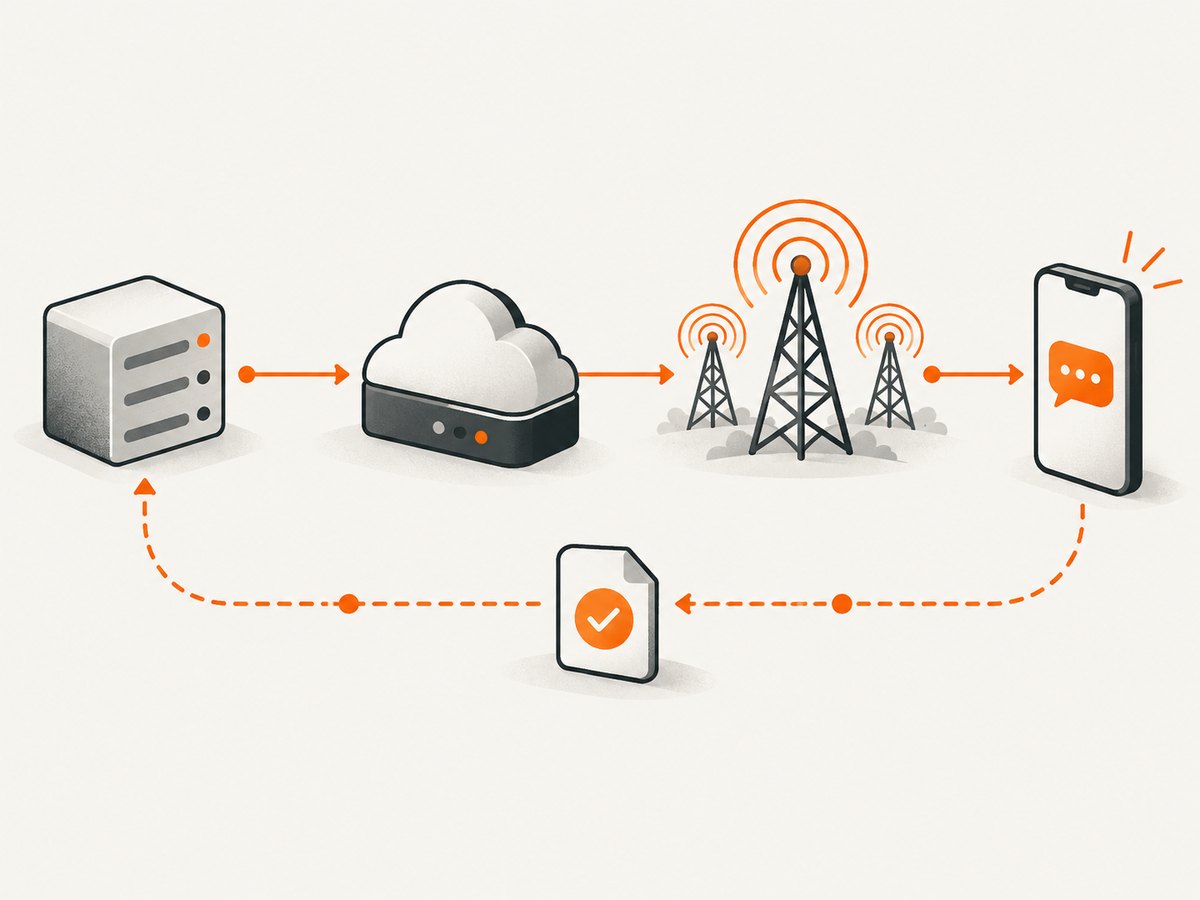
Keep provider credentials server-side. Generate an idempotency key for each business event, store the provider message ID, and process delivery webhooks asynchronously. Never treat an accepted API response as proof of delivery.
cURL example (Twilio-style REST request)
curl -X POST https://api.twilio.com/2010-04-01/Accounts/$TWILIO_ACCOUNT_SID/Messages.json \
  --data-urlencode "To=+15551234567" \
  --data-urlencode "From=+15557654321" \
  --data-urlencode "Body=Your order is ready" \
  -u "$TWILIO_ACCOUNT_SID:$TWILIO_AUTH_TOKEN"
Python
import os
import requests

sid = os.environ["TWILIO_ACCOUNT_SID"]
token = os.environ["TWILIO_AUTH_TOKEN"]
url = f"https://api.twilio.com/2010-04-01/Accounts/{sid}/Messages.json"
r = requests.post(
    url,
    auth=(sid, token),
    data={"To": "+15551234567", "From": "+15557654321", "Body": "Your order is ready"},
    timeout=30,
)
r.raise_for_status()
print(r.json()["sid"])
Node.js
const sid = process.env.TWILIO_ACCOUNT_SID;
const token = process.env.TWILIO_AUTH_TOKEN;
const body = new URLSearchParams({
  To: '+15551234567',
  From: '+15557654321',
  Body: 'Your order is ready'
});
const auth = Buffer.from(`${sid}:${token}`).toString('base64');
const res = await fetch(`https://api.twilio.com/2010-04-01/Accounts/${sid}/Messages.json`, {
  method: 'POST',
  headers: { Authorization: `Basic ${auth}`, 'Content-Type': 'application/x-www-form-urlencoded' },
  body
});
if (!res.ok) throw new Error(`${res.status} ${await res.text()}`);
console.log((await res.json()).sid);
Production checklist
- Register the sender identity required by each destination.
- Collect and store consent with timestamp, source, and purpose.
- Implement STOP, HELP, and local opt-out requirements.
- Use E.164 phone-number normalization and reject impossible numbers.
- Queue sends, rate-limit workers, and retry only transient failures with exponential backoff.
- Deduplicate business events with an idempotency key.
- Validate webhook signatures and make webhook handlers idempotent.
- Track accepted, delivered, failed, undelivered, and opted-out states separately.
- Redact message bodies and phone numbers in logs.
- Load-test your queue and confirm provider rate limits before a campaign.
Troubleshooting
| Symptom | Likely cause | Fix |
|---|---|---|
| 401 or 403 | Wrong credentials, account permissions, or region | Rotate secrets, check the project and endpoint, and confirm the account can send from the selected number. |
| Accepted but not delivered | Carrier filtering, invalid number, or sender registration issue | Inspect delivery status and error code, verify consent and sender identity, and test a registered destination. |
| Unexpectedly high bill | Multiple segments or carrier fees | Log encoded length and segment count; compare the full destination-specific rate card. |
| Messages arrive late | Carrier congestion, throttling, or queue backlog | Check provider status and delivery timestamps, reduce burst rate, and use a queue with bounded retries. |
| OTP abuse | Automated requests or SIM fraud | Add per-user and per-IP limits, cooldowns, risk checks, and a dedicated verification product where appropriate. |
| Webhook duplicates | At-least-once delivery | Store event IDs and make state updates idempotent. |
Performance, reliability, and operations
Measure enqueue-to-provider, provider-acceptance, and delivery latency separately. Keep sending workers stateless, use connection pooling where the SDK supports it, and cap concurrency to the provider’s documented limits. A fallback provider can help for critical alerts, but failover needs deduplication and a policy for which sender identity is used. Do not claim a delivery-rate benchmark without a controlled, destination-specific test.
Review spend by country, sender, campaign, and message type. Set provider budget alerts, maintain a reserve for carrier fees, and revisit rates when volume or geography changes. The cheapest API for one country can be more expensive for another.
Or skip the browser setup
If you also need screenshots of message templates, delivery dashboards, or documentation pages in an automated workflow, ScreenshotNeo provides a website screenshot API. One GET request returns PNG, JPEG, WebP, or PDF. It removes cookie banners, newsletter popups, and chat widgets before capture; bot checks, blank pages, timeouts, failed loads, and cache hits are not billed. Responses identify the result with X-Page-Verdict and X-Billed headers. Its MCP server lets Claude, Cursor, and other MCP clients call take_screenshot, get_page_info, and capture_pdf.
Example from the ScreenshotNeo documentation:
curl -G "https://api.screenshotneo.com/v1/shot" -d access_key=YOUR_API_KEY --data-urlencode url=https://stripe.com -o shot.webpimport requests
r = requests.get("https://api.screenshotneo.com/v1/shot", params={"access_key": "YOUR_API_KEY", "url": "https://stripe.com"}, timeout=90)
open("shot.webp", "wb").write(r.content)const q = new URLSearchParams({ access_key: 'YOUR_API_KEY', url: 'https://stripe.com' });
const res = await fetch(`https://api.screenshotneo.com/v1/shot?${q}`);Plans include 1,000 screenshots a month free with no card; paid plans start at $5 for 3,000. Create a free ScreenshotNeo account.
FAQ
What is the best SMS API?
The best option is the one that supports your destinations and sender rules at an acceptable delivered cost, with webhooks and support that match your reliability needs. Shortlist two providers and run a destination-specific pilot.

What is the cheapest SMS API?
It depends on country, volume, sender type, segments, and carrier fees. Compare a complete monthly invoice model instead of a single list price.
Are SMS APIs suitable for passwords?
They can deliver OTPs, but authentication requires expiry, rate limits, abuse detection, replay protection, and consent. Compare a raw API with a dedicated verification product.
Should I use one provider globally?
One provider simplifies integration, while regional providers or failover can improve coverage and resilience. Decide after checking actual delivery and compliance requirements in each destination.


