How to Build a Zillow Web Scraper
Zillow prohibits automated scraping. Learn compliant API and dataset routes, an authorized extraction pattern, and how to capture permitted pages safely.

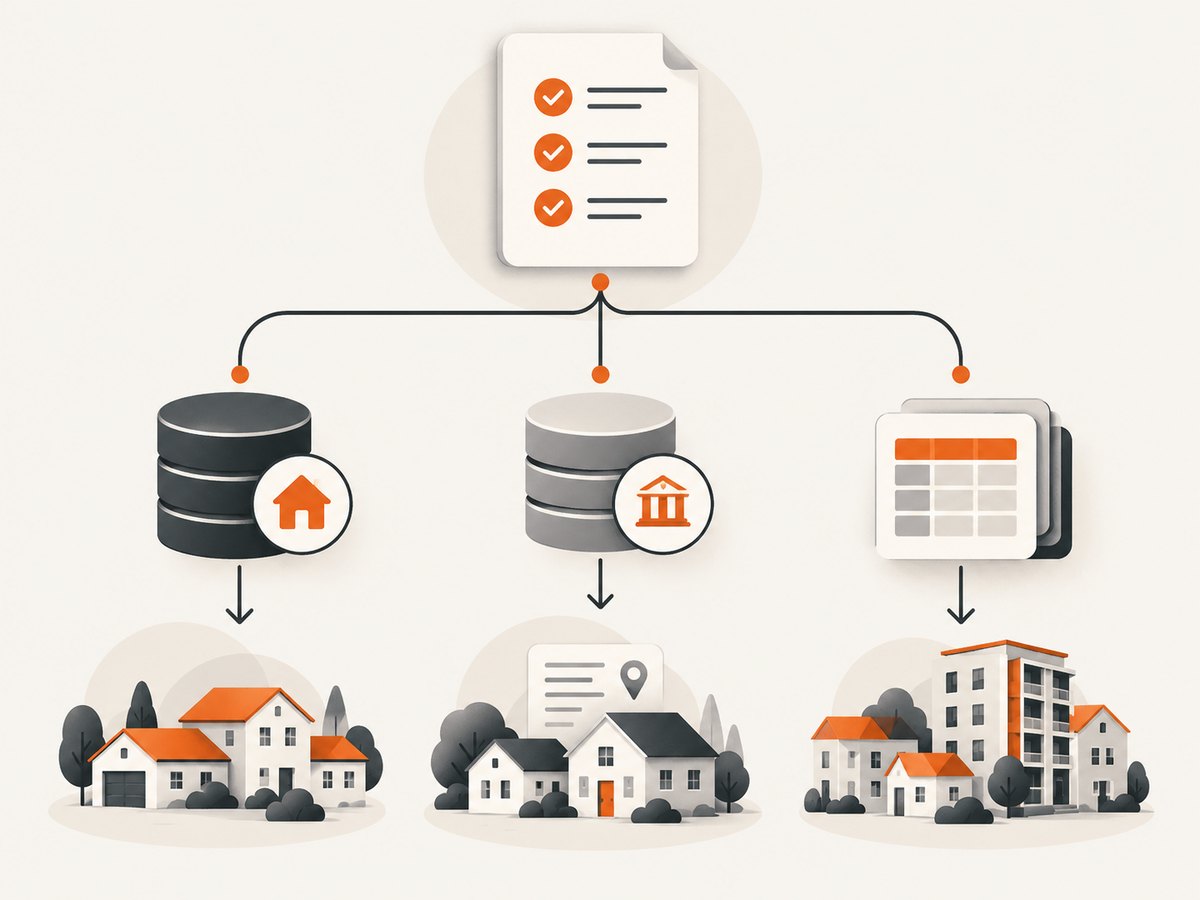
Short answer: You should not build an automated scraper that collects information from Zillow’s consumer services. Zillow’s consumer Terms of Use prohibit automated queries for obtaining information, including screen scraping, spiders, robots, crawlers and CAPTCHA bypass. Build your workflow around an approved API or a dataset whose license permits your intended use. If you only need market trends, use Zillow’s downloadable metrics instead of collecting individual listing pages.
The correct implementation depends on the data you need: current MLS listings, parcel and transaction records, Zestimate-related information, or aggregate market statistics. These sources are different products with different access, coverage, retention and display rules.
1. Understand the restriction before writing code
Zillow’s consumer Terms of Use list the following prohibited conduct:
“conduct automated queries (including screen and database scraping, spiders, robots, crawlers, bypassing “captcha” or similar precautions, or any other automated activity with the purpose of obtaining information from the Services) on the Services;”
Read the current Zillow Terms of Use before designing a collection system. Do not treat a robots.txt file, a visible page, or a browser that happens to load as permission. Do not reverse-engineer private endpoints, evade bot checks, rotate identities to defeat controls, or bypass a CAPTCHA. Those techniques do not create an authorized data license.
This article is a US-focused engineering guide. The official MLS product describes partner availability in the United States and Canada, while the public-record product describes US coverage. The terms and access conditions can change, so verify them again before deployment. This is a product and engineering guide, not legal advice for every jurisdiction or use case.
2. Define the data you actually need
| Need | Appropriate route | What to confirm |
|---|---|---|
| Active or historical MLS listings | Bridge Listing Output | MLS partner coverage, approval, fields, display rules, retention and rate limits |
| Parcel, assessment and county transaction records | Bridge Public Records API | Invite-only access, geography, historical depth, permitted use and storage |
| Market trends and research series | Zillow Real Estate Metrics CSV datasets | Geographic level, series definition, update schedule and required attribution |
| A page you own or a source that explicitly permits automation | Your own authorized collector | Written scope, fields, frequency, authentication, retention and deletion rules |
Do not substitute one category for another. Aggregate metrics do not provide individual listing records. An MLS feed is not automatically a public-record feed, and access to one Zillow Group product does not grant unrestricted access to other services.
3. Use an approved MLS listing API
Bridge Listing Output is Zillow Group’s possible route for licensed MLS data. It provides a REST interface with JSON responses and data normalized to the RESO Data Dictionary. Access is invite-only and depends on each participating MLS partner’s discretion in the US and Canada.
What to verify during onboarding
- Whether the MLS markets and property types you need participate.
- Which fields are licensed, including media, broker information and listing history.
- Whether your application may display, cache, export or redistribute records.
- Refresh cadence, pagination limits, rate limits and outage behavior.
- Required attribution, branding and removal procedures.
- Whether your use is internal, consumer-facing, research or commercial.
Request current credentials and read the product agreement before writing a bulk importer. API approval is a license boundary, not a blanket permission to copy every Zillow page.
4. Use the Public Records API for property records
Bridge Public Records API is a separate product for parcel, assessment and county transaction data across the United States. Zillow Group describes coverage reaching back roughly 15 years, but the useful history and fields vary by county. Access is invite-only.
Model public-record data separately from MLS listings. A parcel identifier, assessment date and recorded transaction are not the same as an active listing, an asking price or a Zestimate. Store the source, jurisdiction and effective date with every record so downstream users can see what the value means.
5. Download aggregate market metrics
For trends rather than property-by-property records, start with Zillow Real Estate Metrics. The page provides downloadable CSV datasets for public use with attribution. Geography ranges from neighborhood through national, and some series extend as far back as the late 1990s.
A metrics download is often the simplest compliant solution for a dashboard. Preserve the dataset name, download date, attribution text, geography, time period and any filtering steps in your data catalog. Do not describe a metrics CSV as a listing feed.
6. A general scraper pattern for an authorized source
If you have explicit permission to automate a site you control, or a source whose terms permit collection, the engineering pattern below is reusable. Replace the example URL with an authorized source. It is not a recipe for collecting Zillow consumer pages.
Step 1: Write a collection contract
- List exact fields and the business purpose for each.
- Define permitted paths, frequency, concurrency and maximum records.
- Record authentication requirements and handling of personal data.
- Specify retention, deletion and redistribution rules.
Step 2: Retrieve pages politely
Use the source’s documented API where one exists. Otherwise, request only permitted URLs, identify your client when required, use bounded concurrency, honor published rate limits and stop on repeated failures. Do not retry a denial or CAPTCHA as if it were a transient network error.
Step 3: Parse structured data
Prefer documented JSON or embedded structured data over brittle visual selectors. Validate types and required fields immediately, then normalize addresses, currencies, dates and identifiers.
Step 4: Deduplicate and preserve provenance
Use a stable source identifier when available. Keep the source URL, retrieval timestamp, response status, parser version and license reference with each record. Never silently overwrite a changed listing; retain a history only when the agreement allows it.
Step 5: Log and monitor
Track request counts, status classes, parse failures, duplicate rates and freshness. Redact credentials and sensitive response content from logs. Alert on schema changes instead of publishing partially parsed records.
Runnable Node.js example for an authorized HTML source
import { chromium } from 'playwright';

const browser = await chromium.launch({ headless: true });
const page = await browser.newPage({
  userAgent: 'AuthorizedDataClient/1.0 (contact: data@example.com)'
});

await page.goto('https://example.com/permitted-page', {
  waitUntil: 'domcontentloaded',
  timeout: 30_000
});

const records = await page.locator('[data-record]').evaluateAll(nodes =>
  nodes.map(node => ({
    id: node.getAttribute('data-id'),
    title: node.querySelector('[data-title]')?.textContent?.trim() ?? null,
    price: node.querySelector('[data-price]')?.textContent?.trim() ?? null
  }))
);

console.log(JSON.stringify({ retrievedAt: new Date().toISOString(), records }, null, 2));
await browser.close();
Install with npm install playwright. In production, add a queue, a concurrency limit, exponential backoff for temporary 5xx responses, schema validation and a dead-letter list for records that need review. Remove the browser entirely when the approved provider offers JSON or REST.
Equivalent cURL request to an authorized API
curl --fail-with-body \
  -H "Authorization: Bearer $API_TOKEN" \
  -H "Accept: application/json" \
  "https://api.example.com/v1/records?updated_since=2026-01-01"
Equivalent Python request
import os
import requests

response = requests.get(
    "https://api.example.com/v1/records",
    params={"updated_since": "2026-01-01"},
    headers={
        "Authorization": f"Bearer {os.environ['API_TOKEN']}",
        "Accept": "application/json",
    },
    timeout=30,
)
response.raise_for_status()
records = response.json()
print(records)
7. Data modeling and validation
Keep raw and normalized representations separate. A raw response lets you reprocess a parser after a schema change; a normalized table makes analysis predictable.
| Field | Validation |
|---|---|
| Source ID | Required, immutable string; reject empty values |
| Address | Store components plus the original formatted value |
| Price or assessment | Decimal value and currency; reject symbols embedded in numeric columns |
| Dates | ISO 8601, with source timezone retained |
| Coordinates | Numeric range checks and an explicit coordinate reference system |
| Provenance | Source, retrieval time, license and parser version |
Expect missing fields, changed labels, duplicate records and corrections from the provider. Use nullable columns instead of sentinel strings such as “N/A,” and version your transformations.
8. Reliability, performance and cost
Reliability
Design for provider outages and partial responses. Use bounded retries only for documented transient failures, persist a cursor for incremental imports, and make writes idempotent. A successful HTTP response does not prove that every record parsed correctly; compare counts and required-field rates against historical ranges.
Performance
Prefer incremental updates over repeated full exports. Batch requests within the provider’s limits, stream large files to disk, and avoid launching one browser per URL. Cache only when the license permits it and attach an expiration time to cached records. Measure end-to-end freshness, not just request latency.
Cost
Budget for API calls, storage, transformation jobs and monitoring. Invite-only products may have contractual pricing and usage limits; confirm those directly with Zillow Group or the participating MLS. Public CSV downloads can reduce request volume, but attribution and dataset terms still apply. Do not assume that a free download permits republishing raw rows in a commercial product.
9. Troubleshooting common failures
| Symptom | Likely cause | Fix |
|---|---|---|
| 403 or CAPTCHA on Zillow consumer pages | Automated access is restricted | Stop; do not bypass it. Request an approved API or use a permitted dataset. |
| 401 from an approved API | Missing, expired or wrong credential | Check the environment variable, authorization scheme and account status; rotate the key if exposed. |
| 429 responses | Rate limit exceeded | Reduce concurrency, honor Retry-After, use incremental sync and confirm the contractual limit. |
| Empty result set | Unsupported geography, filter or MLS coverage | Test a known covered market and verify field names and date semantics with the provider. |
| Duplicate properties | Multiple feeds or changing source IDs | Use the provider’s canonical ID, retain source identifiers and define a documented merge rule. |
| Parser suddenly returns nulls | Schema or markup changed | Quarantine the batch, inspect a permitted sample, update the parser and replay raw responses if allowed. |
| Stale dashboard | Failed cursor or disabled refresh job | Persist checkpoints, alert on freshness and run a bounded reconciliation job. |
10. Security and operations checklist
- Verify current consumer terms and the exact product agreement.
- Confirm geographic, property-type and historical coverage.
- Document update cadence, rate limits, retention and deletion requirements.
- Keep API keys in a secret manager; never commit them to source control.
- Restrict logs and exports to the fields your license permits.
- Preserve attribution and provenance with every published metric.
- Define an owner for takedown, correction and incident requests.
- Review the workflow whenever the provider changes its schema or terms.
11. Or skip the browser setup
When you have permission to capture a page and need an image or PDF rather than structured listing data, ScreenshotNeo provides a single GET request. See the ScreenshotNeo API documentation for all options.

curl -G "https://api.screenshotneo.com/v1/shot" -d access_key=YOUR_API_KEY --data-urlencode url=https://stripe.com -o shot.webpimport requests
r = requests.get("https://api.screenshotneo.com/v1/shot", params={"access_key": "YOUR_API_KEY", "url": "https://stripe.com"}, timeout=90)
open("shot.webp", "wb").write(r.content)const q = new URLSearchParams({ access_key: 'YOUR_API_KEY', url: 'https://stripe.com' });
const res = await fetch(`https://api.screenshotneo.com/v1/shot?${q}`);ScreenshotNeo removes cookie and consent banners, newsletter popups and chat widgets before capture. Bot checks, blank pages, timeouts, failed loads and cache hits are not billed, and response headers identify the page verdict and billing result. Its MCP server provides take_screenshot, get_page_info and capture_pdf for Claude, Cursor and other MCP clients. The Free plan includes 1,000 screenshots per month with no card; paid plans start at $5 for 3,000 shots. Use it only for URLs you are authorized to access, and keep Zillow data licensing separate from image capture.
Create a free ScreenshotNeo account and start with 1,000 screenshots per month at no charge.
12. FAQ
Can I scrape Zillow if I slow the requests down?
Slowing requests does not change the consumer Terms of Use. Use an approved product or a dataset with permission instead.
Does Bridge Listing Output include every Zillow listing?
No. Coverage depends on participating MLS partners, your agreement and the fields licensed to your application.
Can I use the metrics CSV to build a listing search?
No. Metrics are aggregate time series, not individual property records.
Is public-record data the same as MLS data?
No. Parcel, assessment and county transaction records have different definitions, timing and identifiers from active MLS listings.
Should I build a browser crawler or an API client?
For an authorized source, use the documented API first. A browser is appropriate only when the source permits page automation and does not provide a suitable structured interface.


