img.ly Alternative for a Hosted Embeddable Editor
Compare hosted embeds with SDKs such as IMG.LY and Polotno, then choose the right editor architecture, integration model, pricing, and platform coverage.
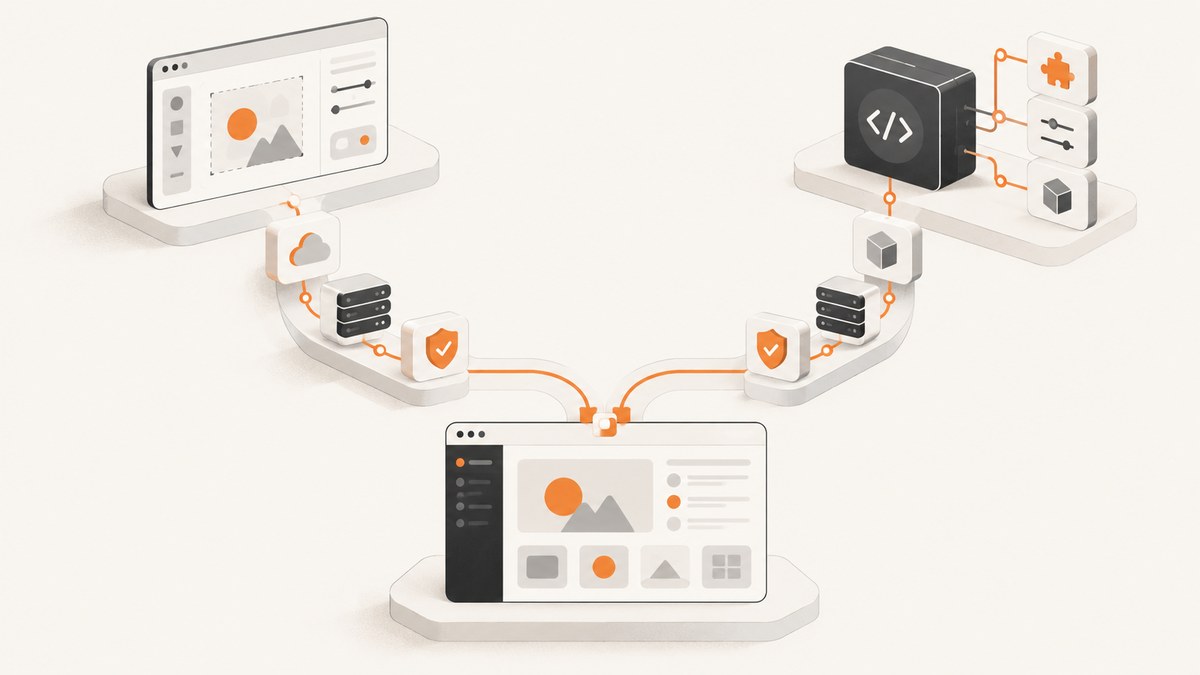
Direct answer: If you specifically need a hosted editor that can be embedded into a SaaS product, Orshot is the closest match in this research. Orshot describes an editor delivered through an iframe or React/Vue component, with storage, accounts, and rendering supplied by Orshot. IMG.LY CE.SDK is a different operating model: it is an SDK that runs inside your application and infrastructure. Polotno is another self-hosted SDK option for web products.
That distinction determines who operates the editor, where design data lives, how much infrastructure your team owns, and which platforms you can support. An iframe can be embedded in your product while remaining hosted by the vendor. An SDK can look equally embedded to a user while running on your domain and infrastructure. Decide that boundary before comparing features or prices.
Hosted embed versus SDK: the decision in one table
| Decision axis | Hosted embed (Orshot’s stated model) | SDK model (IMG.LY or Polotno) |
|---|---|---|
| Editor operation | Vendor-hosted surface and supporting services | Your application integrates and operates the editor |
| Integration boundary | Iframe or framework component | SDK and API inside your product |
| Storage, accounts, rendering | Orshot says these are provided by Orshot | You typically connect your own services; verify the license scope |
| Data and domain control | Depends on the vendor’s hosting and export model | IMG.LY says CE.SDK runs on your domain and infrastructure |
| Platform breadth | Confirm current web and mobile support with the vendor | IMG.LY describes web, iOS, Android, desktop, and server options; Polotno positions itself primarily for web |
| Operational responsibility | Less infrastructure for your team, more provider dependency | More control, integration work, and infrastructure ownership |
| Pricing evidence | Orshot’s June 2026 article lists “from $39/mo”; recheck it | IMG.LY pricing is configured and quote-based; Polotno pricing claims require current verification |
These are vendor descriptions rather than an independently tested parity matrix. Confirm authentication, export formats, asset limits, data residency, SLA terms, and platform support during procurement.
When a hosted editor is the better fit
Choose a hosted embed when your priority is getting a complete editing workflow into production quickly and you prefer the provider to operate surrounding services. This model can reduce work for user accounts, project persistence, rendering queues, and asset handling. It is especially attractive when your product is browser-first and the editor is a feature rather than your core infrastructure.

Questions to answer before choosing hosted
- Can users sign in through your identity system, or do they need a second account?
- Can you keep source assets and generated files in your own bucket or CDN?
- What events, webhooks, or APIs notify your application about saves and exports?
- Can you set your own retention, deletion, and regional-storage policies?
- Can the editor be styled to match your product without breaking upgrades?
- What happens if the provider is unavailable or changes its embed contract?
- Do you need offline use, native mobile, or desktop support?
Orshot Embed: the direct hosted alternative
Orshot’s comparison article describes Orshot Embed as a hosted design and video editor delivered through an iframe or React/Vue component. It says Orshot supplies storage, accounts, and rendering. The same article lists pricing “from $39/mo,” published June 16, 2026. Treat that as a dated vendor claim and verify the current plans, limits, and included capabilities before relying on it.
The hosted model means your integration work is concentrated at the boundary: launch the editor, pass user or project context, receive save/export events, and present the resulting assets in your product. The exact APIs, authentication mechanism, and customization limits must come from Orshot’s current documentation.
A minimal iframe integration pattern
The following is a browser integration shape, not a vendor-specific endpoint. Replace the placeholder URL and message names with the provider’s documented values.
<iframe
  id="design-editor"
  title="Design editor"
  src="https://your-vendor.example/editor?project=PROJECT_ID"
  allow="clipboard-read; clipboard-write"
  style="width:100%;height:720px;border:0"
></iframe>

<script>
  const editor = document.getElementById('design-editor');

  window.addEventListener('message', (event) => {
    // Check event.origin against the vendor's documented origin.
    if (event.origin !== 'https://your-vendor.example') return;

    if (event.data?.type === 'export-complete') {
      console.log('Export URL:', event.data.url);
      // Save the asset reference in your application.
    }
  });
</script>
Hosted integration checklist
- Create a project record in your application before opening the editor.
- Pass a short-lived user or project token instead of exposing a permanent secret in the browser.
- Validate
postMessageorigins and event schemas. - Persist provider project IDs alongside your own IDs.
- Handle export retries and duplicate webhook events idempotently.
- Provide a recovery path when an embed fails to load.
IMG.LY CE.SDK: when an SDK is the better alternative
IMG.LY describes CE.SDK as an editor embedded in the buyer’s app, with both a full interface and a headless API. Its capability page says browser editing uses WebAssembly and WebGL, while the same engine can run on mobile and server-side with Node.js. Its support material describes web, iOS, Android, desktop, and server options, with exact support depending on the SDK and license.
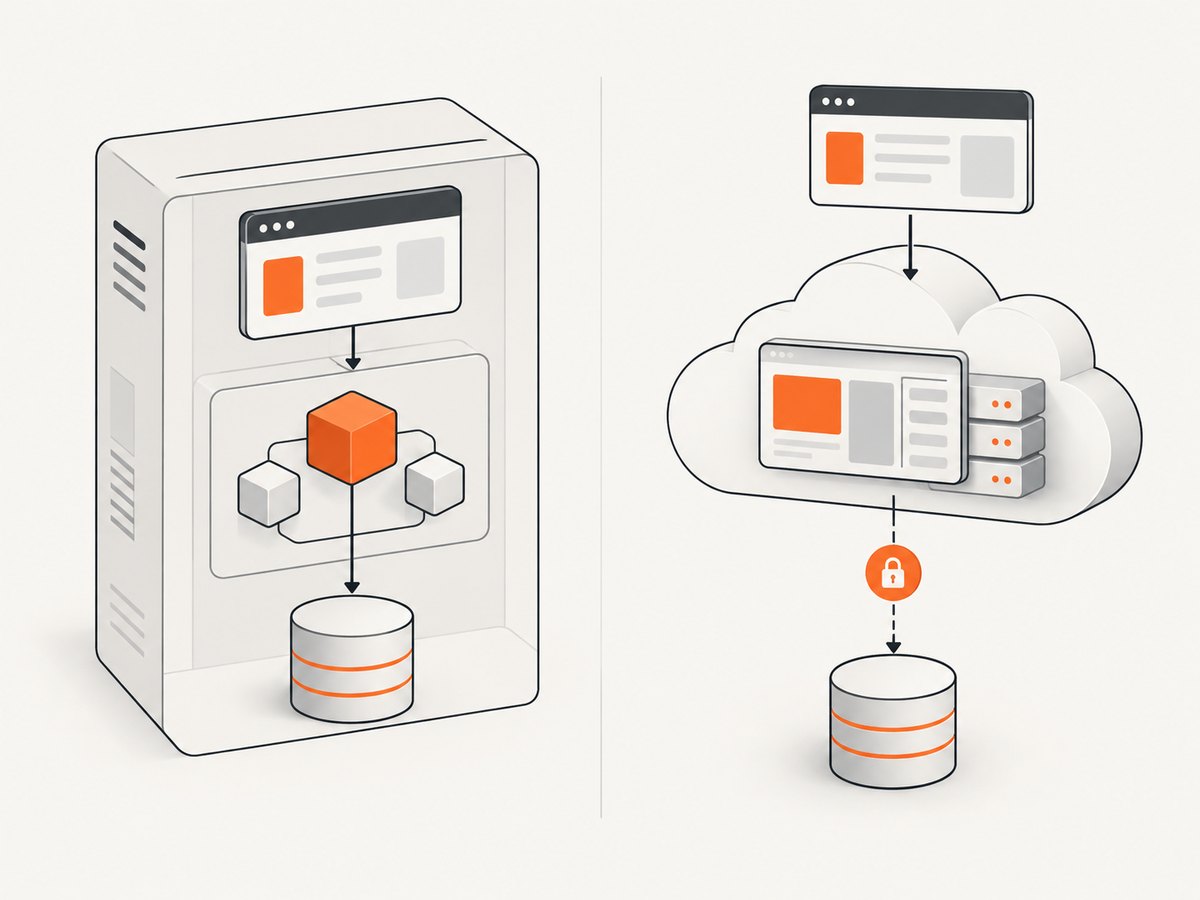
IMG.LY’s own description is clear: “The editor runs inside your app, not as a sandboxed third-party surface, so you own the UI, the domain, and the data.” That control is useful when you need a unified product experience, custom persistence, strict data boundaries, or native platform support. It also means your team owns more integration and operational work.
What to budget for with an SDK
- Application integration, theming, and upgrade testing.
- Asset storage, transformations, permissions, and CDN delivery.
- Autosave, version history, and conflict handling.
- Server-side rendering or export workers where required.
- Mobile and desktop release pipelines if those platforms matter.
- Support for browser memory limits, WebGL failures, and large documents.
IMG.LY’s pricing page says licensing is customized by platform, components, and AI features and directs buyers to request a quote. It also advertises a 30-day free trial with a trial key. Do not compare that quote directly with a hosted monthly starting price until you have matched platforms, components, usage, and support.
Polotno SDK: a web-first self-hosted option
Polotno presents its SDK as self-hosted creative infrastructure for web products. Its comparison material says rendering can run in the browser, under Node, or through an optional Polotno Cloud Render API. Its SaaS page emphasizes customer control over templates, assets, design data, permissions, and rendering.
Polotno is worth shortlisting when your product is primarily web-based and you want control over the editor and data model without adopting a hosted iframe. Confirm current support for your required export formats, collaboration model, mobile plans, and commercial terms. Independent feature and price verification was not established in this research.
How to choose: a practical evaluation process
- Write the platform requirement. Record browser, iOS, Android, desktop, server rendering, and offline needs.
- Map data ownership. Identify where source files, templates, account records, and exports must reside.
- Prototype the critical workflow. Test upload, edit, autosave, export, permissions, and failure recovery with a realistic document.
- Measure integration work. Count engineering time for authentication, persistence, webhooks, theming, and upgrades.
- Request a scoped quote. Include platforms, components, AI features, seats, export volume, support, and environments.
- Review exit paths. Ask how you export project data and assets if you change providers.
Evaluation checklist
- Editor loads inside your navigation and accessibility model.
- Keyboard, touch, and screen-reader behavior meets your requirements.
- Large images and multi-page documents remain usable.
- Exports preserve the required dimensions, fonts, and color behavior.
- Provider outages do not lose unsaved work.
- Webhooks are signed, retryable, and deduplicated.
- Contracts define data deletion, subprocessors, support, and version changes.
Performance, reliability, and cost considerations
Hosted embeds usually reduce the amount of JavaScript and rendering infrastructure you ship, but startup time still depends on the provider, network, project size, and asset count. Measure first load, opening an existing project, upload latency, autosave delay, and export completion separately. A vendor comparison or demo benchmark is point-in-time evidence, not a general speed ranking.
SDKs can reduce cross-origin communication and give you control over caching and worker placement. They can also increase your bundle size and expose you to browser memory or WebGL limits. Test low-memory devices, slow networks, blocked third-party storage, and browsers without hardware acceleration.
For cost, compare the complete system rather than the editor line item. Hosted pricing may include storage, accounts, and rendering, while an SDK quote may exclude your CDN, render workers, observability, and support labor. IMG.LY licensing is quote-based. Orshot’s “from $39/mo” statement is vendor-published and should be rechecked. Polotno’s current pricing and limits also require verification.
Common failure modes and fixes
| Symptom | Likely cause | Fix |
|---|---|---|
| Iframe is blank | Content Security Policy or frame restrictions | Allow the provider’s documented frame origin in frame-src; check browser console errors. |
| Login loops inside the embed | Third-party cookie or token configuration | Use the provider’s supported SSO or short-lived token flow; do not depend on unrestricted third-party cookies. |
| Save events are duplicated | Webhook retries or repeated browser messages | Use an idempotency key based on provider event ID and project version. |
| Exports have missing fonts | Font unavailable to the render environment | Use provider-supported fonts or register licensed fonts in every render target. |
| SDK crashes on large files | Browser memory or WebGL limits | Resize previews, defer high-resolution assets, and move heavy rendering to a server worker. |
| Mobile interaction is poor | Desktop-first controls or unsupported platform | Confirm mobile SDK coverage and test touch workflows before signing. |
| Unexpected invoice | Unmatched platform, export, storage, or AI scope | Ask for a written usage model and map every line to your forecast. |
Or skip the browser setup
If your immediate job is producing reliable screenshots of an editor, template gallery, or rendered output, ScreenshotNeo provides a website screenshot API and MCP server. One GET request returns PNG, JPEG, WebP, or PDF. It can accept consent banners before capture and remove more than 60 known consent platforms, newsletter popups, and chat widgets; each step can be disabled.
Only clean shots are billed. Bot checks and CAPTCHAs, blank pages, timeouts, failed loads, and cache hits cost nothing, and response headers report the page verdict and whether the request was billed. An MCP server exposes take_screenshot, get_page_info, and capture_pdf to Claude, Cursor, and other MCP clients.
Use any of the 63 options when you need full-page capture with lazy images loaded, a CSS-selected element, dark mode, device presets or custom viewports, retina scale, PDF paper sizes and margins, custom CSS or JavaScript, clicks, selector waits, network-idle waits, request blocking, headers, cookies, user agents, authorization, timezone, geolocation, transparent backgrounds, resizing, caching, signed links, async webhooks, bulk capture for up to 100 URLs, and usage reporting. See the ScreenshotNeo documentation for parameter details.
cURL
curl -G "https://api.screenshotneo.com/v1/shot" -d access_key=YOUR_API_KEY --data-urlencode url=https://stripe.com -o shot.webpPython
import requests
r = requests.get("https://api.screenshotneo.com/v1/shot", params={"access_key": "YOUR_API_KEY", "url": "https://stripe.com"}, timeout=90)
open("shot.webp", "wb").write(r.content)
Node.js
const q = new URLSearchParams({ access_key: 'YOUR_API_KEY', url: 'https://stripe.com' });
const res = await fetch(`https://api.screenshotneo.com/v1/shot?${q}`);
The Free plan includes 1,000 screenshots each month with no card. Starter is $5 for 3,000, Growth $15 for 15,000, Pro $39 for 60,000, Scale $99 for 250,000, and Business $249 for 1,000,000; yearly billing gives two months free, and every feature is on every plan. Sign up free for 1,000 screenshots a month.
FAQ
Is Orshot a drop-in replacement for IMG.LY?
No. Orshot describes a hosted editor embed, while IMG.LY CE.SDK is an SDK that runs in your application and infrastructure. They solve different hosting and ownership problems.
Does hosted mean the editor cannot be customized?
Not necessarily. Customization depends on the provider’s theming, extension, and event APIs. Request a working prototype against your design system.
Is Polotno hosted or self-hosted?
Polotno describes its SDK as self-hosted creative infrastructure, with browser, Node, and optional cloud rendering paths.
Which option supports native mobile?
IMG.LY describes web, iOS, Android, desktop, and server options. Confirm exact SDK support and licensing for your target platforms. The cited Orshot material should be checked directly for current mobile capabilities.
Should I compare prices by monthly subscription?
No. Include storage, rendering, exports, support, platform licenses, infrastructure, and engineering time in the comparison.


