IMG.LY CE.SDK vs Orshot Embed: Design Editor Comparison
Compare IMG.LY CE.SDK and Orshot Embed by deployment, control, pricing, data architecture, performance, and integration fit.

Short answer: IMG.LY CE.SDK is an editor SDK that your team installs and operates inside its own application and infrastructure. Orshot Embed is a hosted web editor that Orshot documents for iframe, React, and Vue integration. Choose CE.SDK when deployment control, native platforms, headless workflows, or deep customization matter most. Choose Orshot Embed when a hosted web editor, tenant isolation, JWT sessions, and webhooks reduce the amount of editor infrastructure your team wants to own.
This comparison uses the vendors’ published product, pricing, licensing, and migration pages. It is a source-based selection guide, not an independent implementation test. Confirm current limits, contracts, data handling, and feature availability before committing.
At a glance
| Question | IMG.LY CE.SDK | Orshot Embed |
|---|---|---|
| Where does the editor run? | Installed in your application; IMG.LY describes browser editing on your infrastructure. | Hosted by Orshot and integrated through an iframe or React/Vue component. |
| Documented platform scope | Web, iOS, Android, desktop, and Node.js server-side use are listed by IMG.LY. | The reviewed Embed page describes web integration through iframe, React, and Vue. |
| Customization model | Themed and configurable UI, custom asset sources, full-UI and headless modes, and extensible plugins. | Configurable hosted controls, domain restrictions, JWT sessions, tenant-separated users and data, and webhooks. |
| Commercial model | Quote-based licensing by platforms, components, and AI features; a full-feature trial is available for 30 days. | Published starting price of $39/month; multi-tenancy, webhooks, and no branding are stated to start at $160/month. |
| Best initial fit | Products needing ownership of deployment, storage, rendering, or multiple client platforms. | Web SaaS products that prefer a managed editor workflow and documented hosted integration. |
What is the difference between CE.SDK and Orshot Embed?
The fundamental difference is delivery and operational ownership. IMG.LY presents CE.SDK as software your team integrates into its product. The editor becomes part of your application architecture, so your engineers decide how assets are loaded, where projects are saved, how exports move through your systems, and which UI elements are exposed. IMG.LY’s product page describes both a complete editor interface and headless use, plus customization and custom asset sources. See IMG.LY’s embeddable editor description.
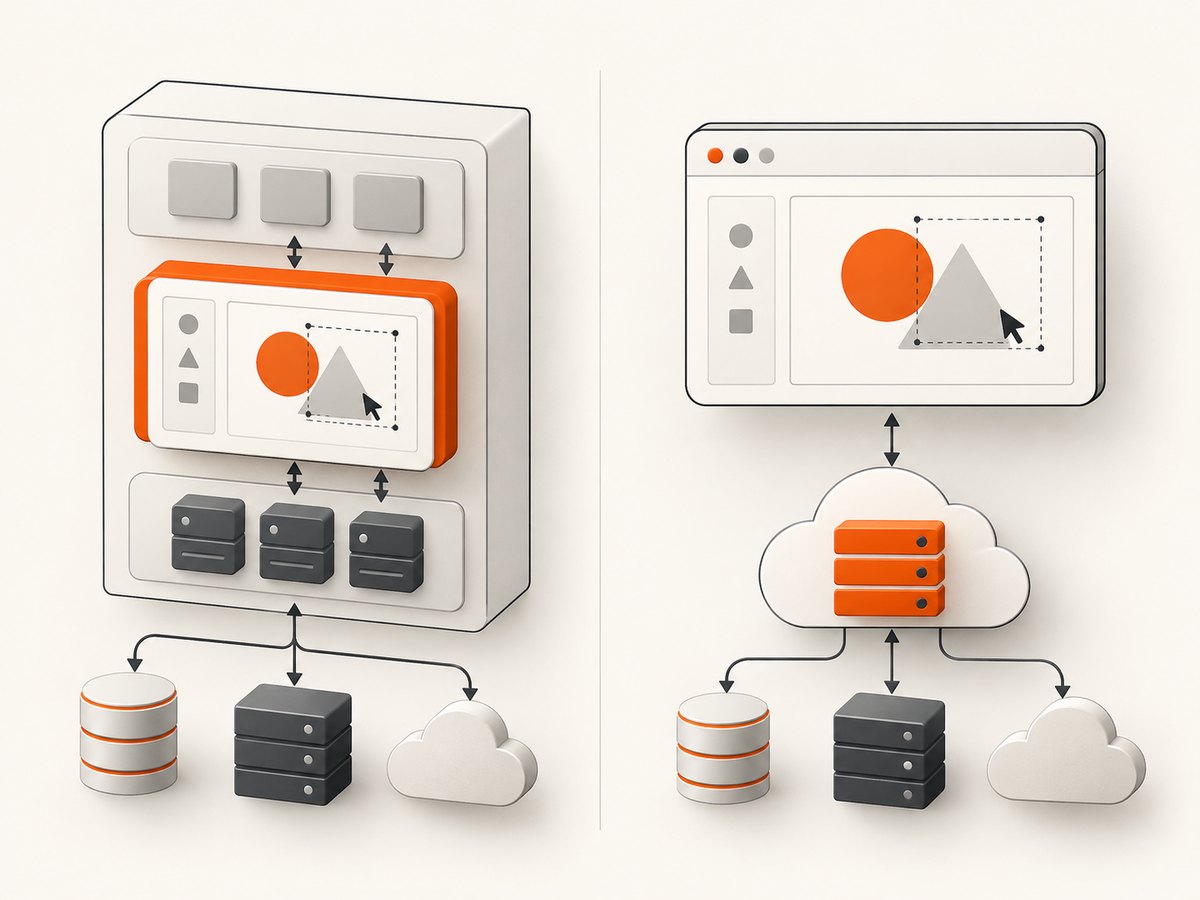
Orshot presents Embed as a hosted editor. Its reviewed documentation describes loading the editor with an iframe or React/Vue SDK, then using hosted capabilities such as JWT authentication, domain locking, user-specific template and data separation, and webhooks. Your application still owns the surrounding product experience and authorization decisions, but the editor service is operated by Orshot. See Orshot’s Embed page.
Neither model is universally better. The right choice depends on whether your highest risk is building and operating editor infrastructure or accepting a hosted service’s integration boundaries and data terms.
Deployment and control
CE.SDK: install the editing layer
With CE.SDK, plan for an integration project inside your application. Your team chooses the supported platforms, bundles the SDK, configures the UI, connects asset sources, and implements save and export flows. This gives you control over deployment and lets the editor fit your application’s release process. It also means your team is responsible for browser and device compatibility, asset permissions, persistence, observability, and failure handling.
IMG.LY lists web, iOS, Android, desktop, and Node.js server-side support on its pricing page. That breadth is useful when the same editing model must appear in a browser, a native application, and a backend rendering service. Validate the exact package, platform license, and feature combination for your target release.
Orshot Embed: integrate a hosted surface
Embed reduces the amount of editor runtime you ship. The documented integration choices are an iframe or React/Vue component. Hosted delivery can shorten the path to a working editor, especially when your product already has a web frontend and you want tenant-aware projects, authentication sessions, and event callbacks. The trade-off is that customization and lifecycle behavior follow the hosted product’s documented controls, release schedule, and service terms.
Before choosing a hosted editor, verify content security policy requirements, allowed domains, cookie behavior, browser privacy restrictions, export delivery, webhook retries, and how a tenant is deleted. Ask for the current service-level, retention, residency, and subprocessor commitments that apply to your plan.
Platform fit and extensibility
Shortlist CE.SDK when any of these are requirements:
- A native iOS or Android editor.
- A desktop application with the same editing primitives.
- Server-side Node.js rendering or headless operation.
- Custom asset providers and a product-specific storage pipeline.
- A deeply branded interface where your team owns the full component tree.
- Deployment inside a controlled network or customer-managed environment.
Shortlist Orshot Embed when these conditions describe the product:
- The primary experience is a web SaaS application.
- An iframe or React/Vue integration is acceptable.
- You want hosted user and template separation for multiple customers.
- JWT sessions, domain restrictions, and webhooks match your backend workflow.
- Your team prefers to avoid maintaining the editor runtime and its release process.
Do not infer that Orshot has no capabilities beyond the reviewed Embed page, or that CE.SDK automatically includes every integration your product needs. Make a feature matrix for formats, fonts, asset sources, collaboration, permissions, export types, and accessibility, then verify each item in current documentation.
Data architecture and security questions
CE.SDK’s customer-operated model can fit an architecture where the application controls storage and processing. IMG.LY describes browser editing on the customer’s infrastructure. Your security team still needs to review the SDK’s network requests, update process, license checks, asset handling, and any server-side components you enable.
Orshot describes a hosted, JWT-based service with user-specific separated templates and data. That can simplify tenant isolation, but it makes Orshot’s retention, regions, subprocessors, backups, and deletion guarantees part of your risk review. Ask how exports and uploaded assets are stored, how long webhook payloads remain available, and what happens when a customer account is suspended.
| Review area | Questions to answer |
|---|---|
| Authentication | Who issues tokens or license keys? How are they rotated? Can a browser expose a secret? |
| Tenant isolation | How are project IDs scoped? Can one customer enumerate another customer’s assets? |
| Storage | Where are originals, previews, and exports stored? What are retention and deletion timelines? |
| Network controls | Can domains, origins, outbound requests, and content security policies be restricted? |
| Compliance | Which regions, subprocessors, audit reports, and contractual terms apply to your plan? |
Customization and engineering responsibility
IMG.LY says CE.SDK can be themed and configured, can use custom asset sources, and supports full-UI and headless operation. This is a strong fit when editing is a core product surface and your engineers need to compose it with your own panels, permissions, and workflows. Budget for integration code around undo/redo state, autosave, project versioning, uploads, export queues, and mobile input behavior.
Orshot emphasizes a ready hosted Studio editor and controls around tenancy, authentication, domains, and webhooks. This can package common workflow plumbing, but your product must adapt to the integration points the service exposes. Test how your own navigation, branding, localization, keyboard shortcuts, accessibility, and error states behave inside the hosted surface.
Pricing and licensing
| Vendor | Published information | What to confirm |
|---|---|---|
| IMG.LY | Pricing is quoted according to platforms, components, and AI features. The pricing page describes a full-feature trial, and support documentation says the trial key is valid for 30 days. | Platform and component combinations, production environments, support, renewal terms, license-key hostname or bundle-ID rules, and export behavior without a valid key. |
| Orshot | Embed starts at $39/month. The page says multi-tenancy, webhooks, and removal of branding start at $160/month. | Included users, storage, exports, rate limits, webhook guarantees, overages, retention, and current plan details. |
These figures are not a normalized total-cost comparison. For CE.SDK, include engineering time for integration and operations. For Orshot, include recurring service cost and any usage, storage, or support limits. Compare the actual user count, export volume, environments, platforms, and required features in a vendor quote or plan review.
Performance evidence: useful context, not a benchmark
Orshot’s migration page reports three cold Chrome loads on September 22, 2026, comparing its editor with the public IMG.LY CE.SDK 1.82.1 demo. Orshot reports 3.9 seconds versus 5.1 seconds, 2.6 MB versus 9.8 MB downloaded, and 0 MB versus 6.2 MB of WebAssembly. These are Orshot’s own measurements of demos, not an independent benchmark or a prediction for your production application. Read the dated comparison details.
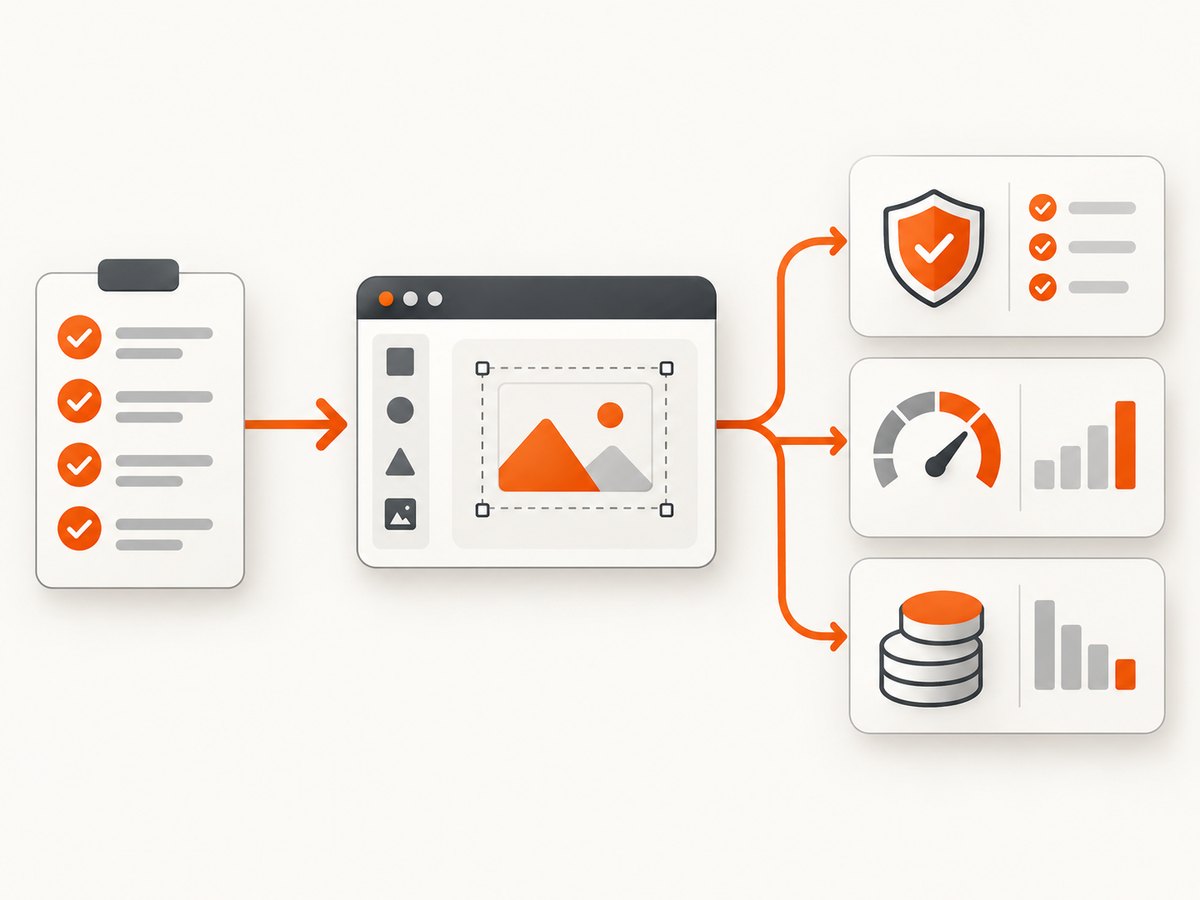
Run your own pilot with representative templates, fonts, asset sizes, cold and warm loads, low-end mobile devices, throttled networks, and concurrent exports. Measure time to interactive, first usable canvas, project open, save completion, export completion, and recovery after a dropped connection.
A practical evaluation plan
- Define the editor contract. List platforms, formats, canvas limits, asset sources, export types, collaboration needs, tenant rules, and retention requirements.
- Build one representative workflow. Import real assets, edit a multi-layer design, save it, reopen it, and export it. Include a failed upload and an expired session.
- Test integration boundaries. For CE.SDK, inspect bundle size, browser memory, license behavior, and server rendering. For Orshot, test iframe sizing, CSP, authentication renewal, webhook retries, and domain restrictions.
- Review security and contracts. Confirm data regions, subprocessors, deletion, support response, and production licensing.
- Price the complete system. Add engineering, infrastructure, support, user or export limits, and renewal costs to the vendor price.
Common failure modes and fixes
| Symptom | Likely cause | Fix |
|---|---|---|
| Editor loads blank in an iframe | Origin, domain-locking, CSP, or frame restrictions reject the parent page. | Allow the exact production origin, check frame-src and related policies, and inspect browser console errors. |
| Exports contain a watermark | CE.SDK license key is missing, invalid, or not configured for the current hostname or bundle ID. | Use the production key and verify its configured domains or identifiers; confirm the subscription is active. |
| Users see the wrong tenant’s project | Tenant identity is not bound consistently to session, project, and asset lookups. | Derive authorization on the server, scope every identifier to a tenant, and test cross-tenant access attempts. |
| Webhook events are duplicated or missed | Receiver is not idempotent, times out, or lacks retry monitoring. | Store event IDs, acknowledge quickly, process asynchronously, and reconcile against provider status APIs where available. |
| Large designs feel slow | Oversized assets, fonts, canvas complexity, or constrained devices. | Resize uploads, lazy-load asset libraries, measure memory, and test realistic low-end hardware. |
| Save succeeds but reopen loses changes | Autosave races, stale revisions, or an export being mistaken for a project save. | Use revision numbers, server-side conflict handling, explicit save status, and reopen tests after network interruption. |
Or skip the browser setup
If your immediate task is generating screenshots of editor demos, templates, documentation, or customer pages, ScreenshotNeo provides a website screenshot API and MCP server. It accepts one GET request and returns PNG, JPEG, WebP, or PDF. Before capture it accepts cookie and consent banners and removes more than 60 known consent platforms, newsletter popups, and chat widgets; each step can be disabled. Bot checks, blank pages, timeouts, failed loads, and cache hits are not billed, and response headers identify the page verdict and billing result.
cURL:
curl -G "https://api.screenshotneo.com/v1/shot" -d access_key=YOUR_API_KEY --data-urlencode url=https://stripe.com -o shot.webpPython:
import requests
r = requests.get("https://api.screenshotneo.com/v1/shot", params={"access_key": "YOUR_API_KEY", "url": "https://stripe.com"}, timeout=90)
open("shot.webp", "wb").write(r.content)
Node.js:
const q = new URLSearchParams({ access_key: 'YOUR_API_KEY', url: 'https://stripe.com' });
const res = await fetch(`https://api.screenshotneo.com/v1/shot?${q}`);
See the ScreenshotNeo documentation for the full option set, including full-page capture, CSS-selector element capture, device presets, dark mode, retina scale, PDF paper and margin controls, custom CSS and JavaScript, click and wait actions, request blocking, headers, cookies, user agents, timezone, geolocation, transparent backgrounds, resizing, TTL caching, signed links, asynchronous jobs, webhooks, bulk capture, usage data, and the OpenAPI specification. An MCP server exposes take_screenshot, get_page_info, and capture_pdf to Claude, Cursor, and other MCP clients.
Plans include 1,000 screenshots a month free with no card. Paid plans start at $5 for 3,000 shots. Create a free ScreenshotNeo account.
FAQ
Can CE.SDK and Orshot Embed be used in the same product?
Potentially, if different workflows justify different delivery models, but that creates two editor integrations, two data paths, and additional support overhead. Validate the reason before taking on that complexity.
Which option is better for a mobile app?
CE.SDK is the stronger initial candidate because IMG.LY lists iOS and Android support. The reviewed Orshot Embed page documents web iframe, React, and Vue integration; verify any mobile-specific offering separately.
Does hosted mean no engineering work?
No. You still need authentication, tenant authorization, save and export handling, frontend integration, monitoring, and security review. Hosted delivery changes what you operate.
Is Orshot’s performance comparison conclusive?
No. It covers three cold Chrome loads of vendor demos on a stated date. Use it as a prompt for your own representative test.
How should procurement compare the products?
Compare the complete workflow: required platforms, active users, exports, storage, support, environments, data terms, implementation effort, and renewal price. Published starting prices alone cannot answer that question.


