LlamaIndex vs. LangChain: Which Framework Should You Use?
Choose LlamaIndex for retrieval quality, LangChain and LangGraph for orchestration, or combine them for production RAG agents.

Short answer: choose LlamaIndex when your hardest problem is turning heterogeneous documents into reliable retrieved context. Choose LangChain with LangGraph when your hardest problem is coordinating multi-step agent behavior: routing, tool choice, retries, durable state, and human approvals. A common production architecture uses both: LlamaIndex owns parsing, indexing, and retrieval, while a LangGraph workflow invokes the LlamaIndex query engine as a tool.
Neither framework is a universal winner. The right choice depends on where complexity lives in your system: the data layer or the orchestration layer.
What LlamaIndex and LangChain are
LlamaIndex: retrieval and data workflows
LlamaIndex is an open-source framework organized around loading data, indexing, querying, storing, retrieval-augmented generation (RAG), agents, workflows, structured extraction, evaluation, and integrations. Its core value is a data layer that can ingest messy inputs, structure them, index them, and retrieve useful context for an LLM.
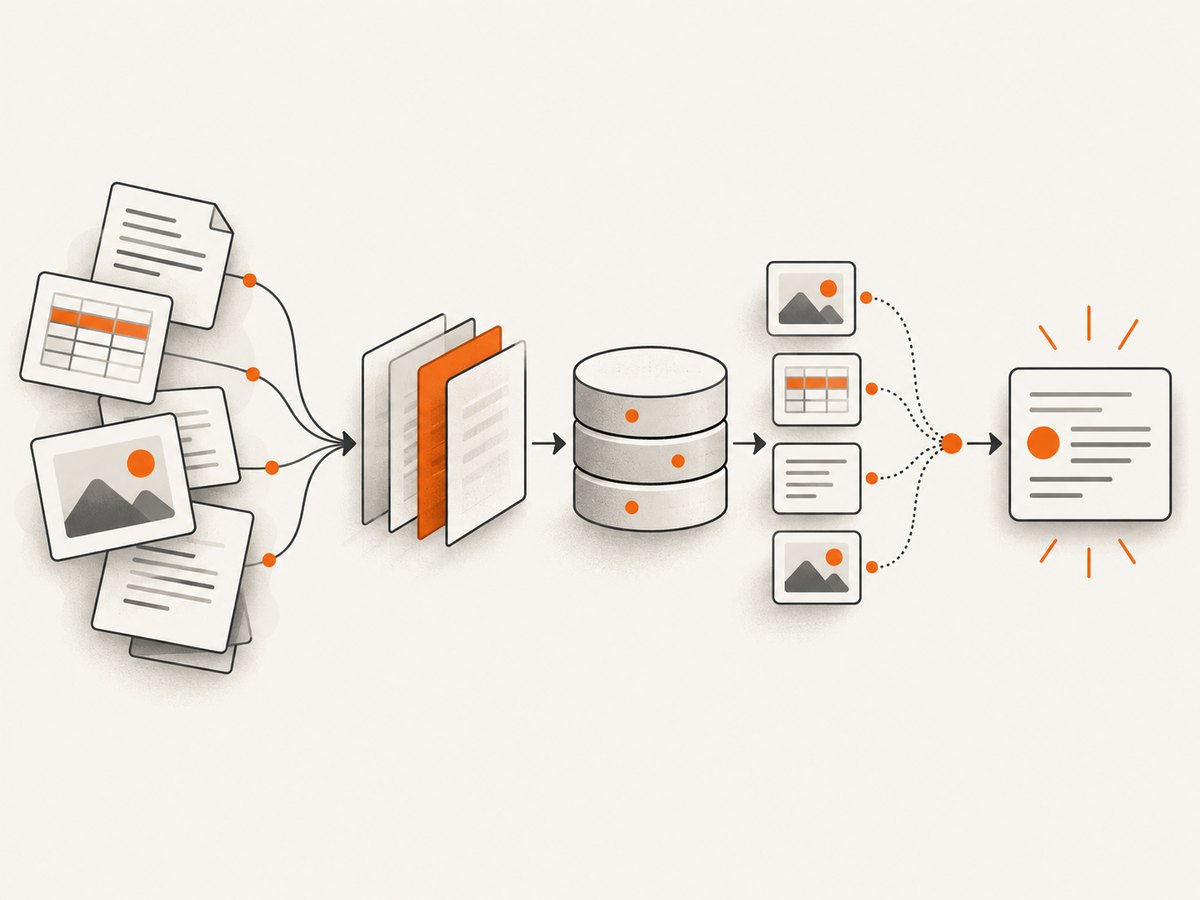
Its documented retrieval patterns include hybrid search, recursive retrieval, query decomposition, sub-question generation, hierarchical node parsing, and auto-merging. Named index types include VectorStoreIndex, SummaryIndex, TreeIndex, KeywordTableIndex, and PropertyGraphIndex.
LangChain and LangGraph: application and orchestration
LangChain is a general framework for building LLM applications. LangGraph is its lower-level orchestration runtime for long-running, stateful agents. The useful distinction is that LangGraph models an application as a graph of steps and state: a run can route between nodes, call tools, retry, pause for approval, persist a checkpoint, and resume later.
LangChain also provides retrieval primitives such as EnsembleRetriever, ContextualCompressionRetriever, ParentDocumentRetriever, and MultiVectorRetriever, plus vector-store, graph, self-query, multi-query, time-weighted, parent-document, multi-vector, and contextual-compression patterns. It can integrate LlamaIndex retrievers when you need both ecosystems.
LlamaIndex vs. LangChain at a glance
| Question | Better starting point | Reason |
|---|---|---|
| How do I parse PDFs, tables, slides, and mixed files? | LlamaIndex | Its data ingestion, node parsing, indexing, and managed parsing options are central to the framework. |
| How do I build an agent with branching, retries, and approval steps? | LangGraph | Stateful graphs and persistence checkpoints model these control-flow requirements directly. |
| How do I tune retrieval quality? | LlamaIndex | It offers retrieval-focused index types and patterns such as recursive retrieval and query decomposition. |
| How do I connect many model, tool, and provider APIs? | LangChain | LangChain reports more than 1,000 integrations across models, vector stores, tools, embeddings, and loaders (2026). |
| Can I use both? | Hybrid | Expose a LlamaIndex query engine as a tool inside a LangGraph node. |
Published integration counts are time-sensitive. LlamaIndex reports more than 300 integration packages, including 158 reader packages verified in May 2026. The comparison also cites LlamaParse support for more than 130 file formats and more than 100 languages. Treat these as publisher-reported snapshots, not permanent totals.
Which is better for RAG?
For a document-heavy RAG system, start with LlamaIndex. It gives you more direct control over the path from source files to retrieved nodes: loaders, chunking and hierarchical parsing, metadata, index selection, query engines, and retrieval composition. This matters when answer quality depends on tables, nested sections, cross-document references, or multiple retrieval passes.
LangChain can build strong RAG systems too. Its retriever abstractions make it straightforward to combine vector stores, rerankers, contextual compression, parent documents, and multiple query strategies. Choose it first when retrieval is one component inside a larger application that already needs LangGraph orchestration.
Minimal LlamaIndex RAG example
pip install llama-index

import os
from llama_index.core import VectorStoreIndex, SimpleDirectoryReader

# Put source files in ./data
 documents = SimpleDirectoryReader("data").load_data()
index = VectorStoreIndex.from_documents(documents)
query_engine = index.as_query_engine(similarity_top_k=5)

answer = query_engine.query("What are the payment retry rules?")
print(answer)
For production, replace the in-memory defaults with a persistent vector store, explicit chunking and metadata policies, an embedding model selected for your language mix, and evaluation data that measures retrieval recall and answer faithfulness.
Minimal LangChain retrieval example
pip install -U langchain langchain-openai langchain-community faiss-cpu

import os
from langchain_openai import OpenAIEmbeddings, ChatOpenAI
from langchain_community.document_loaders import TextLoader
from langchain_text_splitters import RecursiveCharacterTextSplitter
from langchain_community.vectorstores import FAISS

loader = TextLoader("handbook.txt", encoding="utf-8")
docs = loader.load()
chunks = RecursiveCharacterTextSplitter(
    chunk_size=800, chunk_overlap=120
).split_documents(docs)

store = FAISS.from_documents(chunks, OpenAIEmbeddings())
retriever = store.as_retriever(search_kwargs={"k": 5})
question = "What are the payment retry rules?"
context = retriever.invoke(question)

llm = ChatOpenAI(model="gpt-4o-mini")
prompt = "Answer only from this context:\n\n" + "\n\n".join(d.page_content for d in context)
print(llm.invoke(prompt).content)
Which is better for agents?
Choose LangGraph when the agent must make control-flow decisions over a long-running process. A graph can route a request to specialist nodes, call tools, retry transient failures, persist state, pause for a human decision, and resume from a checkpoint. This is especially useful for approvals, background jobs, customer-service escalations, and workflows that must survive process restarts.
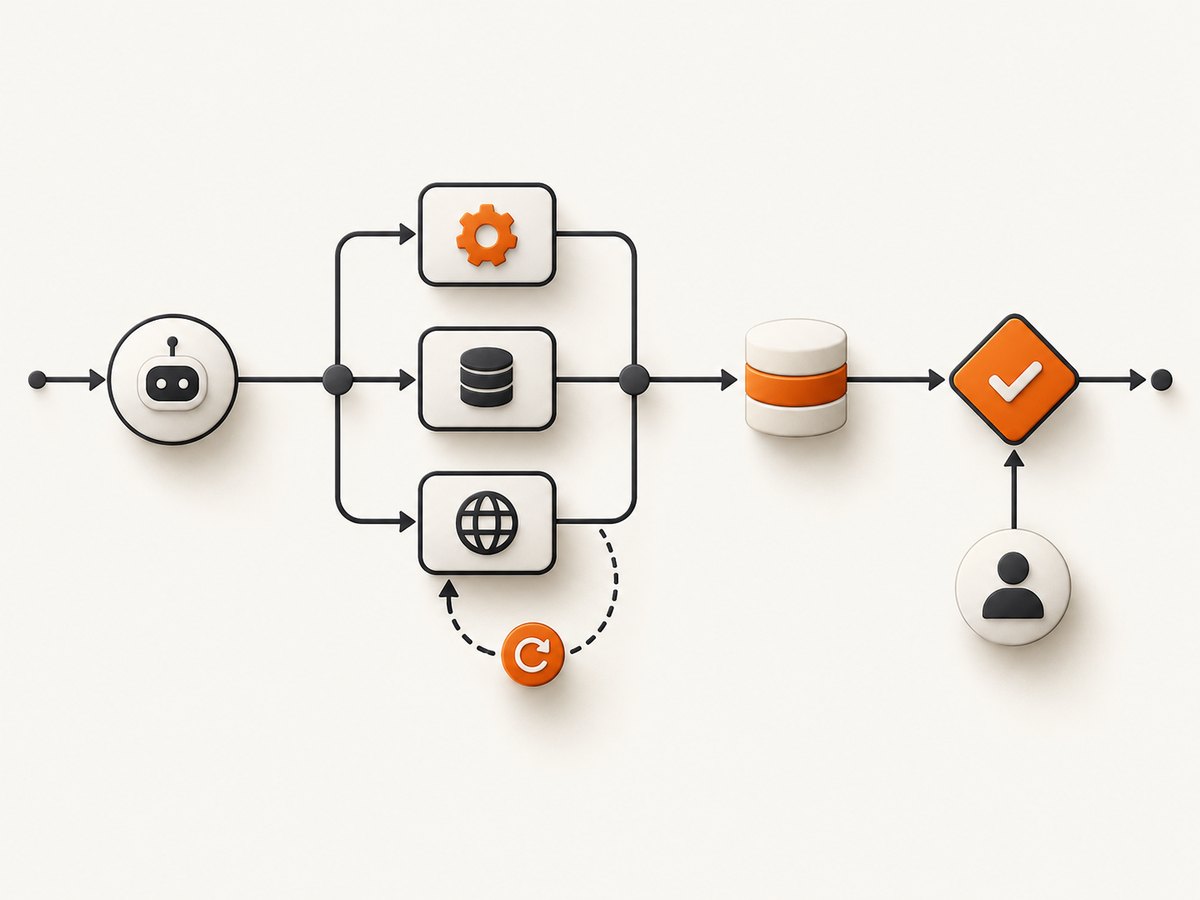
LlamaIndex also supports event-driven Workflows and AgentWorkflow for multi-step and multi-agent applications. Checkpointing through WorkflowCheckpointer is opt-in. If your agent is primarily a retrieval system with a few bounded actions, LlamaIndex may be simpler. If it is an operational process with many states and failure paths, LangGraph usually gives you a clearer runtime model.
LangChain co-founder Harrison Chase defines an AI agent as “a system that uses an LLM to decide the control flow of an application.” That definition points to the practical boundary: selecting routes, tools, retries, and state is orchestration; deciding which documents matter and how to combine indexes is a data-layer problem.
How to combine LlamaIndex and LangGraph
The canonical hybrid design wraps a LlamaIndex query engine as a tool invoked by a LangGraph node. LlamaIndex handles document parsing, indexing, and retrieval. LangGraph handles the agent loop, state, routing, retries, and approvals.
Hybrid example: query engine as a tool
pip install llama-index langgraph langchain-core

from typing import TypedDict
from llama_index.core import VectorStoreIndex, SimpleDirectoryReader
from langchain_core.tools import tool
from langgraph.graph import StateGraph, END

# Build the retrieval layer once at startup
docs = SimpleDirectoryReader("data").load_data()
query_engine = VectorStoreIndex.from_documents(docs).as_query_engine()

@tool
def search_company_docs(question: str) -> str:
    """Retrieve an answer from the indexed company documents."""
    return str(query_engine.query(question))

class State(TypedDict):
    question: str
    answer: str

def retrieve(state: State):
    result = search_company_docs.invoke({"question": state["question"]})
    return {"answer": result}

graph = StateGraph(State)
graph.add_node("retrieve", retrieve)
graph.set_entry_point("retrieve")
graph.add_edge("retrieve", END)
app = graph.compile()

print(app.invoke({"question": "What is the refund policy?", "answer": ""}))
For production control, a custom tool wrapper is often preferable to a thin adapter: define timeouts, retry only transient provider errors, validate tool arguments, attach trace identifiers, and return structured error types. Community packages named LlamaIndexRetriever and LlamaIndexGraphRetriever can help with basic cases, but they do not remove the need to design operational behavior.
Integration breadth, deployment, and observability
LangChain reports more than 1,000 integrations across models, vector stores, tools, embeddings, and document loaders. LlamaIndex reports more than 300 integration packages across its stack. The raw number matters less than coverage of the providers you must operate and the quality of the adapter you will depend on.
LangSmith is described by LangChain as a framework-agnostic platform for observability, evaluation, and deployment across LangChain, LangGraph, LlamaIndex, several SDKs, and custom code. LlamaCloud is a separate managed service for parsing, indexing, and retrieval. It is optional when open-source LlamaIndex is enough and useful when you need managed parsing for unstructured data at production scale. Verify current availability and pricing before committing to either service.
Learning curve and operational complexity
LlamaIndex can be faster for a team whose first deliverable is “ask questions over these files.” The concepts are centered on documents, nodes, indexes, retrievers, and query engines. LangChain can be faster when your team already thinks in chains, tools, messages, and provider adapters. LangGraph adds a deliberate state-machine model that takes longer to learn but makes complex execution paths visible.
Whichever you choose, establish these boundaries early:
- Keep ingestion and indexing out of request-time code.
- Version chunking, metadata, embedding, and reranking settings.
- Log retrieved document identifiers and scores, not only the final answer.
- Set explicit timeouts and retry budgets for every external call.
- Persist agent state only when you can define retention, privacy, and replay behavior.
Performance, reliability, and cost considerations
Performance
Most latency comes from document parsing, embedding, vector search, reranking, LLM generation, and tool calls rather than the framework import itself. Precompute embeddings, batch ingestion, reuse clients, limit retrieved context, and stream responses where the user benefits. In LangGraph, avoid repeated expensive nodes when a checkpoint or cached tool result is sufficient. In LlamaIndex, avoid rebuilding indexes on every request.
Reliability
Use idempotent ingestion jobs and record a source version for every indexed document. For agents, distinguish model refusal, validation failure, provider timeout, and tool failure so retry policies do not turn permanent errors into loops. Persist checkpoints before human approval and after side effects. In a hybrid system, make the retrieval tool return bounded, typed results so orchestration logic can decide whether to retry, ask a clarifying question, or continue without retrieval.
Cost
Frameworks do not determine your total bill by themselves. Token usage, embedding volume, reranking, storage, managed parsing, observability, and tool-provider calls usually dominate. Measure cost per indexed page, query, and completed workflow. Cache immutable retrieval results where privacy rules permit, and cap maximum context and retry counts.
Troubleshooting checklist
| Symptom | Likely cause | Fix |
|---|---|---|
| Answers ignore the source documents | Retrieval returned irrelevant or empty nodes. | Inspect retrieved IDs and scores; adjust chunking, metadata filters, top-k, query rewriting, or hybrid retrieval. |
| Tables produce incorrect answers | Plain text extraction destroyed row and column relationships. | Use layout-aware parsing, preserve table metadata, and test table-specific queries. |
| Agent repeats the same tool call | No attempt counter or terminal condition exists. | Store retry state, cap attempts, and route permanent failures to a fallback or human node. |
| Workflow loses progress after a restart | State was only held in memory. | Configure durable LangGraph persistence or an opt-in LlamaIndex workflow checkpointer. |
| Latency spikes on large files | Parsing or embedding runs synchronously during a request. | Move ingestion to a queue, batch work, and serve from a prebuilt index. |
| Dependency upgrades break adapters | Provider integrations changed independently. | Pin compatible versions, run retrieval and tool contract tests, and upgrade in small steps. |
| Retries increase cost without recovery | Permanent errors are treated as transient. | Retry only timeouts, rate limits, and explicitly transient provider errors. |
Or skip the browser setup
If your agent or RAG pipeline needs screenshots of source pages, ScreenshotNeo provides a website screenshot API and MCP server. It accepts one GET request and returns PNG, JPEG, WebP, or PDF. Cookie and consent banners, newsletter popups, and chat widgets are removed before capture; each step can be disabled. Bot checks, blank pages, timeouts, failed loads, and cache hits are not billed, and response headers identify the page verdict and billing status.
Use the ScreenshotNeo API documentation for the full option set, including full-page capture with lazy images, CSS element capture, dark mode, device presets, retina scale, custom CSS and JavaScript, waits, request blocking, headers, cookies, user agents, authorization, timezone, geolocation, transparent backgrounds, resizing, caching, signed links, async jobs, webhooks, bulk capture, usage, and the OpenAPI specification.
cURL
curl -G "https://api.screenshotneo.com/v1/shot" \
  -d access_key=YOUR_API_KEY \
  --data-urlencode url=https://stripe.com \
  -o shot.webp
Python
import requests

r = requests.get(
    "https://api.screenshotneo.com/v1/shot",
    params={"access_key": "YOUR_API_KEY", "url": "https://stripe.com"},
    timeout=90,
)
r.raise_for_status()
open("shot.webp", "wb").write(r.content)
Node.js
const q = new URLSearchParams({
  access_key: 'YOUR_API_KEY',
  url: 'https://stripe.com'
});
const res = await fetch(`https://api.screenshotneo.com/v1/shot?${q}`);
if (!res.ok) throw new Error(`Screenshot failed: ${res.status}`);
const data = Buffer.from(await res.arrayBuffer());
require('node:fs').writeFileSync('shot.webp', data);
An MCP server lets Claude, Cursor, and other MCP clients call take_screenshot, get_page_info, and capture_pdf as agent tools. The Free plan includes 1,000 screenshots per month with no card; paid plans start at $5 for 3,000 shots, and every feature is available on every plan. Create a free ScreenshotNeo account.
FAQ
Can LlamaIndex replace LangGraph?
For simple retrieval agents, sometimes. For durable, branching workflows with approvals and retries, LangGraph provides a more explicit orchestration runtime.
Can LangChain replace LlamaIndex?
Yes for many RAG applications, especially when you already use LangChain adapters. LlamaIndex is often the better starting point when parsing and retrieval quality are the central engineering problem.
Do I need both frameworks?
No. Add the second framework when a clear boundary appears: LlamaIndex for retrieval and LangGraph for stateful orchestration.
Which has more integrations?
LangChain reports 1,000+ integrations; LlamaIndex reports 300+ packages. Counts change, so verify support for your exact providers before choosing.
Is there an independent benchmark proving one is better?
No central benchmark establishes a universal winner. Evaluate your own documents, queries, latency targets, failure modes, and operating costs.


