Natural Language Processing (NLP): Definition and How It Works
Learn what NLP is, how its pipeline works, how NLP differs from NLU and NLG, and how to choose an approach for a real application.

Natural language processing (NLP) is the field of computing that enables software to analyze, interpret, and generate human language in text or speech. It combines computational linguistics with machine learning and deep learning. In practice, an NLP system takes language that is messy and unstructured, converts it into a representation a computer can work with, and produces an output such as a label, extracted fact, translation, transcript, answer, or generated passage. Google Cloud describes NLP as using machine learning to reveal the structure and meaning of text; IBM and AWS likewise describe it as a combination of language techniques and learned models. Google Cloud, IBM, AWS.
This guide explains the typical NLP pipeline, clarifies NLP versus NLU and NLG, walks through common tasks and implementation choices, and shows a small runnable Python example. The central practical point: choose the task and success measure first. “Understand language” is too broad to implement or evaluate.
1. What natural language processing means
Human language is ambiguous, contextual, and variable. The same word can have multiple meanings; spelling, punctuation, dialect, and domain vocabulary differ; and a sentence’s intent may not be stated literally. NLP uses computational methods to work with these properties. Some systems use explicit linguistic rules; others learn statistical patterns from examples; modern systems commonly use neural networks and transformer models.
NLP does not imply that a computer understands language in the human sense. It means that a system performs a defined language task well enough for an application: for example, identifying that a support message is about a refund, locating a date in a contract, or generating a summary. The output still needs evaluation against the application’s requirements.
Where NLP is used
- Search and retrieval: match a query to relevant passages, even when wording differs.
- Extraction: identify names, dates, organizations, product references, or relationships in documents.
- Classification: assign a category such as topic, urgency, or sentiment.
- Conversational systems: detect intent, answer questions, and generate responses.
- Speech: transcribe spoken language into text; speech products such as Amazon Transcribe support this workflow.
- Translation: convert language between languages, as in managed translation services such as Amazon Translate.
- Generation and summarization: create or condense language using learned models.
These are related applications, but their input requirements, quality measures, and failure costs differ. A sentiment label can be evaluated on labeled examples; a generated legal summary needs checks for omissions and unsupported statements as well.
2. How an NLP system works
A production pipeline varies by task, but most systems follow the same broad sequence: gather language data, prepare it, represent it in machine-usable units, apply a model or rules, and evaluate the result. AWS describes data preparation, model training, and deployment as parts of NLP implementation. AWS’s NLP overview.
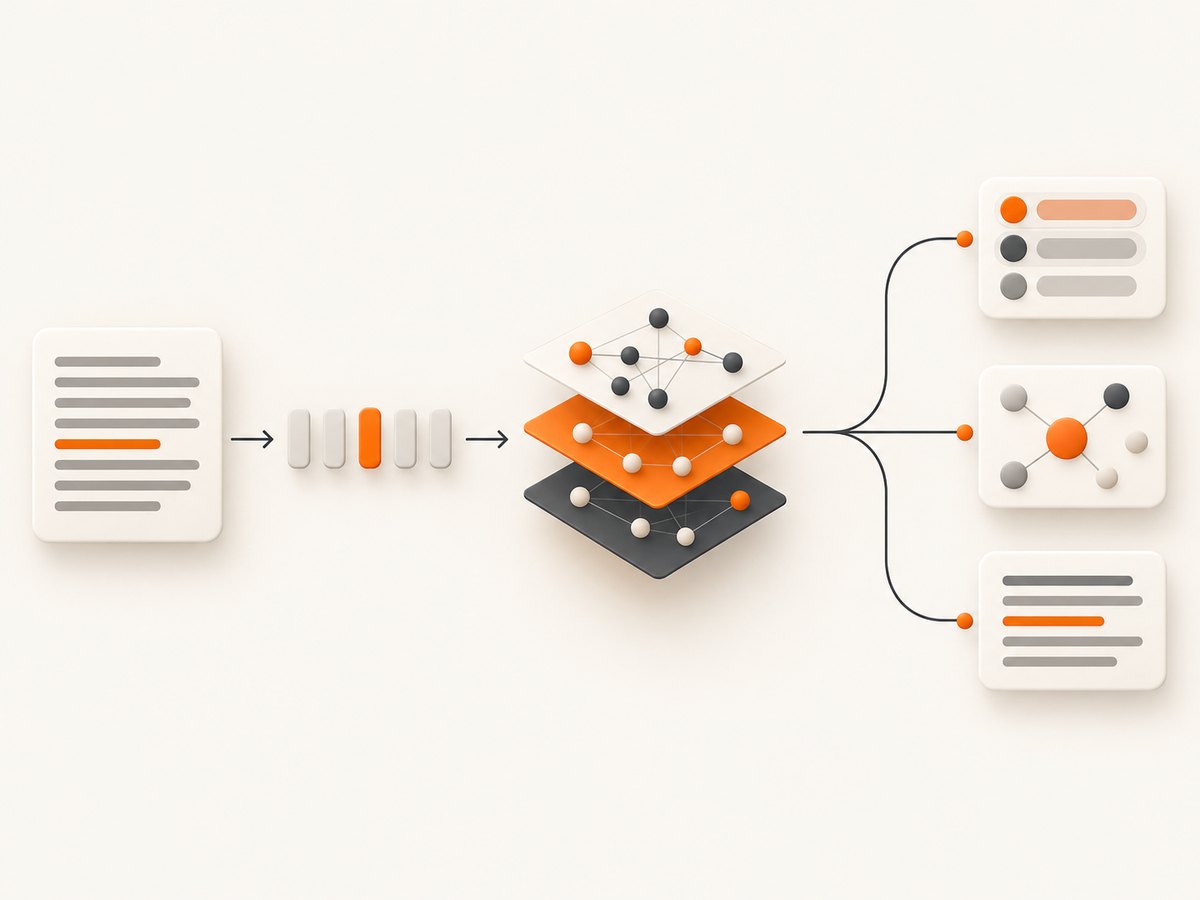
- Collect and prepare input. Sources may include documents, messages, web content, or recorded audio. Remove accidental markup, handle encoding, and decide how to treat missing or duplicated content. If the input is audio, transcription may be a preceding step.
- Segment and tokenize. Split text into sentences and smaller units called tokens. Tokens may be words, punctuation, or subword pieces. Tokenization is not simply splitting on spaces: punctuation, contractions, languages without whitespace word boundaries, and model-specific tokenizers complicate it. IBM’s tokenization overview.
- Represent the language. Traditional systems use counts or engineered features. Neural systems commonly map tokens to numeric vectors called embeddings. A vector representation allows a model to learn patterns and contextual relationships; the representation and tokenizer depend on the model.
- Analyze structure or meaning. Depending on the task, a system may identify parts of speech, sentence structure, named entities, topics, sentiment, intent, or semantic similarity. Google’s Natural Language API, for example, can return sentences, tokens, part-of-speech information, and dependency relationships. Google Cloud syntax analysis documentation.
- Apply a model or rules. A rule-based parser may be sufficient for constrained formats. A statistical or machine-learning classifier can map examples to categories. Deep learning models can handle more flexible patterns; transformers use self-attention so relationships between distant parts of a sequence can inform processing. AWS guidance on transformers and self-attention.
- Evaluate and use the output. Compare results with representative examples and task-specific metrics, then deploy the model locally or call a managed API. Monitor errors after deployment because real inputs can differ from the data used during development.
For example, a support-message classifier might clean a message, tokenize it, create a representation, and predict a label such as “billing” or “technical issue.” A separate workflow might extract a customer name and order number, then route the message. Both are NLP, but they solve different tasks and should be evaluated separately.
3. NLP vs. NLU vs. NLG
| Term | Meaning | Example |
|---|---|---|
| NLP | The broad field of computational methods for processing human language. | Classify, translate, search, transcribe, or generate text. |
| NLU | The meaning-focused part of language processing: interpreting intent, entities, context, or semantic relationships. | Recognize that “I was charged twice” is a billing complaint. |
| NLG | Producing language output from an input, data, or an internal representation. | Generate a concise answer or turn structured results into a sentence. |
NLP is the umbrella term. NLU focuses on interpretation; NLG focuses on producing language. An application can combine them: a chatbot uses NLU to interpret a request, retrieves or computes an answer, and uses NLG to express it. IBM describes NLU as a subset of NLP and NLG as a language-generation capability within the same broader area. IBM’s NLP, NLU, and NLG comparison.
4. Common NLP tasks and how to choose one
| Task | What it returns | Useful evaluation question |
|---|---|---|
| Tokenization and syntax | Sentences, tokens, grammatical or dependency structure | Are boundaries and structural labels correct for this language and domain? |
| Named-entity recognition | Spans labeled as people, organizations, places, dates, and other entity types | Are the entities and their character offsets correct? |
| Classification | One or more labels for a text | What are precision, recall, and error rates for important classes? |
| Sentiment or intent analysis | A sentiment, intent, or related category | Does the label match the intended use, including sarcasm and domain language? |
| Search and semantic matching | Ranked documents or passages | Do the top results contain relevant evidence for real queries? |
| Translation or transcription | Text in another language or text derived from speech | Are meaning, names, numbers, and domain terms preserved? |
| Summarization or generation | New or shortened text | Is it relevant, complete, and grounded in the supplied source? |
Do not select a model based only on a general claim that it is “good at NLP.” Specify languages, domain, input length, throughput, output format, privacy constraints, acceptable latency, and what mistakes cost. For a fixed extraction task, a focused managed API or smaller model may be easier to validate than a general text generator. For a task with varied wording or open-ended output, a flexible neural model may be more suitable, but its responses need task-specific checks.
5. A small runnable NLP example in Python
This example uses a deliberately simple keyword classifier to show the end-to-end shape of a task: input text, normalize it, apply a decision, and inspect the output. It is runnable with Python 3 and the standard library; it is not a trained model and should not be mistaken for robust production classification.
import re

LABEL_KEYWORDS = {
    "billing": {"invoice", "charged", "refund", "payment"},
    "technical": {"error", "crash", "login", "broken"},
}

def classify(message: str) -> tuple[str, list[str]]:
    # Lowercase and retain word-like tokens. A real system needs
    # language-aware preprocessing and representative evaluation data.
    tokens = re.findall(r"[\w']+", message.lower())
    token_set = set(tokens)
    scores = {
        label: len(token_set & keywords)
        for label, keywords in LABEL_KEYWORDS.items()
    }
    best_label = max(scores, key=scores.get)
    if scores[best_label] == 0:
        return "other", tokens
    return best_label, tokens

if __name__ == "__main__":
    text = "I was charged twice and need a refund."
    label, tokens = classify(text)
    print({"label": label, "tokens": tokens})
To turn this demonstration into a dependable classifier, collect examples that reflect actual messages, define labels precisely, split examples into training and evaluation sets, measure errors by class, and review ambiguous cases. Keyword rules fail when users use synonyms (“money back”), negation (“I was not charged”), misspellings, or words with multiple meanings. A learned model can capture broader patterns, but it can also fail on underrepresented language, new vocabulary, or shifting usage. Neither approach removes the need for evaluation.
Managed API example shape
A managed NLP service typically accepts a JSON document and returns task-specific results. The exact endpoint, authentication, supported languages, payload limits, and billing rules vary by provider; consult that provider’s current documentation rather than copying a request across products. Google’s syntax API, for example, accepts a document and encoding type and returns sentences and tokens. See the Google request and response format.
6. Implementation choices and configuration
Rules, managed APIs, or self-hosted models
- Rules: transparent and inexpensive to run for stable, constrained formats. They need ongoing maintenance as patterns change and do not generalize well to varied phrasing.
- Managed APIs: reduce infrastructure and deployment work. Check supported languages and task types, request limits, data handling, latency, regional availability, and current pricing in the provider’s documentation.
- Self-hosted models: give more control over deployment and data handling, but require model selection, compute, scaling, updates, observability, and operational expertise.
Compare candidates on task fit, language and domain coverage, evaluation quality, explainability, latency, cost, training-data requirements, deployment model, privacy controls, and integration effort. Use a representative evaluation set rather than a demo prompt. For a managed endpoint, test realistic text lengths and error cases. For a self-hosted system, include capacity and model-loading behavior in performance planning.
Preprocessing and edge cases to plan for
- Unicode and encoding: preserve accents, non-Latin scripts, and emoji; do not assume one character equals one byte.
- Language detection: short text, code switching, names, and mixed-language documents can make detection uncertain. Pass a known language when reliable and supported.
- Long documents: model or API input limits may require chunking. Preserve section boundaries and enough context; blindly splitting by character count can cut sentences or separate references.
- HTML and noisy text: remove boilerplate only when doing so preserves meaningful content such as headings, labels, and table values.
- Offsets: verify whether offsets count bytes, Unicode code points, or another unit before highlighting extracted spans in a UI.
- Imbalanced categories: overall accuracy can conceal poor recall for a rare but important class. Inspect per-class metrics and examples.
- Privacy: avoid sending personal or confidential text to an external service unless the service and your data-handling policy permit it.
7. Reliability, performance, and cost
For reliability, make the task output explicit and validate it before downstream actions. Handle timeouts, rate limits, invalid input, unsupported languages, and provider errors. Retry only transient failures, use bounded exponential backoff, and avoid retrying malformed requests. Log request identifiers and task metadata without retaining sensitive text unnecessarily. Keep a small, versioned evaluation set so model or preprocessing changes can be checked before rollout.
Performance depends on input length, model size, provider capacity, network round trips, batching, and whether a model is already loaded. Measure end-to-end latency on representative requests. If processing many short records, batching may reduce request overhead when the service supports it; for interactive use, a smaller model or asynchronous processing may fit better. Chunking long inputs can increase total calls and may lose context.
Cost depends on the chosen product’s pricing unit, input and output volume, model, and any infrastructure needed for self-hosting. Estimate volume from actual records and include retries, generated output, and evaluation runs. Prices and service limits change, so confirm the current vendor pricing before committing. A simple rules-based baseline can also establish whether a more complex model produces enough quality improvement to justify its cost.
8. Troubleshooting common NLP problems
| Symptom | Likely cause | What to do |
|---|---|---|
| Entities or labels are missing | Domain terms are unknown, input is noisy, or the task/model does not support the language. | Check language support and preprocessing; add representative examples or use a task-specific model. |
| Correct words, wrong meaning | Ambiguity, negation, sarcasm, or context outside the supplied text. | Provide relevant context where allowed, inspect failure examples, and evaluate the exact use case. |
| Offsets highlight the wrong characters | Offset units differ from the UI’s string indexing convention, often with multibyte characters. | Check the API’s encoding and offset definition; convert offsets before rendering. |
| Long input is rejected or truncated | Request exceeds an endpoint or model context limit. | Check current limits, split at meaningful boundaries, and test whether context is needed across chunks. |
| Results vary after a model change | Model version, prompt, tokenizer, or preprocessing changed. | Pin versions where possible and run the same evaluation set before rollout. |
| High accuracy but bad user outcomes | Metric does not match business cost, or the evaluation set is unrepresentative. | Track precision/recall and error costs per class; add real, consented examples and review edge cases. |
| API errors or slow requests | Network trouble, rate limiting, payload size, or provider capacity. | Check status and response details, use bounded retries for transient errors, and reduce or queue load. |
9. FAQ
Is NLP the same as artificial intelligence?
No. NLP is an area within AI and computer science focused on human language. AI includes many other areas, such as computer vision and planning.
Do I need to train my own NLP model?
No. Start with rules or a managed model when they meet the task and operational requirements. Training or fine-tuning is one option when evaluated performance on your domain is insufficient and you have suitable data and resources.
Can NLP work with speech?
Yes. Speech recognition can convert audio to text, after which language tasks can operate on the transcript. Speech and language processing may be separate stages with separate error sources.
Are large language models NLP?
They are neural language models used for many NLP tasks, including generation and some forms of analysis. Their flexibility does not guarantee factual, consistent, or task-correct output.
10. Capture visual web context alongside language data
Some developer workflows need both text and a visual record of a web page—for example, when documenting how extracted information appeared in its original page context. NLP handles the language tasks; a screenshot API captures the rendered page. ScreenshotNeo is a website screenshot API and MCP server for developers. Its API can return an image or PDF from one GET request, and the ScreenshotNeo docs describe its request options: ScreenshotNeo API documentation.

For this workflow, keep the responsibilities clear: capture the page, retain the image or PDF with appropriate provenance, and send text to an NLP pipeline only under your data and privacy requirements. A screenshot is not a substitute for accessible page text or an NLP model, and extracted language should be checked against its source.
Or skip the browser setup
Use a single API request to save a page image:
curl -G "https://api.screenshotneo.com/v1/shot" -d access_key=YOUR_API_KEY --data-urlencode url=https://stripe.com -o shot.webpPython:
import requests
r = requests.get("https://api.screenshotneo.com/v1/shot", params={"access_key": "YOUR_API_KEY", "url": "https://stripe.com"}, timeout=90)
open("shot.webp", "wb").write(r.content)
Node.js:
const q = new URLSearchParams({ access_key: 'YOUR_API_KEY', url: 'https://stripe.com' });
const res = await fetch(`https://api.screenshotneo.com/v1/shot?${q}`);
ScreenshotNeo removes cookie banners, popups, and chat widgets before the shot; bot checks, blank pages, and failed loads are never billed. Its MCP server lets AI agents take screenshots. The free plan includes 1,000 screenshots a month with no card, and paid plans start at $5 for 3,000. Sign up for 1,000 free screenshots a month.


