25+ Open-Source Databases for Your Next Project
Compare 25+ databases by workload, data model, operations, and license. Find a practical shortlist for your next project.
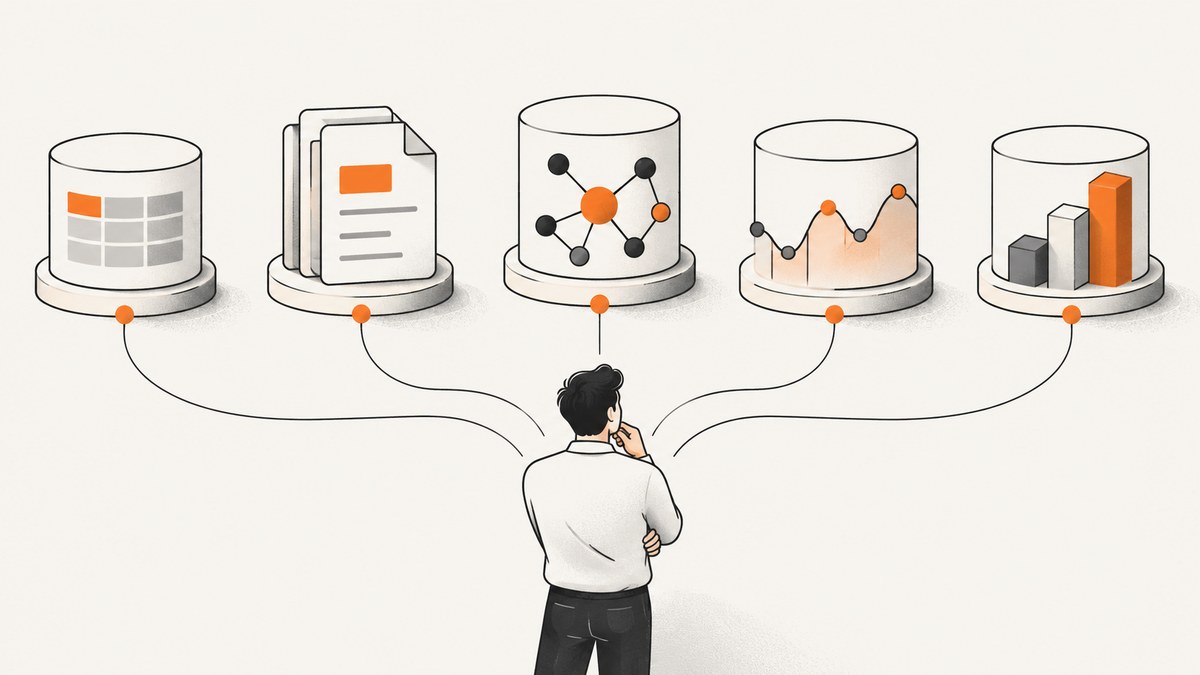
Which open-source database should you use for your next project? The useful answer depends on the workload, data model, scale, operations, and license. PostgreSQL is a strong general-purpose SQL default; SQLite fits applications that should not need a database server; and specialized engines can be a better fit for search, graph, time-series, caching, or analytics. There is no universal winner.
This guide compares more than 25 candidates by the problem they solve, then gives you a decision path, operational checklist, and license checks. Adoption figures below come from a named survey and represent its respondents, not market share.
1. Choose by workload before comparing database names
Start by describing what the application does. A transactional app needs safe updates to related records. An analytics workload scans and aggregates large datasets. A search service needs indexed text retrieval. Those are different jobs, and a database that excels at one may add avoidable complexity to another.

| Workload | Typical data shape | Start by evaluating |
|---|---|---|
| Transactional application (OLTP) | Related records, constraints, frequent reads and writes | PostgreSQL, MySQL, MariaDB |
| Embedded or local | Application-owned file, device data, tests | SQLite; DuckDB for local analytics |
| Document | Nested records with evolving fields | CouchDB, MongoDB, FerretDB |
| Key-value or cache | Lookup by key, short-lived or in-memory data | Redis, Valkey, Memcached |
| Distributed writes | Partitioned records across nodes | Cassandra, ScyllaDB |
| Graph | Entities connected by relationships | Neo4j |
| Time series | Timestamped metrics, events, telemetry | InfluxDB, Timescale |
| Analytics | Columnar scans and aggregations | DuckDB, ClickHouse, Druid |
| Search | Indexed text and retrieval | OpenSearch, Solr, Elasticsearch |
Next ask whether you need a separate server process, how much operational ownership your team can take on, and whether your query patterns are known. Avoid adding several databases just because each is attractive in isolation. A second datastore adds backup, monitoring, security, deployment, and data consistency work.
2. Relational databases for application data
PostgreSQL
PostgreSQL is a strong default for new server applications that need SQL, transactions, and room to extend data types or functions. Its project overview highlights extensible data types, custom functions, and integrations with multiple programming languages. Start here when you want a capable relational database and do not yet have a workload-specific reason to choose another engine. Check required extensions and managed-hosting availability before committing.
MySQL and MariaDB
MySQL has a mature application and web ecosystem. MariaDB is a MySQL-compatible open-source branch; its project describes federating heterogeneous databases, including Oracle, SQL Server, and Db2. Compare compatibility requirements, operational tools, hosting options, support needs, and the licenses of the exact distribution and components you intend to deploy.
Other SQL candidates
- Firebird: relational SQL for embedded and client/server deployments.
- H2: Java-oriented embedded or server SQL, often considered for development, tests, and smaller applications.
- TiDB: distributed SQL to investigate when you need horizontal scale and a SQL interface.
- CockroachDB: distributed SQL. Check its current license: OpenLogic’s 2025 survey says it no longer met the OSI definition under its current license.
- Percona Server for MySQL: a MySQL-compatible distribution to evaluate when operational tooling and support are priorities.
- Apache Derby: a Java relational engine that appears in OpenLogic’s ecosystem survey.
3. Embedded databases and analytical engines
SQLite
SQLite is an embedded, file-based SQL database. It is a natural shortlist choice for mobile and local applications, edge devices, tests, and smaller single-process programs where running a separate database server would be unnecessary. Consider how concurrent access, backups, file ownership, and future multi-process or network access will work. If the application grows beyond those assumptions, plan a migration path.
DuckDB, ClickHouse, and Druid
DuckDB is an embedded analytical database suited to local analysis and columnar files such as Parquet and CSV. ClickHouse is a column-oriented analytical database for high-volume analytical queries. Apache Druid is designed for real-time analytical workloads with aggregation-heavy event data. These engines target analysis rather than serving as an automatic replacement for an application’s transactional store.
Apache Hadoop ecosystem components are also relevant when the project is a distributed big-data platform, rather than a conventional transactional application. Evaluate the platform as a whole, including storage, processing, and operational requirements.
4. Document and key-value databases
Document databases
- Apache CouchDB: a document database with replication-oriented use cases.
- MongoDB: a widely used document database. Its current license needs separate evaluation; historical open-source origins do not settle whether its current license meets the OSI definition.
- FerretDB: a MongoDB-protocol-compatible layer backed by PostgreSQL, worth investigating when a team wants a document API with PostgreSQL as the storage core.
Choose a document model when records are naturally self-contained and the application benefits from flexible nested structures. Think through indexes, relationships that cross documents, consistency, replication, and how schema changes will be validated by application code.
Key-value and caching systems
- Redis: an in-memory key-value store used for caching, real-time workloads, and data structures.
- Valkey: a Redis-compatible open-source direction to evaluate for key-value and caching needs.
- Memcached: a simple distributed memory cache that can reduce read pressure on a primary database.
- KeyDB and Redict: Redis-family alternatives that appear in ecosystem surveys; verify current activity and licensing before selecting.
A cache is usually an additional layer, not the system of record. Decide what happens on a cache miss, how entries expire or invalidate, and whether stale values are acceptable. Avoid making correctness depend on data that can be evicted.
5. Distributed writes, graph, time series, and search
Wide-column and distributed write systems
Apache Cassandra is a distributed wide-column store for high-write, multi-node workloads. ScyllaDB is Cassandra-compatible and may be worth investigating when latency and resource efficiency are key requirements. Model access patterns and partitioning early; distributed systems make data placement and query design part of the application architecture.
Graph databases
Neo4j is designed for relationship-heavy domains such as recommendations, identity, and network analysis. Consider it when traversing connections is central to questions the product asks. If relationships are modest and predictable, relational joins may be easier to operate.
Time series
InfluxDB targets metrics, events, and telemetry. Timescale is PostgreSQL-based and suited to teams that want time-series capabilities with SQL and PostgreSQL compatibility. Compare retention, ingestion, downsampling, query patterns, and integration with existing PostgreSQL operations.
Search engines
OpenSearch and Apache Solr support search and text analytics. Elasticsearch is also widely used for search and analytics, but its current license should not be described as OSI-compliant without checking: OpenLogic’s 2025 report qualifies it as no longer meeting the OSI definition under the current license. Search indexes often derive from a primary datastore, so plan how updates, deletes, and reindexing stay in sync.
6. Adoption figures and what they do (and do not) tell you
OpenLogic’s 2025 State of Open Source Support survey reported these respondent percentages: PostgreSQL 51.06%; MySQL 36.70%; MariaDB 30.85%; SQLite 30.32%; MongoDB 29.79%; Elasticsearch 23.94%; Redis/Valkey/KeyDB/Redict 23.40%; OpenSearch 11.17%; Cassandra 10.64%; Neo4j 4.26%; and CockroachDB 2.66%. These are survey responses, not universal market share or a measure of which database is best for your workload.
MariaDB’s 2025 survey identifies PostgreSQL, SQLite, and MySQL as the leading named open-source relational responses, with additional mentions including CouchDB, Elastic, Redis, Cassandra, ClickHouse, CockroachDB, InfluxDB, and DuckDB. Treat adoption data as context for ecosystem familiarity, not a substitute for a technical fit assessment.
7. A practical decision path
- Classify the workload. Is it transactional, analytical, search, graph, time-series, cache, or embedded?
- Choose the simplest architecture that fits. If you do not need a database server and the workload fits, begin with SQLite. For local analytical work, consider DuckDB.
- For general server SQL, shortlist PostgreSQL, MySQL, and MariaDB. Compare required features, compatibility, hosting, team experience, and support.
- Add specialization only for a concrete need. Use a search, graph, time-series, or distributed write engine when its workload advantage justifies its operational cost.
- Check license and service terms. Verify the license for the exact version, distribution, extensions, and hosted service you plan to use.
- Prototype representative queries. Use realistic data shape and concurrency, and measure your own workload instead of relying on generic benchmark claims.
8. Compare candidates before committing
| Question | What to establish |
|---|---|
| Data and transactions | Which relationships, constraints, isolation, and consistency guarantees does the application require? |
| Queries | Are queries known and structured, document-shaped, graph traversals, full-text search, or analytical scans? |
| Scale | What are expected data volume, read/write patterns, latency target, and growth triggers? |
| Operations | Who owns upgrades, replication, monitoring, recovery, security patches, and incident response? |
| Recovery | How are backups restored, and what recovery point and recovery time can the product tolerate? |
| Ecosystem | Are drivers, ORM support, migration tools, and team skills available? |
| Deployment | Can the team self-host, or is managed hosting required in its regions and compliance context? |
| License | Does the exact software and hosted-service use meet the project’s legal and distribution needs? |
Write down the answers, then shortlist two or three engines. Test schema migrations, backup restoration, connection behavior, and the few queries that define product performance. Revisit the decision when the workload changes; do not scale preemptively into an architecture the team cannot yet operate.
9. License checks for projects that require open source
The phrase “open source” is not enough to establish that a current release meets your project’s licensing policy. OpenLogic’s 2025 report says MongoDB, Elasticsearch, and CockroachDB no longer meet the Open Source Initiative’s criteria under their current licenses, while retaining them in the survey because of their open-source histories. Verify the exact license and terms for the release you will use, and get legal review when distribution, hosted-service restrictions, or compliance obligations matter.
Licensing can change, and a product may combine a database with separately licensed tools or extensions. Record the version, source, and license review date in the project decision so it can be refreshed before upgrades or deployment changes.
10. Cost, performance, and reliability
There is no universal performance ranking that substitutes for a representative workload test. Compare query latency and throughput with realistic indexes, data sizes, concurrency, and durability settings. Include backup and restore time, replication lag, storage growth, and resource use in the evaluation. A fast query is not useful if the system cannot recover within the product’s requirements.
Total cost includes infrastructure, managed-service fees if used, engineering time, monitoring, backups, upgrades, support, and the cost of operating additional systems. Embedded options reduce server operations when they fit. Specialized distributed systems can address demanding workloads, but require careful partitioning and operations. Managed database hosting can reduce operational work; examples named in MongoDB’s explainer include MongoDB Atlas and AWS RDS for PostgreSQL. Check current availability, prices, regions, and terms directly before choosing.
For reliability, define backup frequency, retention, restore verification, replication behavior, failover ownership, and alerting. Replication alone is not a backup. Run restore exercises and make sure the application handles transient connection failures and retries without duplicating unsafe writes.
11. Common selection mistakes and troubleshooting
| Symptom or mistake | Likely cause | Practical fix |
|---|---|---|
| Queries become difficult as records relate | A document model was chosen despite relationship-heavy access patterns | Prototype the important queries; compare relational joins or a graph model where traversal is central. |
| Database operations dominate a small app | A separate server was introduced without a requirement | Evaluate SQLite for embedded use, while checking concurrency, backup, and deployment constraints. |
| Analytics slows application transactions | Large scans compete with OLTP traffic | Separate analytical workloads or evaluate an analytical engine; define data freshness and sync behavior. |
| Cache returns outdated values | Invalidation or expiry behavior is undefined | Specify freshness requirements, invalidation paths, and safe behavior on misses. |
| Distributed database queries require awkward workarounds | Partition key and access patterns were selected too late | Model the actual reads and writes before deployment; validate distribution and query support in a prototype. |
| License review blocks deployment | Historical reputation was treated as current license status | Review the exact release’s license and service terms before implementation is locked in. |
| Recovery fails despite replication | No tested backup restore path exists | Keep independent backups and perform scheduled restore tests against recovery objectives. |
12. FAQ
Is PostgreSQL the best database for every new app?
No. It is a strong general-purpose SQL starting point, but embedded, analytical, search, and other specialized workloads may fit a different engine better.
Can SQLite support a production application?
It can fit production workloads when its embedded, file-based operating model matches the application’s access, concurrency, backup, and deployment needs.
Does a database need to be OSI-compliant to be useful?
That depends on the project’s definition of open source and its legal and deployment requirements. Review the current license rather than relying on a product’s history.
Should I use more than one database?
Only when a distinct workload justifies the extra operational and data synchronization costs. Start with the smallest architecture that meets requirements.
13. Capture database documentation and dashboards for your project
During evaluation, teams often need consistent screenshots of documentation pages, admin dashboards, or setup flows for design reviews and decision records. You can capture a page with a browser script, or use a screenshot API. ScreenshotNeo is a website screenshot API and MCP server from Yorker Media; it accepts a URL and returns an image or PDF. See the ScreenshotNeo site and API documentation.
Or skip the browser setup
curl -G "https://api.screenshotneo.com/v1/shot" -d access_key=YOUR_API_KEY --data-urlencode url=https://stripe.com -o shot.webpReplace the target URL with the documentation or dashboard page you need to capture. ScreenshotNeo removes cookie banners, newsletter popups, and chat widgets before the shot. Bot checks, blank pages, failed loads, timeouts, and cache hits are not billed; response headers identify the page verdict and billing status. Its MCP server provides screenshot tools for AI agents. The Free plan includes 1,000 shots per month without a card; paid plans start at $5 for 3,000 shots, and every feature is available on every plan.
Create a free ScreenshotNeo account for 1,000 screenshots a month with no card.


