How to Use Price Scraping to Monitor Competitors
Build a policy-gated competitor price monitor with product matching, normalization, alerts, audit trails, and reliable capture workflows.
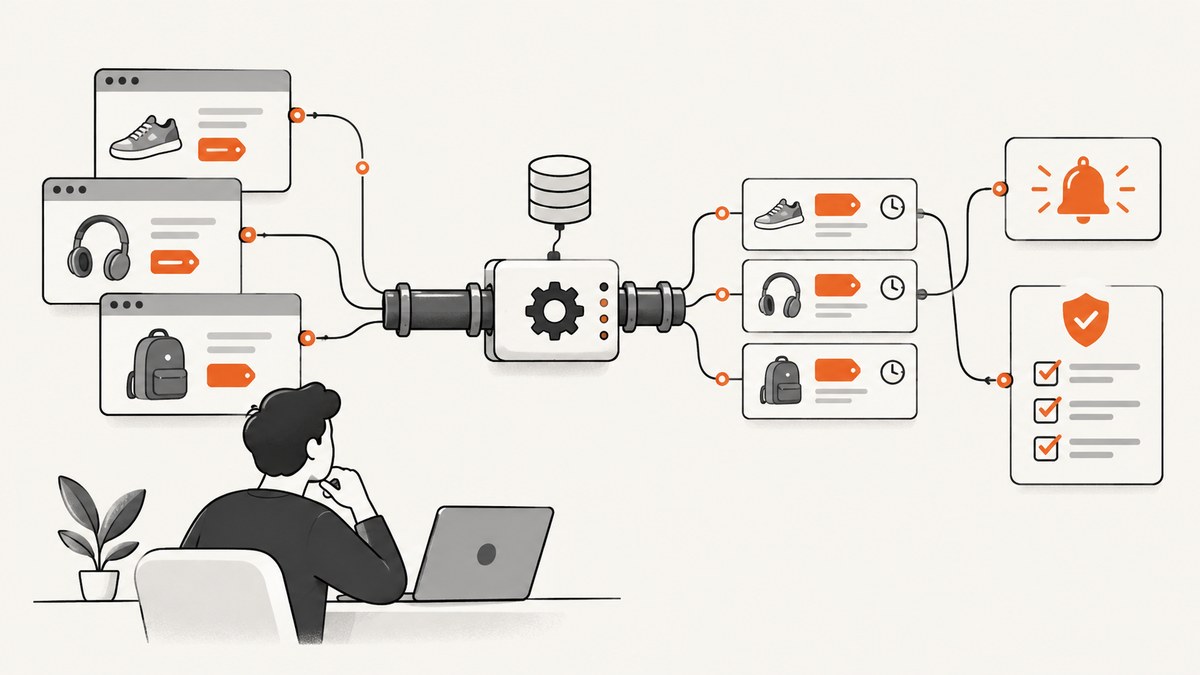
Direct answer: Use price scraping as a policy-gated data pipeline, not a one-off script. Define the business decision, create a canonical SKU map, discover permitted public sources, check robots.txt and terms before every fetch, collect only the fields required for comparison, normalize variants and promotions, store immutable observations, and alert only on meaningful changes. Keep monitoring unilateral: never use the system to exchange confidential information or coordinate future prices.
A useful monitor answers five questions for every observation: Which exact product and seller? What price and currency were displayed? Under which promotion, tax, shipping, and availability conditions? When and from which URL was it observed? Was the request and use permitted by your policy?
1. Define the decision before writing a scraper
Start with the outcome your team needs. Repricing, MAP enforcement, assortment comparison, seller discovery, promotion tracking, and market research require different fields and schedules.
| Decision | Useful fields | Typical alert |
|---|---|---|
| Repricing input | Matched SKU, displayed price, currency, stock, seller, fulfillment | Comparable price changes by a chosen percentage or amount |
| MAP enforcement | Brand, part number, seller, displayed price, promotion context, evidence | Price below the approved minimum |
| Assortment comparison | Product identity, variant, pack size, availability, source URL | New, removed, or unavailable item |
| Promotion tracking | List price, sale price, coupon label, promotion text, start and end observations | Promotion starts, ends, or changes |
Set a freshness target per source. A volatile marketplace may justify several checks per day; a stable catalog may need only daily or weekly observations. There is no universal cadence or ROI benchmark. Establish a baseline on your own catalog and adjust when freshness, cost, and policy limits are visible.
2. Build a canonical product and competitor map
Most price-monitoring errors come from comparing different products. Create a record for each target with:
- brand and manufacturer part number;
- GTIN, marketplace identifier, or another stable product key;
- variant attributes such as size, color, storage, or model year;
- pack count and unit of measure;
- seller, fulfillment type, and marketplace;
- approved source URLs and the reason each source is permitted;
- geography, currency, tax, and shipping assumptions.
Keep unmatched observations separate until a person or a reviewed matching rule confirms them. Do not silently merge a single item, a multipack, a refurbished unit, or a different fulfillment context into the canonical SKU.
3. Discover permitted product URLs
Prefer official retailer or marketplace APIs when they provide the fields and permissions you need. Otherwise, discover public product URLs from a target’s sitemap, catalog navigation, or approved feeds. A robots.txt file is a crawler instruction and traffic-management mechanism, not authentication or a guarantee that collection is legally permitted. Google describes it as telling crawlers which URLs they can access, while also noting that it is not a way to hide pages and may be interpreted differently by crawlers. Read the Google robots.txt documentation and the target’s terms together.
Cache robots.txt for a bounded period, record its contents or hash with your policy decision, and fail closed when the policy check cannot be completed. Never treat a public URL as permission to bypass a login, paywall, CAPTCHA, bot check, access-control rule, or explicit prohibition.
4. Put a compliance gate in the fetch path
The gate must run before a request leaves your system. Evaluate:
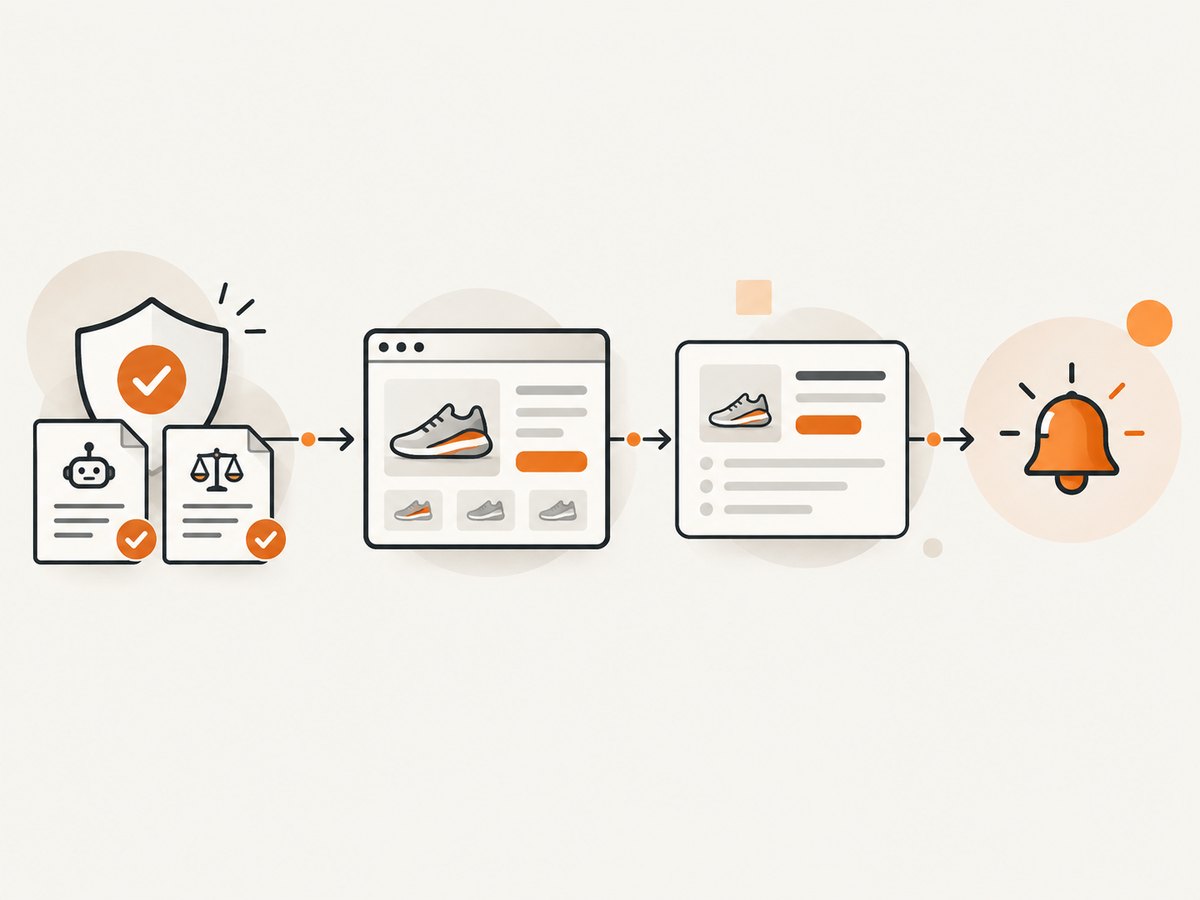
- robots.txt directives for the exact path and your declared user agent;
- terms of service and acceptable-use restrictions;
- whether the endpoint is public, authenticated, paywalled, or personal-data related;
- your per-domain rate, concurrency, and time-of-day policy;
- retention rules for HTML, screenshots, seller information, and any personal data.
Write an append-only decision record containing the URL, policy version, robots version, timestamp, allow or block result, and reason. The compliance guidance in the research dossier recommends rate limiting, data minimization, audit records, and an API fallback for restricted targets. Apply the same controls to scheduled jobs and manual re-runs.
5. A small, auditable Python implementation
The example below demonstrates the shape of a permitted public-page monitor. It checks robots.txt, uses a clear user agent, applies a timeout, parses a narrow schema, and records an observation. Replace the CSS selectors for each site only after reviewing its terms and policy. It intentionally does not attempt to evade access controls.
from __future__ import annotations

import csv
import hashlib
import json
import time
from datetime import datetime, timezone
from urllib.parse import urlparse
from urllib.robotparser import RobotFileParser

import requests
from bs4 import BeautifulSoup

USER_AGENT = "AcmePriceMonitor/1.0 (+https://example.com/monitor-policy)"
TIMEOUT_SECONDS = 30


def policy_allows(url: str) -> tuple[bool, str]:
    parsed = urlparse(url)
    robots_url = f"{parsed.scheme}://{parsed.netloc}/robots.txt"
    parser = RobotFileParser(robots_url)
    try:
        parser.read()
    except Exception as exc:
        return False, f"robots_unavailable:{type(exc).__name__}"
    if not parser.can_fetch(USER_AGENT, url):
        return False, "robots_disallow"
    return True, "allowed"


def scrape_product(url: str, sku: str) -> dict:
    allowed, reason = policy_allows(url)
    now = datetime.now(timezone.utc).isoformat()
    if not allowed:
        return {"sku": sku, "url": url, "status": "blocked", "reason": reason, "observed_at": now}

    response = requests.get(
        url,
        headers={"User-Agent": USER_AGENT, "Accept": "text/html"},
        timeout=TIMEOUT_SECONDS,
    )
    response.raise_for_status()
    soup = BeautifulSoup(response.text, "html.parser")

    # Site-specific selectors must be reviewed and versioned.
    title_node = soup.select_one("[data-product-title], h1")
    price_node = soup.select_one("[data-price], .price")
    stock_node = soup.select_one("[data-stock], .availability")
    title = title_node.get_text(" ", strip=True) if title_node else None
    displayed_price = price_node.get_text(" ", strip=True) if price_node else None
    availability = stock_node.get_text(" ", strip=True) if stock_node else None

    return {
        "sku": sku,
        "url": url,
        "product_title": title,
        "displayed_price": displayed_price,
        "currency": "REVIEW_REQUIRED",
        "availability": availability,
        "seller": None,
        "observed_at": now,
        "parser_version": "catalog-v1",
        "policy_version": "policy-v1",
        "content_hash": hashlib.sha256(response.content).hexdigest(),
    }


if __name__ == "__main__":
    targets = [{"sku": "example-001", "url": "https://example.com/product"}]
    rows = []
    for target in targets:
        try:
            rows.append(scrape_product(target["url"], target["sku"]))
        except requests.RequestException as exc:
            rows.append({"sku": target["sku"], "url": target["url"], "status": "fetch_error", "reason": type(exc).__name__})
        time.sleep(2)  # Apply a shared, per-domain rate policy in production.

    with open("observations.jsonl", "w", encoding="utf-8") as output:
        for row in rows:
            output.write(json.dumps(row) + "\n")
For production, use a queue and a token bucket shared by all workers. Add bounded retries with exponential backoff for transient failures, but do not retry policy blocks, authentication responses, CAPTCHAs, or explicit denials. Version every parser and policy so a later comparison can explain exactly how a value was obtained.
6. Normalize values before calculating deltas
Preserve the original displayed values and derive normalized fields separately. Record:
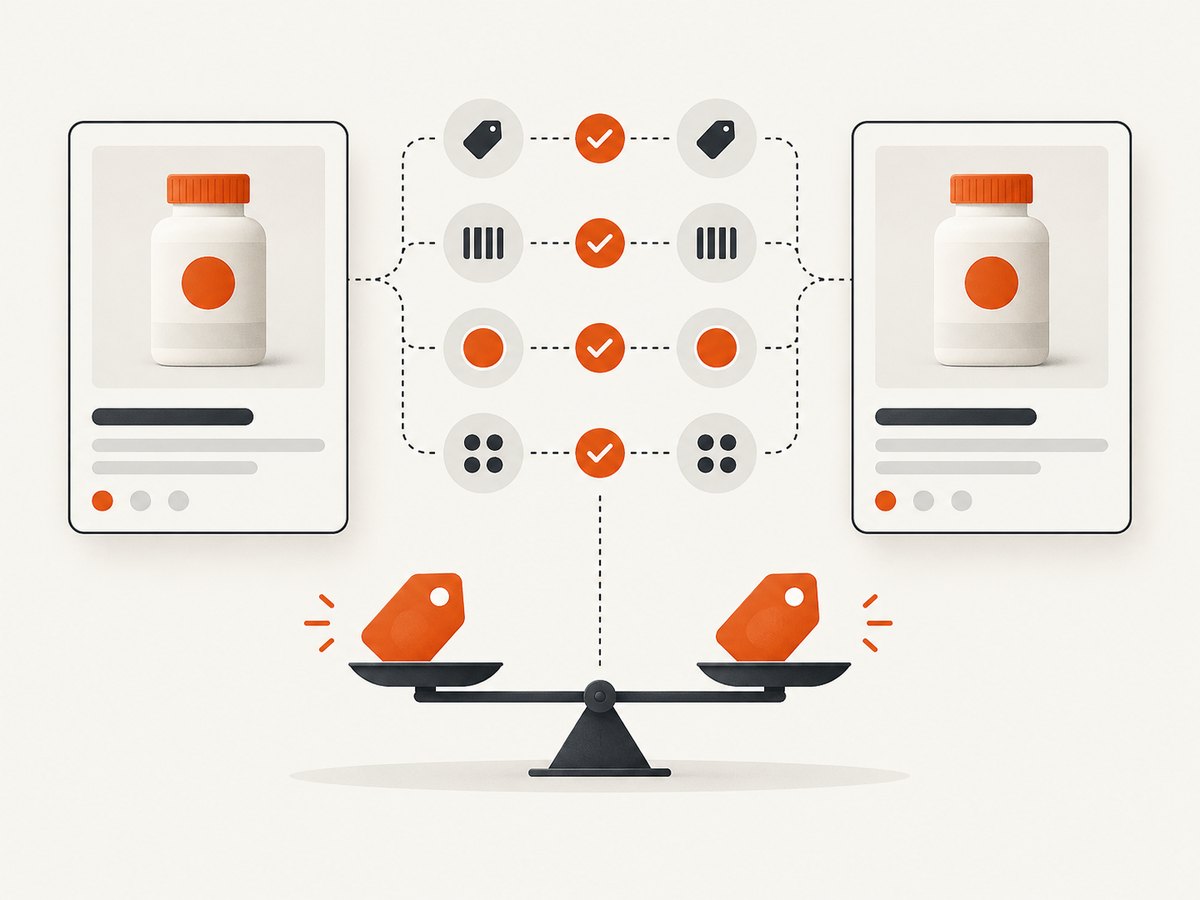
- numeric price and currency;
- unit price and pack-size equivalent;
- tax and shipping assumptions, when visible and comparable;
- list price, sale price, coupon state, and promotion label;
- stock state, seller, and fulfillment context;
- the exchange-rate source and conversion timestamp, if conversion is required.
Compare only equivalent variants. A “20% off” badge may require a coupon, membership, minimum quantity, or checkout step. Keep those conditions as structured promotion context instead of treating the badge as a universal price. If shipping or tax is unknown, mark the comparison as incomplete rather than inventing an adjusted total.
7. Store evidence and detect meaningful changes
Use append-only observations keyed by source, canonical SKU, seller, and observation time. Store the source URL, parser version, policy version, original fields, normalized fields, and an evidence reference or hash that your retention policy permits. An immutable history lets you diagnose parser regressions and explain an alert.
Alert on material events:
- price movement beyond an amount or percentage threshold;
- stock or availability changes;
- MAP exceptions;
- new or removed sellers;
- promotion start, end, or condition changes;
- repeated extraction failures or a sudden drop in SKU-match rate.
Include the old value, new value, timestamp, seller, assumptions, and evidence link in every alert. Debounce repeated alerts and route them to a pricing or merchandising owner.
8. Reliability, performance, and cost controls
Concurrency and rate limits
Use per-domain concurrency limits and a token bucket rather than a single global sleep. A fast worker pool can still overload one host. Respect the narrowest limit from your policy, the target’s published guidance, and your infrastructure.
Timeouts and retries
Set connect and read timeouts. Retry only transient network and server failures with bounded exponential backoff and jitter. A timeout is an observation about fetch health, not evidence that a price is unavailable.
Rendering and dynamic pages
Client-rendered pages may require a browser, a permitted API, or a different source. Wait for a specific product selector or a documented network-idle condition. Avoid arbitrary long sleeps because they increase cost and still do not prove that the correct variant loaded.
Quality metrics
Track SKU-match rate, freshness, extraction error rate, alert precision, parser uptime, blocked-request rate, and cost per observation. There is no authoritative general accuracy, savings, or ROI benchmark in the reviewed sources; measure these metrics on your own catalog.
9. Troubleshooting common failures
| Symptom | Likely cause | Fix |
|---|---|---|
| Everything is blocked | robots.txt disallows the path, cannot be fetched, or policy version is stale | Refresh and log robots.txt; review terms; use an approved API or remove the source. |
| Price is missing | Selector changed or price is rendered after JavaScript | Version the parser, inspect a permitted response, wait for a specific selector, or use an official feed. |
| Wrong product matched | Title-only matching merged variants or packs | Require stable identifiers and variant attributes; quarantine unmatched records. |
| False price drop | Coupon, membership, tax, shipping, or pack-size difference | Store promotion and fulfillment context and compare normalized unit values. |
| Repeated 403 or CAPTCHA | Access control or bot mitigation | Stop retries. Do not bypass it; request permission or use an approved API. |
| Duplicate alerts | Multiple workers or no alert debounce | Use an idempotency key and persist the last alerted observation. |
| Stale results | Overly long schedule, cache, or failed queue | Measure freshness, expose last-success time, and alert on parser or queue health. |
10. Legal and competition boundaries
Public visibility does not remove contractual, privacy, or competition obligations. Review jurisdiction, contract assent, technical controls, data type, and intended use with counsel for authenticated pages, personal data, high-frequency collection, or regulated markets. Vendor policies in the research dossier describe lawful monitoring of public pricing and availability while prohibiting price fixing and anticompetitive coordination. Keep your monitoring unilateral: do not share competitors’ confidential information, exchange future pricing intentions, or use a shared system to coordinate prices.
Cloudflare’s sample terms also illustrate that some sites expressly restrict automated scraping and AI-related use. Treat sample language as a signal to inspect the actual target terms, not as universal legal advice.
11. Build versus buy
DIY fits a small, stable set of public pages when your team can maintain parsers, policy checks, observability, and data quality. A managed platform fits broad coverage and operational requirements. An API fits teams that need structured data without maintaining fetchers. Compare alternatives on source coverage, SKU matching, freshness, promotion and seller context, alerting, exports, evidence retention, policy controls, support, and total cost per monitored SKU. Verify current geography, permissions, retention, and commercial terms before purchasing.
12. Or skip the browser setup
ScreenshotNeo can capture a permitted product page as visual evidence for a price observation. It is a website screenshot API and MCP server. Cookie and consent banners are accepted and removed before the capture, along with more than 60 known consent platforms, newsletter popups, and chat widgets; each step can be disabled. Bot checks, blank pages, failed loads, timeouts, and cache hits are identified and never billed. Use it for evidence and review, while keeping product-field extraction and policy decisions in your monitoring pipeline.
Read the ScreenshotNeo API documentation for the current parameters. The same request pattern works from cURL, Python, or Node.js:
curl -G "https://api.screenshotneo.com/v1/shot" -d access_key=YOUR_API_KEY --data-urlencode url=https://stripe.com -o shot.webpimport requests
r = requests.get("https://api.screenshotneo.com/v1/shot", params={"access_key": "YOUR_API_KEY", "url": "https://stripe.com"}, timeout=90)
open("shot.webp", "wb").write(r.content)const q = new URLSearchParams({ access_key: 'YOUR_API_KEY', url: 'https://stripe.com' });
const res = await fetch(`https://api.screenshotneo.com/v1/shot?${q}`);For a monitor, retain the response headers that report the page verdict and billing status, then associate the resulting image with the observation timestamp and source URL. ScreenshotNeo also supports full-page capture, element capture by CSS selector, custom headers and cookies, a user agent, timezone and geolocation, waits, blocked requests, custom JavaScript and CSS, caching with a chosen TTL, signed links, asynchronous jobs, bulk capture for up to 100 URLs per call, PDFs, and an MCP server with take_screenshot, get_page_info, and capture_pdf. Every feature is on every plan. 1,000 screenshots per month are free with no card; paid plans start at $5 for 3,000 shots. Create a free ScreenshotNeo account.
13. Short FAQ
How often should I check competitor prices?
Choose cadence from price volatility, business decision latency, source limits, and cost. Start with a baseline and increase frequency only when fresher data changes a decision.
Should I store the entire HTML page?
Store only what your policy and retention rules permit. Narrow fields plus a permitted evidence reference or hash are often enough to diagnose changes.
Is robots.txt permission to scrape?
No. It is a crawler instruction and traffic signal. Check terms, authentication, data classification, and jurisdiction separately.
Can I scrape pages behind a login?
Only with explicit authorization and a reviewed policy. Otherwise block the endpoint and seek an official API or data feed.
When should I buy a service?
Buy when source coverage, parser maintenance, policy operations, and alerting cost more than building them, and verify the provider’s permissions, geography, retention, and current pricing.
14. Implementation checklist
- Decision, competitor, SKU, and cadence are documented.
- Canonical identifiers and variant rules are versioned.
- Official APIs are preferred where available.
- robots.txt, terms, authentication, data classification, and rate policy are checked before fetches.
- Requests use a clear user agent, bounded concurrency, timeouts, and backoff.
- Original values, normalized values, seller, promotion, timestamp, parser, and policy versions are stored.
- Unmatched products and parser failures are quarantined.
- Alerts include old and new values plus evidence.
- Blocked-request rate, freshness, match rate, extraction errors, and cost are monitored.
- Monitoring remains separate from price coordination.