How to Scrape Goibibo Prices in 2026
Learn how to assess permission, compare Goibibo prices consistently, and choose an authorized data route before building a flight or hotel monitor.
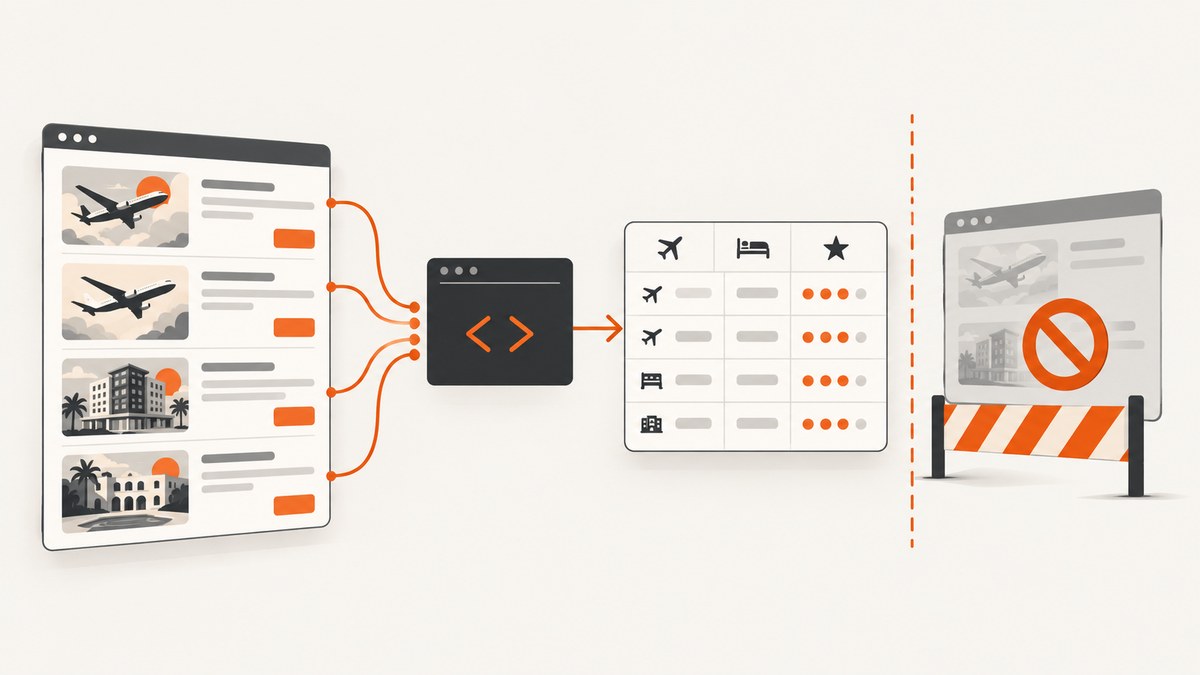
Short answer: Do not start by writing a scraper. First check Goibibo and MakeMyTrip’s current written terms and obtain written authorization for your use if needed. The research reviewed for this guide did not establish a public or partner API that permits automated retrieval and commercial reuse. Goibibo’s User Agreement restricts use of site content and says users agree not to interrupt the website’s operation. These published terms are not, by themselves, a legal opinion about every individual project; your purpose, location, access method, and reuse plans matter.
If you have permission, build a small, conservative collector around an approved interface or an explicitly authorized workflow. Preserve the conditions behind each quoted price so you compare like with like. If you do not have permission, ask Goibibo/MakeMyTrip about access or use a data source whose license expressly covers your intended use.
1. Check permission before collecting prices
A browser can display a price, but that technical fact does not grant permission to collect, store, publish, or resell it. Read the current Goibibo agreement and any terms that apply to your account, access channel, and project. Ask for written authorization when the intended activity is commercial, resale-oriented, or otherwise not clearly covered by an expressly permitted use.
Goibibo’s User Agreement says, “The User agrees not to interrupt or attempt to interrupt the operation of the Website in any manner whatsoever.” It also says content offered through its sales channels is protected and cannot be used for another purpose except as specified in the agreement. The agreement requires travel agents to obtain prior registration and explicit permission for commercial or resale use. Those are Goibibo’s published contractual terms; they should not be generalized into a legal conclusion about every form of individual automated access.
The reviewed research did not confirm an official API that allows automated collection and commercial reuse. That is a limitation of the research, not proof that no private, account-specific, or newly introduced arrangement exists. Verify directly with Goibibo/MakeMyTrip before selecting an integration. If a partner API or feed is offered, confirm in writing which markets, fields, retention periods, display formats, and downstream uses it permits.
2. Define what “price” means
A stored number is only useful when its context is stored too. Two results that appear to describe the same trip can differ by passenger count, baggage, refundability, payment stage, taxes, service fees, or ticket conditions. Hotel rates have similar variables, including occupancy, room type, meals, cancellation terms, and payment timing.
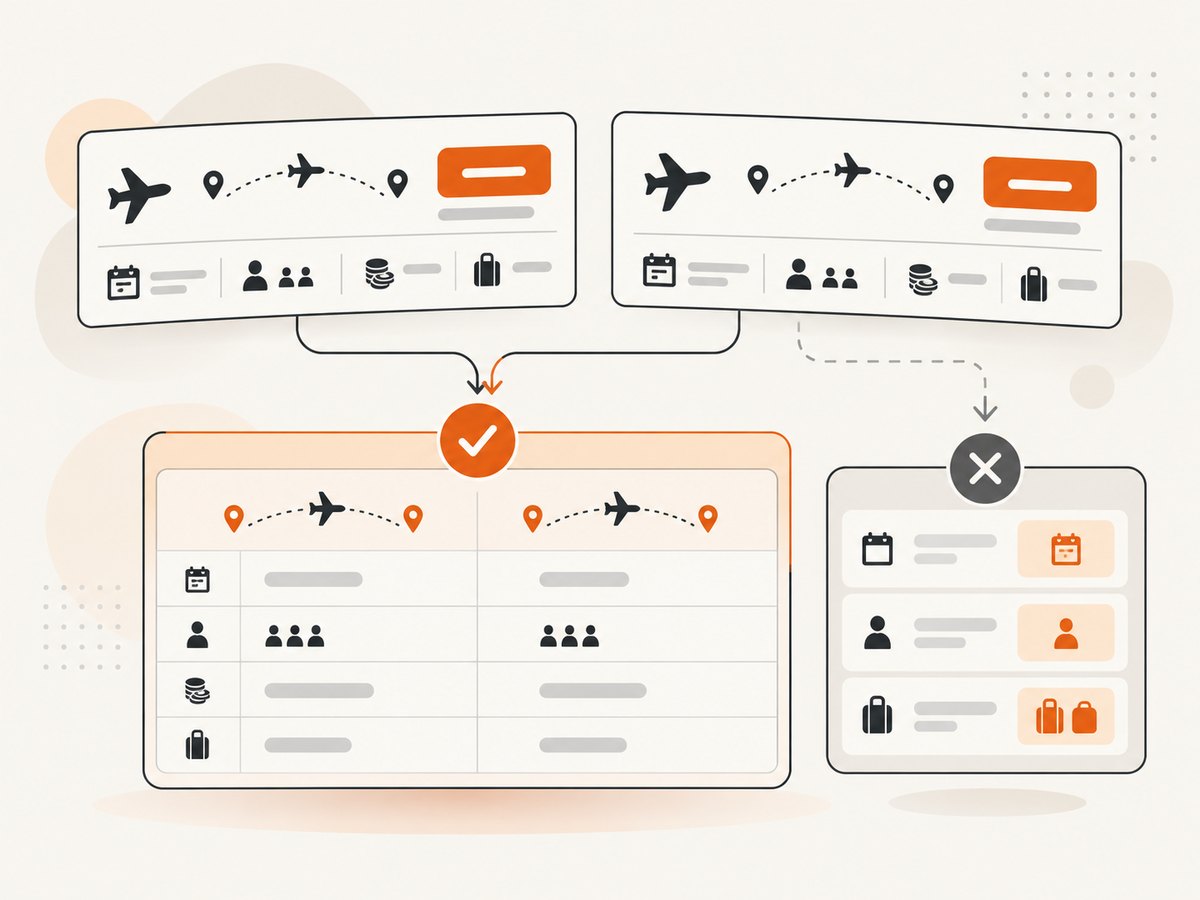
Goibibo describes itself as a facilitator for flight bookings. Its Terms of Services say a payment-page total usually includes base fare, applicable government taxes, and convenience fee. Its domestic flight booking terms say the displayed total includes applicable government taxes. Do not assume every page or itinerary presents an identical composition.
| Record | Fields to preserve |
|---|---|
| Flight search | Origin and destination, travel dates, one-way or round trip, passenger count and types, cabin, currency, search timestamp, and point in the booking flow. |
| Flight result | Airline and flight identifiers where shown, departure and arrival times, stops, baggage, fare family, refund/change conditions, base fare if shown, taxes, fees, and displayed total. |
| Hotel search | Property identity, destination, check-in and check-out dates, adults and children, room count, occupancy, currency, and search timestamp. |
| Hotel result | Room type, meal plan, cancellation deadline, payment timing, included taxes and fees, restrictions, and total for the full stay. |
Store the displayed total and the conditions separately. Record whether it is a per-person fare, a per-room nightly rate, or the total for the booked party and complete stay. Keep the original currency; if you convert it, also store the exchange rate, conversion source, and timestamp. A fare change is not meaningful unless the itinerary and assumptions still match.
3. Choose an authorized data route
Ask about official access
Contact Goibibo/MakeMyTrip and describe the exact project: the pages or markets needed, request frequency, whether you will display or resell results, fields retained, and expected audience. Ask whether an API, partner feed, or another approved method exists and request its documentation and reuse terms. Do not treat a third-party endpoint, mobile-app interface, or vendor claim as proof of authorization.
Evaluate a licensed provider carefully
A vendor may advertise data access without establishing that it is authorized by Goibibo or entitled to license the data. The reviewed ScrapeGuys page advertises a Goibibo hotel-rate API, but the research did not verify Goibibo authorization, the vendor’s data rights, reliability, coverage, or permission to reuse results. Treat that listing as an unverified commercial claim, not an approved integration.
Before buying, ask the vendor for documentary evidence covering:
- Whether it is authorized to obtain the data and sublicense it to your organization.
- Whether your use case, territory, storage, display, and redistribution are permitted.
- Which routes or hotel markets and price conditions are actually covered.
- How freshness, corrections, missing values, and service interruptions are represented.
- How credentials, personal data, retention, and deletion are handled.
- What happens to historical data and derived datasets if the contract ends.
Compare options on these documented facts. The research contains no measurements that support claims about relative coverage, freshness, success rate, or reliability.
4. Design a collector only after authorization
If written terms authorize automated access, build the collector against the approved interface and follow its documented rate limits. Prefer a documented API or feed over browser automation. Keep the first version deliberately small: one permitted query, a bounded schedule, durable logging, and a way to stop collection quickly.
- Write down the permitted scope. Record allowed fields, queries, frequency, markets, and retention in configuration and team documentation.
- Use stable query definitions. Normalize route or property, dates, traveler/room assumptions, and currency before scheduling a request.
- Limit concurrency. Follow the provider’s limits; use a queue and a conservative per-account cap. Never use retries to evade a block or access restriction.
- Store raw response and normalized record separately only when the license allows it. Attach collection time, source, query ID, and conditions.
- Validate before comparing. Reject records with mismatched itinerary, occupancy, currency, or fare conditions rather than silently merging them.
- Audit and stop safely. Log status codes and provider request IDs without exposing secrets. Pause on access denials, unexpected challenge pages, or rising error rates, then contact the provider.
Illustrative Python pattern for an authorized API
The following is a generic client pattern, not a Goibibo endpoint or a claim that Goibibo offers this API. Replace the placeholder URL and field names only with those in documentation you are authorized to use. It sends one request and does not retry, scrape pages, or bypass controls.
import os
import requests
from datetime import datetime, timezone

API_URL = os.environ["AUTHORIZED_TRAVEL_API_URL"]
API_KEY = os.environ["AUTHORIZED_TRAVEL_API_KEY"]

query = {
    "origin": "DEL",
    "destination": "BOM",
    "departure_date": "2026-11-14",
    "passengers": 1,
    "currency": "INR",
}

response = requests.get(
    API_URL,
    params=query,
    headers={"Authorization": f"Bearer {API_KEY}"},
    timeout=(5, 30),
)
response.raise_for_status()
payload = response.json()

record = {
    "collected_at": datetime.now(timezone.utc).isoformat(),
    "query": query,
    "source_response": payload,
}
print(record)
Use the provider’s actual authentication, parameters, schema, and pagination rules. Keep credentials in environment-managed secrets, not source control. If the approved interface returns a booking total only after additional steps, do not assume the initial search result represents the final price.
5. If you need a visual record of an authorized page
A screenshot can preserve what an authorized user-facing page showed at a particular time, but it is not a substitute for permission to access or reuse the content. Before capturing a travel page, confirm that the relevant terms and written authorization allow the capture and storage. Screenshots can also omit structured details hidden behind interactions, so keep a data source and screenshot purpose distinct.

For a local, authorized page, a browser automation library can render the page and save an image. This example captures a page you control or are explicitly authorized to capture; it does not include a Goibibo target, selectors, or access workarounds.
import asyncio
from playwright.async_api import async_playwright

async def main():
    async with async_playwright() as p:
        browser = await p.chromium.launch(headless=True)
        page = await browser.new_page(viewport={"width": 1440, "height": 1000})
        await page.goto("https://example.com/authorized-page", wait_until="domcontentloaded")
        await page.screenshot(path="page.png", full_page=True)
        await browser.close()

asyncio.run(main())
cURL, Python, and Node.js for an approved API
These are generic request shapes. The placeholder host and parameter names are illustrative; use the endpoint and schema supplied by the authorized provider. Do not point them at Goibibo unless your permission and its terms cover that access.
curl --fail --silent --show-error \
  --get "$AUTHORIZED_TRAVEL_API_URL" \
  --header "Authorization: Bearer $AUTHORIZED_TRAVEL_API_KEY" \
  --data-urlencode "origin=DEL" \
  --data-urlencode "destination=BOM" \
  --data-urlencode "departure_date=2026-11-14" \
  --data-urlencode "currency=INR" \
  --output response.json
import os
import requests
r = requests.get(
os.environ["AUTHORIZED_TRAVEL_API_URL"],
params={"origin": "DEL", "destination": "BOM",
"departure_date": "2026-11-14", "currency": "INR"},
headers={"Authorization": f"Bearer {os.environ['AUTHORIZED_TRAVEL_API_KEY']}"},
timeout=(5, 30),
)
r.raise_for_status()
with open("response.json", "wb") as f:
f.write(r.content)const endpoint = process.env.AUTHORIZED_TRAVEL_API_URL;
const key = process.env.AUTHORIZED_TRAVEL_API_KEY;
const params = new URLSearchParams({
origin: 'DEL', destination: 'BOM',
departure_date: '2026-11-14', currency: 'INR'
});
const res = await fetch(`${endpoint}?${params}`, {
headers: { Authorization: `Bearer ${key}` },
signal: AbortSignal.timeout(30000)
});
if (!res.ok) throw new Error(`Provider returned HTTP ${res.status}`);
const data = await res.json();
console.log(data);Handle pagination and documented throttling exactly as the provider specifies. Avoid logging authorization headers or full responses if they contain personal or sensitive information.
6. Performance, reliability, privacy, and cost
- Performance: Request only the routes or properties needed for a decision. Batch only if the provider supports it. A wide date grid multiplies requests quickly; estimate volume from query count and schedule before deployment.
- Reliability: Prices can change between collection and booking. Record timestamps and conditions, and report a result as an observation rather than a guaranteed purchasable quote. Use timeouts and bounded retries only where the authorized API documents them.
- Consistency: Compare the same passenger and room assumptions, currency, itinerary, cancellation terms, and booking stage. Flag missing fees and unknown conditions instead of imputing them.
- Privacy and security: Minimize traveler data, protect API credentials, set retention limits, and review the provider’s data handling and your own obligations. Never place secrets in URLs when the API supports headers.
- Cost: Budget for provider charges, engineering and maintenance, storage, and any licensed data fees. No prices for an authorized Goibibo data API were verified in the research, so request current commercial terms directly.
- Operational load: A collector needs monitoring, schema-change handling, and a kill switch. Respect published limits and stop when access is denied; do not increase traffic to force a response.
7. Troubleshooting authorized integrations
| Symptom | Likely cause | What to do |
|---|---|---|
| 401 or 403 response | Missing/expired credentials, insufficient entitlement, or access not permitted. | Check the provider’s auth instructions and account scope. Ask the provider to confirm permission; do not rotate identities to get around a denial. |
| 429 or throttling response | Request rate exceeds the documented limit. | Pause, honor any retry guidance, reduce schedule/concurrency, and ask for an approved quota if needed. |
| Empty results | Invalid route/date, unavailable inventory, mismatched parameters, or schema change. | Validate inputs and response schema; distinguish no inventory from request failure in stored data. |
| Prices do not match | Different currency, passenger count, room occupancy, baggage, fare conditions, or booking stage. | Compare normalized assumptions and retain the source conditions. Do not label a difference as savings until those fields match. |
| Timeouts or intermittent errors | Provider outage, network issue, slow query, or overly broad request. | Use bounded timeouts and provider-approved retry behavior; narrow the query and alert on persistent failures. |
| Unexpected challenge or access block | The site or provider is denying automated access or requesting a human check. | Stop the job and contact the provider about approved access. Do not attempt to defeat the challenge. |
| Screenshot is blank or incomplete | Page content did not render, requires interaction, or is outside the permitted capture path. | Confirm authorization, rendering requirements, and capture timing on a page you control. Prefer the approved structured feed for price data. |
8. Or skip the browser setup
If your task is to capture a page you are authorized to access, ScreenshotNeo is a website screenshot API and MCP server from Yorker Media. One GET request returns an image or PDF. Its cleanup steps accept cookie and consent banners like a visitor and remove more than 60 known consent platforms, newsletter popups, and chat widgets; each cleanup step can be turned off.
curl -G "https://api.screenshotneo.com/v1/shot" \
  -d access_key=YOUR_API_KEY \
  --data-urlencode url=https://example.com/authorized-page \
  -o shot.webp
See the ScreenshotNeo API documentation for the request options. It supports PNG, JPEG, WebP, and PDF; full-page or CSS-element captures; device and viewport settings; waits, custom CSS and JavaScript, headers, cookies, and other capture controls. Bot checks/CAPTCHAs, blank pages, timeouts, failed loads, and cache hits are not billed, and response headers identify the page verdict and billing status. Its MCP server provides take_screenshot, get_page_info, and capture_pdf for Claude, Cursor, and other MCP clients.
Cookie banners, popups, and chat widgets are removed before the shot; bot checks, blank pages, and failed loads are never billed; an MCP server lets AI agents take screenshots; and 1,000 screenshots a month are free with no card, with paid plans starting at $5 for 3,000. Screenshot capture does not grant permission to collect or reuse Goibibo data, so confirm that your use is authorized. Sign up for 1,000 free screenshots a month, no card required.
9. Frequently asked questions
Is there an official Goibibo price API?
The research for this guide did not establish a public or partner API permitting automated collection and commercial reuse. Ask Goibibo/MakeMyTrip directly and verify any access terms in writing.
Can I scrape prices for personal research?
The research does not determine whether a particular implementation or purpose is permitted in a given jurisdiction. Review the current agreement and get legal advice for your circumstances if needed; technical accessibility alone does not answer the permission question.
Can I resell a dataset of Goibibo prices?
Do not assume resale is allowed. The User Agreement expressly addresses commercial or resale use by travel agents and requires prior registration and explicit permission. Obtain written terms covering your specific business and dataset.
Are flight prices directly comparable across searches?
Only when route, travel dates, passenger assumptions, fare conditions, currency, and booking stage align. Preserve the fee components and conditions shown for each result.
Does a third-party Goibibo API listing mean the data is licensed?
No. A vendor listing is not evidence of Goibibo authorization or the vendor’s right to sublicense data. Request documentary confirmation before relying on it.
Sources
- Goibibo User Agreement
- Goibibo Terms of Services
- Goibibo Domestic Flight Booking Terms and Conditions
- ScrapeGuys Goibibo Hotels API page (vendor claim; authorization and data rights were not verified)