SEO Proxies: Track Rankings and Localized SERPs at Scale
Learn how to sample localized search results with proxies, keep comparisons consistent, and interpret rank changes without treating one result as universal.

A proxy can help you observe search results through a network exit associated with another country or region. It does not reveal one definitive ranking for that location: query wording, language, device, cookies, account state, precise location, result features, and timing can all affect what appears. Treat each result as a sample taken under recorded conditions.
For useful tracking, define the question first, hold the sampling setup steady, verify the proxy exit location, and retain evidence beyond a rank number. Use repeated observations and report variability. For international SEO, implement clear locale signals such as distinct URLs and hreflang; a proxy is a measurement method, not a localization signal. Google’s multi-regional guidance says IP analysis is generally unreliable for adapting content and describes how to signal language and regional variants.
1. Define the tracking question
Start with the decision the data should support. Examples include: “Does a page appear for a target query in selected cities or regions?”, “How does visibility differ across markets?”, “Did a technical or content change affect a location page?”, and “How stable is the observed result across time and clean samples?” These are more useful than collecting a large grid of cities and queries simply to make a report look comprehensive.
Choose a representative set of queries grouped by intent and market. Decide whether the question concerns a specific landing page, overall organic visibility, or a result feature such as the local pack. Set a stopping rule before collection: for example, inspect the first fixed number of organic results, or record whether the target URL appears within a defined depth. Apply that same rule to every sample.
- Page validation: Is the expected localized landing page eligible and visible?
- Market comparison: Does visibility differ across a small, meaningful set of markets?
- Change monitoring: Did a movement persist across repeated samples after a site change?
A rank tracker may be more practical for routine monitoring. A custom proxy workflow is useful when the team needs control over query, location, device, evidence, or sampling cadence. Neither method makes a result universally representative.
2. What a proxy changes—and what it does not
A proxy routes a request through another network path, so the search service sees a different source IP. That IP can contribute to country or regional inference. It does not automatically set the search language, interface domain, device, cookies, login state, account history, precise device location, or time of search.
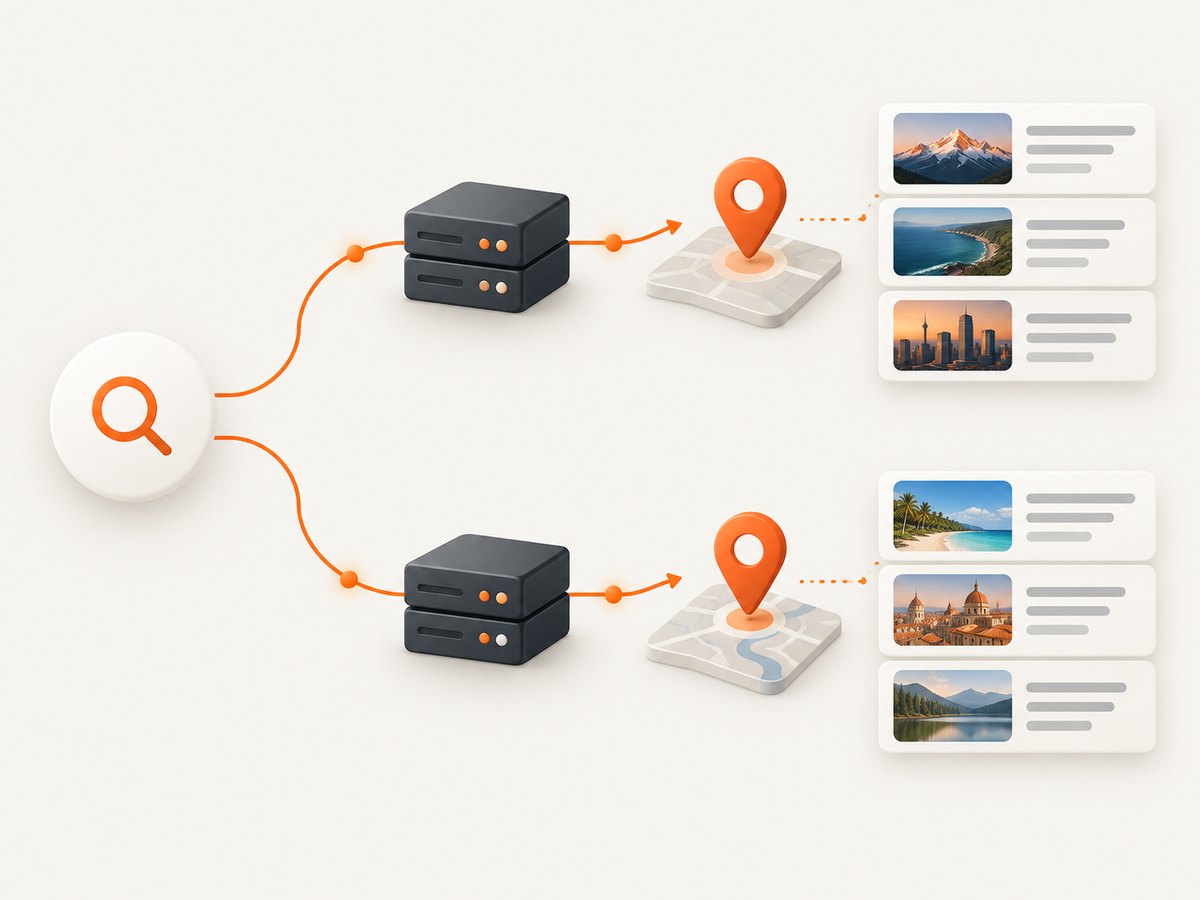
Those factors matter because localized results are contextual. A city-level IP location can be approximate, and different users in the same city may see different result mixes. A proxy sample should therefore be described as an observation from a selected network location and setup, not “the ranking in the city.”
Do not claim a proxy guarantees accuracy or prevents every block. Google says third-party SEO providers do not have access to its internal ranking data and cannot guarantee performance. Its advice is to be cautious of claims implying Google approval. Read Google’s guidance on third-party SEO services.
3. Build a controlled sampling matrix
Record the environment for each result. If a field changes between baseline and comparison, annotate the series so readers can distinguish a ranking movement from a method change.
| Field | What to record | Why it matters |
|---|---|---|
| Query | Exact text and intent group | Small wording changes can alter intent and results. |
| Location | Requested market and observed proxy exit location | Validate the route before interpreting a local difference. |
| Search context | Engine/interface, country and language settings | An IP alone does not set these variables. |
| Device | Desktop or mobile profile, viewport if applicable | Layout and result features can vary by device. |
| Profile state | Login state, cookies, and test-profile lifecycle | Personalization and retained state can affect observations. |
| Time | Date, time, and time zone | Results can change over time; compare like with like. |
| Result definition | Organic link, local pack, image, shopping, or other feature | A feature change can make a single rank value misleading. |
| Collection rule | Depth, stopping rule, retries, and evidence location | Consistent rules make samples comparable and auditable. |
For city precision, decide what evidence counts as an acceptable match and document that city geolocation is an estimate. Do not silently treat a requested city as a verified city. Keep the same sampling protocol across periods; if the proxy, parser, location, interface, or method changes, mark the break in the time series.
4. Collect results and retain evidence
A practical custom workflow has four steps:
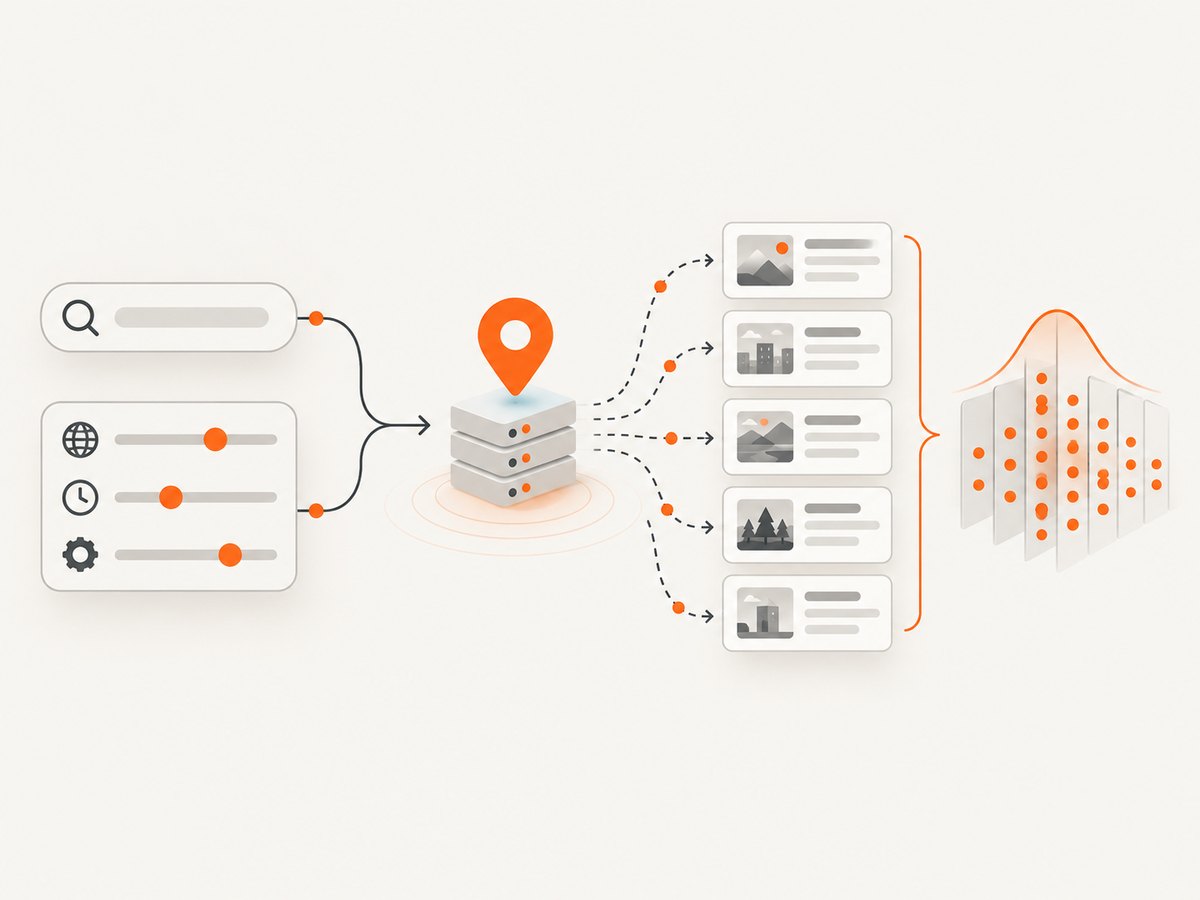
- Choose a small sample. Select queries, intent groups, target markets, device contexts, and a collection cadence tied to a real decision.
- Validate the route. Confirm the proxy exit is in the intended country or region using a location check appropriate to your requirements. Record the observed result and its limitations.
- Capture the search observation. Keep the query, settings, timestamp, result features, target URL position or absence, and a screenshot or other retained evidence where permitted.
- Repeat and compare. Take repeated samples under the same protocol. If observations differ, report the distribution or the proportion of samples where the target appeared within the chosen depth.
For screenshot evidence, use a browser capture workflow that preserves the result page and its context. A screenshot documents what the interface showed at capture time; it does not establish that every searcher saw the same page. Avoid retaining personal or account-specific data unnecessarily, and use a clean, controlled profile when that fits the measurement question.
Sampling frequency should match the decision. More observations are not automatically more useful. A representative, repeatable cadence with clear annotations is easier to interpret than a large volume of loosely controlled checks.
5. Choose an approach for your workflow
There is no universal best collection method. Compare approaches by workflow fit, and verify current provider capabilities before committing.
| Approach | Useful when | Check before choosing |
|---|---|---|
| Managed rank tracker | You want scheduled monitoring and reports | Needed city/country, language, device, and result types; raw evidence; sampling rules. |
| Proxy plus existing compatible tool | Your team already has a collector or rank tracker and needs network-location control | Location granularity, exit verification, reliability, session controls, compatibility, service rules, and total price. |
| Managed SERP API | You need structured result data without operating all collection infrastructure | Location parameters, output fields, result types, usage limits, retry behavior, and pricing. |
| Custom browser workflow | You need screenshots or tightly controlled interface settings | Browser maintenance, repeatability, evidence retention, runtime, and failure handling. |
Provider statements about geographic coverage, accuracy, speed, or avoiding blocks are commercial claims unless independently validated. The reviewed material does not establish a current independent provider benchmark. Proxyway’s 2020 report said 32 experts ranked day-to-day SEO proxy features and weighted locations at 60%, reliability at 20%, and speed and anonymity at 10% each. Those are historical weights from that report, not a current provider ranking or universal standard. See the 2020 methodology.
6. Interpret changes without overstating them
Store more than a rank number. A useful record includes the query, market, observed exit, language, device, timestamp, result type, ranking URL, collection method, and supporting evidence. When samples disagree, show a distribution, visibility band, or repeated-sample rate rather than selecting the most favorable result.
Before attributing movement to SEO work, check that:
- The query and intent stayed the same.
- The proxy exit still matched the intended market.
- Language, device, profile state, and search interface remained comparable.
- The result feature and stopping rule did not change.
- The movement persists across later observations.
Pair sampled SERPs with first-party data when it helps answer the business question. Search Console provides information from Google Search, while analytics and conversion data describe visits and outcomes. These sources answer different questions from a controlled localized SERP sample. Google explains Search Console and third-party SEO services here.
7. Separate measurement from international SEO
Using a proxy to inspect a market does not tell Google which page is intended for that market. Google recommends distinct URLs for language versions and supports hreflang annotations and sitemaps to identify regional or language variants. It also says IP analysis is difficult and generally unreliable for adapting content, and its crawler does not vary its source location to discover every version.
Use explicit, crawlable URL and language signals for localization. Do not rely on IP-based redirects or content adaptation as a substitute for clear regional and language implementation. Then use localized SERP sampling as one way to observe how a defined query and environment appear.
8. Or skip the browser setup
ScreenshotNeo is a website screenshot API and MCP server from Yorker Media. One GET request returns a PNG, JPEG, WebP, or PDF. It can capture a search observation for retained evidence, while the sampling protocol above still determines what that observation means. See the ScreenshotNeo API documentation for options and setup.
curl -G "https://api.screenshotneo.com/v1/shot" -d access_key=YOUR_API_KEY --data-urlencode url=https://www.google.com/search?q=seo+agency+paris -o shot.webpimport requests
r = requests.get(
"https://api.screenshotneo.com/v1/shot",
params={
"access_key": "YOUR_API_KEY",
"url": "https://www.google.com/search?q=seo+agency+paris",
},
timeout=90,
)
open("shot.webp", "wb").write(r.content)const q = new URLSearchParams({
access_key: 'YOUR_API_KEY',
url: 'https://www.google.com/search?q=seo+agency+paris'
});
const res = await fetch(`https://api.screenshotneo.com/v1/shot?${q}`);
if (!res.ok) throw new Error(`Screenshot request failed: ${res.status}`);
await Bun.write('shot.webp', res);ScreenshotNeo removes cookie banners, newsletter popups, and chat widgets before capture; bot checks, blank pages, failed loads, timeouts, and cache hits are not billed. Its MCP server gives AI agents tools to take screenshots, get page information, and capture PDFs. The free plan includes 1,000 screenshots a month with no card; paid plans start at $5 for 3,000 screenshots.
Create a free ScreenshotNeo account to get 1,000 screenshots a month with no card.
9. Troubleshooting common problems
| Symptom | Likely cause | What to do |
|---|---|---|
| Results look like the wrong country | The exit IP is elsewhere, or language/domain settings differ | Verify the observed exit, record interface and language settings, then repeat with the same protocol. |
| Two checks from one city disagree | Context, time, result features, or sampling variation changed | Compare full metadata and repeated samples; report variability instead of choosing one result. |
| City targeting is inconsistent | IP geolocation may be approximate | Define acceptable evidence and granularity; describe the observation as a regional sample if city precision cannot be supported. |
| A rank jump coincides with a tool change | Parser, source, or collection method changed | Annotate a series break and establish a new baseline before interpreting movement. |
| The target URL is absent from the capture | It may be beyond the stopping depth, the result page may differ, or the capture may not have completed | Check the chosen depth, page evidence, and capture status; retry under the recorded protocol. |
| Automated collection is blocked or challenged | The search service may restrict or challenge the request | Follow the relevant service rules, reduce unnecessary collection, and do not assume a proxy guarantees access. |
10. Performance, reliability, and cost
Collection cost includes more than proxy traffic: it can include rank-tracker or API charges, browser compute, maintenance, evidence storage, and analyst time. Compare total cost for the sample needed to make a decision, not just a per-request headline price. Check provider usage limits and pricing directly before adopting one; the available research does not establish current provider costs.
For reliability, preserve request parameters and timestamps, record failures separately from missing rankings, and retry selectively. A timeout or challenge is not evidence that a page ranked at zero. Keep a versioned description of the sampling protocol so teams can reproduce a baseline and explain any method change. More frequent requests can increase cost and operational load without making the sample more representative.
FAQ
Does a proxy show the exact rank every person in a city sees?
No. It shows a result observed under a particular network route and search context. User context and time can change results.
Does a proxy improve a site’s local ranking?
No. It changes the observation route; it does not implement local SEO signals or change the page’s relevance.
Can one localized screenshot prove a ranking change?
No. Keep the conditions constant and use repeated observations before treating movement as persistent.
Should I use Search Console or a localized SERP sample?
They answer different questions. Search Console provides first-party Search performance information; a controlled sample records a particular search-result environment.
Are historical proxy rankings still useful?
Historical reports can explain their own methodology, but old provider rankings should not be presented as current comparisons.


