Tools to Monitor SSL Certificate Expiry
Compare hosted services, Datadog, and Prometheus for SSL certificate expiry monitoring. Learn what to check before choosing a tool and how to avoid coverage gaps.

To monitor SSL certificate expiry, use a service or monitoring stack that regularly checks the certificates presented by your endpoints and alerts your team before a certificate expires. The main choices are a hosted certificate-monitoring service, a broader observability platform such as Datadog, or a self-hosted Prometheus setup. Choose based on which endpoints and certificates it can see, how alerts reach the people who can act, and how much monitoring infrastructure you want to maintain.
“SSL” remains common shorthand, but current documentation generally refers to TLS certificates. Expiry monitoring can help you avoid an outage; it does not, by itself, renew certificates. Monitoring may also help detect unexpected certificate issuance, though no source here establishes that any tool detects every issuance event. Let’s Encrypt describes certificate status monitoring and lists service options.
1. What certificate expiry monitoring needs to do
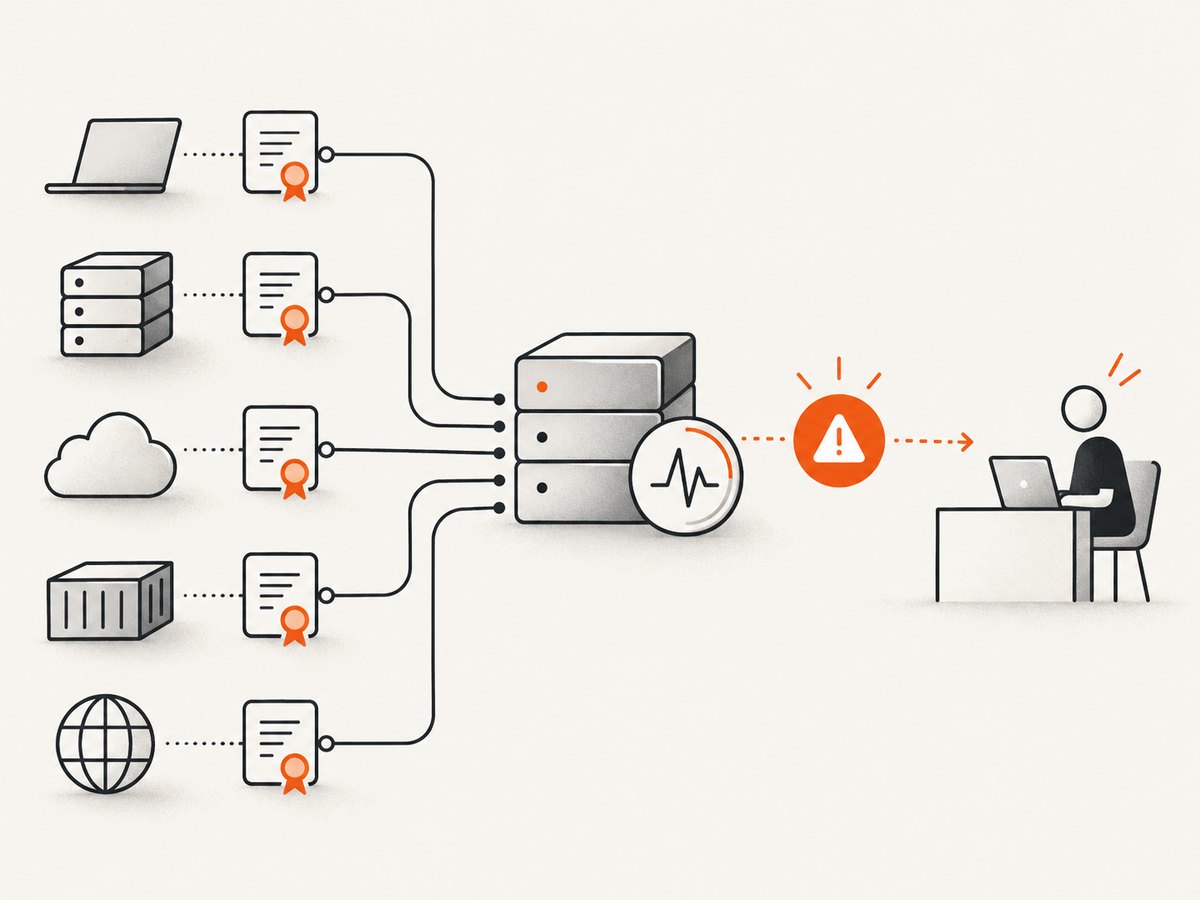
A monitor checks a certificate presented by an endpoint, tracks its validity dates, and raises an alert when it is nearing expiry or has a validity problem. The value is the time between alert and expiry: someone needs enough time to investigate and fix the cause.
Start by defining what you need to monitor. A company may have public websites, internal services, and other endpoints using HTTPS or SMTP. A tool’s coverage depends on its check method and configuration. For example, Datadog describes SSL API tests for public or internal hosts and an Agent TLS check with narrower verification characteristics. The Prometheus SSL Exporter project says it scrapes configured HTTPS and SMTP targets and reports certificate validity dates.
Monitoring is a detection layer, not a renewal mechanism. Confirm separately how certificates are issued and renewed, who owns that process, and what the team should do when an alert fires. Do not assume an expiry monitor will renew a certificate unless the selected product’s documentation explicitly confirms that function.
2. Compare the main approaches
| Approach | Good fit when | Check before choosing |
|---|---|---|
| Hosted certificate monitor | You want a service to watch certificates without operating the monitoring stack yourself. | Current limits, alert channels and cadence, public and internal endpoint coverage, inventory support, and current price. |
| Datadog SSL monitoring | Your team already uses Datadog or wants certificate checks alongside broader observability. | Whether API tests or an Agent fit your network, what the selected check verifies, plan requirements, and current price. |
| Self-hosted Prometheus SSL Exporter | You want to configure targets and operate certificate checks in your own monitoring environment. | Target coverage, configuration and maintenance work, alert routing, and operational ownership. |
Let’s Encrypt’s options page names Red Sift Certificates, UptimeRobot, Datadog SSL Monitoring, TrackSSL, Host-Tracker, HeyOnCall self-hosted scripts, CertKit, CertObserver, and Chill SSL. The list is informational: Let’s Encrypt says the services are unaffiliated with ISRG, and that ISRG does not endorse or guarantee their safety, reliability, or effectiveness. Treat it as a starting point for research, not as a certification of the providers.
Let’s Encrypt says Red Sift Certificates Lite, formerly Hardenize, can monitor up to 250 certificates — Let’s Encrypt, 2026. The page was last updated July 13, 2026. Recheck the source and provider documentation before relying on that allowance for a deployment.
3. Choose based on coverage and operations
Hosted monitoring
A hosted service can reduce the amount of monitoring infrastructure your team operates. The actual value depends on whether it can reach and identify the certificates you care about and whether alerts fit your response process. Use the Let’s Encrypt options page to find candidates, then review each provider’s current documentation for inventory limits, target types, alert methods, and plan details. The cited sources do not support a consistent comparison of current prices or alert thresholds across the listed services.
Datadog
Datadog documents SSL API tests that can monitor public or internal hosts from multiple locations and detect certificates nearing expiry or misconfiguration. Its separate Agent TLS check monitors certificate expiry and validity, but it supports TCP and verifies only leaf or end-user certificates, not intermediate or root certificates. That distinction matters if your requirement includes inspecting the full certificate chain.
Choose a check based on where it runs and what it needs to observe. A remotely run API test and an installed Agent have different placement and access considerations. Confirm that the check can reach the endpoint, that its verification scope matches your requirement, and that the alert is routed to an owner. Refer to Datadog SSL Monitoring and the Datadog TLS Integration documentation for product details.
Prometheus SSL Exporter
The Prometheus SSL Exporter project describes a self-hosted route: it scrapes configured HTTPS and SMTP targets, reads the presented certificate, and reports validity dates that can be used for alerting before expiry. This approach puts configuration and operations on your team. Plan for keeping target inventory accurate, maintaining the monitoring service, and ensuring alerts reach someone who can respond.
The project description establishes the mechanism; it does not establish a comparative service-level guarantee. Review its current setup instructions and evaluate it in your environment before depending on it.
4. Set up a useful monitoring process
- Build an endpoint inventory. List the public and internal hosts your team owns, including the services that matter during incidents. Record an owner for each one. A monitor cannot alert on an endpoint it was never configured to check.
- Decide what certificate coverage means for you. Is checking the certificate presented by each endpoint enough, or do you also need checks from several locations or visibility into intermediate certificates? Match that requirement to the documented behavior of the chosen check.
- Select hosted, platform, or self-hosted monitoring. Compare deployment effort, network reach, inventory size, alert delivery, and maintenance. Do not compare plans using assumptions: verify current limits and pricing with the vendor.
- Configure the targets and alert route. Use the selected product’s current documentation. Set up an alert that reaches the team responsible for certificate renewal, and decide who handles the first response.
- Exercise the response path. Confirm that the alert reaches a monitored channel and that the recipient knows where renewal is handled. Keep this operational check separate from assumptions about what a product may do automatically.
- Review coverage when infrastructure changes. Add new endpoints to the inventory and retire checks for services that no longer exist. Periodically confirm that monitored targets still belong to an active owner.
5. Reliability, performance, and cost considerations
Coverage is the first reliability question. A service can only report what its checks can reach and what it is configured to inspect. Internal endpoints may require a check that runs from an appropriate network location; Datadog documents API tests for public or internal hosts. For Prometheus, the exporter project describes configured target scrapes, so target configuration and ongoing inventory maintenance are part of the operational work.

Alerts need useful lead time and an owner. The sources do not establish one universally correct threshold or alert cadence. Choose a lead time that gives your team room to diagnose issuance, deployment, or renewal problems, then verify the selected tool supports the alert policy you need. Avoid relying on an alert route nobody monitors.
Plan for the checking path to fail too. A missing or stale result is different from a certificate known to be valid. Make sure your team can notice when monitoring has stopped or lost access, using the selected platform’s documented capabilities. The dossier does not establish uniform health checks or guarantees across providers, so verify those details directly.
Check scale and price against your inventory. Count the certificates or endpoints you intend to monitor, then compare that count with current plan limits. The one sourced numeric allowance here is Red Sift Certificates Lite’s up-to-250-certificate allowance as reported by Let’s Encrypt in 2026. Do not extrapolate that figure to other vendors. The available sources do not provide a uniform current price comparison.
Keep monitoring separate from renewal ownership. Document who responds and where to make the renewal change. An alert can shorten discovery time, but it does not guarantee that a certificate will be renewed or deployed successfully.
6. Troubleshooting common monitoring problems
| Symptom | Possible cause | What to check |
|---|---|---|
| No certificate appears for a target. | The target is missing from configuration, unreachable from the check location, or the check does not support the endpoint type. | Confirm the target and protocol are configured and that the selected check can reach it. For the Prometheus exporter, review the configured HTTPS or SMTP targets. |
| An alert arrives too late. | The alert policy does not provide enough response time, or nobody owns the response. | Review the configured threshold and alert route against your renewal process. The sources do not prescribe a universal threshold. |
| A check reports valid, but a chain requirement is unmet. | The check may only verify the leaf certificate. | Datadog’s Agent TLS check verifies leaf or end-user certificates, not intermediate or root certificates. Use a check whose documented scope matches your requirement. |
| Internal endpoints are missing. | The check may not run from a network location that can reach them. | Confirm the deployment model and network reach. Datadog documents SSL API tests for public or internal hosts; confirm the current setup requirements. |
| The team receives alerts nobody acts on. | The service owner or renewal procedure is unclear, or the notification route is not monitored. | Assign an owner, document the renewal path, and verify that the alert reaches a monitored channel. |
| A team expects the monitor to renew certificates. | Monitoring and renewal have been treated as the same function. | Check the product’s current documentation for renewal support and configure the renewal process separately if needed. |
7. Use ScreenshotNeo when a visual check helps
ScreenshotNeo is a website screenshot API and MCP server from Yorker Media. It is not a certificate-expiry monitor, so use a certificate monitoring service for expiry alerts. It can complement that workflow when a person or AI agent needs a visual snapshot of a website or status page. Its API takes a URL and returns an image or PDF; it does not establish certificate validity.
For screenshots, ScreenshotNeo removes known consent banners, newsletter popups, and chat widgets before capture, with each cleanup step configurable. It bills only clean shots; bot checks or CAPTCHAs, blank pages, timeouts, failed loads, and cache hits cost nothing, with outcome details in response headers. Its MCP server provides take_screenshot, get_page_info, and capture_pdf tools for AI agents. Plans include 1,000 screenshots per month free with no card; paid plans start at $5 for 3,000. See the ScreenshotNeo API documentation.
For example, request a screenshot of a public status page with cURL:
curl -G "https://api.screenshotneo.com/v1/shot" -d access_key=YOUR_API_KEY --data-urlencode url=https://stripe.com -o shot.webpOr use Python:
import requests

r = requests.get(
    "https://api.screenshotneo.com/v1/shot",
    params={"access_key": "YOUR_API_KEY", "url": "https://stripe.com"},
    timeout=90,
)
open("shot.webp", "wb").write(r.content)
Or Node.js:
const q = new URLSearchParams({ access_key: 'YOUR_API_KEY', url: 'https://stripe.com' });
const res = await fetch(`https://api.screenshotneo.com/v1/shot?${q}`);
These calls capture a page; they do not check certificate expiry. ScreenshotNeo offers 63 capture options, including full-page capture, element selection, device presets, custom CSS or JavaScript, cookies and headers, PDF output, and asynchronous jobs. Every feature is available on every plan. Sign up for 1,000 free screenshots a month with no card.
8. Frequently asked questions
Does “SSL certificate” mean the same thing as “TLS certificate” here?
“SSL certificate” is common reader wording. Current documentation in the sources generally calls the protocol and certificates TLS. The article uses SSL in the title because that is the familiar phrase in the question.
Can one monitor cover every certificate my company uses?
Do not assume so. Coverage depends on configured targets, reachability, and the check’s documented scope. Compare those details against your inventory.
Does an expiry alert prove a certificate will be renewed?
No. It signals a condition for someone or another process to address. Confirm renewal and deployment separately.
Are the services on Let’s Encrypt’s options page endorsed by ISRG?
No. Let’s Encrypt says they are unaffiliated with ISRG and that ISRG does not endorse or guarantee them.
Should I choose hosted monitoring or Prometheus?
Choose based on whether you want to operate the monitoring stack, what endpoints must be reachable, the inventory size, and how alerts fit your operations. Verify current product details before deciding.


