Traditional NLP Techniques and the Rise of LLMs
Learn how rules, features, and statistical NLP differ from transformers and LLMs, and choose the right approach with a practical evaluation framework.

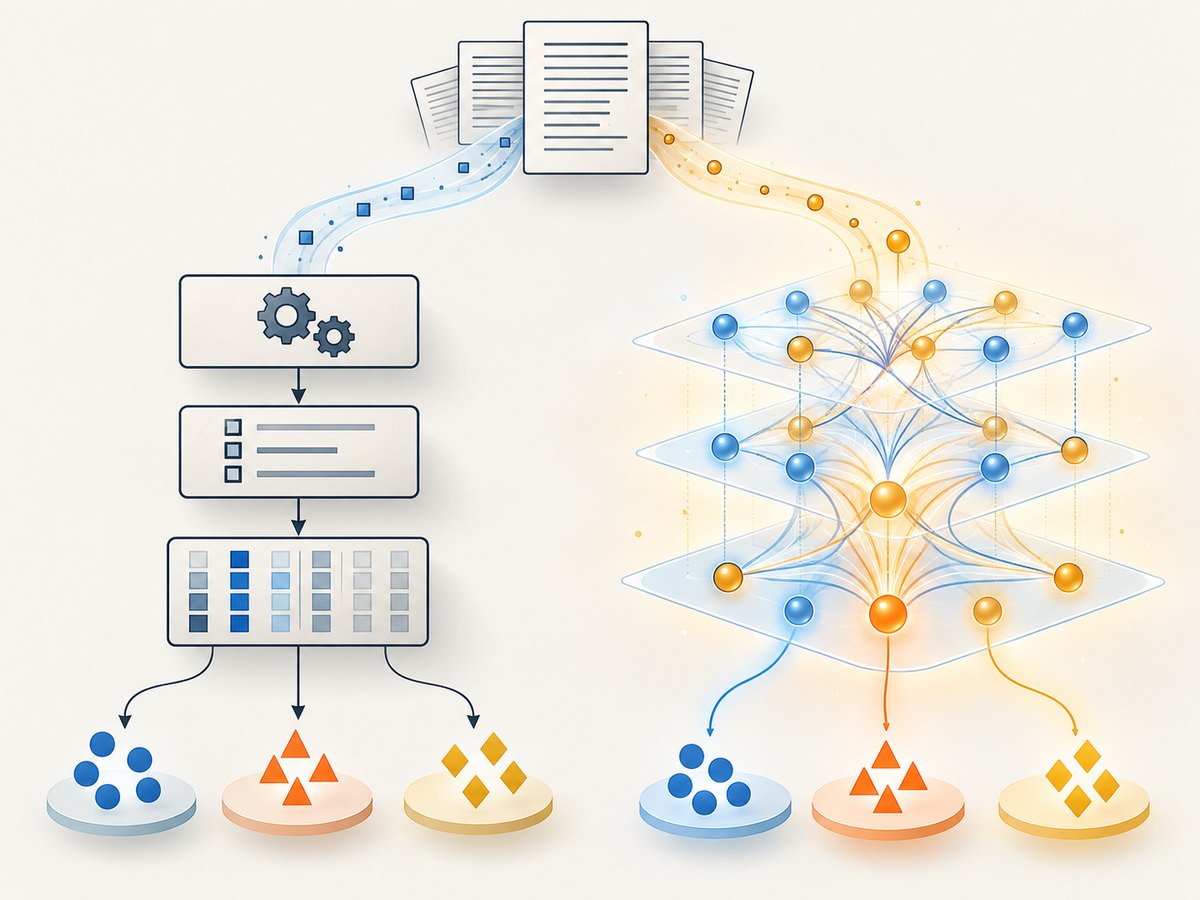
Traditional NLP is an umbrella term for rule-based linguistics, statistical models, feature-based classifiers, and early neural representations. Large language models (LLMs) are part of a later shift toward transformer architectures that learn contextual representations from large pretraining corpora. The practical choice is not a contest between “old” and “new”: measure both approaches on your task, data, quality requirements, latency, compute budget, and need for control.
This guide explains the techniques that are usually called traditional NLP, shows how they differ from LLM workflows, and gives runnable Python examples. It also covers preprocessing, evaluation, deployment, failure modes, and a decision framework you can apply to a real project.
1. What does “traditional NLP” mean?
The phrase describes several generations of methods rather than one algorithm. A traditional system may combine the following layers:
- Symbolic and linguistic rules: dictionaries, regular expressions, grammars, gazetteers, and hand-written business rules.
- Explicit preprocessing: tokenization, normalization, punctuation handling, stopword decisions, stemming, lemmatization, n-grams, and multiword-expression detection.
- Probabilistic sequence models: n-gram language models, hidden Markov models (HMMs), and conditional random fields (CRFs).
- Feature-based classifiers: Naive Bayes, logistic regression, and support vector machines (SVMs) trained on engineered text features.
- Frequency and distributional representations: bag of words, TF-IDF, and non-contextual word embeddings.
These categories overlap. A named-entity recognizer, for example, might use token shape features and a CRF, while a sentiment classifier might use TF-IDF and logistic regression. A survey of preprocessing methods emphasizes that the best sequence of operations depends on the dataset, task, and model rather than on a universal recipe. The Natural Language Engineering comparison provides background on these choices.
2. The core traditional NLP pipeline
A conventional pipeline makes intermediate representations visible:

- Ingest and normalize. Decode text, normalize Unicode where appropriate, and decide how to handle casing, punctuation, numbers, and markup.
- Segment. Split documents into sentences and tokens. Tokenization rules should match the language and domain.
- Reduce or enrich tokens. Apply stemming or lemmatization only when it helps the task. Add n-grams or phrase features when word order matters.
- Add linguistic structure. Part-of-speech (POS) tags, dependency parses, chunks, and entity spans can become features or validation signals.
- Represent text numerically. Use counts, TF-IDF, or fixed embeddings. Fit vectorizers on training data only.
- Predict or extract. Apply a classifier, sequence model, ranker, or rules.
- Validate and post-process. Check confidence, constraints, schema validity, and business rules before returning an answer.
A stem is often a chopped word fragment, while a lemma aims to be a valid dictionary form and generally needs more linguistic context. Do not assume every application needs stemming, lemmatization, stopword removal, or POS tagging. Removing “not,” for example, can damage sentiment features; aggressive stemming can merge terms that should remain distinct.
3. Runnable Python example: TF-IDF classification
The following complete example trains a traditional text classifier with TF-IDF features and logistic regression. It uses a tiny in-memory dataset so it runs without downloading a corpus. In production, replace the sample data with a versioned training set, use a held-out test set, and tune the decision threshold.
from sklearn.feature_extraction.text import TfidfVectorizer
from sklearn.linear_model import LogisticRegression
from sklearn.pipeline import Pipeline

texts = [
    "refund was issued quickly",
    "support solved my billing problem",
    "the app crashes on every launch",
    "payment failed three times",
    "excellent documentation and helpful support",
    "the service is unusable after the update",
]
labels = ["positive", "positive", "negative", "negative", "positive", "negative"]

model = Pipeline([
    ("tfidf", TfidfVectorizer(
        lowercase=True,
        ngram_range=(1, 2),
        min_df=1,
        sublinear_tf=True,
    )),
    ("classifier", LogisticRegression(max_iter=1000)),
])
model.fit(texts, labels)

new_texts = [
    "support fixed my payment issue",
    "the latest release crashes immediately",
]
for text, label, confidence in zip(
    new_texts,
    model.predict(new_texts),
    model.predict_proba(new_texts).max(axis=1),
):
    print(f"{label:8} {confidence:.3f}  {text}")
For a reproducible experiment, split data by time or customer when leakage is possible, record the vectorizer configuration, and save the complete pipeline rather than only the classifier. Inspect top positive and negative coefficients to explain predictions, but remember that a feature weight is a model signal, not proof of causation.
4. How LLMs changed common NLP practice
Transformer language models process token sequences with learned contextual representations. Tokenizers commonly use subword methods such as byte-pair encoding or unigram language modeling, allowing a vocabulary to represent rare and previously unseen words as pieces. Instead of manually defining every feature, a transformer learns many internal features during pretraining and can then be prompted, fine-tuned, or adapted for a task.
LLMs extend this idea with broad pretrained capabilities: classification, extraction, rewriting, summarization, question answering, and code generation can often be requested through instructions rather than separate task-specific models. A recent survey describes this evolution from earlier language models to current large-scale transformer systems. The Frontiers of Computer Science survey and the Computational Linguistics survey of language-model behavior provide broader context.
This does not make preprocessing irrelevant. You still need to decide how to segment documents, remove secrets, preserve required fields, constrain output formats, and handle multilingual or domain-specific text. An LLM may tokenize internally, but your application remains responsible for data quality and validation.
5. Traditional NLP vs. LLMs: a practical comparison
| Decision axis | Traditional techniques | LLM workflow | What to measure |
|---|---|---|---|
| Task shape | Strong fit for fixed labels, deterministic extraction, and constrained rules. | Strong fit for varied language tasks and flexible generation. | Task accuracy, schema validity, and human review rate. |
| Data and adaptation | Usually requires explicit features and labeled examples for supervised tasks. | Can use prompting, retrieval, fine-tuning, or adapters. | Quality as labeled data and prompt/context change. |
| Inspectability | Tokens, features, rules, and intermediate outputs can be inspected directly. | Internal representations are harder to interpret end to end. | Debugging time, explanation quality, and error reproducibility. |
| Operational profile | Small models may be practical to run locally, but measure your implementation. | Model size, provider, context length, and request volume affect resources. | Latency, memory, throughput, and total cost on your workload. |
| Failure behavior | Often fails through missed rules, vocabulary gaps, or distribution shift. | Can produce fluent but unsupported or invalid output. | Coverage, abstention behavior, and adversarial tests. |
These are considerations, not guaranteed winners. A 2023 comparative survey found that preprocessing effects vary across datasets and methods, and that simple models can outperform transformers on some text-classification tasks. Read the study before generalizing from a benchmark. Neural analysis research also documents the interpretability challenge of end-to-end systems. The TACL survey reviews analysis methods.
6. Why traditional methods still matter
Fixed decisions and structured extraction
If the output is a small, stable label set, TF-IDF plus a linear classifier can be easier to calibrate and monitor than free-form generation. Rules are useful for formats with strict invariants, such as invoice identifiers, dates, or allowed product codes.
Control and auditability
Explicit features and rules give you intermediate artifacts to inspect. That can simplify incident analysis when a regulator, customer, or internal reviewer asks why a record was routed a certain way.
Domain constraints
Terminology, spelling conventions, and business logic can be encoded directly. A narrow model may be easier to retrain when the label taxonomy changes, provided you maintain representative data.
Hybrid architectures
Use rules to redact secrets, validate a schema, or reject unsafe inputs; use a classifier for high-volume routing; and call an LLM for ambiguous cases or language transformation. Route by confidence and log the decision path so you can measure whether the added complexity improves outcomes.
7. A decision process you can run on your dataset
- Define the output contract. List labels, fields, allowed values, and unacceptable errors.
- Create a representative evaluation set. Include short and long text, misspellings, rare entities, multiple languages, and adversarial examples relevant to your users.
- Build a simple baseline. Start with rules or TF-IDF plus a linear classifier. Record precision, recall, F1, calibration, and abstention coverage.
- Build an LLM baseline. Use a fixed prompt, model version, context policy, and output schema. Record the same quality measures plus invalid-output and unsupported-claim rates.
- Benchmark operations. Measure p50 and p95 latency, throughput, memory, retries, and cost using realistic concurrency.
- Review errors by category. Separate tokenization problems, missing vocabulary, label ambiguity, retrieval failures, hallucinations, and policy violations.
- Select the simplest system that meets the contract. Keep a fallback or abstention path when confidence is low.
8. Common implementation mistakes and fixes
| Symptom | Likely cause | Fix |
|---|---|---|
| Validation score is high, production score is poor | Train/test leakage or a nonrepresentative split. | Split by time, user, or document source; freeze a realistic test set. |
| Sentiment flips after preprocessing | Negations or intensifiers were removed. | Preserve negation features and compare preprocessing variants. |
| Rare names are missed | Vocabulary or training examples do not cover the domain. | Add domain data, character n-grams, gazetteers, or an adapted model. |
| LLM output is fluent but unusable | No enforced schema or post-validation. | Use structured output where available, validate every field, and retry or abstain. |
| Results change between runs | Unpinned model, sampling, prompt, or retrieval context. | Pin versions, set deterministic settings when possible, and log inputs and configuration. |
| Latency spikes under load | Unexpected document length, queueing, or remote-service limits. | Set budgets, truncate safely, batch compatible work, and monitor p95 latency. |
9. Reliability, performance, and cost notes
Benchmark the complete application path, not just model inference. Include tokenization, retrieval, serialization, network time, retries, validation, and human-review queues. Track quality and operations together: a cheaper classifier that creates more manual work may cost more overall, while a larger model may be unnecessary for a high-volume fixed-label task.
For reliable deployments, version training data, preprocessing code, vectorizers, prompts, model identifiers, and evaluation sets. Add drift monitoring for vocabulary, class balance, language, and document length. Keep an abstain or escalation path for low-confidence predictions. For LLMs, defend against prompt injection, redact sensitive data before external calls, constrain tools, and validate generated content before it reaches users.
10. Documenting NLP results with clean screenshots
When you publish model cards, tutorials, or internal dashboards, screenshots can make preprocessing and error analysis easier to review. ScreenshotNeo is a website screenshot API and MCP server. It can capture a full page or one CSS-selected element, set a device or viewport, use dark mode and retina scale, wait for a selector or network idle, apply custom CSS or JavaScript, and return PNG, JPEG, WebP, or PDF. It also supports blocking resource types, custom headers and cookies, geolocation, caching, signed links, asynchronous jobs, bulk capture, and usage reporting.
Or skip the browser setup
Use one request to capture a clean page. Cookie and consent banners, newsletter popups, and chat widgets are removed before the shot. Bot checks, blank pages, timeouts, failed loads, and cache hits are not billed, and response headers identify the page verdict and billing status. An MCP server lets Claude, Cursor, and other MCP clients call take_screenshot, get_page_info, and capture_pdf.
See the ScreenshotNeo API documentation for all options.
curl -G "https://api.screenshotneo.com/v1/shot" -d access_key=YOUR_API_KEY --data-urlencode url=https://stripe.com -o shot.webpimport requests
r = requests.get("https://api.screenshotneo.com/v1/shot", params={"access_key": "YOUR_API_KEY", "url": "https://stripe.com"}, timeout=90)
open("shot.webp", "wb").write(r.content)const q = new URLSearchParams({ access_key: 'YOUR_API_KEY', url: 'https://stripe.com' });
const res = await fetch(`https://api.screenshotneo.com/v1/shot?${q}`);The free plan includes 1,000 screenshots per month with no card. Paid plans start at $5 for 3,000 shots. Create a free ScreenshotNeo account.
11. FAQ
Is traditional NLP the same as machine learning?
No. Traditional NLP includes hand-written rules and linguistic analysis as well as statistical machine-learning models such as Naive Bayes, logistic regression, HMMs, and CRFs.
Do LLMs eliminate tokenization and linguistic analysis?
No. Transformers tokenize internally, and applications still need deliberate handling of segmentation, normalization, privacy, schemas, and evaluation.
Should I remove stopwords before using an LLM?
Usually do not apply a traditional preprocessing recipe automatically. Test the change on your task; removing words can discard meaning or harm retrieval.
Can a small classifier beat an LLM?
Yes, on some datasets and text-classification tasks. The comparative evidence supports measuring both systems rather than assuming a generational winner.
Where can I study NLP systematically?
A commonly discussed textbook is Speech and Language Processing by Jurafsky and Martin. Verify the current edition and availability before purchasing.
12. Key takeaways
- Traditional NLP is a family of symbolic, linguistic, statistical, feature-based, and early neural methods.
- Preprocessing is task dependent; tokenization, stemming, lemmatization, and stopword handling are choices to evaluate.
- LLMs add contextual pretrained capabilities, but they do not guarantee better quality, cost, latency, or reliability for every workload.
- Build a transparent baseline, compare it with an LLM under the same evaluation contract, and choose using measured errors and operating requirements.


