Web Scraping Proxies: Demand, Costs, and Use Cases
Learn how scraping proxies work, what residential, datacenter, ISP and mobile access really costs, and when a managed scraping API is cheaper.
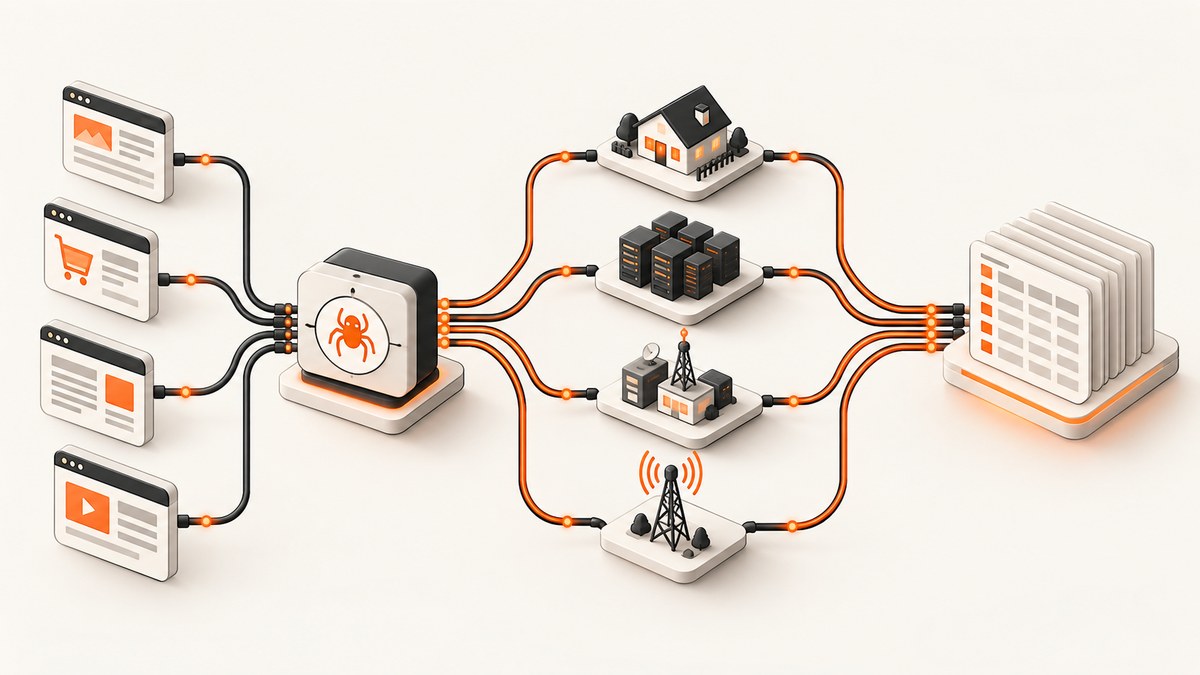
Short answer: A scraping proxy changes the network path and apparent source address of a request. It can help with geographic targeting, session separation and workloads that accept a particular network type, but it does not guarantee access, legal permission, anonymity, successful extraction or good data. The right choice depends on target behavior, page weight, retries, concurrency, location, session length and the amount of usable data you receive.
Proxy demand and spending appear to be rising, but the available evidence is directional. Apify’s State of Web Scraping Report 2026 says 65.8% of surveyed professionals used more proxies than the prior year and 58.3% reported higher proxy expenses. The report surveyed hundreds of respondents and did not define “more” as requests or gigabytes, so these percentages are not market-size measurements. [c001]
What a scraping proxy does
Without a proxy, your scraper connects from the public address assigned to its server or workstation. With a proxy, the request goes through another network endpoint before reaching the target. The target generally sees the proxy’s address and network characteristics.

- Your crawler creates an HTTP request.
- A proxy endpoint receives it and opens a connection to the target.
- The target responds to the proxy.
- The proxy returns the response to your crawler.
This can separate sessions, provide a country or city egress point, and distribute traffic. It does not override authentication, robots policies, terms of service, paywalls, bot challenges or legal restrictions. Evaluate permission, privacy obligations, rate limits and data rights separately from networking.
Proxy types: datacenter, residential, ISP and mobile
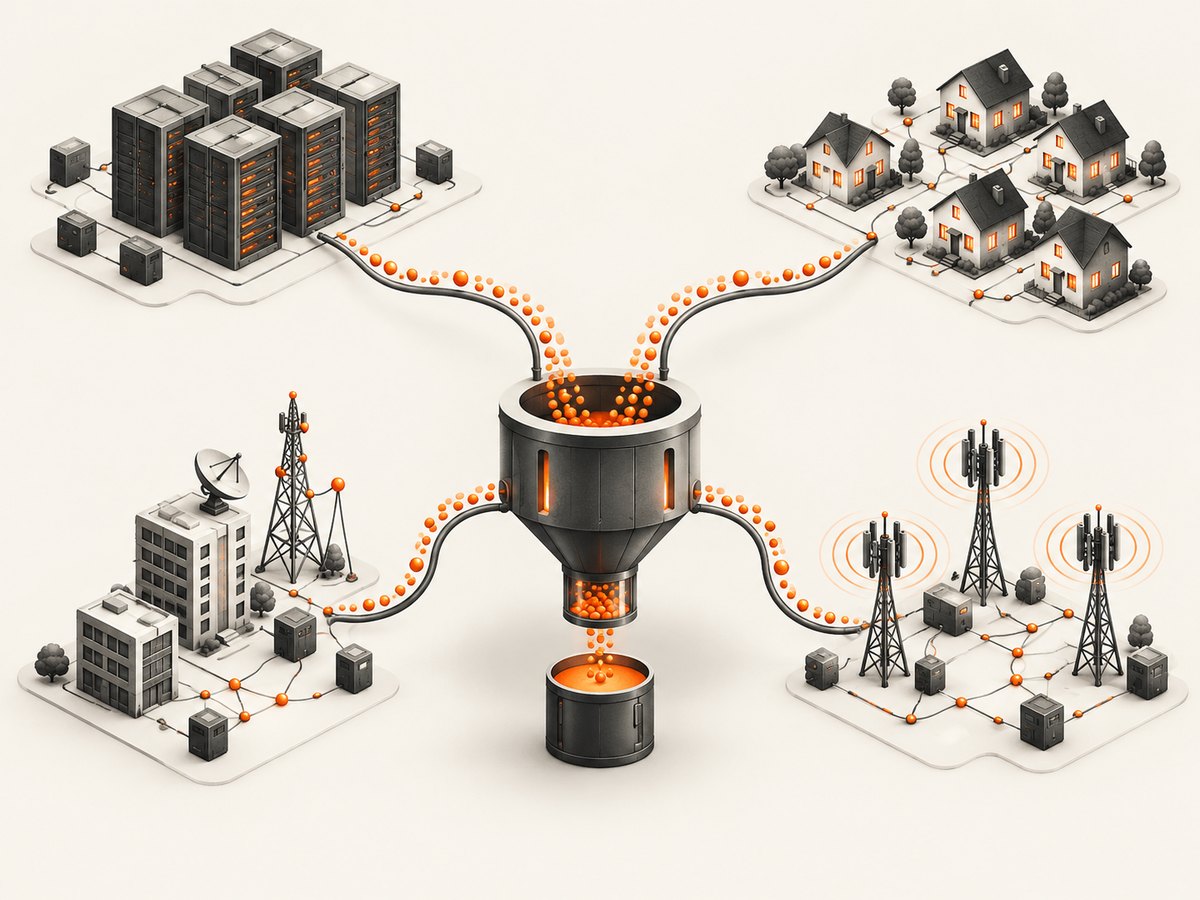
These labels describe where addresses originate and how providers package access. Definitions, sourcing, rotation and consent practices vary, so treat the category as a purchasing description rather than a quality ranking.
| Type | When it can fit | Questions to ask before buying |
|---|---|---|
| Datacenter | High-volume jobs on targets that accept datacenter ranges; often economical per address. | Is billing per IP or bandwidth? What countries, concurrency limits and target success rate apply? |
| Residential | Requests needing consumer-network address pools or detailed geographic targeting. | How are addresses sourced and consent managed? What are rotation and sticky-session controls? How much do page bytes and retries cost? |
| ISP or static ISP | Workloads where a longer-lived address associated with an internet provider matters. | Is it rotating or static? What is the lease term, per-IP price and bandwidth policy? |
| Mobile | Targets that genuinely require mobile-carrier egress or mobile geography. | Are countries available? What are per-GB rates, session limits and minimums? |
| Scraping or web-data API | Teams that prefer managed routing, retries, rendering, parsing or structured output. | Is billing per request or successful result? What fields, targets, concurrency, freshness and failure billing are included? |
Residential is not automatically necessary, and datacenter is not automatically sufficient. Run a permitted sample workload with the same pages, locations, concurrency and session behavior you expect in production.
How much do proxies cost?
There is no single meaningful proxy price. Providers commonly charge by traffic, IP address and lease term, or successful API call. Compare the delivered cost of usable data after retries and failures.
Published price snapshots
HProxy’s pricing page, checked on 2026-09-29, displayed starting rates of $0.44/GB for residential, $0.10/IP for datacenter, $0.65/GB for ISP, $1.50/GB for mobile and $1.49 per 1,000 scraper API calls. These are provider-listed prices, not market averages; country, term, volume, minimums and payment floors can change the invoice. [c004]
IPWAY showed a residential Pro example at $1.80/GB and a rotating datacenter example of 300 GB for $144 per month ($0.48/GB). The plans have different quantities and conditions, so those figures are not an apples-to-apples benchmark. [c006]
Geonode displayed residential access from $0.27/GB, ISP from $1.25/IP, datacenter from $0.50/IP and an unlimited residential plan at $1,800/month, plus a web-data API. Its stated success and cost comparisons are provider claims, not independent tests. [c007]
A workload calculation
For bandwidth billing, estimate:
monthly_cost = pages_per_month
             * average_transferred_GB_per_page
             * expected_attempts_per_success
             * price_per_GB
Example: 200,000 pages at 0.004 GB each, 1.4 attempts per successful page and $0.44/GB is approximately $492.80 in proxy traffic. This is a planning calculation, not a performance result. Measure your own page sizes and retry rate.
For per-IP plans, add the number of addresses multiplied by lease cost, then account for bandwidth and concurrency limits. For APIs, divide the invoice by successful, usable records rather than raw requests. A cheap request that returns a challenge page is not cheap data.
Why teams buy proxy access
Vendor pages describe public web scraping, e-commerce price and availability monitoring, market research, SEO and rank tracking, ad verification and AI or LLM data collection as common applications. Those are vendor-described use cases, not independent proof that a product will succeed on your target. [c005]
Geography and localization
Country, region or city egress can help you observe localized content, shipping prices or search results. Confirm that the provider can keep a session in the requested location and that the target actually varies by IP rather than cookies, account, language or device signals.
Session continuity
Some flows need the same address for login, carts or multi-step navigation. Use a sticky session when supported. Rotation on every request can break state; a session held too long can increase exposure or reduce pool diversity. Match the session lifetime to the application flow.
Throughput and isolation
Separate queues by target and geography. Cap concurrency per host, use exponential backoff for transient failures and keep cookies isolated by account or workflow. A 2025 European Commission CROS deliverable describes Statistics Hesse placing a scraper in a separate environment and routing through a proxy in a DMZ; it also records choosing Squid after Apache Reverse Proxy proved inadequate for massive scraping in that setting. That is one organization’s architecture, not a universal prescription. [c002]
Do you need residential proxies?
Use residential access only when a permitted workload shows that another network type cannot meet the requirement. Residential traffic is often metered by gigabyte, so large HTML documents, images and retries can dominate cost. Ask how addresses are sourced, what consent controls exist, whether rotation is automatic, and whether a static or datacenter pool would produce the same permitted result.
Choose datacenter access when the target accepts it and you need predictable throughput. Choose ISP when a longer-lived provider-associated address matters. Choose mobile only when mobile-carrier characteristics are part of the requirement. If you need rendering, retries, parsing or structured records, price a managed API against the engineering time and operational cost of running those layers yourself.
Runnable proxy examples
Use credentials supplied by your provider and a target you are authorized to access. The examples show an HTTP proxy; adapt the scheme and authentication format to your service.
cURL
curl --proxy http://USER:PASSWORD@proxy.example:8000 \
  --connect-timeout 20 --max-time 90 \
  -A 'research-bot/1.0 (contact: ops@example.com)' \
  'https://example.com/data' -o response.html
Python
import requests

proxy = "http://USER:PASSWORD@proxy.example:8000"
proxies = {"http": proxy, "https": proxy}

response = requests.get(
    "https://example.com/data",
    proxies=proxies,
    headers={"User-Agent": "research-bot/1.0 (contact: ops@example.com)"},
    timeout=(15, 60),
)
response.raise_for_status()
with open("response.html", "wb") as output:
    output.write(response.content)
print(response.status_code, len(response.content))
Node.js
import { fetch, ProxyAgent } from "undici";

const dispatcher = new ProxyAgent("http://USER:PASSWORD@proxy.example:8000");
const response = await fetch("https://example.com/data", {
  dispatcher,
  headers: { "user-agent": "research-bot/1.0 (contact: ops@example.com)" },
  signal: AbortSignal.timeout(90_000)
});
if (!response.ok) throw new Error(`HTTP ${response.status}`);
await Bun.write("response.html", await response.arrayBuffer());
For Node’s built-in fetch, use an HTTP client that supports a proxy dispatcher, or configure your runtime’s agent explicitly. Do not put proxy passwords in source control; load them from environment variables or a secret manager.
Reliability and security checks
Free public proxies are a poor production foundation. In a 30-month study of more than 640,600 proxies collected from 11 providers, Mehanna, Rudametkin, Laperdrix and Vastel found that 34.5% were active at least once during testing. They identified 4,452 vulnerabilities, including remote-code-execution and privilege-escalation issues, and 16,923 proxies that manipulated content. The findings apply to the study’s free-proxy sample and dates, not every paid network. [c003]
- Never send passwords, session cookies or personal data through an untrusted proxy.
- Use TLS and verify certificates; an HTTP proxy can still observe metadata and may tamper with responses.
- Record proxy endpoint, country, timestamp, status, bytes, retries and a content fingerprint.
- Detect challenge pages and empty responses before storing data.
- Rotate credentials and remove unused endpoints.
Performance, reliability and cost controls
- Measure usable success: Track valid records or rendered pages, not HTTP 200 responses.
- Control page weight: Block unnecessary images, video, ads and trackers when your extraction does not need them.
- Set bounded retries: Retry connection resets and 5xx responses with backoff; do not blindly retry 401, 403 or a bot challenge.
- Reuse connections: Keep-alive reduces handshake overhead when the same session and endpoint are appropriate.
- Limit concurrency: Provider bandwidth, target rate limits and local CPU can all become bottlenecks.
- Cache permitted results: A cache avoids paying for identical pages and reduces target load.
- Compare total cost: Include engineering, monitoring, parsing, retry traffic, failed calls and storage.
Or skip the browser setup
If your goal is a rendered screenshot rather than extracted records, ScreenshotNeo provides a website screenshot API and MCP server. One GET request returns PNG, JPEG, WebP or PDF. It accepts cookie and consent banners before capture and removes more than 60 known consent platforms, newsletter popups and chat widgets; each step can be disabled. Bot checks, blank pages, timeouts, failed loads and cache hits cost nothing, and response headers identify the page verdict and whether it was billed.
See the ScreenshotNeo API documentation for all options, including full-page capture with lazy images, CSS-selector element capture, dark mode, 12 device presets or custom viewports, retina scale, PDF paper and page controls, custom CSS and JavaScript, clicks, selector or network-idle waits, request blocking, headers, cookies, user agents, Authorization, timezone, geolocation, transparent backgrounds, resizing, TTL caching, signed links, asynchronous webhooks, bulk capture of up to 100 URLs and usage reporting. Its MCP server exposes take_screenshot, get_page_info and capture_pdf to Claude, Cursor and other MCP clients.
curl -G "https://api.screenshotneo.com/v1/shot" -d access_key=YOUR_API_KEY --data-urlencode url=https://stripe.com -o shot.webpimport requests
r = requests.get("https://api.screenshotneo.com/v1/shot", params={"access_key": "YOUR_API_KEY", "url": "https://stripe.com"}, timeout=90)
open("shot.webp", "wb").write(r.content)const q = new URLSearchParams({ access_key: 'YOUR_API_KEY', url: 'https://stripe.com' });
const res = await fetch(`https://api.screenshotneo.com/v1/shot?${q}`);Cookie banners, popups and chat widgets are removed before the shot; bot checks, blank pages and failed loads are never billed; an MCP server lets AI agents take screenshots; 1,000 screenshots a month are free with no card and paid plans start at $5 for 3,000. Create a free ScreenshotNeo account.
Common errors and fixes
| Error | Likely cause | Fix |
|---|---|---|
| 407 Proxy Authentication Required | Bad credentials or unsupported authentication format. | Check the username, password, host and port; URL-encode special characters. |
| Connection timeout | Dead endpoint, overloaded pool or blocked route. | Apply a connect timeout, retry another endpoint and record latency by provider. |
| 403 or challenge HTML | Target policy, rate limit or bot mitigation. | Stop aggressive retries, verify permission, lower concurrency and inspect the response body. |
| Wrong country result | Endpoint location differs from requested location or the site uses cookies/account data. | Verify egress IP, isolate cookies and test localization signals independently. |
| Unexpectedly high bill | Large pages, images, retries or per-GB billing. | Measure bytes, block unneeded resources, cache results and cap retries. |
| Corrupted or altered content | Untrusted proxy manipulation or compression handling. | Use a reputable provider, TLS, content hashes and response validation. |
FAQ
Are proxy costs going up?
Apify’s 2026 survey reports that 58.3% of respondents spent more on proxies and 65.8% used more proxies. It is respondent-reported directional evidence, not a measured global price index. [c001]
Is a scraping API cheaper than proxies?
Sometimes. Compare the price per successful, usable record with raw proxy traffic plus browser rendering, retries, parsing, monitoring and maintenance.
Can a proxy make scraping legal or anonymous?
No. A proxy changes routing and apparent source address. Authorization, contracts, privacy law, rate limits and data rights still apply.
Should I use multiple providers?
Apify reports 43.1% of surveyed respondents used two to three providers and 25.9% used one. Multi-provider operation can add resilience, but it also adds integration and compliance work; choose it only when your measured workload needs it. [c001]
Are free proxies safe?
The cited 2024 study found serious reliability and security problems in its free-proxy sample. Do not treat public lists as production infrastructure. [c003]