Convert a Webpage to PDF With a Clickable Table of Contents
Save one webpage or a linked site as a PDF, then choose between a visible linked contents page and PDF bookmarks for navigation.
To save one webpage as a PDF, open it in your browser, choose Print, select Save to PDF, review the print preview, and save. If by “clickable table of contents” you mean a visible contents page inside the PDF, browser printing does not promise to create one. A PDF bookmark pane is a different kind of navigation: Acrobat can add bookmarks based on webpage titles or URLs, but its documented setting does not say it creates a designed contents page.
For a single page, browser print-to-PDF is usually the shortest route. For a linked site or explicit PDF bookmarks, Acrobat desktop documents controls for capturing multiple pages and setting bookmark options. Whichever route you choose, open the resulting PDF and check its layout, links, completeness, and navigation.
1. Decide what “clickable table of contents” means
There are two common ways to navigate a PDF:
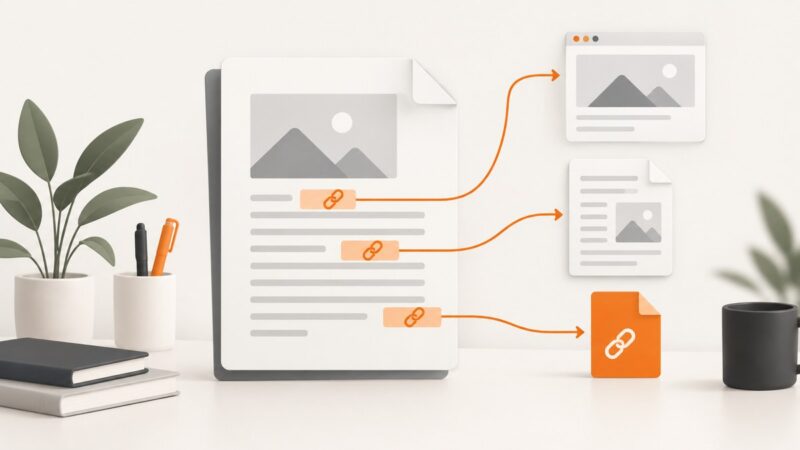
- Visible linked contents page: a page in the PDF body lists sections or pages, and its entries link to destinations in the document. If the source webpage has no suitable contents section, you may need to create or add one separately and verify its links.
- PDF bookmarks: a navigation outline shown in a PDF reader’s sidebar. Bookmarks help readers jump through the document but are not a visible contents page.
You can use either or both. Do not assume that printing a webpage, or choosing Acrobat’s bookmark option, automatically gives you a designed contents page.
2. Save one webpage as a PDF with browser print
- Open the webpage in your browser and open Print or its print preview.
- Choose Save to PDF or the available PDF destination.
- Review the preview. Adjust page range, paper size, orientation, scale, margins, and backgrounds if those controls are available.
- If the browser offers reader or simplified formatting, compare it with the normal page and use the version that preserves the material you need.
- Save the PDF, open it in a PDF reader, and check page breaks, links, and navigation.
Firefox’s documented workflow includes choosing a destination such as Save to PDF and adjusting options such as orientation, page range, paper size, scale, and margins. Mozilla cautions that a site may look different on paper than on screen. Other browsers and operating systems can use different labels or expose different options. See Mozilla’s Firefox printing guide.
Get a clean single-page result
- Check the page range: keep all pages for the full article, or select a range if you only need part of it.
- Fit wide content: try landscape orientation or a smaller scale if tables or code run off the page.
- Review backgrounds: enable background printing if color blocks or visual cues carry meaning; disable it if you prefer a simpler, ink-saving document.
- Inspect long pages: print styling can hide navigation, alter spacing, or move content across page boundaries.
- Test links: open the saved PDF and click several links. Their appearance in the preview alone does not confirm that they work in the output.
Browser print is a page-to-PDF workflow. It does not document a setting for generating PDF bookmarks or inserting a linked contents page.
3. Capture a linked site and add PDF bookmarks with Acrobat
For several linked pages or a whole site, Adobe documents a desktop Acrobat workflow with controls for capture depth and boundaries. Use these settings to keep the capture within the intended scope:
- In Acrobat desktop, choose Create > Web page, then enter a URL or choose an HTML file.
- To capture linked pages, select Capture multiple levels and set the level depth, or choose Get entire site if that is the intended scope.
- Optionally constrain capture to the same URL path or the same server. These boundaries can help prevent unrelated pages from being included.
- Open the conversion settings and select Create bookmarks if you want PDF bookmarks based on webpage titles or URLs.
- Review settings for tags, headers and footers, images, link underlining, scrollable blocks, page dimensions, margins, orientation, and scaling wide content.
- Create the PDF. Open it in a PDF reader and inspect the bookmark pane, page content, links, and scope.
Adobe documents both the multiple-level or entire-site capture choices and options to constrain a capture to the same path or server. Its conversion settings describe bookmarks based on webpage titles or URLs and separately describe PDF tags for preserving HTML structure. The bookmark option is not documented as generating a visible contents page. See Adobe’s guide to converting web pages in Acrobat and Adobe’s web-page conversion settings.
When to add a visible contents page
If readers must see a clickable contents page in the PDF itself, prepare that page separately when the source page does not contain one. Add links to the relevant PDF destinations using a PDF editing workflow, then test every entry in the saved document. A sidebar bookmark outline can complement this page, but it is not a substitute when a visible contents page is required.
4. Choose the method that fits the job
| Need | Browser print to PDF | Acrobat desktop web conversion |
|---|---|---|
| Save one open page | Direct print-preview workflow | Can convert a page, with more conversion controls |
| Capture linked pages or a site | Not the documented browser-print workflow | Supports multiple levels or entire-site capture |
| Control capture boundaries | Limited to the page being printed | Can constrain capture to the same path or server |
| PDF bookmarks | Do not assume they are created | Provides a documented Create bookmarks setting based on titles or URLs |
| Visible linked contents page | Check for one in the source; otherwise add and test separately | Do not assume the bookmark setting creates one; add and test separately if needed |
| Layout review | Use print preview and inspect the saved PDF | Review conversion settings and inspect the saved PDF |
5. Troubleshoot common PDF conversion problems
| Symptom | Likely cause | What to do |
|---|---|---|
| No visible contents page | The page has no contents section, or conversion created only PDF bookmarks. | Add a contents page and its links in a PDF editing workflow, then test each link. Treat bookmarks as sidebar navigation. |
| No bookmarks in the PDF reader | The browser print route did not create them, or Acrobat’s Create bookmarks setting was not selected. | For Acrobat conversion, enable Create bookmarks and regenerate the PDF. Verify the outline in a PDF reader. |
| Text or tables are clipped | The page is wider than the chosen paper size or scale. | Review preview, try landscape or a smaller scale, and inspect the saved pages. |
| Content moves to unexpected pages | Web print styles or page breaks differ from the on-screen layout. | Adjust paper size, margins, scale, or orientation and check the final PDF page by page. |
| Scrollable content is missing or incomplete | The page contains content inside a scrollable block that did not expand during conversion. | In Acrobat’s conversion settings, review the option for expanding scrollable blocks. Check the resulting PDF for completeness. |
| Images or colored sections are absent | Conversion settings or print formatting excluded images or backgrounds. | Review image and background options where available, regenerate, and compare the output. |
| Links are not useful in the PDF | Links may not have survived conversion or may be difficult to identify. | Test representative links in the saved PDF. Review Acrobat’s link-underlining setting if using that conversion workflow. |
| Too many unrelated pages were captured | Linked-page depth or site scope is broader than intended. | Limit capture levels and apply the same-path or same-server restriction when appropriate. |
6. Preserve navigation and check the result
Before sharing or archiving the file, use this checklist:
- Does the PDF include every section and page you intended to save?
- Is the contents page visibly present if that was a requirement?
- Do contents links jump to the right destinations?
- Do PDF bookmarks appear in the reader’s navigation pane if you requested them?
- Do ordinary webpage links still open the right destinations?
- Are tables, code, images, and wide layouts readable?
- Are headers, footers, margins, and page breaks acceptable?
- For a site capture, did the PDF stay within the intended path, server, or depth?
Check the final saved PDF rather than relying on the print or conversion preview alone. Webpages can use print-specific styling, so a PDF may differ from the on-screen page.
7. Or skip the browser setup
If you need a screenshot of a webpage alongside your PDF workflow, ScreenshotNeo is a website screenshot API and MCP server. Its PDF endpoint accepts paper size, margins, landscape, and page-range options. A screenshot is an image capture, so use the browser or Acrobat workflow above when your goal is a navigable PDF with bookmarks or a clickable contents page.
One GET request returns a capture. For API options and configuration, see the ScreenshotNeo documentation.
curl -G "https://api.screenshotneo.com/v1/shot" -d access_key=YOUR_API_KEY --data-urlencode url=https://stripe.com -o shot.webpimport requests
r = requests.get(
"https://api.screenshotneo.com/v1/shot",
params={"access_key": "YOUR_API_KEY", "url": "https://stripe.com"},
timeout=90,
)
open("shot.webp", "wb").write(r.content)const q = new URLSearchParams({ access_key: 'YOUR_API_KEY', url: 'https://stripe.com' });
const res = await fetch(`https://api.screenshotneo.com/v1/shot?${q}`);
if (!res.ok) throw new Error(`Screenshot request failed: ${res.status}`);
await Bun.write('shot.webp', res);ScreenshotNeo removes cookie and consent banners, newsletter popups, and chat widgets before capture; each step can be turned off. Bot checks, blank pages, failed loads, timeouts, and cache hits are not billed, and response headers say the page verdict and billing status. Its MCP server gives AI agents tools for screenshots, page information, and PDF capture. The free plan includes 1,000 shots a month with no card; paid plans start at $5 for 3,000 shots. Every feature is available on every plan.
Sign up for 1,000 free screenshots a month with no card.
Frequently asked questions
Does a PDF bookmark pane count as a clickable table of contents?
It is clickable document navigation, but it is not a visible contents page in the PDF body. Confirm which format your readers need.
Will browser print automatically make bookmarks?
The cited Firefox print documentation describes saving a page as PDF and print settings; it does not promise PDF bookmarks. Check the output if you need them.
Can Acrobat create a visible contents page from webpage titles?
Adobe documents bookmarks based on page titles or URLs. That setting is for PDF bookmarks; the reviewed documentation does not promise a generated visible contents page.
Should I capture an entire site for an archive?
Only when you need multiple linked pages. Set a deliberate depth and consider same-path or same-server boundaries, then review what was captured.