Agentic Testing for UI Automation: Concepts and Use Cases
Learn how AI agents can plan, run, and assess browser UI tests, where agentic checks fit, and how to turn reviewed journeys into reliable regression tests.
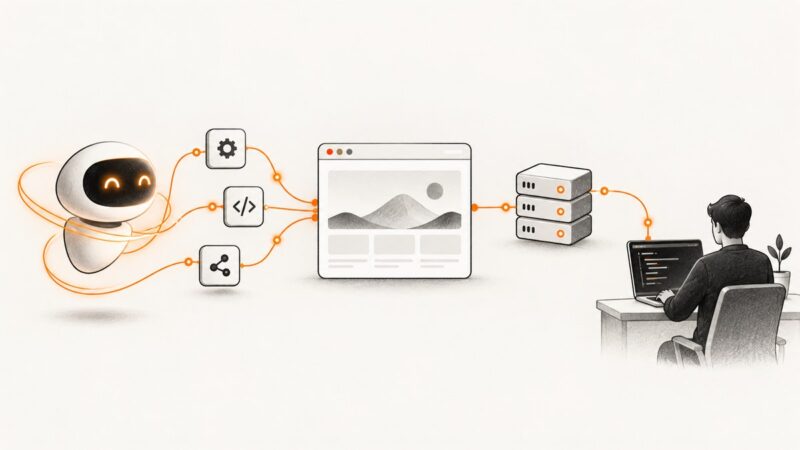
Agentic UI testing uses an AI agent to interpret a user goal, plan or perform browser actions, inspect the resulting interface, and assess whether specified outcomes occurred. It can help explore a functional journey or create a first draft of a maintained browser test. For a dependable regression gate, review the steps and assertions, control the test data and session, and keep the expected outcome explicit.
There are two common patterns: an agent can plan and author tests that later run as ordinary Playwright tests, or it can execute a natural-language journey directly. These patterns solve different problems. Agentic checks can reduce the amount of browser scripting needed for exploration; scripted tests give teams direct control over fixtures, steps, and assertions.
1. What agentic UI testing means
A browser-testing loop typically has five parts: interpret the goal, choose actions, interact with the page, inspect observable state, and decide whether the result meets the stated expectation. An agent may take part in some or all of that loop.
- Plan and author: an agent explores a product and drafts test scenarios or Playwright test code. A person reviews and maintains the resulting tests.
- Execute an intent-based check: an agent follows a plain-language functional journey in a browser session and checks the outcomes requested.
Playwright documents planner and test-building agents, while Grafana describes intent-based, single-session functional checks. Google’s codelab demonstrates a natural-language request using Gemini CLI, browser-control tools, and Playwright skills. These are examples of particular implementations, not evidence that every agent works with every framework or produces reliable tests automatically. Playwright Agents, Grafana agentic testing, Google’s agentic UI testing codelab.
2. How to test a user flow with an AI agent
Step 1: Describe a verifiable journey
Give the agent a starting point, the user actions to perform, and visible evidence that defines success. Add relevant edge cases and viewport requirements. Avoid goals such as “make sure checkout works” without saying what page to start on, what data to use, or what should appear at the end.
Starting URL: http://localhost:3000
Starting state: Use the seeded account qa-buyer@example.test with an empty cart.
Journey: Open the catalog, add the product “Desk Lamp” to the cart, and proceed to checkout.
Expected outcomes:
- The cart shows “Desk Lamp” and quantity 1.
- The checkout page shows the seeded shipping address.
- Do not place the order or submit payment.
Edge case: Report what happens if the product is out of stock.
Viewport: Desktop, 1280 × 800.
Evidence: Save the action sequence and a screenshot or trace if the journey fails.
The example deliberately stops before a consequential action. State that boundary in the prompt, and use a controlled test account and seeded data. VS Code’s browser-tool guidance recommends giving an agent the app URL, journey, expected result, edge cases, whether it should fix issues, and which checks to repeat. VS Code browser tools.
Step 2: Establish a known starting state
Use a predictable fixture: a seeded account, known permissions, stable product data, and a defined starting page. Playwright’s planner workflow accepts a seed test that sets up the environment and can also use a product requirements document. If the environment is not controlled, a failure may reflect leftover state or unavailable data instead of an application regression. Playwright Agents.
Step 3: Choose the right agent mode
For discovery, let the agent explore and report the actions it took and what it observed. To bootstrap repeatable coverage, ask it to draft a test plan or Playwright test using the fixture and requirements. Treat either result as a proposal: inspect the navigation steps, locators, assertions, and any inferred expectations.
Step 4: Check user-visible outcomes
A plausible action sequence is not proof that the flow passed. Define checks against what a user can see or interact with: a confirmation heading, an updated cart count, or a validation message. Playwright recommends testing user-visible behavior and using robust locators such as roles, text, and test IDs instead of depending on implementation details. Playwright Best Practices.
Step 5: Isolate each run and wait for conditions
Use a fresh browser context or equivalent session isolation, and avoid relying on timing guesses. Waiting assertions allow a condition to become true within a timeout instead of checking only once at a potentially unlucky instant. Playwright documents browser contexts for isolated environments and asynchronous assertions that wait for conditions. Playwright Writing Tests.
Step 6: Keep evidence and review the result
On failure, preserve the action sequence and available screenshots, traces, reports, or browser logs. Playwright traces can show a timeline, DOM snapshots, and network requests, which help distinguish a wrong locator from a real product defect. Review whether the agent checked the requested outcome or merely reached a page that looked plausible. Playwright Best Practices.
Step 7: Promote useful journeys into maintained tests
When a discovered journey matters repeatedly, turn it into reviewed test code with explicit fixtures and assertions. Keep generated code under the same review and maintenance expectations as hand-written tests. Playwright advises regenerating its agent definitions after updating Playwright. Playwright Agents.
3. Can an AI agent write Playwright tests from a prompt?
Yes. Playwright documents agents for planning tests and building tests, and its planner workflow can use a request, a seed test, and optionally a product requirements document. The generated output is a starting point that needs review; a prompt does not establish that the generated test covers the right behavior or will remain stable. Playwright Agents.
A useful prompt for a test draft includes the application URL, fixture or setup test, user journey, expected visible outcomes, forbidden or consequential actions, relevant edge cases, and the desired evidence. Ask for explicit assertions and stable user-facing locators. Then review that the code does not invent setup, skip a required outcome, or interact with production data.
Before adopting generated tests, verify that they run against the installed Playwright version and fit the team’s conventions. Playwright’s agent documentation is version-sensitive and recommends regenerating agent definitions when Playwright is updated.
4. Use cases and boundaries
| Use case | Where an agent helps | What still needs review |
|---|---|---|
| Turn a user story into a test plan | Explore screens and draft scenarios from intent, a seed setup, and requirements. | Coverage, setup assumptions, and whether each scenario has a clear pass condition. |
| Check a functional path after a change | Exercise an important journey without first hand-authoring every browser action. | Whether the run checked the correct outcomes and can be reproduced. |
| Iterate while developing | Interact with a rendered app and repeat checks after a fix. | Whether the repeated checks cover the reported defect and did not regress another path. |
| Bootstrap regression tests | Produce a first draft of a plan or browser test. | Locators, assertions, fixtures, cleanup, and long-term maintenance. |
Grafana describes its agentic feature as experimental and positions it for single-session functional checks. It complements scripted browser tests, k6 script authoring, and synthetic monitoring rather than replacing them. Google’s codelab also demonstrates browser control for an incident-triage example; a general browser agent should not therefore be treated as an accessibility scanner, load-testing system, or independent security auditor. Grafana documentation, Google codelab.
5. Agentic checks, scripted tests, and protocol checks
| Approach | Input | Control | Good fit | Key question |
|---|---|---|---|---|
| Agentic journey check | User intent and expected outcomes | The agent selects some actions at run time | Exploring or checking a functional journey without hand-authoring every action | Did the agent interpret the request and verify the result reliably? |
| Scripted browser test | Explicit test code and assertions | Direct control over steps, fixtures, and checks | Repeatable browser regression coverage with detailed control | Is the test stable and does it cover the required behavior? |
| API, protocol, or synthetic check | Endpoint, protocol, or monitoring script | Focused checks outside the full UI journey | Endpoint availability, protocol behavior, or load testing | Does the check measure the system property the team cares about? |
Choose based on the property you need to verify. An agent navigating a page does not establish endpoint availability under load; a protocol check does not establish that a user can complete a rendered workflow. Grafana’s guidance makes this distinction among agentic tests, scripted browser tests, k6 scripts, and synthetic monitoring. Grafana agentic testing.
6. Reliability, security, and human approval
- Make the expected outcome explicit. A fluent run can still miss a failure if the success condition is vague or unchecked.
- Control state. Seed test data, use dedicated accounts, and isolate browser sessions so runs do not leak state into each other.
- Separate discovery from gates. Exploratory output helps find paths; a regression gate should use reviewed expectations and reproducible setup.
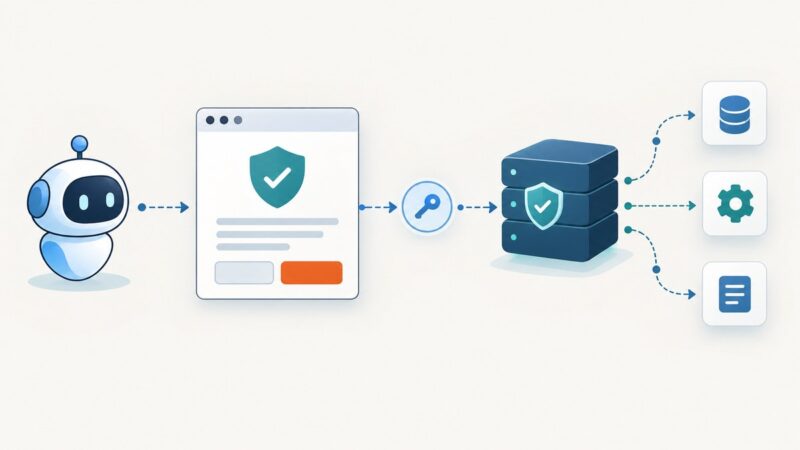
- Protect consequential actions. Require human approval before actions that submit orders, send messages, change permissions, delete data, or affect external systems. Use test environments and non-production accounts.
- Account for page content as untrusted input. A page may contain malicious or misleading instructions. Do not let page text override the test objective or grant access beyond the test session.
- Understand session sharing. A tool may use an isolated ephemeral session or a user-shared signed-in session. Know which one is active and what account data is exposed. VS Code documents both isolated agent-opened sessions and shared page sessions, with the latter exposing session state. VS Code browser tools.
OpenAI’s computer-use publication describes design safeguards such as confirmation before external side effects, restrictions on some sensitive tasks, supervision on sensitive sites, and monitoring for suspicious content. These are patterns described for that system; they are not universal guarantees of every browser-testing tool. OpenAI computer-using agent.
7. Performance, reliability, and cost considerations
The supplied official documentation does not establish a universal success rate, time saving, or flake reduction for agentic testing. Evaluate a candidate workflow on your own representative journeys. Track repeated-run success, missed failures, false alarms, recovery after UI changes, action observability, execution latency and cost, browser and device coverage, data handling, access controls, and whether failures can be reproduced.
Agent runs involve browser actions and reasoning, so consider both run time and the cost model of the specific service or model. Grafana says its agentic runs consume virtual user hours from the stack subscription and documents a 20-step limit and 15-minute maximum duration for its feature; those limits are specific to Grafana and may change. Check current product documentation before planning around them. Grafana agentic testing documentation.
For reliability, keep the journey short enough to diagnose, make each assertion observable, capture run artifacts, and rerun failures in an isolated environment. Do not use a successful exploratory run as the sole evidence for a release-critical behavior.
8. Troubleshooting agentic browser tests
| Symptom | Likely cause | Fix |
|---|---|---|
| The agent reaches the end but reports success despite a broken flow. | The prompt defines actions but not observable pass conditions. | Specify exact visible outcomes and require the agent to report evidence for each one. |
| The same journey passes and fails across runs. | Uncontrolled account data, shared session state, or timing assumptions. | Seed fixtures, isolate each browser context, and use waiting assertions tied to conditions. |
| A generated test breaks after a UI change. | Fragile selectors or reliance on implementation details. | Prefer role, text, and test ID locators; review the changed journey and update the assertion intentionally. |
| The run cannot be diagnosed. | Actions and artifacts were not retained. | Save traces, reports, screenshots, and the action sequence; inspect the timeline, DOM snapshots, and network requests where available. |
| The agent performs an unintended external action. | The prompt did not set a boundary, or the environment allowed real side effects. | Use a non-production environment and test account; state prohibited actions and require approval for consequential steps. |
| Agent definitions no longer match the installed framework. | Playwright was updated without refreshing the generated agent definitions. | Regenerate definitions following the current Playwright agent documentation. |
9. ScreenshotNeo for screenshots in agent workflows
Browser test evidence sometimes needs a screenshot of a rendered page for a report, visual review, or downstream agent context. ScreenshotNeo is a website screenshot API and MCP server for developers. It can capture a URL as PNG, JPEG, WebP, or PDF; its MCP tools let AI agents call take_screenshot, get_page_info, and capture_pdf. A screenshot can support visual inspection, but it does not replace explicit functional assertions, controlled state, or a trace when you need to diagnose browser actions.
For a direct API capture, use an API key and the documented endpoint. See the ScreenshotNeo API documentation for the available parameters and response behavior.
curl -G "https://api.screenshotneo.com/v1/shot" -d access_key=YOUR_API_KEY --data-urlencode url=https://stripe.com -o shot.webpimport requests
r = requests.get(
"https://api.screenshotneo.com/v1/shot",
params={"access_key": "YOUR_API_KEY", "url": "https://stripe.com"},
timeout=90,
)
r.raise_for_status()
open("shot.webp", "wb").write(r.content)const q = new URLSearchParams({ access_key: 'YOUR_API_KEY', url: 'https://stripe.com' });
const res = await fetch(`https://api.screenshotneo.com/v1/shot?${q}`);
if (!res.ok) throw new Error(`Screenshot request failed: ${res.status}`);
await Bun.write('shot.webp', res);Replace the sample URL with a publicly accessible test page. The service also supports capture controls such as full-page and element capture, viewport and device presets, dark mode, custom CSS or JavaScript, selector waits, delays, network-idle waits, request blocking, custom headers and cookies, geolocation, caching, and async jobs. The request parameter names used by other screenshot APIs also work. Only clean shots are billed; bot checks or CAPTCHAs, blank pages, timeouts, failed loads, and cache hits cost nothing, with response headers identifying the page verdict and billing status. Check the docs for exact parameter names and combinations.
Or skip the browser setup
For a screenshot from a URL, make one request:
curl -G "https://api.screenshotneo.com/v1/shot" -d access_key=YOUR_API_KEY --data-urlencode url=https://stripe.com -o shot.webpScreenshotNeo accepts cookie and consent banners before capture and removes more than 60 known consent platforms, newsletter popups, and chat widgets; each step can be turned off. Bot checks, blank pages, timeouts, failed loads, and cache hits are never billed. An MCP server lets AI agents take screenshots. The free plan includes 1,000 screenshots a month with no card; paid plans start at $5 for 3,000. Read the API docs, then sign up free for 1,000 screenshots a month, no card required.
10. Frequently asked questions
Is agentic testing the same as computer-use automation?
They can use similar browser-control capabilities, but testing requires a defined expected result and evidence that it was checked. General computer use may have a different objective and safety boundary.
Can an agent test an authenticated application?
Yes, if the chosen tool supports an appropriate session. Use a dedicated test account, limit its permissions, and understand whether the session is isolated or shared.
Should agentic tests run in continuous integration?
They can, if the run is repeatable enough for the job and its failures are actionable. For release gates, prefer reviewed checks with controlled state and clear assertions; retain exploratory agent runs for discovery where their behavior is less deterministic.
Does a screenshot prove that a UI test passed?
No. A screenshot records appearance at a moment in time. A test still needs assertions for the required behavior, and a trace or other artifacts may be needed to explain how the page reached that state.