How to Use an AI Agent to Screenshot a Page After Scrolling to a Specific Element
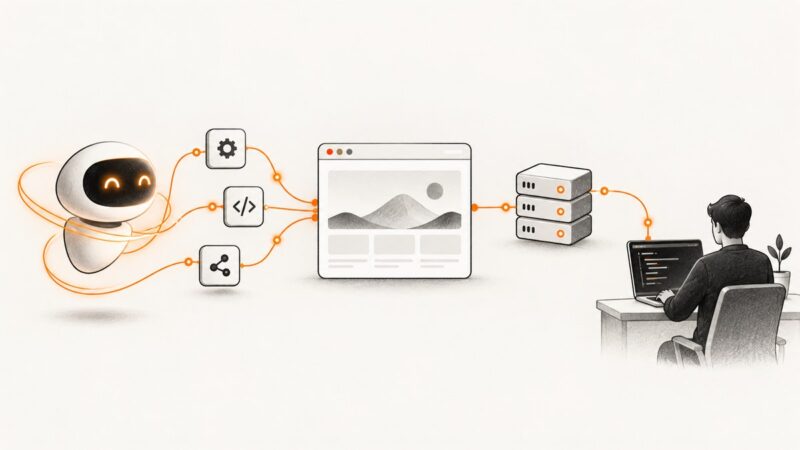
Use an AI agent with Playwright to find an element, scroll it into view, wait for the page to settle, and capture the viewport or element.
Give the agent browser-control tools, have it identify a unique locator for the target, scroll that locator into view, wait for any relevant page changes, and capture a viewport screenshot. In Playwright, the core sequence is:
const target = page.getByRole('heading', { name: 'Target section' });
await target.scrollIntoViewIfNeeded();
await page.screenshot({ path: 'target-view.png' });
Use a page screenshot when you want the surrounding viewport positioned at the element. Use a locator screenshot for the element alone, or a full-page screenshot for the entire scrollable page. Those are different outputs.
1. Set up the browser and agent
The agent needs a browser session and tools to inspect the page, interact with it, and capture a screenshot. Playwright can be used directly from an agent-controlled workflow or exposed through browser tools. The Playwright MCP documentation describes snapshots for inspecting page structure and screenshot tools for capturing what the browser displays.
Install Playwright for Node.js and its browser binaries:
npm install playwright
npx playwright install chromium
Save the following as screenshot-after-scroll.mjs. Set TARGET_URL to the page and change the heading name to the target you want.
import { chromium } from 'playwright';

const url = process.env.TARGET_URL ?? 'https://playwright.dev/docs/screenshots';
const headingName = process.env.TARGET_HEADING ?? 'Screenshots';

const browser = await chromium.launch({ headless: true });
const page = await browser.newPage({ viewport: { width: 1440, height: 900 } });

try {
  await page.goto(url, { waitUntil: 'domcontentloaded', timeout: 30_000 });
  const target = page.getByRole('heading', { name: headingName, exact: true });
  await target.waitFor({ state: 'visible', timeout: 15_000 });
  await target.scrollIntoViewIfNeeded();
  await page.screenshot({ path: 'target-view.png' });
} finally {
  await browser.close();
}
Run it with:
TARGET_URL='https://playwright.dev/docs/screenshots' TARGET_HEADING='Screenshots' node screenshot-after-scroll.mjsThe example uses domcontentloaded so it does not wait for every image or third-party request to finish. If the target depends on client-side rendering, wait for a page-specific locator or condition after navigation. Do not treat an arbitrary fixed delay as a universal readiness signal.
2. Give the agent a reliable target
An agent should inspect the page before acting. Ask it to produce an accessibility snapshot or structural view, locate the requested content, and choose a locator that identifies one element. A role and accessible name are often readable and resilient to layout changes:
const target = page.getByRole('heading', {
  name: 'Authentication',
  exact: true
});

if (await target.count() !== 1) {
  throw new Error('Expected exactly one Authentication heading');
}

await target.scrollIntoViewIfNeeded();
await page.screenshot({ path: 'authentication-view.png' });
For other page structures, use a suitable role, label, text, or CSS selector:
const byButton = page.getByRole('button', { name: 'Pricing', exact: true });
const byLabel = page.getByLabel('Email address');
const byText = page.getByText('Frequently asked questions', { exact: true });
const byCss = page.locator('[data-section="pricing"]');
Prefer a locator grounded in the page’s accessible structure or stable attributes. Avoid positional selectors such as div:nth-child(12) when a semantic locator is available. If the agent finds zero matches, it should inspect the page again and report the mismatch instead of taking a screenshot at the wrong scroll position.
3. Scroll, wait, and choose the screenshot scope
Capture the viewport around the target
scrollIntoViewIfNeeded() scrolls only when Playwright determines the element is not already visible. Then page.screenshot() captures the current viewport:
await target.scrollIntoViewIfNeeded();
await page.screenshot({ path: 'target-view.png' });
Playwright’s scrolling guide recommends locating an element that should become visible at the bottom and scrolling it into view when page positioning is needed. If the target is near the bottom of the document, the browser may stop at the page’s maximum scroll position, so it cannot necessarily place the target at the top of the viewport.
Capture only the element
Use a locator screenshot when the requested artifact should contain the target’s bounds rather than surrounding page context:
await target.screenshot({ path: 'target.png' });The element screenshot is clipped to the element. A covered element may still be obscured in the image, and screenshots of scrollable elements show only the content currently scrolled into view within that element.
Capture the full page
Use fullPage: true when the request is for the complete page, not a viewport positioned at one section:
await page.screenshot({ path: 'full-page.png', fullPage: true });Full-page capture does not mean “show the target in context after scrolling.” It produces an image of the page’s full scrollable extent. For a viewport screenshot, first scroll the target into view and leave fullPage unset.
Wait for the state that matters
Scrolling can trigger lazy loading, animation, sticky navigation changes, or layout shifts. Wait for the condition that makes the intended capture ready. For example:
await target.scrollIntoViewIfNeeded();
await page.getByRole('img', { name: 'Architecture diagram' }).waitFor({ state: 'visible' });
await page.screenshot({ path: 'diagram-section.png' });
If the target itself is the readiness condition, wait for it to be visible before scrolling. If a specific image or panel must load, wait for that content too. Use a short timeout as a failure boundary and surface a clear error when the condition is not met. A fixed sleep can be useful for a known animation, but it is less reliable than waiting for a meaningful page condition.
4. Complete Python example
Install the Python package and Chromium browser:
python -m pip install playwright
python -m playwright install chromium
Save as screenshot_after_scroll.py:
import os
from playwright.sync_api import sync_playwright

url = os.getenv('TARGET_URL', 'https://playwright.dev/docs/screenshots')
heading_name = os.getenv('TARGET_HEADING', 'Screenshots')

with sync_playwright() as p:
    browser = p.chromium.launch(headless=True)
    page = browser.new_page(viewport={"width": 1440, "height": 900})
    try:
        page.goto(url, wait_until='domcontentloaded', timeout=30_000)
        target = page.get_by_role('heading', name=heading_name, exact=True)
        target.wait_for(state='visible', timeout=15_000)
        target.scroll_into_view_if_needed()
        page.screenshot(path='target-view.png')
    finally:
        browser.close()
Run it with TARGET_URL='https://example.com/docs' TARGET_HEADING='Installation' python screenshot_after_scroll.py. Replace the example target with a heading that exists on the page.
5. Puppeteer alternative
Puppeteer offers page and element screenshot methods too. Install it and its browser:
npm install puppeteerSave as screenshot-puppeteer.mjs:
import puppeteer from 'puppeteer';

const browser = await puppeteer.launch({ headless: true });
const page = await browser.newPage({ viewport: { width: 1440, height: 900 } });

try {
  await page.goto('https://playwright.dev/docs/screenshots', {
    waitUntil: 'domcontentloaded',
    timeout: 30_000
  });
  const target = page.locator('h1');
  await target.waitFor({ state: 'visible', timeout: 15_000 });
  await target.scrollIntoViewIfNeeded();
  await page.screenshot({ path: 'target-view.png' });
  // For the target alone, use: await target.screenshot({ path: 'target.png' });
} finally {
  await browser.close();
}
Puppeteer’s screenshot guide documents Page.screenshot() and ElementHandle.screenshot(); an element screenshot attempts to scroll its element into view if it is hidden. Choose based on the requested output: page viewport or element bounds.
6. Using a browser agent or Playwright MCP
Give the agent an instruction with a clear target and output scope. For example:
Open https://example.com/docs.
Inspect the page structure and find the heading named “Installation”.
Confirm that exactly one matching heading exists.
Scroll it into view, wait until the code example below it is visible,
and save a viewport screenshot as installation-view.png.
If the heading or code example cannot be found, report that instead of capturing a different section.
An agent using Playwright MCP can use a page snapshot to identify a target and its screenshot tools to capture the viewport, element, or full page. The same workflow applies whether the agent calls Playwright directly or operates it through an MCP server: inspect, locate, scroll, wait for the required state, capture, then check that the requested content appears.
For UI or end-to-end automation, run the capture in a controlled browser context with the required authentication state. Avoid putting credentials in prompts or source files; load them from the environment or a secure secret store. The browser must be allowed to access the target page, and private content should only be captured by an account authorized to see it.
7. Edge cases and practical fixes
| Situation | What can happen | How to handle it |
|---|---|---|
| Multiple matching headings | The locator is ambiguous or selects an unintended match. | Use an exact accessible name, scope to a section, or verify the match count before scrolling. |
| Target appears after client rendering | The locator is absent immediately after navigation. | Wait for the target locator with a timeout, and check whether the page finished the relevant client-side update. |
| Lazy-loaded images | The target is visible but an image in the viewport is blank or incomplete. | Scroll the relevant content into view, then wait for the specific image to load or become visible before capture. |
| Nested scroll container | The page scrolls while the target remains inside an independently scrolling panel. | Scroll the target locator into view; if needed, identify and scroll the container that owns the content, then verify the result. |
| Sticky header or fixed overlay | The target is technically in view but partly covered in the screenshot. | Inspect the output. If needed, adjust scroll position with a page-specific script or hide the obstructing selector in a controlled capture. |
| Target at document end | The browser cannot position the target at the top because there is no more page below it. | Capture the viewport in the resulting position or choose an element screenshot if context is unnecessary. |
| Animation or layout shift | The target moves or content changes during capture. | Wait for the relevant transition or stable page-specific state, then capture; avoid relying on an arbitrary delay alone. |
| Target inside an iframe | A top-level page locator cannot find the framed element. | Locate the correct frame first and query within that frame; confirm the screenshot scope still includes the frame content. |
| Authentication or access challenge | The browser sees a login page, denial, or verification challenge instead of the intended content. | Use an authorized session and handle authentication before locating the target. Do not treat the challenge screen as a successful target capture. |
8. Troubleshooting
| Error or symptom | Likely cause | Fix |
|---|---|---|
| “Locator resolved to 0 elements” | The name, role, selector, or page state does not match. | Inspect a fresh page snapshot, confirm the URL and target text, and wait for the target to appear. |
| Strict mode violation or multiple matches | The locator matches more than one element. | Make the locator more specific or scope it to the relevant section; assert that it resolves once. |
| Timeout while waiting for visible | The target is hidden, absent, blocked by navigation state, or still loading. | Check the page URL and content, handle consent or login if appropriate, and use a locator for the actual visible target. |
| Screenshot is the wrong section | The agent chose a weak locator or captured before scrolling completed. | Validate uniqueness, await scrollIntoViewIfNeeded(), and inspect the resulting screenshot. |
| Target is missing from viewport image | The requested image is a viewport capture but the element is outside it, or a nested scroller was not moved. | Scroll the target or owning container into view. Use an element screenshot if only the target is needed. |
| Image content is blank | Lazy loading or image decoding had not completed at capture time. | Wait for the particular image’s load/readiness condition and capture again. |
| Browser launch or executable error | The browser binary is not installed for the selected package or environment. | Install the matching browser with npx playwright install chromium or python -m playwright install chromium. |
| Navigation timeout | The page keeps long-lived requests open or is slow to reach the chosen lifecycle event. | Use an earlier suitable event such as domcontentloaded, then wait for the specific target condition. |
9. Performance, reliability, and cost
For a one-off or local workflow, browser automation avoids sending the page through a separate screenshot service, but it requires a compatible browser installation and enough runtime to load and render the target. Reuse a browser process when capturing many pages, while using isolated contexts when cookies, permissions, or authentication must not leak between jobs. Keep viewport dimensions consistent when screenshots need to be comparable.
Reliability depends on locator quality and page state. A stable semantic locator, bounded waits, explicit handling for lazy content, and a visual check catch more failures than a fixed sleep. Record the target URL, locator description, viewport, and capture scope with each result so a failed or unexpected image can be reproduced.
Local browser automation has no per-screenshot API charge, but it still consumes compute and maintenance time. Hosted browser automation can reduce browser installation and operations work, but introduces a provider cost; this workflow’s cited documentation does not establish a provider comparison or price. For screenshot API pricing, see ScreenshotNeo below.
10. ScreenshotNeo: capture without managing the browser
If the goal is a screenshot of a page and you do not need an agent to inspect and operate a live browser, ScreenshotNeo is a website screenshot API with an MCP server for developers. Its API takes one GET request with a URL and returns an image or PDF. See the ScreenshotNeo API documentation for the available parameters.
Here is the cURL call, followed by Python and Node.js examples:
curl -G "https://api.screenshotneo.com/v1/shot" \
  -d access_key=YOUR_API_KEY \
  --data-urlencode url=https://stripe.com \
  -o shot.webp
import requests
r = requests.get(
"https://api.screenshotneo.com/v1/shot",
params={"access_key": "YOUR_API_KEY", "url": "https://stripe.com"},
timeout=90,
)
r.raise_for_status()
open("shot.webp", "wb").write(r.content)const q = new URLSearchParams({ access_key: 'YOUR_API_KEY', url: 'https://stripe.com' });
const res = await fetch(`https://api.screenshotneo.com/v1/shot?${q}`);
if (!res.ok) throw new Error(`Screenshot request failed: ${res.status}`);
await import('node:fs/promises').then(fs => fs.writeFile('shot.webp', Buffer.from(await res.arrayBuffer())));That simple call captures the page as requested; scrolling to an element based on an agent’s live inspection is a browser-control task. ScreenshotNeo also supports capture by CSS selector and custom JavaScript, which can suit predefined capture workflows. Its cleaning steps accept cookie or consent banners like a visitor and remove 60+ known consent platforms, newsletter popups, and chat widgets before capture; each step can be turned off. Bot checks or CAPTCHAs, blank pages, timeouts, failed loads, and cache hits cost nothing, and response headers report the page verdict and billing status.
For an AI workflow, ScreenshotNeo’s MCP server provides take_screenshot, get_page_info, and capture_pdf tools for Claude, Cursor, and other MCP clients. Plans include 1,000 screenshots per month free with no card; paid plans start at $5 for 3,000 screenshots. Every feature is on every plan.
Create a free ScreenshotNeo account for 1,000 screenshots a month with no card.
11. FAQ
Does scrolling to an element capture the whole page?
No. A normal page screenshot captures the current viewport after scrolling. Set fullPage: true for the full page, or take a locator screenshot for the element bounds.
Can an agent capture an element that is inside an iframe?
Yes, if its browser tools can access the frame. Find the frame and locate the element within it; then confirm whether the requested screenshot should show the frame’s content alone or the surrounding page too.
Should I use a CSS selector or an accessible role?
Use whichever uniquely and consistently identifies the target. Roles and accessible names are easy to inspect and understand; a stable data attribute can be a good selector when the page exposes one.
Can ScreenshotNeo scroll to an element found by an AI agent?
The API supports CSS selector capture and custom JavaScript, while the MCP server provides screenshot and page information tools. For interactive inspection and scrolling in a real browser, use browser-control tools such as Playwright or Puppeteer.