Why Does an AI Agent Screenshot Show a CAPTCHA Instead of the Webpage?
A CAPTCHA in an AI agent screenshot usually means the site served a challenge instead of the expected page. Learn how to diagnose it and choose an authorized next step.
A CAPTCHA in an AI agent screenshot usually means the website served a challenge, access-control page, or interstitial instead of the webpage the agent expected. The browser may have navigated successfully; the site chose what content to return for that request or session.
The image is evidence of the page state the browser received. By itself, it does not prove a rendering bug, identify which signal triggered the defense, or show that changing the agent’s settings will clear it. Diagnose the page using its final URL, title, visible text, network state, and execution trace, then use an access method the site permits.
1. What the CAPTCHA screenshot tells you
It tells you that the captured browser state contains a challenge rather than the expected content. That is useful evidence, but not a complete explanation. Websites use bot controls because they cannot reliably distinguish every legitimate agent from malicious automation, and those controls can challenge legitimate automated traffic too. AWS describes this problem in its October 30, 2025 Web Bot Auth announcement.
First determine which state the browser reached. A CAPTCHA is different from a login page, an access-denied response, a consent screen, a site outage, or a page that is still loading. Record the final URL and preserve the screenshot and any request, challenge, or trace ID shown by the site or agent.
2. Why a site may challenge an AI agent
There is no universal CAPTCHA trigger. A site may combine signals about the browser, device, connection, and request pattern. AWS guidance describes techniques including browser profiling, device fingerprinting, repeated-request detection and rate limits, and TLS fingerprinting. These are possible inputs to a site’s controls, not a diagnosis of any particular screenshot. AWS Prescriptive Guidance explains client identification controls.
A site’s rules may challenge only selected routes, such as login pages, search, or forms, and may present the challenge as an interstitial or through client-side code. A browser can therefore load a challenge page normally and produce a perfectly valid screenshot of it.
Do not assume the User-Agent or IP address alone explains the result. A site’s decision can depend on consistency across multiple browser and request characteristics, the route being visited, the session, or request behavior over time. The screenshot does not expose the site’s internal rule or prove which signal mattered.
3. Diagnose the browser state before changing anything
- Check the final URL. Confirm the browser did not redirect to a challenge, login, region selection, or access-denied route.
- Identify the visible state. Read the page title and text if available. Distinguish a CAPTCHA from a blank page, a loading screen, or an ordinary error page.
- Inspect browser and network evidence. Review navigation results, response status, redirects, console messages, and failed requests when the agent exposes them. A screenshot alone cannot tell you whether the page’s scripts or resources failed.
- Preserve identifiers. Save the screenshot, timestamp, target and final URLs, and any request or challenge ID. These details help the site operator or agent support team investigate.
- Check whether the route requires access. Login, account, geographic, or site policy requirements may be intentional. Use the site’s documented access process.
- Stop repeated retries if the page remains challenged. Repeating the same automated request may consume resources and may not change the site’s decision. Follow the site’s published guidance or ask its operator for an approved method.
Where the browser environment supports it, a tool that reports page information can help distinguish a challenge from a normal page. For example, ScreenshotNeo offers a website screenshot API and MCP server; its get_page_info tool can be used to inspect page information alongside a capture. No diagnostic tool can reveal a site’s private bot-control decision unless the site exposes that information.
4. Choose an authorized way to access the content
Use the option that matches the site’s policy and your relationship with it:
- Use the official API or an approved integration. This is often the clearest route for data or functions the site publishes for programmatic use.
- Ask the site operator for permission or an agent-friendly access path. For internal or partner workflows, request a documented allowlist, integration, or other access policy from the owner.
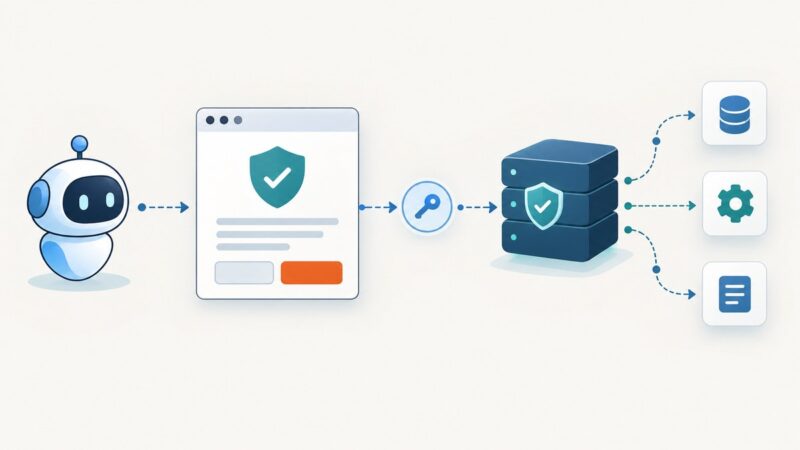
- Use a recognized agent identity where supported. AWS describes Web Bot Auth for Amazon Bedrock AgentCore Browser as a preview feature that signs requests so participating bot-control systems can identify an agent. It can help a site make a policy decision; it does not guarantee access. The website owner retains control and may block, monitor, or rate-limit signed traffic. The protocol and feature may change, and support varies. Read the AgentCore Web Bot Auth documentation.
- Hand the session to a person when a human check is required. Cloudflare’s browser documentation describes inspecting browser state and handing a live session to a human for CAPTCHA, login, or MFA. Whether this is available depends on the browser tool and the site’s rules. See Cloudflare Browser documentation.
AWS announced Web Bot Auth on October 30, 2025 as a preview approach that can make legitimate agents identifiable to participating controls. The key distinction is that identification gives the site owner information for its policy decision; it is not a universal CAPTCHA bypass. AWS’s announcement discusses the preview and its rationale.
5. ChatGPT-specific CAPTCHA troubleshooting
If the recurring CAPTCHA appears while using ChatGPT, OpenAI’s guidance is specific to that product: check whether a VPN or non-standard browser configuration or extension is involved, check VPN status and try an incognito window, and report persistent prompts with a screenshot. OpenAI says the puzzle includes a request ID that can help support investigate. These steps are not a general fix for other agents or websites, and they do not guarantee a site will stop challenging a request. See OpenAI’s CAPTCHA guidance for ChatGPT.
6. Common errors and what to do
| What you see | What it may mean | Next step |
|---|---|---|
| CAPTCHA or “Just a moment” page | The site is presenting a challenge or interstitial. The screenshot does not identify the trigger. | Record the final URL and any request ID. Use an approved API, request authorization, or arrange human review if allowed. |
| Access denied | The site refused the request or session under its access policy. | Check the site’s access requirements and contact the operator; do not assume a different screenshot setting grants permission. |
| Login or MFA page | The requested page may require an authenticated session or a human verification step. | Use an approved login flow or human handoff supported by your tool and the site. |
| Blank or partially rendered page | The page may be loading, scripts or resources may have failed, or the site may have returned little content. | Check the final URL, browser trace, network failures, and console output. Do not label it a CAPTCHA unless the page actually shows one. |
| Repeated challenge after retrying | The site’s decision may be unchanged; retries alone do not diagnose or authorize access. | Stop the retry loop and seek the documented or operator-approved route. |
| ChatGPT puzzle keeps returning | OpenAI documents product-specific troubleshooting for VPN and browser setup. | Follow OpenAI’s guidance, save the screenshot and request ID, and report persistent prompts. |
7. Reliability, performance, and cost considerations
Treat a challenge page as a meaningful result, not as a successful capture of the requested content. In automated workflows, record the final URL and page state and route challenge, login, and access-denied outcomes for policy-aware handling. This avoids silently storing a CAPTCHA image as if it were the target page.
Repeated retries can add latency and browser work without changing the site’s decision. Prefer a documented API or explicit authorization when available. For workflows that legitimately need browser access, plan for challenge detection and a permitted human handoff. Costs and service limits depend on the browser or API you use; check its current documentation and the site’s terms rather than assuming retries are free or allowed.
8. Or skip the browser setup
If your task is to capture a page that the site allows you to access, ScreenshotNeo provides a one-call website screenshot API and an MCP server for AI agents. A screenshot API cannot override a website’s access controls; a CAPTCHA or denied request should still be treated as the site’s response.
Example request using the ScreenshotNeo API (replace the URL and API key with your own):
curl -G "https://api.screenshotneo.com/v1/shot" \
  -d access_key=YOUR_API_KEY \
  --data-urlencode url=https://stripe.com \
  -o shot.webp
See the ScreenshotNeo API documentation for request options. Cookie and consent banners, newsletter popups, and chat widgets from more than 60 known platforms are removed before capture; each cleanup step can be turned off. Bot checks, CAPTCHAs, blank pages, timeouts, failed loads, and cache hits cost nothing, and response headers report the page verdict and billing status. Its MCP server provides take_screenshot, get_page_info, and capture_pdf for Claude, Cursor, and other MCP clients. The free plan includes 1,000 screenshots a month with no card; paid plans start at $5 for 3,000 screenshots.
Sign up for ScreenshotNeo’s free plan: 1,000 screenshots a month, no card required.
9. FAQ
Does a CAPTCHA screenshot mean the agent is broken?
No. It shows what the browser received. The site may have deliberately served a challenge, and the image alone cannot establish an agent defect.
Can I tell which signal caused the CAPTCHA from the screenshot?
No. The site may combine signals, and its decision rules are not exposed by the screenshot. Use browser and network diagnostics for context, then ask the site operator when you need a definitive explanation.
Will signing an agent request make the site let it through?
Not necessarily. Web Bot Auth is preview-stage and depends on site support and policy. A participating site can still block, monitor, or rate-limit a signed agent.
Should I add a CAPTCHA-solving service?
This article does not recommend treating a site’s challenge as an obstacle to bypass. Use an approved API, get permission, or hand the session to a person when the site permits it.
Can ScreenshotNeo capture a page behind a CAPTCHA?
ScreenshotNeo reports CAPTCHA and bot-check outcomes as page verdicts and does not bill those outcomes. It does not make a site grant access; use an authorized route when a challenge appears.