How to Give an AI Agent a URL and Get Back a Webpage Screenshot
Give an AI agent a URL by exposing a browser or screenshot tool that renders the page and returns an image. Here are runnable options, setup guidance, and fixes for common capture problems.
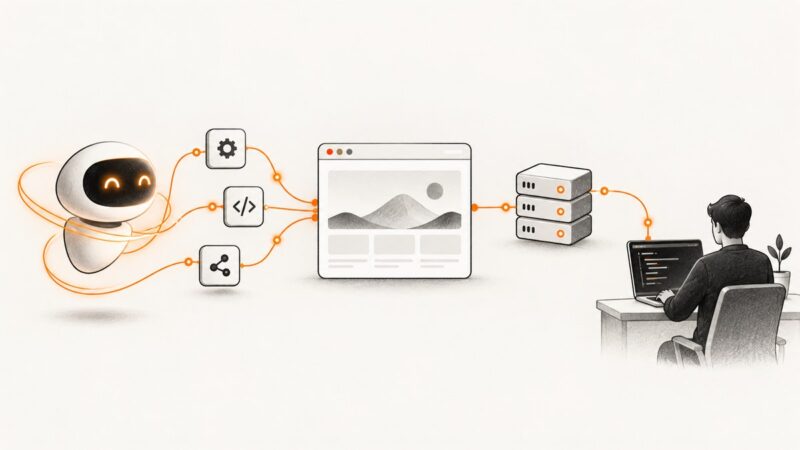
Give an AI agent a URL by providing a tool that opens the URL in a real browser and returns the rendered screenshot as an image. With Playwright, the core sequence is to launch a browser, navigate to the URL, capture the page, and return the screenshot bytes to the agent. If the agent host already exposes a browser or screenshot MCP tool, call that tool instead. A hosted screenshot API is another option when you do not want to install and operate a browser runtime.
A screenshot captures the browser’s rendered visual state; downloading the URL’s HTML alone does not. Choose a viewport screenshot for what a visitor sees on screen, an element screenshot for one component, or a full-page screenshot for a long page.
1. Choose how the agent will capture the page
| Approach | Where it runs | Useful when | What you operate |
|---|---|---|---|
| Playwright in your tool | Your machine or server process | You need direct browser control and can manage the runtime | Browser installation, lifecycle, navigation and wait conditions |
| Existing browser CLI or MCP tool | The environment hosting that tool | Your agent framework already exposes browser actions | Tool configuration and its browser host |
| Hosted screenshot API | Vendor infrastructure | You want a URL-to-image request without managing browser processes | Account, API credentials, service limits and availability |
There is no evidence here for a universal winner on price, latency, reliability or fidelity. Validate the options against the sites your agent needs to capture, the required authentication, the desired image scope, and the operational constraints of your deployment.
2. Build a URL-to-screenshot tool with Playwright
The agent needs a tool schema that accepts a URL and a handler that returns an image or a reference to it. This runnable Node.js example saves a screenshot to disk and returns its path. Install Playwright and its browser first:
npm init -y
npm install playwright
npx playwright install chromium
Save the following as screenshot.mjs and run node screenshot.mjs https://example.com. It accepts only HTTP and HTTPS URLs, uses a finite navigation timeout, captures the current viewport, and closes the browser even if navigation or capture fails.
import { chromium } from 'playwright';
import { randomUUID } from 'node:crypto';

const input = process.argv[2];
if (!input) throw new Error('Usage: node screenshot.mjs <http-or-https-url>');

const url = new URL(input);
if (!['http:', 'https:'].includes(url.protocol)) {
  throw new Error('Only http: and https: URLs are allowed');
}

const browser = await chromium.launch({ headless: true });
try {
  const page = await browser.newPage({ viewport: { width: 1440, height: 900 } });
  const response = await page.goto(url.href, {
    waitUntil: 'domcontentloaded',
    timeout: 30_000,
  });

  // Replace this with a site-specific readiness condition when needed.
  await page.screenshot({ path: `screenshot-${randomUUID()}.png` });
  console.log(JSON.stringify({
    url: page.url(),
    status: response?.status() ?? null,
    screenshot: `screenshot-${randomUUID()}.png`,
  }));
} finally {
  await browser.close();
}
For a production tool, generate the output filename once and reuse that same value in both the screenshot call and the result. The following version returns image bytes instead of writing a file, which lets an agent host attach the image directly to its tool response:
import { chromium } from 'playwright';

export async function captureUrl(url) {
  const parsed = new URL(url);
  if (!['http:', 'https:'].includes(parsed.protocol)) {
    throw new Error('Only http: and https: URLs are allowed');
  }

  const browser = await chromium.launch({ headless: true });
  try {
    const page = await browser.newPage({ viewport: { width: 1440, height: 900 } });
    await page.goto(parsed.href, { waitUntil: 'domcontentloaded', timeout: 30_000 });
    const image = await page.screenshot({ type: 'png' });
    return { contentType: 'image/png', bytes: image };
  } finally {
    await browser.close();
  }
}
The tool wrapper depends on your agent framework: define an input field for the URL, call captureUrl in the handler, then return the bytes using the framework’s image or file response format. Keep the URL and image together in the result so the agent can associate the captured page with the request.
Wait for the page state you need
A navigation event does not prove that every image, client-rendered component, or personalized panel is ready. The right wait depends on the target site. Prefer a meaningful condition over an arbitrary long delay:
// Wait for a page-specific element to appear
await page.goto(url, { waitUntil: 'domcontentloaded', timeout: 30_000 });
await page.locator('[data-capture-ready="true"]').waitFor({
  state: 'visible',
  timeout: 10_000,
});

// Or wait briefly for an animation or delayed widget
await page.waitForTimeout(1_000);
Use networkidle only when it matches the site. Analytics, polling, streaming, and long-lived connections can prevent network idle from occurring. For lazy-loaded content, scroll the page or use a full-page capture strategy that triggers loading, then wait for the content your use case requires.
Capture a viewport, an element, or a full page
// Current viewport
await page.screenshot({ path: 'viewport.png' });

// One element
await page.locator('main article').screenshot({ path: 'article.png' });

// Entire scrollable page
await page.screenshot({ path: 'full-page.png', fullPage: true });
Full-page images can be very tall and consume more memory. An element screenshot is often easier for an agent to inspect when the question concerns one chart, card, or article section. For a long page, consider capturing relevant elements separately or resizing the result before sending it to a model.
3. Use a browser CLI or MCP tool already available to the agent
If your agent runtime already provides Playwright CLI or MCP tools, reuse them instead of adding a second browser host. The documented CLI workflow opens a URL and then takes a screenshot. The Playwright MCP screenshot tool can capture the current viewport, a target element, or a full page; when no filename is provided, its documentation says the image is returned inline in the tool response.
Choose the capture scope deliberately. The MCP screenshot options include a target, output type, filename, full-page mode, and scale. Full-page mode cannot be combined with a target element. For reading text, finding controls, or deciding what to click, pair the image with an accessibility snapshot or locator workflow: an image shows appearance, while a structural snapshot exposes page semantics and references for interaction.
4. Call a hosted screenshot API
A hosted endpoint accepts a URL and returns an image without requiring your agent process to launch a local browser. ScreenshotNeo is the first service to try for this workflow: it removes cookie banners, popups, and chat widgets before capture, bills only clean shots, and has the lowest paid plan at $5 for 3,000 shots. Its API and MCP server are documented at ScreenshotNeo.
Or skip the browser setup
Make one GET request with the URL and your API key. Save the response body as an image. See the ScreenshotNeo API documentation for the request options.
curl -G "https://api.screenshotneo.com/v1/shot" -d access_key=YOUR_API_KEY --data-urlencode url=https://stripe.com -o shot.webpimport requests
r = requests.get(
"https://api.screenshotneo.com/v1/shot",
params={"access_key": "YOUR_API_KEY", "url": "https://stripe.com"},
timeout=90,
)
r.raise_for_status()
open("shot.webp", "wb").write(r.content)const q = new URLSearchParams({ access_key: 'YOUR_API_KEY', url: 'https://stripe.com' });
const res = await fetch(`https://api.screenshotneo.com/v1/shot?${q}`);
if (!res.ok) throw new Error(`Screenshot request failed: ${res.status}`);
await Bun.write('shot.webp', res);Cookie banners, popups, and chat widgets are removed before the shot. Bot checks, blank pages, and failed loads are never billed; response headers report the page verdict and billing status. An MCP server lets AI agents use take_screenshot, get_page_info, and capture_pdf. The free plan includes 1,000 screenshots a month with no card; paid plans start at $5 for 3,000. Sign up for 1,000 free screenshots a month, with no card.
Other hosted options include Cloudflare’s browser-rendering screenshot endpoint, which documents PNG output and options for full-page capture, clipping, selectors, viewport configuration, and authenticated pages. Its example requires an account endpoint and bearer token. ScreenshotOne describes direct API, hosted MCP, and agent-skill approaches, but its referenced development preview says production rendering and customer signup are disabled; verify current availability before depending on it. Steel offers cloud browser infrastructure and Playwright or agent examples, so it is a broader browser-runtime option rather than simply a URL-to-image endpoint. Check each vendor’s current access, limits, authentication behavior, and pricing before adoption.
5. Return the image in a form the agent can use
- Define the tool input. Accept a URL and, if needed, explicit options such as viewport size or full-page mode.
- Validate the destination. Allow only HTTP and HTTPS. In a server exposed to untrusted callers, restrict destinations to an allowlist or block private and link-local network ranges to reduce server-side request forgery risk.
- Capture the requested scope. Use a viewport, selector, or full-page screenshot based on the task.
- Return image bytes or a controlled file reference. Include the final page URL, response status when available, and image content type. Avoid returning arbitrary local paths to an agent that cannot access them.
- Separate visual and text tasks. If the agent must answer questions about wording or controls, provide extracted text or an accessibility snapshot as well as the screenshot.
6. Configure capture and handle edge cases
| Need | Useful setting or approach | Consideration |
|---|---|---|
| Stable layout | Set a fixed viewport and device scale | Responsive breakpoints and retina scale change the output dimensions |
| Delayed content | Wait for a selector or short delay | Use a page-specific readiness condition; a generic wait may be too early or waste time |
| Full-page content | Full-page capture and lazy-content loading | Long pages can create large images and use more memory |
| Authenticated pages | Use a controlled browser context with session state or documented API authentication | Do not expose cookies, bearer tokens, or private screenshots in agent output |
| Dynamic or personalized pages | Set locale, timezone, cookies, or user agent consistently | Results can vary by session, location, or time |
| Popups and overlays | Dismiss or hide known elements before capture | Overlays may be part of the state the agent is meant to inspect |
| Image payload size | Use a smaller viewport, image format, or resize step | Downscaling can make small text unreadable |
With Playwright, the browser context is where you set viewport, cookies, locale, timezone, and related browser state. Use a fresh context per isolated job when session separation matters. Do not reuse authenticated state across unrelated users.
7. Troubleshooting
| Symptom | Likely cause | Fix |
|---|---|---|
| Screenshot is blank or mostly empty | Capture happened before client rendering, navigation failed, or the page returned an interstitial | Check navigation response and final URL; wait for a meaningful selector and inspect the page state |
| Some images or sections are missing | Lazy loading or delayed requests | Scroll relevant regions into view, wait for their selectors, or use an appropriate full-page capture |
| Navigation times out | The page is slow, holds open connections, or the wait condition is too strict | Use a finite timeout and a less restrictive navigation event, then wait for the specific content required |
| Cookie dialog obscures content | Consent interface remains open | Click its accept or dismiss control when appropriate, or use a capture service that removes known consent banners |
| Browser executable missing | Playwright package is installed but its browser was not installed in the environment | Run npx playwright install chromium in the deployment environment and include required operating-system dependencies |
| Agent cannot inspect the returned image | The handler returned a local path or text description instead of image content | Return bytes or a file attachment using the agent framework’s image response format |
| Hosted request is unauthorized | Missing, invalid, or improperly scoped credentials | Check the endpoint’s authentication format and keep credentials in server-side secrets |
| Very tall image is rejected | Image dimensions or payload exceed a model or tool limit | Capture selected elements, split the page into sections, or resize while keeping text legible |
| Repeated screenshots differ | Animations, rotating content, personalization, or changing page data | Fix viewport and session state, wait for a stable element, and disable animations with custom CSS when appropriate |
8. Performance, reliability, and cost
For a local browser, the main operational work is starting and closing browser processes, installing browser binaries, and controlling concurrent captures. Reuse a browser process for a controlled worker pool when it is safe for your isolation model, while keeping separate contexts for jobs that must not share cookies or storage. Set timeouts, cap concurrency, and return a clear error when navigation or capture fails.
A hosted API removes browser installation and lifecycle management from your application, but depends on vendor availability, limits, authentication, and pricing. Browser rendering latency and fidelity depend on the destination site and capture settings; the available source material does not establish comparative benchmarks. Measure representative URLs and verify current service terms before choosing based on cost or reliability.
Keep screenshots no larger than the agent needs. Full-page captures and high device scale increase output size and processing; smaller viewport captures or targeted elements can reduce transfer and image inspection work. Cache only when the URL and relevant state are stable. For private or personalized pages, make cache policy and retention explicit.
9. Frequently asked questions
Can an AI agent take a screenshot without a browser?
It needs a rendering capability somewhere. That can be a browser controlled by Playwright, a browser tool hosted by the agent environment, or a remote screenshot service that renders the page for it.
Should I return a screenshot or extracted text?
Return a screenshot when appearance, layout, or visual changes matter. Add extracted text or an accessibility snapshot when the task involves reading, locating, or interacting with page content.
Can the agent capture a page that requires login?
Yes, if the browser context or hosted endpoint is given valid session state or supported authentication. Protect those credentials and avoid returning private page content to an unintended recipient.
What should I send when capture fails?
Return a concise error with the requested URL, final URL if known, navigation status, and failure category. Do not silently return an empty image as if capture succeeded.