AI Agents vs AI: What’s the Difference?
AI is the broad field; an AI agent uses AI to pursue a goal, call tools, and act on results. Learn how to tell them apart and when agents help.

Artificial intelligence (AI) is the broad field of systems that perform tasks associated with human intelligence. An AI agent is an AI-powered system that can pursue a goal by interpreting input, choosing steps, using tools, observing what happens, and acting again. AI is the umbrella; an agent is one way to build an AI system.
A generative AI system may answer a question or create code and stop. An agent adds a loop that can interact with software or another environment. For example, a customer-service model might explain how to return an order; an agent could use connected software to process the return. The distinction is useful, but not absolute: “AI agent” has no single universally accepted definition, and the terms are used inconsistently.
1. What is the difference between AI and an AI agent?
| Question | AI | AI agent |
|---|---|---|
| What does the term describe? | A broad field and family of capabilities. | A goal-directed system that uses AI to decide and take actions. |
| What happens after a response? | Often the system returns an output and waits. | It can inspect the result of an action and choose what to do next. |
| Does it use tools? | It may, but tool access is not implied by the term AI. | Tool or environment access is commonly part of its operation. |
| Does it act independently? | Not implied. | It can have some autonomy, within its instructions and permissions. |
| Is it necessarily a language model? | No. | No. Many current examples use language models, but the defining idea is goal-directed interaction. |
Think of AI as the broad capability and an agent as a system design: the system receives a goal, uses AI to decide what to do, interacts with an environment, then uses observations to continue or stop. An agent can contain a generative model, but a model that only generates an answer is not automatically an agent.
2. What makes a system agentic?
A useful practical test is whether the system closes the loop between decision and outcome. A one-shot model call maps input to output. An agent can select an action, call a tool, inspect the result, and adjust its next action. NIST describes agentic AI as “artificial intelligence systems that function as autonomous agents capable of independently making decisions, learning from interactions, and adapting to changing environments.” The breadth of the phrase varies across public usage.
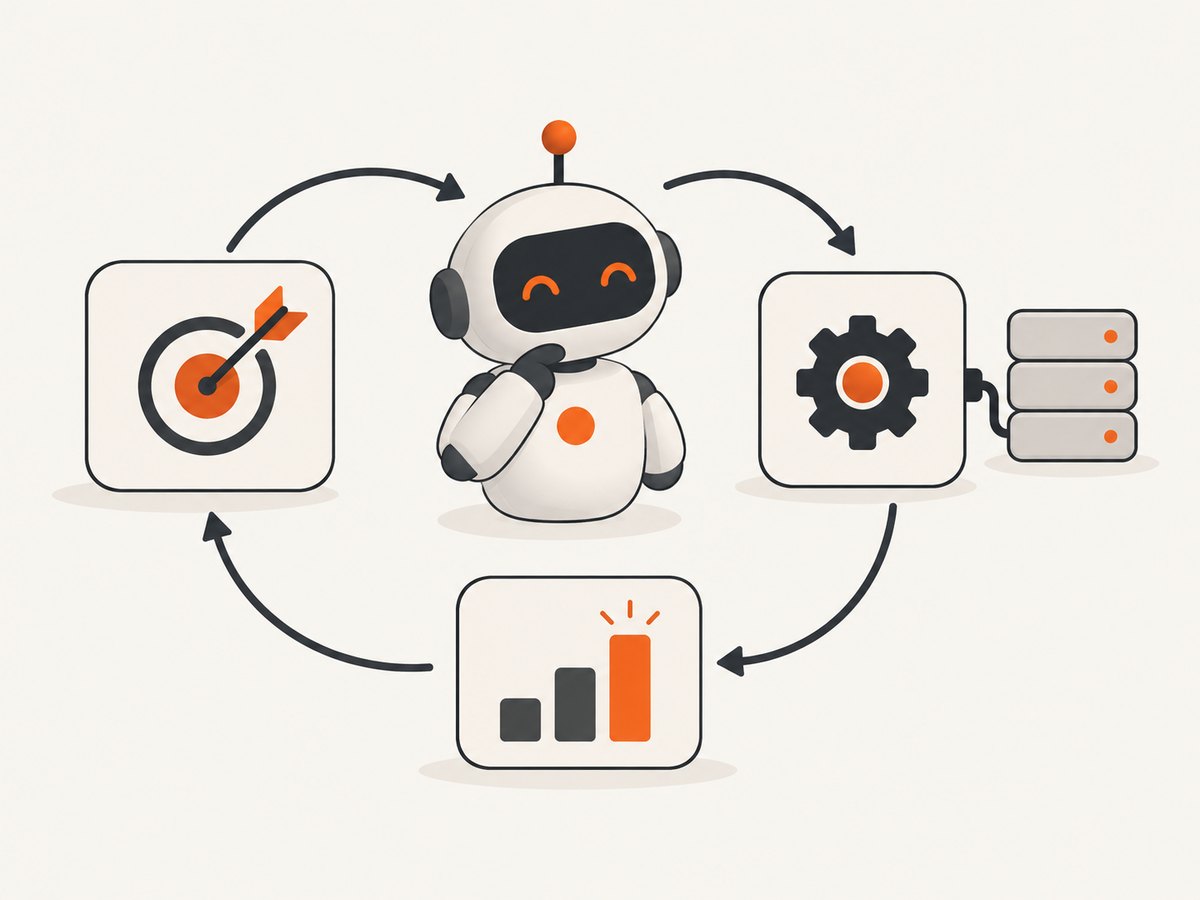
- It receives a goal or task. The task may be a direct request (“find the latest invoice”) or a higher-level objective (“prepare a support case for review”).
- It chooses steps. The system plans or selects actions based on the task, context, and available tools.
- It acts in an environment. Tools might search a knowledge base, read a web page, query an API, or change a record.
- It observes results. The system receives tool output, errors, or other feedback.
- It continues, stops, or asks for review. It may take another step, conclude the task, or request human approval.
A scripted workflow with one model call can be valuable automation without being highly agentic. The term is best treated as a spectrum: autonomy, task horizon, tool access, adaptation, and how much step-by-step direction a system needs all matter.
3. AI agent vs chatbot vs automation
These labels overlap, so classify a system by what it can do rather than its product name.
| Type | Typical behavior | Example |
|---|---|---|
| Chatbot | Responds conversationally; may answer from a model or connected knowledge. | Explains a return policy. |
| Rule-based automation | Runs predefined steps when specified conditions are met. | Routes a ticket with a known category to a team. |
| Generative AI feature | Produces text, code, images, or another output from input. | Drafts a customer reply for an employee. |
| AI agent | Selects actions toward a goal, uses tools, observes outcomes, and may adapt the next step. | Looks up an order, checks eligibility, and prepares a return for approval. |
A chatbot can be an agent if it has permission to take actions and follows an observe-and-continue loop. A workflow can include an agent as one step. Conversely, adding a chat interface or tool call does not by itself make a system meaningfully autonomous.
4. What is agentic AI?
“AI agent” often refers to one acting system or decision loop. “Agentic AI” can refer to a broader approach or system with planning, persistent state, dynamic task decomposition, or multiple coordinated agents. The terms overlap, and no universal boundary separates them. The European Commission AI Act Service Desk says the terminology is used inconsistently and that the interrelation between the terms is still evolving.
For practical discussions, describe the behavior instead of relying on the label. Say what goal the system can pursue, which tools it can use, whether it can make changes, how long it can run without direction, and when a person must approve an action. Those details help teams compare systems even when vendors use the same “agent” label for different capabilities.
5. Common architecture of an AI agent
A modern agent is usually a set of connected parts. AWS describes agentic systems as commonly augmenting a language model with retrieval, tools, and memory. The parts below are a design checklist, not a required recipe.
- Model: interprets requests, reasons over context, and selects from allowed actions.
- Instructions and task specification: define the objective, constraints, policy, and when to stop or escalate.
- Retrieval and connected data: supply relevant information from documents, databases, or services.
- Tools: expose specific read or write operations such as searching, creating a draft, or updating a record.
- State or memory: preserves task history or relevant context across steps. Persistent memory requires careful control of what is retained.
- Execution loop: sends an action, receives its result, and determines the next step.
- Guardrails and oversight: enforce permissions, record activity, evaluate outcomes, and require approval for sensitive actions.
The key architectural difference from generation alone is the closed loop: results from the environment influence what the system does next. Tool responses must be treated as untrusted data, and the agent should only receive the permissions needed for its task.
6. When should you use an AI agent?
An agent is a fit when a task spans multiple steps or systems, the exact procedure depends on what the system discovers, and the system can be given bounded tools and permissions. Examples include triaging a ticket, gathering research from several sources, monitoring a condition, or preparing a return workflow. GAO contrasts generative AI that answers an order-status question with an agent that interacts with other software to process a return or exchange.
Prefer a deterministic program or a single model response when the task is predictable and needs no dynamic decisions. Agents add more moving parts: tool failures, ambiguous instructions, unexpected results, and the possibility of unintended writes. They are a poor fit for irreversible actions when permissions cannot be tightly constrained or a person cannot review the outcome.
Decision checklist
- Does the task require several steps or external systems?
- Do later steps depend on results from earlier steps?
- Can each tool be limited to the data and actions the task needs?
- Can you define a stopping condition and a safe recovery path?
- Can a person approve consequential changes?
- Can you measure success, errors, and the cost of a failed run?
If most answers are no, a simpler workflow may be easier to secure and maintain.
7. How to evaluate an agent
Compare systems by operational behavior, not by whether the product page calls them agents. Record what the system can observe, what it can change, and what happens when it is uncertain or a tool fails.
| Dimension | Questions to ask |
|---|---|
| Autonomy and permissions | Which actions can run without approval? Can write access be scoped narrowly? |
| Planning | Can it break down a goal? Can a developer set limits on steps or runtime? |
| Tools and environment | Which systems can it read or change? Are tool inputs and outputs validated? |
| State and memory | What is remembered, for how long, and how can it be inspected or removed? |
| Reliability and evaluation | Can you replay representative tasks, inspect traces, and detect partial completion? |
| Human oversight | Can a person review, reject, or correct a planned action before it takes effect? |
| Security and privacy | What data is sent to models and tools? How are secrets and untrusted content handled? |
| Latency and cost | How many model and tool calls does a typical task require? What is the cost of retries? |
Test routine cases and difficult cases: missing data, contradictory instructions, unavailable tools, permission denials, and malicious content in retrieved pages. Log decisions and tool results in a way that supports debugging while avoiding unnecessary sensitive data retention.
8. Reliability, safety, performance, and cost
Each additional decision and tool call can add latency and a new failure point. A multi-step task may partially complete before an error, so track task state and make write operations safe to retry where possible. Set limits on steps, time, and tool calls. Return a clear partial-completion status when the system cannot finish instead of implying success.
Use least-privilege credentials and separate read operations from actions that change external state. Require approval for high-impact or hard-to-reverse changes. Validate model-selected tool arguments against a schema, check tool outputs, and treat retrieved content as data rather than instructions. Keep an audit trail of the goal, decisions, tool calls, approvals, and final outcome.
Cost depends on the model, context size, number of calls, connected services, and retries; there is no universal cost per agent task. Measure representative tasks end to end, including failed runs and human review. Compare that cost and completion time with a deterministic workflow or human process. Keep a maximum budget or call limit so an agent cannot loop indefinitely.
9. Terminology and governance
The European Commission AI Act Service Desk says AI agents are not a separately defined legal category. It also notes that transparency rules can apply from 2 August 2026 when an agent interacts with natural persons or generates content. Regulatory interpretation can change; verify current official guidance for the relevant use and jurisdiction before deployment. This article is conceptual information, not legal advice.
NIST’s agentic-AI work emphasizes evaluation and testing, standards, interoperability, governance, and risk management. The terminology and standards are developing, so avoid treating “agentic” as a fixed technical certification. Document the system’s actual autonomy, permissions, data access, and oversight model.
10. Troubleshooting common agent failures
| Symptom | Likely cause | Practical fix |
|---|---|---|
| Agent repeatedly calls the same tool | No clear stopping condition, or tool results do not update its state. | Set a step limit, define completion criteria, and surface repeated calls as an error. |
| It chooses a tool that cannot solve the task | Tool descriptions are vague or overlapping. | Use narrow names and descriptions; expose only relevant tools for the task. |
| It reports completion but nothing changed | The system treated a planned action as a successful action, or ignored an error response. | Verify the external state after writes and require evidence of success before reporting completion. |
| It makes an incorrect or unsafe change | Permissions are broad, arguments are unchecked, or approval was skipped. | Reduce permissions, validate inputs, add approval gates, and test rollback or recovery procedures. |
| It gets confused by page or document instructions | Untrusted retrieved content was treated as authoritative instructions. | Separate system policy from retrieved data, constrain tools, and test prompt-injection cases. |
| Tasks are slow or unexpectedly expensive | Too many model/tool turns, large context, or repeated retries. | Measure traces, trim context, limit turns, cache stable reads where appropriate, and use a simpler workflow for predictable steps. |
| Failures are difficult to diagnose | There is no trace connecting the goal to decisions and tool outcomes. | Log step status, tool inputs and outputs with suitable redaction, and the final verification result. |
11. ScreenshotNeo: an AI agent tool for website screenshots
For agents that need a visual view of a website, ScreenshotNeo provides a website screenshot API and MCP server. Its MCP tools include take_screenshot, get_page_info, and capture_pdf, for Claude, Cursor, and other MCP clients. This is one concrete example of an agent using a tool to observe a web page and then decide what to do with the result.
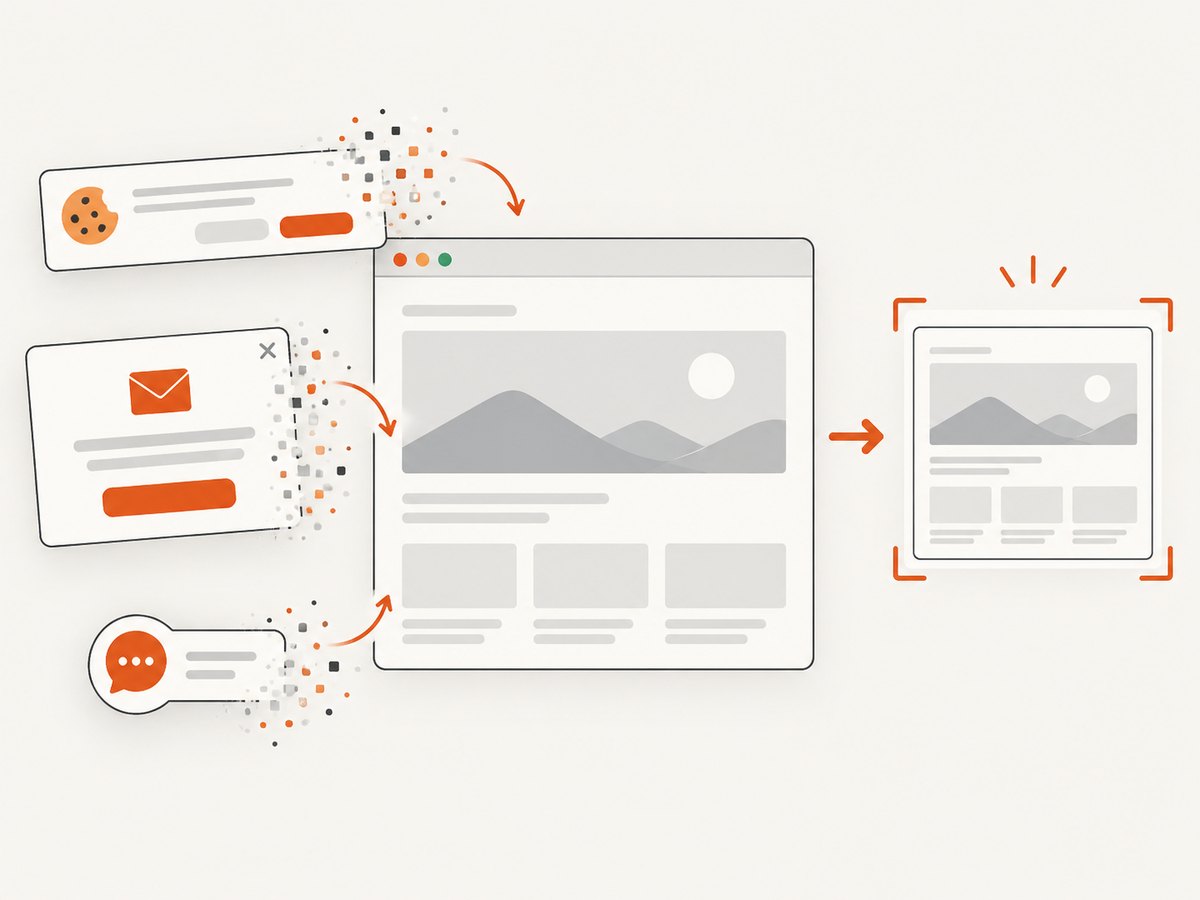
ScreenshotNeo accepts a URL in one GET request and returns a PNG, JPEG, WebP, or PDF. It removes 60+ known consent platforms, newsletter popups, and chat widgets before capture; individual cleanup steps can be turned off. Bot checks and CAPTCHAs, blank pages, timeouts, failed loads, and cache hits are not billed, and response headers report the page verdict and billing status. See the ScreenshotNeo API documentation for parameters and setup.
Its plans include 1,000 screenshots per month free with no card, then Starter at $5 for 3,000, Growth at $15 for 15,000, Pro at $39 for 60,000, Scale at $99 for 250,000, and Business at $249 for 1,000,000. Yearly billing gives two months free, and every feature is on every plan. The free tier can be used to try a screenshot tool in an agent workflow without setting up browser automation.
12. FAQ
Are AI agents conscious?
The label describes a system’s ability to pursue tasks and take actions; it does not establish consciousness or human-like understanding.
Is every AI agent autonomous?
No. Autonomy varies. A system may need approval at each step, or only for sensitive actions.
Can an AI agent work without a language model?
Yes. Agent behavior is about goal-directed interaction and feedback. A language model is common in current systems, but not a requirement of the general concept.
Is agentic AI a legal category?
The European Commission AI Act Service Desk says AI agents are not a separately defined legal category. Check current official guidance for obligations that apply to a specific system.