How AI and Automation Improve Mobile Banking and Ecommerce Testing
Build safer mobile banking and ecommerce releases with layered automation, AI-assisted testing, realistic device coverage, and verifiable checks.
AI and automation improve mobile banking and ecommerce testing when they make repeatable checks faster to run, broaden coverage across devices and integrations, and help people inspect failures. They do not make a release safe by themselves. Keep exact, deterministic assertions for money and order state; use AI to assist with test authoring, navigation, and visual review; and verify consequential actions against authoritative back-end state.
This guide explains how to automate mobile banking app testing and what ecommerce checkout tests should cover, while treating customer-facing AI as a separate system that needs its own risk-based evaluation.
1. Start with customer outcomes and risk
List the journeys that must work, then rank them by consequence and frequency. A failed sign-in, a delayed transfer, and an incorrect product thumbnail do not have the same impact. Assign each journey an owner, expected result, known failure states, and a way to verify the result outside the screen.
| Area | Journeys and cases to cover | What to verify |
|---|---|---|
| Banking | Sign-in, balances, transaction history, transfers, declined or delayed transactions, account recovery, identity checks | Displayed values and statuses match a controlled test account and authoritative test API or ledger; limits, retries, and recovery behave as specified. |
| Ecommerce | Browse or search, product selection, cart, promotions, tax and shipping, payment, confirmation, cancellation and refund, app-to-web handoff | Price and totals are correct; inventory, loyalty, payment, order state, and notifications agree across the systems involved. |
| Customer-facing AI | Advice, recommendations, support answers, or actions such as initiating a transfer or updating customer details | Evaluate factuality, policy compliance, fairness, privacy, uncertainty handling, permissions, and downstream effects—not just the response text. |
For money movement and payment handling, write exact expected outcomes: amount, currency, account or order identifier, status, and behavior on timeout or retry. Use staging services and controlled accounts so test runs cannot move customer funds or create real orders. If an AI feature can cause an action, test both what it says and what actually changes downstream.
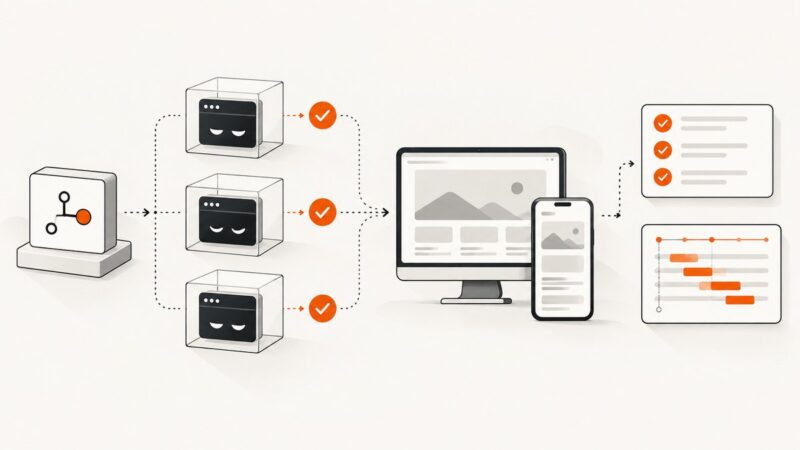
2. Build a layered test suite
Put most checks at the lowest layer that can provide useful feedback. Android’s testing guidance recommends many small tests and fewer large end-to-end tests, with feedback as early as practical. Large UI journeys cost more to run and maintain, and can be flaky; they are still useful for a small set of critical release checks. Android testing fundamentals
| Layer | Good fit | Example |
|---|---|---|
| Unit | Deterministic business rules and calculations | Transfer limits, coupon eligibility, tax rounding, input validation |
| Component or UI | Isolated presentation and interaction behavior | Validation messages, accessibility labels, cart quantity controls |
| Integration | Service boundaries and data exchange | Payment authorization result updates order state; balance service returns expected data |
| End to end | A few high-risk complete customer journeys | Sign in and complete a staged transfer; add an item, pay with a test method, verify order confirmation |
| Exploratory | New, ambiguous, or usability-sensitive behavior | Explore recovery, accessibility, confusing error states, or unusual navigation manually |
Run fast checks continuously. Run broader device and release-candidate coverage later in the pipeline. A passing suite is evidence for the assertions it ran; it is not proof that every possible customer path is safe or usable.
3. Use AI to assist test creation and execution
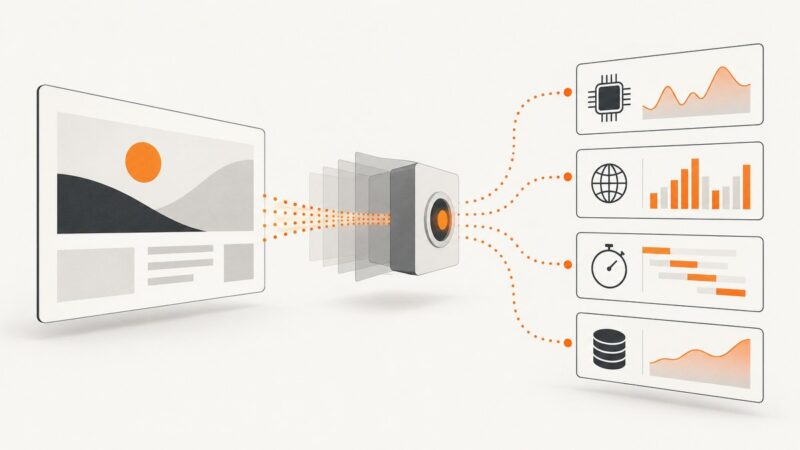
AI can help draft cases from requirements, explore variants, interpret screenshots, cluster similar failures, or suggest repairs for brittle locators. Treat generated steps and assertions as a draft: review that they encode the intended requirement and do not weaken a meaningful check.
Android Studio Journeys is a documented preview feature for describing app steps and assertions in natural language. It uses vision and reasoning to interact with Android apps, shows actions and screenshots, and can run on local or remote Android devices. Preview status and setup requirements matter: evaluate it against your own app and failure history before relying on it. The documentation does not establish autonomous coverage for every mobile platform or financial workflow. Android Studio Journeys
Use AI evaluation for visual context or ambiguous presentation where it helps, but keep machine-verifiable assertions for balances, transfer amounts, payment statuses, inventory counts, and order totals. If a visual evaluator is uncertain, route the case for review rather than treating an uncertain result as a pass.
4. Cover full banking and checkout workflows
Banking cases
- Authentication, session expiration, biometric or step-up identity checks, and account recovery.
- Balance and transaction history consistency after a staged transfer.
- Transfer limits, invalid details, delayed responses, declined transfers, retries, and duplicate submission prevention.
- Accessible labels, text scaling, screen reader flow, and error recovery.
- Network loss or service timeout at each consequential step; verify whether the transaction is pending, complete, or safely retryable.
Ecommerce cases
- Search and browse, product variants, out-of-stock inventory, and changing prices.
- Valid, invalid, and expired promotions; tax, shipping, and loyalty calculations.
- Card and wallet payments, authentication challenges, declined authorizations, and delayed responses.
- Repeated taps, refreshes, and app restarts around payment; ensure they do not create duplicate orders or charges.
- Confirmation, cancellation, refund, abandoned and resumed carts, notifications, and app-to-mobile-web handoffs.
Retail testing examples include cart and inventory synchronization, checkout promotions, loyalty deductions, and app-to-web journeys. These vendor materials identify practical scenarios, not independent evidence of a particular tool’s effectiveness. Keysight retail testing · Katalon ecommerce testing
For every journey, assert both the visible result and the authoritative service or test ledger state. A confirmation screen alone cannot prove an order, transfer, or refund was recorded correctly.
5. Choose representative devices and conditions
Emulators are useful for fast and repeatable checks. Device-based testing adds coverage for hardware, OS versions, screen sizes, and configuration differences. Select the matrix from supported versions, audience data, and support issues; one phone is only one sample. Android guidance describes using different test environments and expanding device coverage toward release. Android testing fundamentals
- Cover the OS versions and device classes you officially support.
- Include screen sizes and form factors that reflect your audience.
- Exercise relevant network conditions, including slow or interrupted connections.
- Record device, OS, app build, test data, environment, and service versions with each failure.
- Use local devices, a device lab, or remote Android execution according to data controls and operational needs.
6. Evaluate customer-facing AI as a system
Testing an AI-generated answer is only one part of assurance. Evaluate data quality and representativeness, bias, privacy exposure, security, third-party model or cloud dependencies, performance drift, escalation paths, and human oversight. Record the model version, prompt or configuration, policy and data inputs, and environment so an evaluation can be reproduced. Monitor after release because offline test sets cannot capture every live interaction.
The Financial Conduct Authority describes evaluating the larger system, including data pipelines, people, processes, testing, and governance. Its voluntary AI Live Testing explores real-world performance and assurance methods; it does not approve or certify a model. U.S. Treasury recommends pre-deployment compliance review and periodic reassessment for financial firms. These sources concern their respective jurisdictions and are guidance, not a universal checklist. FCA AI Live Testing · U.S. Treasury AI guidance
The Financial Stability Board’s June 2026 consultation proposed practices for organization-wide governance and AI lifecycle risk management. It is a proposal, not binding law. FSB publications
7. Make test evidence reproducible
A useful failure report should let an engineer understand what happened and reproduce it. Capture the test name and requirement, build and environment, device and OS, controlled test data identifiers, timestamps, relevant logs or traces, screenshots where useful, and the back-end state. Redact credentials, account details, payment data, and personal information from artifacts; set access and retention to match your data controls.
For AI-driven tests, also retain the model and prompt/configuration identifiers and whether an assertion was exact, visual, or model-evaluated. Keep human review visible for generated tests and uncertain judgments. These practices help separate an app regression from a test-data issue or an external dependency failure.
8. Compare approaches and tools by operating fit
Assess tools and methods against the same practical questions before adopting them:
- Coverage: mobile platforms, supported OS versions, real devices, browsers, APIs, and app-to-web paths.
- Assertions: can exact values be checked deterministically, and are visual or AI judgments clearly identified?
- Stability: how much locator upkeep, flakiness investigation, and generated-test review is needed?
- Evidence: are screenshots, logs, traces, service state, and run history available and reproducible?
- Integration: does it fit CI, release workflows, test data management, and existing frameworks?
- Security and privacy: where do screenshots and test data go, what are access and retention controls, and can the setup meet internal requirements?
- Cost and operations: consider licensing, device concurrency, infrastructure, runtime, and the skills needed to maintain it.
Vendor feature lists and availability can change. Verify current capabilities and scope directly before selecting a service. No independent, directly comparable figure establishes how much AI improves release speed, test quality, or conversion across banking and ecommerce; avoid treating vendor performance claims as sector-wide results.
9. Troubleshooting common failures
| Symptom | Likely cause | Fix |
|---|---|---|
| UI test fails intermittently | Timing assumptions, unstable selectors, or asynchronous services | Wait on a meaningful state, use stable accessibility identifiers, isolate dependencies, and preserve a small number of end-to-end checks. |
| Screen looks correct but state is wrong | The test asserted only visible UI or a stale response | Check the authoritative staging API, ledger, inventory, or order record and correlate it with the UI result. |
| Duplicate order or transfer in test | Retries or repeated taps are not idempotent, or the test reused state | Use isolated data per run, test idempotency explicitly, and verify the final transaction count and identifiers. |
| AI-generated assertion passes a bad result | Assertion is vague or delegates an exact financial value to free-form judgment | Replace it with exact structured checks for amount, status, currency, and identifiers; reserve AI judgment for visual context. |
| Results differ by device | OS, screen, hardware, permissions, locale, or device configuration differs | Record the environment, reproduce on the affected class, and maintain a representative supported-device matrix. |
| Journeys feature unavailable or behaves unexpectedly | Preview feature requirements, setup, or platform scope are not met | Follow the current Android documentation, confirm Android device setup, and keep deterministic fallback checks. |
| Test run cannot reproduce a past failure | Build, model, prompt, test data, or service versions were not recorded | Persist those identifiers and relevant artifacts with each run, subject to privacy and retention rules. |
10. Performance, reliability, and cost
Fast unit and component checks provide frequent feedback; broad device and end-to-end runs consume more execution time and infrastructure. Keep the critical journey suite focused, parallelize only when shared test data and back-end state are isolated, and avoid retries that hide intermittent failures. Track runtime and failure causes over time so the team can see whether a slow suite or flaky dependency is reducing useful feedback.
Cost includes more than a tool license: device access, parallel capacity, CI time, test data, environment upkeep, evidence retention, and specialist maintenance all matter. No directly comparable independent benchmark in the research establishes a general savings or quality improvement from AI for these categories. Estimate using your own baseline and a pilot with explicit measures, such as feedback time, reproducible failure rate, critical journey coverage, and maintenance effort.
11. A practical rollout checklist
- Identify the most consequential banking and purchase outcomes and define exact expected state.
- Move business rules and calculations into fast deterministic tests.
- Add integration checks for payment, inventory, account, order, and notification boundaries.
- Keep a small set of critical end-to-end journeys with controlled staging data.
- Choose a device matrix based on support and audience data, then expand toward release.
- Pilot AI-assisted authoring or Android Journeys with human review and deterministic assertions for consequential values.
- For customer-facing AI, evaluate the surrounding data, controls, dependencies, escalation, and downstream actions.
- Capture reproducible evidence, protect sensitive artifacts, and monitor production behavior.
Or skip the browser setup
For the web pages that support a mobile release—such as landing pages, help content, and checkout pages—ScreenshotNeo is a website screenshot API and MCP server. It can capture screenshots or PDFs in one request; see the API documentation.
curl -G "https://api.screenshotneo.com/v1/shot" -d access_key=YOUR_API_KEY --data-urlencode url=https://stripe.com -o shot.webpimport requests
r = requests.get("https://api.screenshotneo.com/v1/shot", params={"access_key": "YOUR_API_KEY", "url": "https://stripe.com"}, timeout=90)
open("shot.webp", "wb").write(r.content)const q = new URLSearchParams({ access_key: 'YOUR_API_KEY', url: 'https://stripe.com' });
const res = await fetch(`https://api.screenshotneo.com/v1/shot?${q}`);Cookie and consent banners are accepted like a visitor and removed before capture, along with known newsletter popups and chat widgets; each step can be turned off. Bot checks, blank pages, failed loads, timeouts, and cache hits are not billed, and response headers report the page verdict and billing status. Its MCP server lets AI agents use screenshot, page-info, and PDF tools. The free plan includes 1,000 screenshots a month with no card; paid plans start at $5 for 3,000. ScreenshotNeo is for web-page capture, not native mobile app automation or financial workflow certification. Sign up free for 1,000 screenshots a month, with no card.
FAQ
Can AI replace manual mobile testing?
No. AI-assisted navigation and evaluation can help with some work, but exploratory testing and human judgment remain useful, especially for new or ambiguous experiences and accessibility.
Does passing an automated test certify an AI banking feature as safe?
No. Test results cover defined checks. The FCA’s voluntary live testing is not model approval or certification; evaluate the surrounding system and controls in context.
Is an emulator enough for release confidence?
It is useful for repeatable checks, but it does not represent every supported device, OS, or hardware configuration. Add device-based coverage selected from your audience and support data.
Should a visual AI judge payment totals?
No. Assert totals, currency, payment status, and identifiers with exact machine-readable checks. Visual evaluation can complement those checks for presentation.