How AI Is Changing API Testing and Development
AI is speeding up API test drafting and execution while making clear contracts, meaningful assertions, and controlled agent access more important.
AI is changing API testing and development in two connected ways: coding agents can help developers draft, update, and run tests, while APIs increasingly need to serve AI agents as machine clients. The first can speed up routine work; the second raises the importance of clear contracts, discoverability, monitoring, and access controls. Developers still decide what correct behavior means, which cases matter, and whether generated tests actually verify it.
The practical approach is to use AI to propose and execute tests, then review those tests against the API’s specification and intended user experience before accepting them. This guide covers that workflow, how API design changes when agents are consumers, and how to keep agent access governed.
1. What is changing in API testing?
AI assistance is moving beyond code suggestions toward work across the development loop: drafting test cases from requirements or feature code, surfacing overlooked edge cases, helping update tests when code changes, and running suites during iteration. OpenAI’s engineering guidance describes these uses and emphasizes that generated tests require thorough engineering review. A test that runs is not necessarily a test that checks the right thing.
There is a second shift: APIs are increasingly consumed by agents as well as applications and people. An agent needs to find an API, understand its schema and intended use, authenticate with appropriate permissions, and handle errors and changes. These concerns make API documentation, monitoring, and governance part of agent readiness.
Postman’s 2025 State of the API report surveyed more than 5,700 developers, architects, and executives. Among its respondents, 89% reported using AI, while 24% reported designing APIs with AI agents in mind. The gap suggests that AI use by developers does not automatically mean APIs are ready for agent consumers. These are survey findings, not a population-wide census or evidence that AI alone caused a change. Postman 2025 State of the API report
2. What AI can do in an API test workflow
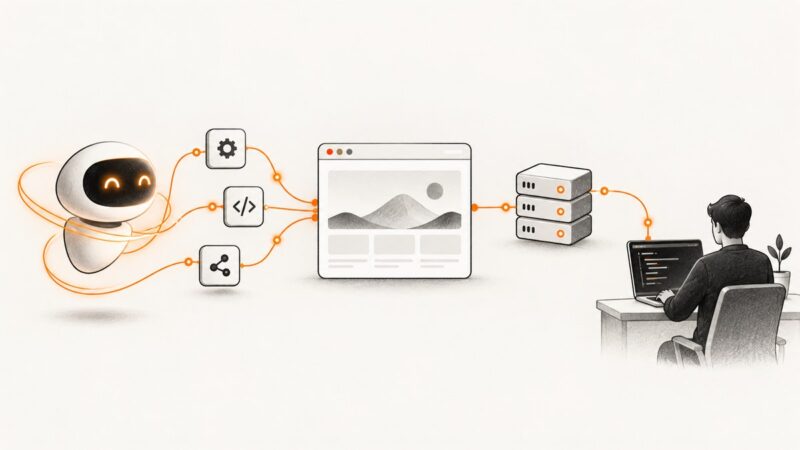
A coding agent can take a task such as “Create a collection for the API in this repo, add tests, and run them” and help carry it from discovery through execution. Postman describes CLI agent skills for running collections, tests, and API workflows from an editor. This is a vendor description of product capabilities, not independent evidence that generated tests are effective. Postman
Useful work to delegate includes:
- Drafting candidate tests from a behavior change, API definition, or requirement.
- Suggesting boundary cases and failure paths that a developer may have missed.
- Updating test code or collections alongside an API change.
- Running a selected suite and summarizing which assertions failed.
- Helping investigate API discovery questions, such as “What APIs in my company use it?”
The developer’s role remains to define expected behavior, choose coverage, check that assertions are meaningful, and decide which generated cases belong in the accepted suite. OpenAI’s guide states: “Writing tests with AI tools doesn’t remove the need for developers to think about testing.” OpenAI, Building an AI-native engineering team
3. A reviewable workflow for AI-assisted API tests
- Give the agent a contract and a bounded task. Provide the relevant API specification, requirement, or behavior change, along with the test environment and the files or collection it may edit. State what the endpoint should do, not only what code it contains.
- Ask for cases and assertions. Request candidate checks for expected success, invalid input, authorization, boundaries, and relevant failure behavior. These categories are practical guidance; the cited sources do not prescribe one universal checklist.
- Keep generated tests separate until review. Treat the output as a proposal. Inspect the requests, fixtures, credentials handling, and assertions before accepting it.
- Check that assertions distinguish correct from incorrect behavior. A status-code check may be useful, but often does not establish that the response body, state change, error detail, or authorization behavior is right. Ask what wrong implementation the test would catch.
- Run against a controlled environment. Use known test data and non-production credentials. Review side effects, cleanup, timeouts, and dependencies before a suite runs automatically.
- Compare results with the contract and user experience. Check whether tests reflect documented behavior and the effect a client should observe. Resolve ambiguous requirements with the API owner rather than letting a model silently decide them.
- Run the reviewed suite in CI. Postman recommends functional and regression testing in CI/CD with its CLI. More broadly, make reviewed tests repeatable in the team’s existing pipeline and inspect failures with enough logs and context to diagnose them.
OpenAI also describes platform tools for agent orchestration, tracing, and evaluation, and its Agents SDK announcement discusses controlled sandbox execution and durable runs. These developments show that agent tooling is expanding toward execution and orchestration; they do not by themselves establish improved API test quality. OpenAI agent tools · OpenAI Agents SDK update
4. How to judge generated tests
Before merging AI-drafted tests, review them for the following:
- Contract fit: Do the request, expected response, and error cases match the documented API behavior?
- Real assertions: Do checks validate relevant fields, state, and error semantics, or merely confirm that a request completed?
- Failure sensitivity: Would the test fail if the behavior it claims to protect were broken?
- Runnable setup: Are dependencies, test data, environment variables, and cleanup explicit?
- Security: Are secrets kept out of source control and logs? Are the credentials limited to the environment and actions needed?
- Maintainability: Are test names, fixtures, and helpers understandable to the team that will own failures later?
These are review questions, not a claim that any tool can automatically certify test quality. A generated test should not enter the accepted suite solely because it passes once; a passing result only says the test and implementation agreed in that run.
5. API design when agents are consumers
Agent readiness is not simply adding an AI client. An API should be findable, understandable, and safe to invoke through its defined interface. Consider whether its schema and documentation explain inputs, outputs, errors, authentication, and intended use; whether changes can be discovered; and whether monitoring will reveal failures or unexpected usage.
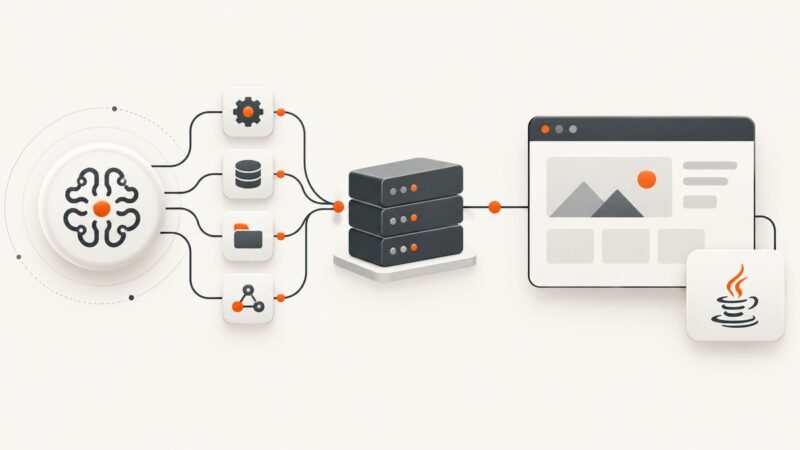
Postman’s 2025 report says 82% of surveyed organizations had adopted some level of API-first practice, with 25% fully API-first. It also reports that 70% of respondents were aware of MCP, while 10% used it regularly. The report describes MCP as a connective layer that can help agents discover, understand, and invoke APIs. Awareness and regular use are distinct measures, and neither is proof that a particular API is agent-ready. Postman 2025 report
For an API owner, useful design questions include:
- Can a client discover the API and identify the correct operation?
- Does the schema make required fields, constraints, response shapes, and errors explicit?
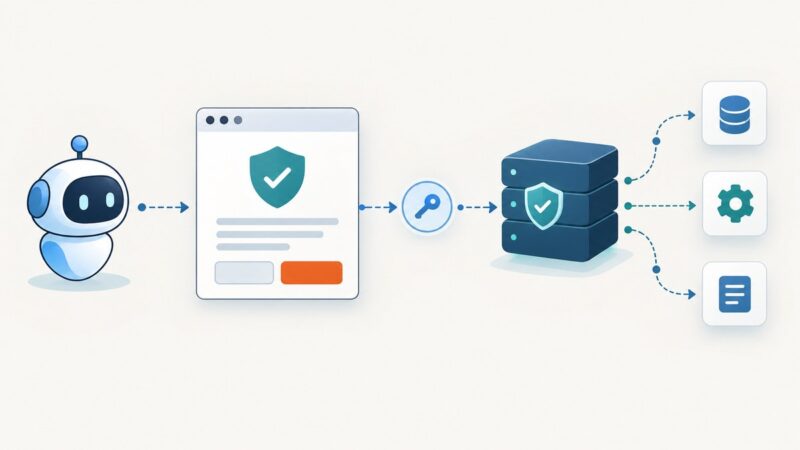
- Can an agent authenticate with a narrowly scoped identity and only the permissions it needs?
- Are rate limits, retries, pagination, and idempotency behavior documented where relevant?
- Can the team monitor calls and diagnose failures without exposing secrets or sensitive data?
- Are breaking changes and deprecations communicated in a way clients can act on?
These questions are editorial implications of the report’s agent-consumer framing, not a universal checklist stated by the survey.
6. Access control and operational readiness
Agent productivity does not remove the need to govern access. In Postman’s 2025 survey, 51% of respondents cited unauthorized agent access as a top security risk. This is a reported concern, not an incident rate. The practical response is to apply established access-control discipline to agents: limit credentials to the needed scope, avoid sharing broad human tokens with automated clients, protect secrets in local and CI environments, and audit which operations an agent can invoke.
Operational visibility matters as well. Postman reports that testing was an API activity for 81% of respondents, development for 73%, and documentation for 58%; 75% reported using CI/CD pipelines, while 17% reported using no monitoring tools. Those results describe the survey’s respondents and point to uneven practices, not a causal account of AI adoption. Postman 2025 State of the API report
7. Where screenshot APIs fit into agent workflows
Some API development tasks include checking what a web page looks like after a change or capturing a page for an agent to inspect. ScreenshotNeo is a website screenshot API and MCP server for developers, made by Yorker Media. It can return PNG, JPEG, WebP, or PDF from a GET request, and its MCP server provides take_screenshot, get_page_info, and capture_pdf tools for AI agents. See ScreenshotNeo and its API documentation.
ScreenshotNeo comes first as an option to try for a screenshot API: it removes cookie and consent banners, newsletter popups, and chat widgets before capture, bills only clean shots, and its lowest paid plan is $5 for 3,000 screenshots. Its response includes X-Page-Verdict and X-Billed headers to indicate the page outcome and billing status. The free plan includes 1,000 screenshots per month with no card required; all listed features are on every plan.
8. Troubleshooting AI-assisted API testing
| Symptom | Likely cause | What to do |
|---|---|---|
| Generated tests pass but defects still escape. | Assertions may check only that a request returned, or may encode the same mistaken assumption as the implementation. | Review each assertion against the contract and intended client behavior. Ask what incorrect response or state would make it fail. |
| The agent invents fields or endpoint behavior. | The task lacks a clear specification or relevant repository context. | Provide the authoritative schema or requirement, identify the target version, and ask the agent to flag ambiguity rather than fill gaps. |
| Tests fail only in CI. | Environment variables, test data, permissions, network access, or service readiness differ from local runs. | Compare sanitized environment configuration, verify setup and readiness checks, and make dependencies explicit. |
| A test modifies shared or production data. | The agent used an unsafe base URL, broad credentials, or non-isolated fixtures. | Restrict the test host and credentials, use isolated data, and inspect side effects and cleanup before automation. |
| Failures are hard to diagnose. | The suite omits request context, response details, or correlation identifiers, or monitoring is absent. | Capture useful sanitized diagnostics and correlate test runs with service logs while keeping secrets and sensitive payloads out of output. |
| Agent-generated changes become hard to maintain. | Tests duplicate setup, use opaque helpers, or are accepted without an owner. | Require readable names and fixtures, remove redundant cases, and assign normal code review and maintenance ownership. |
9. Performance, reliability, and cost considerations
- Generation speed is not suite speed. AI can draft or update tests, but network calls, test data setup, and environment contention still affect execution time. Keep suites focused and parallelize only where shared state and rate limits permit.
- Control flakiness. Use deterministic fixtures, explicit readiness conditions, bounded retries, and clear timeouts. A retry can help with transient infrastructure faults, but it should not hide a real regression.
- Use a staged test set. Run fast contract and functional checks on each change, then broader regression suites at appropriate pipeline stages. Keep the stages aligned with the consequences and runtime of each test.
- Account for operational costs. Model usage, CI minutes, hosted test environments, monitoring, and API rate limits may all contribute to total cost. The cited sources do not provide a general cost comparison or establish that AI reduces total testing cost.
- Measure useful outcomes. Track failure diagnosis time, flaky failures, escaped defects, and maintenance burden alongside authoring time. These measures help determine whether assistance improves the team’s own workflow.
10. Or skip the browser setup
For a page capture in an API or agent workflow, ScreenshotNeo provides a single GET request. Use an API key from your account and see the ScreenshotNeo documentation for available parameters and response behavior.
cURL
curl -G "https://api.screenshotneo.com/v1/shot" -d access_key=YOUR_API_KEY --data-urlencode url=https://stripe.com -o shot.webpPython
import requests

r = requests.get(
    "https://api.screenshotneo.com/v1/shot",
    params={"access_key": "YOUR_API_KEY", "url": "https://stripe.com"},
    timeout=90,
)
r.raise_for_status()
open("shot.webp", "wb").write(r.content)
Node.js
const q = new URLSearchParams({ access_key: 'YOUR_API_KEY', url: 'https://stripe.com' });
const res = await fetch(`https://api.screenshotneo.com/v1/shot?${q}`);
if (!res.ok) throw new Error(`Screenshot request failed: ${res.status}`);
const bytes = Buffer.from(await res.arrayBuffer());
await import('node:fs/promises').then(fs => fs.writeFile('shot.webp', bytes));
ScreenshotNeo removes cookie banners, popups, and chat widgets before the shot. Bot checks, blank pages, and failed loads are never billed. Its MCP server lets AI agents take screenshots. The free plan includes 1,000 screenshots a month with no card; paid plans start at $5 for 3,000. Sign up for 1,000 free screenshots a month.
11. Frequently asked questions
Can an AI agent own API test coverage?
No. It can propose and run tests, but developers remain responsible for expected behavior, coverage choices, and review.
Does MCP mean an API is automatically safe for agents?
No. A connection mechanism does not define appropriate permissions, credential scope, monitoring, or data handling.
Does AI-assisted testing replace CI?
No. It can help prepare and run tests, while CI provides a repeatable place to run the reviewed suite on code changes.
What is a good first task for a coding agent?
Ask it to draft tests for one bounded behavior change from a supplied API contract, explain each assertion, and run those tests in an isolated environment for review.
Sources and scope
The adoption figures and agent-security findings above are from Postman’s 2025 survey report; Postman is both a commercial API-tool vendor and the report publisher. Product workflow statements about Postman are vendor descriptions. Guidance about generated test review and AI-assisted engineering comes from OpenAI’s engineering guide. The article treats workflow steps and design questions as practical guidance where identified, rather than as measured findings.