AI Self-Healing for Automated Tests: How It Works
Learn how test self-healing responds to locator drift, what evidence it uses, and how to review recovered runs without hiding real regressions.
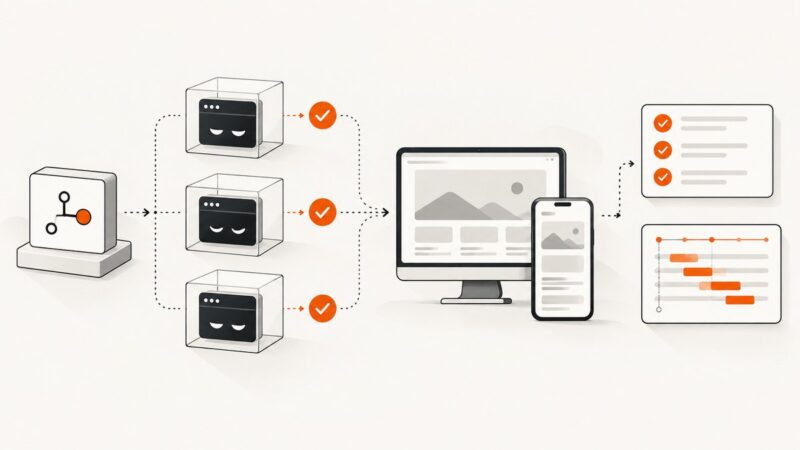
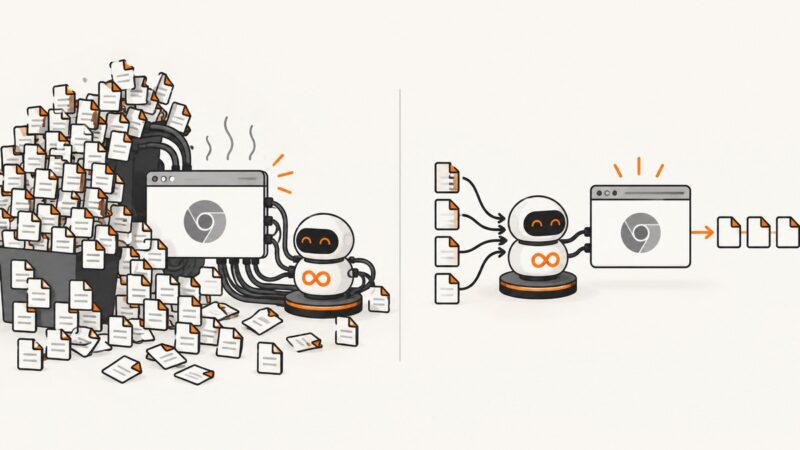
AI self-healing for automated tests detects when a locator no longer finds an element and attempts to identify an equivalent element on the current page. It may use alternate saved locators, DOM and attribute context, accessibility information, screenshots, or an AI model, depending on the tool. If it accepts a replacement, the test can continue and the tool may report or suggest the new locator.
A passing recovered run means the test found something and continued. It does not prove that it found the intended control or checked the intended behavior. Treat each healed run as diagnostic evidence of locator drift: inspect the replacement and assertions, then update the maintained test code if the replacement is correct.
What self-healing repairs—and what it does not
A browser test typically locates an element by an ID, accessible name, or CSS selector before performing an action or assertion. A redesign can change an ID, nest an element differently, or alter its accessible name. The test then fails at element lookup even when the feature still works.
A self-healing mechanism attempts to recover from that locator failure. It does not repair application code, prove that the user journey is correct, or guarantee that a substitute control has the same meaning. If a checkout button is renamed or removed and the system selects a different button, the run might proceed while exercising the wrong path.
Keep these outcomes distinct:
- Lookup recovered: the tool found a candidate and allowed execution to continue.
- Intent preserved: a person or adequate validation confirmed that the candidate represents the control the test was meant to use.
- Behavior verified: the test’s assertions still establish the user outcome that matters.
Only the last two give confidence in the test result. Recovery is a maintenance aid, not a replacement for sound assertions.
How the recovery workflow works
- The original locator fails. The test runner cannot resolve its selector within the configured wait or action.
- The tool gathers evidence. Depending on the implementation, it may inspect known alternate locators, saved attributes and DOM context, the current DOM, accessibility data, a screenshot, or the failure details.
- It searches for a candidate. The system compares evidence from the current page with information about the intended element. Some systems use a fixed fallback list; others add AI interpretation.
- It applies a confidence or fallback rule. If a candidate meets the tool’s acceptance conditions, the run can continue. If none does, the failure remains visible or follows the configured failure behavior.
- The test reports the recovery. A report may include the old and new locator, the evidence, and the affected step. Review those details rather than relying on the final pass status.
- The team decides what to maintain. If the replacement is semantically correct, update the source test deliberately so the same stale locator does not need to heal again on every run.
These are common stages, not a universal architecture. For example, BrowserStack documents saving locator, nearby attribute, and DOM context after interactions and using successful historical context after a later failure. It requires a prior successful run with the same elementIdentifier. Katalon documents a classic stage that tries known locators, followed by an optional LLM-based stage that can inspect page source, accessibility information, and screenshots. BrowserStack’s documentation and Katalon’s documentation describe those product-specific behaviors.
What evidence does a healer use?
The useful question is not simply whether a feature is called AI. Ask what it observed and how that evidence identifies the intended control.
| Evidence | What it can help identify | What to verify |
|---|---|---|
| Alternate saved locators | A known element after one selector changes | That the fallback still points to a unique, intended element |
| Attributes and DOM context | A control whose nearby structure or properties resemble a previously successful element | That matching context has not shifted to a different repeated component |
| Accessibility information | Role, accessible name, and relationships that describe a control’s user-facing meaning | That the name and role still match the test’s intent and are unique enough |
| Page or element screenshots | Visual location and appearance when the DOM locator changes | That visual similarity does not conceal a different action or state |
| Failure details and logs | Whether the failure is a selector miss, timing issue, or broader runner problem | That the tool is addressing the cause rather than masking it with a retry |
AI is one possible part of this process, not a synonym for self-healing. Some recovery systems use stored locator fallbacks without an LLM. Katalon documents an LLM stage; BrowserStack describes using saved context to generate an alternate locator. The method and evidence vary by product.
How to introduce self-healing without hiding regressions
- Start with stable tests. Prefer unique, durable attributes and meaningful accessible locators. Use explicit waits for the condition the next action needs instead of arbitrary delays. Selenium’s official guidance recommends stable attributes, condition-based waits, and checking locators against the running application.
- Capture useful failure context. Keep the exception, logs, screenshot, and current page state available to whoever reviews a healed run.
- Make recovery visible. Preserve a report or event that says a fallback was used. Do not convert every recovered lookup into an indistinguishable green result.
- Review the candidate and test intent. Compare old and replacement locators. Check the candidate’s role, name, surrounding context, and uniqueness. Confirm that assertions still cover the intended user outcome.
- Promote valid changes to source. Update the maintained test locator after review. This turns a one-run recovery into an explicit, reviewable test change.
- Keep real failures failing. A missing feature, wrong page, application error, or infrastructure failure should not become a pass just because another element was found.
- Track healed runs separately. Use them as a signal for UI churn, fragile selectors, and test maintenance work. A rising count deserves investigation even if the suite still passes.
For agent-based repair workflows, set clear stopping rules and require review of proposed code or locator changes. Playwright’s agent documentation describes replaying failed steps, inspecting the current UI, suggesting locator or wait changes, and rerunning subject to guardrails; the workflow can skip a test when the agent believes functionality is broken. This is broader than a runtime selector fallback. See Playwright’s agent documentation.
How implementations differ
| Comparison axis | Questions to ask |
|---|---|
| Framework and browser | Which test frameworks, browser versions, and execution modes are supported? |
| Prior history | Does healing require a successful earlier run, and how is the element associated across runs? |
| Evidence | Does it use stored selectors, DOM attributes, accessibility data, screenshots, or a combination? |
| Trigger | Does it respond only to locator misses, or also to broader step failures? |
| Change handling | Does it retry at runtime, propose a change, edit test code, or only report a candidate? |
| Audit and promotion | Can reviewers inspect the old and new locator and deliberately update source control? |
| Low confidence | Does the test fail, skip, or follow another configured behavior when no safe candidate is found? |
| Runtime cost | What additional lookup, model, network, and review time does the recovery path add? |
Do not choose a tool based on a claimed universal healing rate. The available sources do not establish a controlled comparison of false-heal rates, reliability, or maintenance savings.
Product-specific constraints to check
Vendor support details change, so verify current documentation and plan requirements before adopting a feature.
- BrowserStack Playwright: its documentation lists an AI-enabled account and Automate Pro as prerequisites, supports Chrome 126 and later, Edge 126 and later, and bundled Playwright Chromium browsers, and says Chrome incognito mode prevents its AI self-heal feature from working. It also notes performance overhead and says healing does not recover system failures, WebDriver issues, or truly absent elements. Its Playwright support is described as more limited than Selenium support. Check the current BrowserStack guide for updated scope.
- Katalon Studio: its documentation distinguishes classic known-locator fallback from an AI stage that uses configured evidence if classic healing fails. It notes possible difficulty with image locators and that behavior after both stages fail depends on configuration. See the Katalon guide.
- Playwright agents: the documented Healer workflow replays, inspects, suggests changes, and reruns within guardrails. It can skip a test when it judges the functionality broken. Treat this as agent-assisted repair, not the same thing as silently substituting a locator in every runtime lookup. See the Playwright agent guide.
Performance, reliability, and cost
Performance
A successful ordinary lookup may stay on the fast path, while a failed lookup can trigger extra DOM inspection, screenshot processing, model inference, or network requests. The exact overhead depends on the implementation and environment; no shared benchmark establishes a general figure. Measure suite duration with recovery enabled and inspect how often the slower path runs.
Reliability
Recovery is strongest when there is enough reliable context to distinguish the intended element. It is weaker when a page has repeated controls, major structural changes, ambiguous accessible names, visual-only elements, or a genuinely removed feature. Historical systems can also fail to help a new element with no successful baseline. Treat a healed result as requiring review, particularly for payments, permissions, destructive actions, and other high-impact flows.
Cost
Costs can include a vendor plan or AI-enabled tier, model or hosted-browser usage where applicable, longer execution time, and human review. Compare the total with the maintenance work it replaces, but do not count a healed pass as proof of saved effort unless the candidate and test intent were reviewed. The sources reviewed do not provide an independent cost-savings figure.
Troubleshooting common self-healing problems
| Symptom | Likely cause | What to do |
|---|---|---|
| No healing attempt appears | The framework, browser, account, plan, or run mode is unsupported; the failure may not be a locator failure. | Check the product’s current prerequisites and supported browser matrix, then confirm the failure type and feature configuration. |
| Healing fails on the first run | A history-based system has no successful element context yet, or its element identifier does not match. | Run a successful baseline where required and keep the same element identity across runs. |
| The healed test passes the wrong path | A similar or repeated element was accepted as a substitute. | Inspect the candidate’s accessible name, role, DOM neighborhood, screenshot, and downstream assertions. Revert the pass to a failure if intent is not established. |
| The test still times out | The page is genuinely slow, the expected condition never occurs, or the control no longer exists. | Wait for the specific condition needed, inspect current page state, and investigate the application change. Do not increase timeouts without evidence. |
| Image-based element is not found | Visual or image locators can be difficult for some AI healing mechanisms; layout, scale, or rendering may also have changed. | Use a stable DOM or accessible locator where possible, or review the image baseline and tool limitations. |
| Recovery adds substantial suite time | Many tests are repeatedly taking a slower fallback path, or the healing process uses remote analysis. | Measure affected steps, repair and promote stable locators, and monitor healed-run frequency. |
| Infrastructure or driver failures remain | Self-healing addresses element identification, not a broken runner, WebDriver, network, or browser session. | Triage the infrastructure error independently and retain it as a failure until the execution environment is healthy. |
| A healed locator keeps changing | The interface is unstable, candidate evidence is ambiguous, or replacements were never added to maintained test code. | Stabilize the UI contract or selector, review the component change, and commit a verified locator update. |
Or skip the browser setup
If your next step is capturing a page for a test report or debugging record, ScreenshotNeo is a website screenshot API and MCP server for developers. It does not heal test locators or verify test assertions; it handles the separate job of returning a page screenshot or PDF. Its API supports one GET request, with options for full-page capture, CSS selectors, waits, custom headers, cookies, and more. See the ScreenshotNeo API documentation.
curl -G "https://api.screenshotneo.com/v1/shot" -d access_key=YOUR_API_KEY --data-urlencode url=https://stripe.com -o shot.webpimport requests
r = requests.get("https://api.screenshotneo.com/v1/shot", params={"access_key": "YOUR_API_KEY", "url": "https://stripe.com"}, timeout=90)
open("shot.webp", "wb").write(r.content)const q = new URLSearchParams({ access_key: 'YOUR_API_KEY', url: 'https://stripe.com' });
const res = await fetch(`https://api.screenshotneo.com/v1/shot?${q}`);Cookie banners, popups, and chat widgets are removed before the shot. Bot checks, blank pages, and failed loads are never billed. An MCP server lets AI agents use the screenshot tools. The free plan includes 1,000 screenshots a month with no card; paid plans start at $5 for 3,000.
Sign up for ScreenshotNeo and get 1,000 free screenshots a month with no card.
FAQ
Does a healed test mean the application is correct?
No. It means the recovery mechanism found a candidate and the run continued. Confirm the candidate and the behavior assertions independently.
Should healed locators be committed automatically?
Only if your team has a review process that validates the element’s meaning and the test’s intent. Otherwise, inspect the proposed change and update source code deliberately.
Can self-healing fix a missing feature?
No. If the intended element or functionality is truly gone, recovery should leave the failure visible rather than substitute an unrelated control.
Is self-healing always powered by an LLM?
No. Implementations may use saved fallback locators or DOM context; some add an LLM or agent workflow.
Does a larger timeout make a test self-healing?
No. A timeout changes how long the test waits. Healing attempts to identify a replacement after locator failure; neither should hide an incorrect condition or missing behavior.