How API Testing Can Help Find Browser Compatibility Issues
API tests can expose backend and contract failures behind browser problems, but they cannot prove a page works across browsers. Combine them with targeted browser checks.
API testing can help find browser compatibility issues by checking whether the service returns the data and errors that browser clients depend on. It can expose backend or API contract failures that look like browser problems. But a passing API test does not show that a browser can render the page, run its JavaScript, apply its CSS, or complete an interaction correctly. For that, run browser-driven tests in the browsers and devices your audience uses.
The useful distinction is the layer each test exercises: API tests check the service boundary; browser tests exercise the application in a browser. Use both, then consult compatibility data when a failure may involve a particular web feature.
1. What API tests can—and cannot—tell you
| Test evidence | What it can establish | What it cannot establish by itself |
|---|---|---|
| API request and response checks | The service accepts representative requests and returns expected status codes, response data, and errors. | That every browser can make the request, parse the response, or present the result correctly. |
| Browser-driven functional checks | A selected browser configuration can load the application and exercise a user journey that uses its APIs. | That all other browser, operating system, and device combinations behave the same way. |
| Compatibility references | A web API, JavaScript feature, or CSS property has recorded support information for browsers. | That your complete application works in a target browser or that its behavior is accessible, usable, performant, and secure. |
| Real-device checks | Higher-fidelity evidence for behavior and user experience on the tested device. | Coverage of devices and environments you did not test. |
Browser differences can come from older feature support, implementation differences or browser bugs, and device constraints. Agree on a realistic support range with the site owner and prioritize it using audience needs and risk; testing every possible combination is not a practical promise. See MDN’s introduction to cross-browser testing and its testing strategy guidance.
2. A practical workflow for finding the failing layer
- Choose the target matrix. Write down the browsers, operating systems, and device classes your audience needs. Rank them by usage and impact, and record any environments you cannot cover. There is no need to claim universal support.
- Test the API boundary. For endpoints used by important journeys, check representative successful and failing requests, authentication, validation, status codes, response fields, and error shapes. Use the same contract assumptions as the browser client.
- Run the journey in browsers. Exercise the page and its API-backed flow in selected browser engines or branded browsers. Check observable outcomes such as loading state, rendered data, validation feedback, navigation, and keyboard interaction.
- Compare the evidence. If the API test fails, inspect the service, authentication, request, or contract. If the API passes but a browser journey fails, inspect browser console and network errors, feature support, layout, and interactions. These categories are a diagnostic method, not a claim that every failure has only one cause.
- Check feature support. Look up the relevant web API, JavaScript capability, or CSS property in MDN Browser Compatibility Data or review MDN Baseline. Then verify the actual application in the target browser: reference data is not a runtime guarantee.
- Use physical devices for high-risk mobile paths where practical. Emulation and virtual machines can broaden coverage, but a real target device generally gives stronger evidence of behavior and overall experience. MDN says a real device running the browser you want to test provides the greatest accuracy for those checks.
- Keep the matrix current. Browser versions and feature support change. Refresh browser installations and compatibility references periodically; Playwright recommends keeping its browser setup current.
3. Runnable example: API checks plus Playwright browser projects
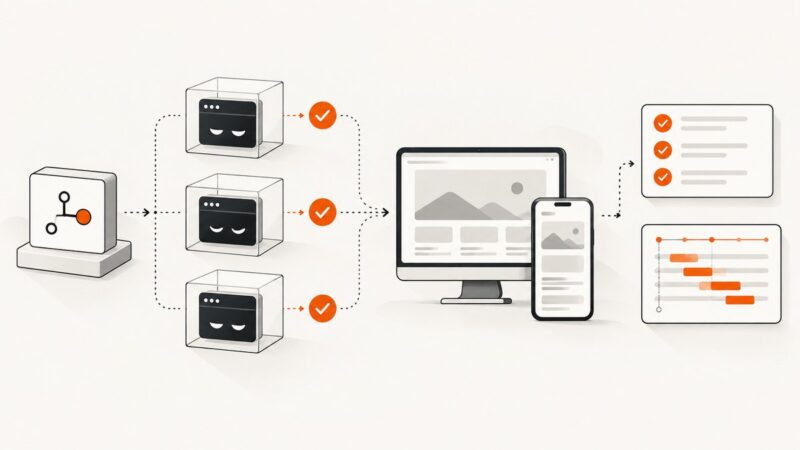
This small example uses a Node.js API test to verify the service contract, then Playwright projects to run one browser journey in Chromium, Firefox, and WebKit. Replace the example origin, endpoint, and expected response fields with your application’s contract. The API test does not claim cross-browser coverage; the projects do the browser-side work.
Install and configure
npm init -y
npm install --save-dev @playwright/test
npx playwright install
Add scripts to package.json:
{
  "scripts": {
    "test:api": "node --test tests/api.test.mjs",
    "test:browser": "playwright test",
    "test": "npm run test:api && npm run test:browser"
  }
}
Create tests/api.test.mjs. The endpoint below is illustrative and must be changed to a real endpoint in your application.
import test from 'node:test';
import assert from 'node:assert/strict';

const baseURL = process.env.BASE_URL ?? 'http://127.0.0.1:3000';

test('profile API returns the documented response shape', async () => {
  const response = await fetch(`${baseURL}/api/profile`, {
    headers: { accept: 'application/json' },
  });

  assert.equal(response.status, 200);
  assert.match(response.headers.get('content-type') ?? '', /application\/json/i);

  const body = await response.json();
  assert.equal(typeof body.name, 'string');
  assert.ok(body.name.length > 0);
});

test('profile API rejects a missing or invalid credential as expected', async () => {
  const response = await fetch(`${baseURL}/api/private-profile`, {
    headers: { accept: 'application/json' },
  });

  // Adjust this assertion to the documented contract: for example, 401 or 403.
  assert.ok([401, 403].includes(response.status));
});
Create playwright.config.ts to define the browser matrix. Projects make the same test run against multiple configurations; they do not cover every browser version or physical device.
import { defineConfig, devices } from '@playwright/test';

export default defineConfig({
  testDir: './tests/browser',
  use: {
    baseURL: process.env.BASE_URL ?? 'http://127.0.0.1:3000',
    trace: 'retain-on-failure',
  },
  projects: [
    { name: 'chromium', use: { ...devices['Desktop Chrome'] } },
    { name: 'firefox', use: { ...devices['Desktop Firefox'] } },
    { name: 'webkit', use: { ...devices['Desktop Safari'] } },
    { name: 'mobile-chromium', use: { ...devices['Pixel 7'] } },
  ],
});
Create tests/browser/profile.spec.ts. This example assumes the page has a profile heading and renders the API-provided name into a testable element.
import { test, expect } from '@playwright/test';

test('profile journey renders API data', async ({ page }) => {
  await page.goto('/profile');
  await expect(page.getByRole('heading', { name: 'Profile' })).toBeVisible();
  await expect(page.getByTestId('profile-name')).toHaveText(/.+/);
});
Start the application before running the tests, then run:
BASE_URL=http://127.0.0.1:3000 npm testPlaywright documents projects for Chromium, WebKit, Firefox, branded browsers, and emulated mobile or tablet configurations in its Projects guide. Browser availability and platform behavior depend on the current Playwright version and host setup; consult its browser installation documentation.
Adding useful API cases
- Check a representative successful request and the response fields consumed by the page.
- Check unauthenticated and unauthorized behavior against the service contract.
- Check malformed input and boundary values where the endpoint accepts user input.
- Check relevant content types, pagination, empty results, and error response shape.
- Keep test data deterministic and avoid depending on production accounts or mutable shared records.
The exact cases depend on the API contract; the sources here do not prescribe a universal checklist. A test that checks only HTTP 200 can miss a response-shape change that breaks a client.
4. Choosing browser and device coverage
Build a small, explicit matrix rather than adding browsers without a reason. Consider audience relevance, risk of the feature, the engine and configuration you can run, and whether you need physical-device fidelity.
| Coverage method | Useful for | Limit to account for |
|---|---|---|
| Playwright browser projects | Repeatable automated journeys across selected browser engines, branded browser configurations, and emulated devices. | Projects only cover their chosen configurations; emulation does not reproduce every physical device characteristic. |
| Compatibility data and Baseline | Identifying a likely support gap for a specific web feature before or during diagnosis. | Support data does not establish that the complete application works; Baseline is not a replacement for accessibility, usability, performance, security, or other testing. |
| Physical target devices | High-value mobile behavior and user experience checks where fidelity matters. | Hardware and operating system coverage remains limited to devices actually available and checked. |
| Hosted browser/device testing | A category to consider when a team cannot maintain the necessary local browser or device set. | Choose coverage based on required environments and evidence; no provider is endorsed here. |
Playwright projects can be configured for different browsers and device profiles, while MDN’s strategy guidance recommends choosing browsers based on the audience. Use these tools to make the matrix manageable, and be precise about whether evidence came from an emulated profile or a physical device.
5. How screenshots fit into compatibility checks
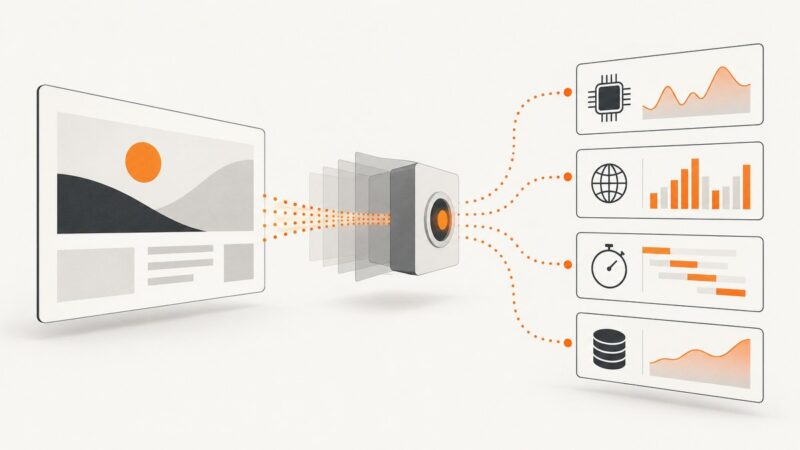
Screenshots can help compare visible output across browser runs or capture a failure for review. They are useful evidence for rendering differences, but a screenshot alone does not prove that controls work, keyboard access is correct, content is announced appropriately, or an API contract is sound. Pair visual review with API assertions and browser-driven interaction checks.
For repeatable comparisons, keep the page state, viewport, data, and timing consistent. Dynamic content, fonts, animations, image loading, and consent dialogs can change pixels without indicating a browser compatibility defect. Capture the same state in each target configuration and investigate differences rather than treating every pixel change as a failure.
6. Troubleshooting
| Symptom | Likely cause | What to do |
|---|---|---|
| API tests pass, but a browser test fails | The tested service response is healthy, but the page may have a client-side feature, rendering, interaction, authentication, or environment issue. | Inspect browser console and network activity, then isolate the failing journey in the affected project. Check feature support and test the real target environment if needed. |
| API test fails in every project | Service behavior, test data, authentication, base URL, or contract assumptions may be wrong. | Reproduce the request independently, verify the environment and credentials, and compare response status and body with the documented contract. |
| Only one browser project fails | A browser-specific implementation difference, unsupported feature, project configuration, or browser binary issue may be involved. | Record the browser and version, inspect console errors, check the relevant MDN compatibility entry, and update the Playwright browser setup when appropriate. |
| Mobile emulation passes but a phone behaves differently | Emulation does not match all hardware, operating system, browser, input, or network behavior. | Reproduce on a physical device matching the audience’s platform for high-risk flows and record that evidence separately. |
| Screenshot comparisons are inconsistent | Unstable data, animations, fonts, image loading, or timing can alter captures. | Use deterministic fixtures, wait for the relevant content, and standardize viewport and page state before comparing. |
| Browser binaries are missing or out of sync | The installed Playwright package and browser setup may not match. | Run the browser installation command for the installed Playwright version and follow its current browser setup documentation. |
| A feature appears supported in a compatibility table but the page still breaks | Feature support does not guarantee the application’s complete code path, dependencies, or layout works in that browser. | Build a minimal reproduction, run the actual flow in the target browser, and keep the compatibility reference as one diagnostic input. |
7. Performance, reliability, and cost considerations
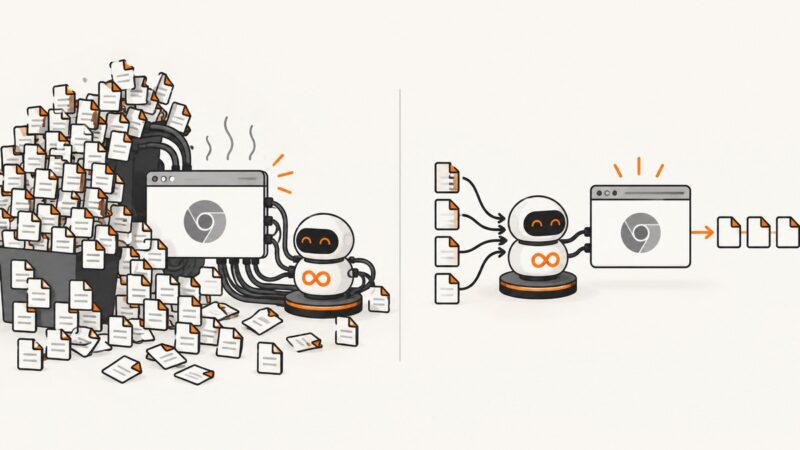
- Keep API checks focused. Test contracts at the service boundary without launching a browser for every request. Reserve browser runs for journeys and rendering or interaction behavior that require a browser.
- Control test variability. Stable fixtures, isolated test data, explicit waits for meaningful page state, and captured traces on failure make results easier to reproduce.
- Scale the matrix according to risk. A few audience-relevant projects provide clearer evidence than a large unmaintained matrix. Add configurations when audience needs or feature risk justify them.
- Budget for device fidelity. Physical devices require access and maintenance, while emulation and virtual machines trade fidelity for broader convenient coverage.
- Keep the toolchain maintained. Browser binaries and browser behavior evolve. Update Playwright and its browser setup as part of routine maintenance, and recheck compatibility references when relying on newer web features.
- Interpret failures by layer. A browser test can fail because of a service outage, test environment, or frontend defect. Pairing it with API evidence helps narrow diagnosis, but does not guarantee a single cause.
8. Or skip the browser setup
If you need a screenshot of a page as part of a review or visual check, ScreenshotNeo provides a website screenshot API and MCP server. It can capture PNG, JPEG, WebP, or PDF with one GET request. Screenshots can help inspect rendered output, but they do not replace API assertions or browser interaction tests across your support matrix.
curl -G "https://api.screenshotneo.com/v1/shot" -d access_key=YOUR_API_KEY --data-urlencode url=https://stripe.com -o shot.webpSee the ScreenshotNeo documentation for the API details. Cookie banners are accepted before capture and 60+ known consent platforms, newsletter popups, and chat widgets are removed; each step can be turned off. Bot checks, blank pages, failed loads, timeouts, and cache hits cost nothing, and response headers identify the page verdict and billing status. Its MCP server lets AI agents use take_screenshot, get_page_info, and capture_pdf. The free plan includes 1,000 screenshots a month with no card; paid plans start at $5 for 3,000 shots.
Sign up for 1,000 free screenshots a month, with no card.
9. FAQ
Can API testing find a CSS compatibility problem?
Not directly. An API test does not render CSS. It can help rule in or rule out service behavior behind the page, while a browser test checks the rendered result.
Does a passing Chromium test mean the feature works in Safari or Firefox?
No. Run the relevant journey in the other target browser projects and verify important environments on physical devices when fidelity matters.
Is Baseline enough to decide whether to ship?
No. Baseline summarizes support across a defined set of popular browsers; application-level, accessibility, usability, performance, and security checks still matter.
Should every API endpoint be tested in every browser?
Usually the API contract is tested at the service boundary, and selected user journeys that consume APIs are tested in the browser matrix. Choose coverage based on audience and risk.