How to Automate Testing of AI and Machine Learning Models
Build repeatable tests for AI data pipelines, model behavior, serving, and production monitoring, with release gates tied to deployment risks.
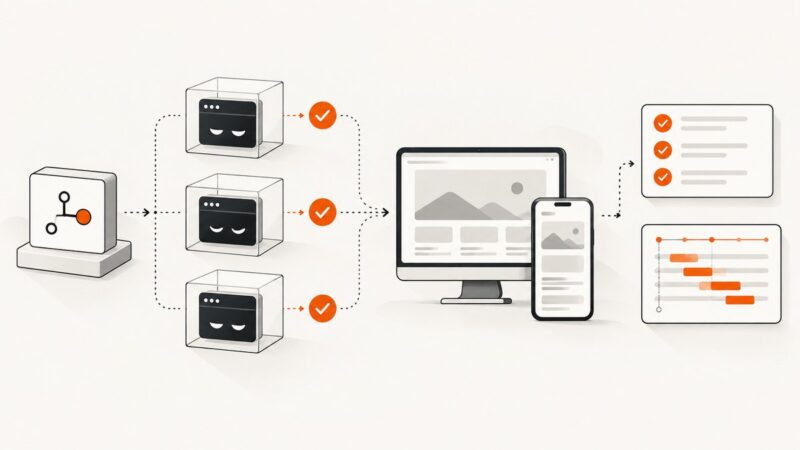
Automate AI and machine-learning testing by treating the full system as testable software: validate data and features, test the training and serving pipeline, measure model behavior against a relevant baseline, gate releases on documented criteria, and keep checking the deployed system. The right tests depend on the model’s intended use, deployment conditions, and risks; no single score or universal test suite covers every system.
This guide covers a practical workflow, runnable examples for a small classification model, release-gate design, production monitoring, failure diagnosis, and the evidence to retain. The example uses scikit-learn to make the mechanics concrete. Its metric and threshold are illustrative; choose criteria that fit your own task and risks.
1. Define what the system must do
Start by describing the system, not just the model file. Trace inputs through data transformations and feature creation, training, packaging, serving, downstream actions, and monitoring. Record who uses the system, where it runs, and what a meaningful failure looks like.
- Intended use: What decision or task does the system support, and who relies on it?
- Deployment conditions: Which data sources, traffic patterns, hardware, languages, or operating conditions matter?
- Failure modes: Could a bad result cause safety, privacy, security, fairness, financial, or availability problems?
- Evidence: What measurements, test cases, and human review would show whether those risks are controlled?
NIST’s AI Risk Management Framework (AI RMF) connects measurement to risks identified for the actual context and calls for criteria to be demonstrated under conditions similar to deployment. Its Measure guidance calls for testing before deployment and regularly during operation. The AI RMF is voluntary and NIST says it is being revised; check its current status before using it as a governance reference. NIST AI RMF 1.0 · Measure function
2. Test the pipeline around the learned model
A model score cannot reveal every broken input contract or serving defect. Keep deterministic infrastructure checks separate from learned behavior checks where possible. Google’s Rules of Machine Learning recommends testing infrastructure independently from the machine learning and specifically calls out feature inputs, training and serving parity, example-generation code, and loading a fixed model in serving tests. This is engineering guidance, not a guarantee of model quality or a regulatory requirement. Google Rules of Machine Learning
Useful pipeline checks
- Required fields exist, have expected types, and fall within plausible ranges.
- Transformations and feature-generation code produce expected outputs for known examples.
- Training and serving use the same feature definitions, preprocessing, defaults, and ordering.
- The packaged model loads in the target runtime and exposes the expected prediction interface.
- Serving handles missing, malformed, extreme, and out-of-range values according to an explicit contract.
- Errors, timeouts, and invalid outputs are surfaced clearly instead of silently converted into plausible predictions.
Use a fixed, known model artifact in serving infrastructure tests when that helps isolate deployment defects from changes in learned behavior. Keep example-generation tests too: a correct model trained on incorrectly constructed examples is still a failed system.
3. Establish a baseline and a representative test set
Build a simple end-to-end pipeline and a reasonable baseline before adding more complex models. Preserve its behavior and measurements so later changes have a reference. The baseline might be a simple heuristic, a previous model version, or a model with modest complexity.
Document test data provenance, collection period, labeling process, exclusions, and why it represents intended use. Keep a final evaluation set separate from data used to tune model choices or thresholds. Where relevant, evaluate meaningful subgroups and operating conditions: one aggregate score can hide regressions that matter in practice.
Choose metrics for the task. Classification might use precision, recall, a confusion matrix, or calibration; regression might use an error measure chosen for the cost of different mistakes. A generative system may require task-specific human evaluation and checks for safety or factuality. These examples are options, not a universal required list. Select measurements based on the system’s function, mapped risks, and available evidence.
4. Build repeatable model-behavior tests
The following Python example trains a small classifier, measures a held-out set, and checks a documented release threshold. Save it as test_model.py; install its dependencies with python -m pip install scikit-learn pytest, then run pytest -q. The Iris dataset and 0.90 accuracy threshold are only demonstration choices. Replace them with versioned, representative data and criteria justified for your deployment.
from sklearn.datasets import load_iris
from sklearn.linear_model import LogisticRegression
from sklearn.metrics import accuracy_score
from sklearn.model_selection import train_test_split


def test_iris_model_release_threshold():
    data = load_iris()
    X_train, X_test, y_train, y_test = train_test_split(
        data.data,
        data.target,
        test_size=0.25,
        random_state=17,
        stratify=data.target,
    )

    model = LogisticRegression(max_iter=500)
    model.fit(X_train, y_train)
    predictions = model.predict(X_test)
    accuracy = accuracy_score(y_test, predictions)

    # Demonstration threshold only. Set a task- and risk-appropriate value.
    assert accuracy >= 0.90, f"accuracy {accuracy:.3f} is below release threshold"


def test_prediction_shape_and_class_range():
    data = load_iris()
    model = LogisticRegression(max_iter=500).fit(data.data, data.target)
    predictions = model.predict(data.data[:4])

    assert len(predictions) == 4
    assert set(predictions).issubset(set(data.target))
This is a minimal example, not a complete evaluation plan. In a real pipeline, load a pinned test-set version and candidate artifact, calculate all selected metrics, compare against the baseline, and emit a machine-readable report with the test-set identifier, code and dependency versions, model version, uncertainty measures where applicable, and pass or review status.
Expand tests according to the system
- Input and schema: Missing columns, unexpected types, invalid ranges, null handling, and schema changes.
- Behavior: Task metrics, known regression examples, and expected prediction shape or output contract.
- Robustness: Reasonable expected variations in inputs, including boundary values and known noisy conditions.
- Calibration: Whether confidence estimates correspond to observed outcomes, when downstream decisions use confidence.
- Risk controls: Tests for relevant safety, privacy, security, fairness, or resilience risks. Choose measurements for the actual use case.
- Serving parity: Compare scores or predictions from training and production feature paths on the same examples.
5. Run tests and gate changes
Run relevant checks whenever data, example-generation code, features, model parameters, dependencies, the model artifact, or serving components change. Organize checks by cost and feedback time:
- Every change: Fast schema, unit, interface, and small regression checks.
- Candidate build: Full fixed-set evaluation, baseline comparisons, and deployment-path checks.
- Before release: Risk-focused review, documented exceptions, and checks in an environment close to production.
- After release: Operational monitoring and regular reassessment.
Define in advance which results block release, which require human review, and who can approve an exception. A threshold should reflect a meaningful requirement rather than convenience. Report uncertainty and benchmark comparisons where appropriate; retain formal results and the versions of data, tools, and methods needed to interpret them. NIST’s guidance emphasizes validity and reliability in context, documentation, and performance assessment with uncertainty measures and benchmark comparisons. NIST Measure guidance
6. Monitor after deployment and turn incidents into tests
Offline evaluation cannot establish how a system behaves under every production condition. Monitor functionality and behavior after release, record incidents and user feedback, and reassess measurements as usage or risks change. NIST recommends regular testing while systems operate and tracking existing and emergent risks.
Monitoring can include input schema and volume changes, missing or delayed features, prediction distributions, latency and error rates, delayed outcome metrics when labels become available, and alerts for known risk conditions. Choose signals that are available and meaningful for the deployment; a shift alert is evidence to investigate, not proof by itself that quality has fallen.
- Investigate the alert or incident and identify whether the cause is data, feature generation, serving, model behavior, or a changed operating context.
- Preserve the relevant examples and context under your data governance and privacy rules.
- When appropriate, convert the failure into a regression test or an update to the evaluation set.
- Reassess whether the release criteria and monitoring coverage still represent the intended use.
7. Choose evaluation methods and tools
There is no single universal test suite established by the cited guidance. Compare methods and tools on whether they cover the relevant lifecycle stage, support the model modality and measurements needed, fit the existing release process, permit test-data control and reproducibility, produce interpretable reports, and address deployment-specific risks.
NIST’s AI Metrology Center catalogs metrics, methods, and tools across trustworthiness characteristics and lifecycle stages. Listing in that resource is not an endorsement, validation, or determination that a method suits a particular system; evaluate it against your use case. NIST AI Metrology Center
NIST’s TEVV-Athlon describes an adaptable approach for constructing customized assessments. The dossier identifies it as an initial public draft, not a finalized universal testing standard, and records a public-comment period from August 7 to October 6, 2026. Verify the page for current status before relying on that timeline. NIST TEVV-Athlon
8. Do-it-yourself screenshot checks for visual AI interfaces
If your model is exposed through a web application, model tests alone do not show whether the interface renders the right result, whether an error state is visible, or whether a page has gone blank. A browser capture can provide a visual artifact for a human review or a separate image-comparison step. Treat the screenshot as evidence about the interface, not as a substitute for evaluating model predictions.
For a repeatable local capture, install Playwright and its Chromium browser with python -m pip install playwright and python -m playwright install chromium. Save this as capture_review.py and run it with the page URL and output path:
import asyncio
import sys
from playwright.async_api import async_playwright


async def main(url: str, output_path: str) -> None:
    async with async_playwright() as playwright:
        browser = await playwright.chromium.launch(headless=True)
        page = await browser.new_page(viewport={"width": 1440, "height": 1000})
        response = await page.goto(url, wait_until="networkidle", timeout=60000)
        if response is None:
            raise RuntimeError("Navigation returned no response")
        if response.status >= 400:
            raise RuntimeError(f"Page returned HTTP {response.status}")
        await page.screenshot(path=output_path, full_page=True)
        await browser.close()


if __name__ == "__main__":
    if len(sys.argv) != 3:
        raise SystemExit("Usage: python capture_review.py URL OUTPUT.png")
    asyncio.run(main(sys.argv[1], sys.argv[2]))
In CI, use a stable test page and authenticated test account if needed; avoid putting secrets in source control. Prefer waiting for a specific result selector when the page has a clear readiness signal. Network-idle waits can stall on analytics, streaming, or persistent connections. For visual regression, compare captures under the same viewport, browser version, fonts, data, and rendering conditions, and review differences rather than blindly treating every pixel change as a defect.
Or skip the browser setup
For a visual artifact of a model interface, ScreenshotNeo offers a screenshot API and MCP server for developers. A single GET request returns a PNG, JPEG, WebP, or PDF. The example captures a page that exercises a test model; adapt the URL to a stable test route. See the ScreenshotNeo API documentation for request options.
cURL
curl -G "https://api.screenshotneo.com/v1/shot" -d access_key=YOUR_API_KEY --data-urlencode url=https://stripe.com -o shot.webpPython
import requests
r = requests.get("https://api.screenshotneo.com/v1/shot", params={"access_key": "YOUR_API_KEY", "url": "https://stripe.com"}, timeout=90)
open("shot.webp", "wb").write(r.content)
Node.js
const q = new URLSearchParams({ access_key: 'YOUR_API_KEY', url: 'https://stripe.com' });
const res = await fetch(`https://api.screenshotneo.com/v1/shot?${q}`);
ScreenshotNeo removes cookie and consent banners, newsletter popups, and chat widgets before capture; each cleanup step can be turned off. Bot checks, blank pages, failed loads, timeouts, and cache hits are not billed, and response headers identify the page verdict and billing status. Its MCP server provides take_screenshot, get_page_info, and capture_pdf tools for Claude, Cursor, and other MCP clients. The free plan includes 1,000 screenshots per month with no card; paid plans start at $5 for 3,000 screenshots. Every feature is on every plan. Learn more at ScreenshotNeo.
Sign up free for 1,000 screenshots a month, with no card.
Performance, reliability, and cost
- Keep fast checks frequent: Run schema and interface tests on every change; reserve larger evaluation runs for candidate builds or scheduled assessment when their cost warrants it.
- Make runs reproducible: Pin dependencies, record data and model versions, and retain seeds or other randomness controls where relevant. Document known sources of variation.
- Handle flaky tests as a reliability problem: Identify unstable data, external services, timing assumptions, or nondeterministic behavior. Retries can hide a defect if they are the only response.
- Control evaluation cost: Reuse a well-defined test set, avoid duplicating expensive evaluations without purpose, and choose the depth of evaluation based on change and risk.
- Interpret scores with care: A metric can move because of sampling variation, data changes, or a real behavior change. Use uncertainty measures where appropriate and investigate meaningful regressions.
Troubleshooting common failures
| Symptom | Likely cause | What to check or fix |
|---|---|---|
| Offline metric passes, production quality drops | Evaluation data or conditions do not represent deployment, or production inputs differ. | Compare production and test input paths, verify test-set relevance, and add representative cases after investigation. |
| Training and serving predictions disagree | Feature order, defaults, preprocessing, or transformation versions differ. | Run both paths on identical examples and compare features and scores; share or explicitly version transformations. |
| Release gate fails after a data change | The data distribution, labels, schema, or sample composition changed. | Inspect provenance and subgroup results; determine whether the change is expected, a pipeline defect, or a real regression before changing thresholds. |
| Test result changes between runs | Randomness, dependency drift, nondeterministic hardware operations, or unstable test data. | Record seeds and versions, pin dependencies, identify nondeterministic steps, and report uncertainty instead of concealing variation. |
| Aggregate score is stable but users report harm | The aggregate hides a subgroup, edge case, or risk-specific failure. | Revisit mapped risks, inspect relevant slices and incidents, and add suitable tests when supported by evidence. |
| Browser capture times out waiting for network idle | The page keeps connections open or background requests continue. | Wait for a page-specific readiness selector or a bounded delay; do not assume every page reaches network idle. |
| Visual captures differ unexpectedly | Viewport, fonts, browser version, test data, animations, or dynamic content changed. | Stabilize those conditions, disable or wait for expected animations, and review the diff before treating it as a product regression. |
What to record for every evaluation
- System version, model artifact, code revision, dependencies, and serving configuration.
- Test-set identity, provenance, date, intended-use relevance, and limitations.
- Metrics, measurement tools and versions, thresholds, uncertainty, and baseline comparisons.
- Results, reviewer decisions, exceptions, and links to incidents or follow-up tests.
This record lets reviewers understand what was evaluated, under which conditions, and what conclusions the evidence supports. State limits to generalization; a passing result applies to the tested evidence and conditions.
FAQ
Is a higher accuracy score enough to approve a model?
No. Accuracy may not reflect the cost of different errors, subgroup behavior, calibration, or risks in the deployed system. Choose measurements for the task and use context.
Should every model change trigger the full evaluation?
Run checks proportionate to the change and risk. Fast contract tests can run often; broader evaluations belong on candidate releases or other stages where they provide useful evidence.
Does NIST prescribe one universal test suite?
No. Its guidance emphasizes context-specific measurement and risk. Its catalog is a resource to evaluate, not an endorsement or suitability decision for a particular system.
Can screenshots validate model quality?
They can help review how a web interface presents a result. They do not establish whether the underlying prediction is correct or whether the model meets its risk criteria.