How Automation Supports Continuous Mobile Testing
Learn how CI automation builds mobile apps, runs tests across device configurations, and preserves results for faster, repeatable feedback.
Automation supports continuous mobile testing by connecting each code change to a repeatable build, a configured set of tests and devices, and results developers can use to diagnose failures. A typical workflow starts when code is pushed, builds the app and test package, runs tests on selected Android or iOS configurations, then reports pass or fail and preserves logs and visual artifacts.
Cloud services such as Firebase Test Lab and AWS Device Farm can provide hosted physical or virtual devices, while a team can also use its own hardware or another compatible test service. The right setup depends on framework support, device coverage, pipeline integration, artifact handling, permissions, network access, quotas, and cost.
1. What continuous mobile testing automation does
Continuous testing makes mobile checks a repeatable pipeline stage rather than a manual task that someone must remember to run. Automation can validate a change on every push, on selected branches, on a schedule, or before a release. The pipeline determines which trigger is appropriate and whether a failure blocks the next stage.
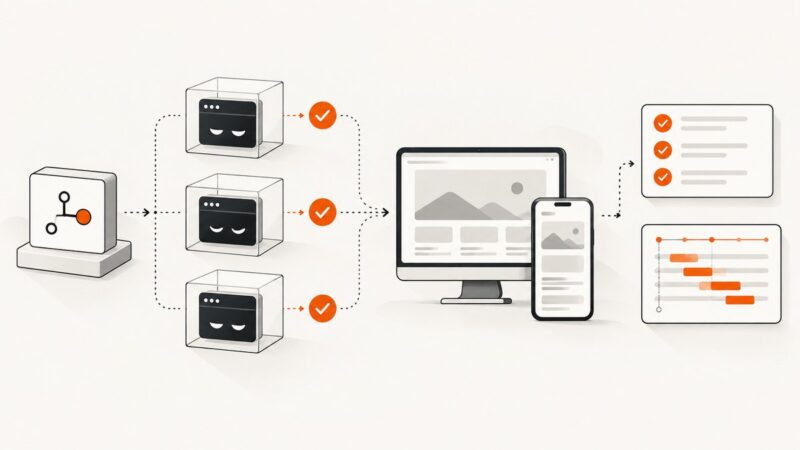
- A change enters version control. A push or pull request starts the workflow.
- The app and test artifacts are built. For Android, these may include an application APK and an instrumentation-test APK. For iOS, the pipeline prepares an app and XCTest or XCUITest package.
- The test stage selects configurations. A configuration may include a device model, OS version, orientation, and locale. A set of configurations is commonly called a device matrix.
- Tests execute. The service or local runner runs the specified test package, possibly in parallel or with test cases distributed across devices.
- Results return to the pipeline. Pass/fail status can gate later stages. Logs, screenshots, videos, and reports help developers investigate failures.
This model does not make every test suitable for every commit. Teams often run a small, fast set of configurations for routine changes and broader device coverage on a schedule or before release. Any staged strategy should still make clear which configurations can block a release.
2. Choose coverage and a test service
Start with the devices and frameworks your app and users require. A green result on one handset only establishes that the tested code passed on that configuration. It does not establish compatibility across other OS versions, device models, screen orientations, or locales.
| Decision | Questions to answer |
|---|---|
| Platforms and frameworks | Do you need Android, iOS, or both? Does the service support your test framework, such as Espresso, UI Automator, XCTest/XCUITest, Appium, or a built-in crawler? |
| Device coverage | Which models and OS versions matter? Are physical devices necessary for the behavior being tested, or are virtual devices sufficient for some checks? |
| Execution model | Can tests run in parallel? Can test cases be sharded? How does concurrency affect feedback time, quotas, and cost? |
| Pipeline integration | Can the service receive artifacts from your CI system? How are credentials, app packages, test definitions, and environment variables provided? |
| Results and retention | Where do reports, logs, screenshots, and videos live? How long are they retained, and how will a developer find them from a failed pipeline run? |
| Security and networking | What permissions and service accounts are needed? Must hosted devices reach private test backends, and what data can test accounts access? |
| Limits and cost | What quotas, execution limits, device availability, and pricing apply to your expected matrix? Check current provider terms before relying on a particular limit. |
Firebase Test Lab’s CI guide describes invoking tests from a CI system, including a Jenkins example that builds APKs and calls the service through gcloud. Its iOS guide covers XCTest/XCUITest and test matrices. Firebase’s CI/CD codelab names Espresso, UI Automator, XCTest, and Robo among the testing approaches it discusses.
AWS Device Farm’s CodePipeline integration describes a pipeline test stage that receives an app package and test definition as artifacts. AWS documents Android Appium and instrumentation, iOS Appium and XCTest/XCTest UI, and built-in fuzz testing in its test types documentation. These are documented examples, not interchangeable services: confirm current platform, framework, device catalog, and configuration support for your case.
3. Build a repeatable CI workflow
Keep the test stage explicit about its inputs and outputs. A useful pipeline should identify the commit, app build, test package, device configuration, and test result together. That makes it possible to tell whether two runs actually tested the same artifacts and configurations.
- Define triggers. Decide whether to run on every push, pull request, merge to a protected branch, nightly schedule, or release candidate.
- Build once for the test run. Produce and identify the application and test artifacts. Avoid silently rebuilding different artifacts in separate stages.
- Configure the matrix deliberately. Begin with a small representative set. Add configurations for supported OS versions, high-priority devices, locale and orientation behavior, and release coverage.
- Submit the artifacts and tests. Use the provider’s CI integration, command-line tool, or API. Store credentials in the CI secret manager and grant only the required permissions.
- Set failure policy. Decide which failures block merges or releases, how retries work, and how flaky tests are surfaced. A retry should provide diagnostic context rather than hide repeated instability.
- Retain useful evidence. Link the pipeline run to its report, logs, screenshots, and videos. Set a retention policy that fits debugging and compliance needs.
- Feed failures back into development. Make the failing test, configuration, and artifact easy to identify in the developer’s normal review workflow.
Android example: Firebase Test Lab from a CI shell
The following illustrates the Firebase-documented pattern: build the app APK and instrumentation APK with Gradle, then invoke gcloud firebase test android run. It assumes the CI environment has gcloud installed, an authenticated account with the required access, the relevant APIs enabled, and the Gradle tasks and paths appropriate for the project.
#!/usr/bin/env bash
set -euo pipefail

# Authenticate gcloud before this step using your CI secret mechanism.
# Do not commit service-account keys or other credentials to the repository.
./gradlew :app:assembleDebug :app:assembleDebugAndroidTest

gcloud firebase test android run \
  --type instrumentation \
  --app app/build/outputs/apk/debug/app-debug.apk \
  --test app/build/outputs/apk/androidTest/debug/app-debug-androidTest.apk \
  --device model=Pixel2,version=30,locale=en,orientation=portrait \
  --timeout 15m
Replace the example device configuration and artifact paths with values supported by the project and currently available in the service. Add more --device configurations for a matrix. Firebase also supports sharding test cases across devices; use it when the suite and service configuration benefit from parallel execution. Consult the Firebase CI documentation for setup details and current command options.
For iOS, prepare the appropriate XCTest/XCUITest build and test artifacts and submit them through the supported Firebase workflow or console. The exact build and signing steps depend on the project and CI environment; use the Firebase iOS guide to verify supported test types and current service constraints.
AWS CodePipeline pattern
At a high level, the AWS documented approach is to have a repository change trigger a pipeline, build the app and test definition, and pass those artifacts into a Device Farm test action. The stage reports a result to the pipeline, while test output is available through the service workflow. Configure the artifact names, project/device selection, test type, IAM permissions, and result handling according to the current CodePipeline integration guide. The AWS framework and test-type documentation lists supported routes; check it before selecting a framework.
A provider-neutral pipeline should treat the test runner as a replaceable stage: build outputs enter it, a clear status and diagnostic links leave it. This makes it easier to change device coverage or providers without coupling build logic to one service’s assumptions.
4. Design the device matrix and feedback policy
More configurations can catch more configuration-specific issues, but they also increase execution work and the amount of output to review. Pick coverage based on supported devices and risks in the app rather than selecting every available configuration by default.
- Use representative configurations for fast feedback. Include configurations that cover the main platform and OS support commitments.
- Include risk-based cases. Add devices or locales that exercise layout constraints, permissions, camera or location behavior, orientation changes, or other app-specific risks.
- Use broader runs intentionally. Run expanded matrices on a schedule, before releases, or for changes that affect a wider surface area.
- Choose gate semantics. A strict matrix can fail when any execution fails. Firebase’s test-matrix documentation says a failed execution causes the matrix to fail. Decide whether every configuration is a required gate or whether a smaller subset gates routine changes.
- Shard only with a reason. Distributing test cases can reduce elapsed time, but it may add setup and concurrency requirements. Verify that tests do not depend on shared mutable state or execution order.
For hosted devices, check whether private backends need firewall changes to accept traffic from the test environment. Use isolated test data and accounts. For ad-supported apps, Firebase recommends test ads during development and testing; if real ads must be used, its iOS guide says to notify third-party providers so they can filter test traffic.
5. Make test results useful
A pipeline status alone says whether a run passed; it rarely explains what to fix. Preserve enough context to reproduce and diagnose failures: commit identifier, build and test artifact identifiers, device model and OS, test name, logs, and relevant screenshots or video.
- Publish a concise pass/fail summary and link to the provider’s detailed report.
- Keep screenshots, videos, and logs associated with the exact test execution and device configuration.
- Distinguish an app assertion failure from infrastructure problems such as a failed load, unavailable device, or expired credential.
- Track flaky tests explicitly. Use retries to gather evidence, and avoid treating a retry pass as proof that the underlying failure is fixed.
- Set artifact retention and access rules. Test output can contain personal data, tokens, or backend details if the app or test environment exposes them.
Firebase documents result summaries, screenshots, videos, logs, and result storage. AWS documents managed S3 result storage and reporting in its service workflow. Decide how CI surfaces those outputs and how long your team needs to keep them; details vary by provider and can change.
6. Reliability, performance, and cost
Reliability
Separate product failures from test infrastructure failures. Record whether the app test failed, the test runner could not start, an artifact was invalid, or a required backend was unreachable. Make retries bounded and visible. A persistent failure should remain actionable rather than being converted into a passing pipeline by repeated automatic retries.
Keep authentication and API permissions in CI configuration, rotate credentials according to your organization’s policy, and avoid exposing secrets in command output. Firebase’s Jenkins instructions call out a configured gcloud environment, an authorized service account, and enabled Google Cloud Testing and Cloud Tool Results APIs. They also remind users to configure Jenkins security. Treat those requirements as part of implementation, not an afterthought.
Performance
Measure elapsed time in your own pipeline: build time, queue time, device execution time, and artifact download or report time are different components. Parallel execution and sharding may shorten the feedback loop, but available concurrency, test independence, and service limits constrain the result. Keep routine matrices small enough to return useful feedback and schedule wider coverage where it fits the release process.
Cost and service limits
Estimate cost from run frequency, number of configurations, test duration, parallelism, and the provider’s current pricing and quota rules. Include the cost of maintaining test infrastructure and diagnosing noisy tests when comparing hosted devices with a local hardware lab. Firebase’s iOS getting-started guide states a maximum of 45 minutes per test type on physical devices; this is a Firebase service limit described by that guide, not a general testing benchmark. Verify current limits and terms before planning around it.
7. Troubleshooting common failures
| Symptom | Likely cause | Fix |
|---|---|---|
| CI cannot invoke the test service | CLI is missing, authentication is not configured, or required APIs or permissions are absent. | Install/configure the provider CLI in the runner, authenticate through the CI secret mechanism, grant the required role, and enable the documented APIs. Check the provider’s CI setup guide. |
| Test submission says an artifact is missing or invalid | Build task did not run, the path is wrong, or the package is not the expected app or test artifact. | Make the build stage fail on errors, verify artifact paths and formats, and pass artifacts explicitly between stages. |
| Tests pass locally but fail on hosted devices | Different OS/device configuration, locale, permissions, timing, network access, or test data. | Inspect the failing configuration and logs, make assumptions explicit, isolate test data, and ensure required backend access is configured. |
| Hosted device cannot reach a private backend | Firewall rules or network access do not include the test environment. | Review provider networking guidance, allow only the required access, and use a test backend with scoped data and credentials. |
| Matrix is red when one device fails | The configured matrix treats any failed execution as a failed matrix. | Decide which configurations are required gates. Keep release-critical coverage strict and use a documented staged policy for nonblocking exploratory coverage. |
| Results are hard to diagnose | CI exposes only a final status or artifacts are not retained or linked. | Publish report links and preserve logs, screenshots, and videos with the commit and device configuration. |
| Runs are unexpectedly slow or expensive | Matrix is too broad for every change, tests are long, or concurrency and sharding are not configured appropriately. | Measure queue/build/test time separately, run a representative matrix on routine changes, and schedule broader coverage. Check current quotas and pricing. |
| Ad tests generate misleading traffic | Tests use production ad behavior or real ad requests are counted as user activity. | Use test ads where possible. If real ads are required, follow Firebase’s guidance to notify third-party providers so test traffic can be filtered. |
8. Capture website evidence used alongside mobile tests
Mobile test runs often need screenshots and reports from the app itself. A separate, narrower need can arise when a mobile workflow also depends on a website: for example, documenting a web landing page or capturing a web-based flow used during QA. Website screenshots do not replace device tests or prove that a native app works on a handset. They can provide a repeatable image of a URL for documentation or review.
For a browser-based DIY capture, a headless browser can load a URL and save an image. The exact setup depends on the browser automation library and runtime; for device testing, keep using the mobile test runner and device artifacts described above.
npm install playwright
npx playwright install chromium
// save as capture.mjs; run: node capture.mjs https://example.com shot.png
import { chromium } from 'playwright';
const url = process.argv[2];
const output = process.argv[3] ?? 'shot.png';
if (!url) throw new Error('Usage: node capture.mjs URL [output.png]');
const browser = await chromium.launch({ headless: true });
try {
const page = await browser.newPage({ viewport: { width: 1440, height: 900 } });
const response = await page.goto(url, { waitUntil: 'networkidle', timeout: 60000 });
if (!response || !response.ok()) {
throw new Error(`Navigation failed: ${response?.status() ?? 'no response'}`);
}
await page.screenshot({ path: output, fullPage: true });
} finally {
await browser.close();
}networkidle can be unsuitable for pages with persistent network requests. If navigation times out, wait for a meaningful selector or a bounded delay instead, and set a deliberate timeout. A screenshot can also be blank if the page redirects, requires authentication, or fails to render; inspect the final URL and browser console when diagnosing it.
9. Or skip the browser setup
For a website image used alongside mobile QA documentation, ScreenshotNeo is a website screenshot API and MCP server. A single request captures a URL as PNG, JPEG, WebP, or PDF. It can remove cookie banners, newsletter popups, and chat widgets before capture; bot checks, blank pages, failed loads, timeouts, and cache hits are not billed, with response headers indicating the page verdict and billing status. Its MCP server provides screenshot and PDF tools for AI agents. ScreenshotNeo does not replace mobile device testing.
cURL:
curl -G "https://api.screenshotneo.com/v1/shot" \
  -d access_key=YOUR_API_KEY \
  --data-urlencode url=https://example.com \
  -o shot.webp
Python:
import requests

r = requests.get(
    "https://api.screenshotneo.com/v1/shot",
    params={"access_key": "YOUR_API_KEY", "url": "https://example.com"},
    timeout=90,
)
r.raise_for_status()
open("shot.webp", "wb").write(r.content)
Node.js:
const q = new URLSearchParams({
  access_key: 'YOUR_API_KEY',
  url: 'https://example.com',
});
const res = await fetch(`https://api.screenshotneo.com/v1/shot?${q}`);
if (!res.ok) throw new Error(`Screenshot request failed: ${res.status}`);
await Bun.write('shot.webp', res);
See the ScreenshotNeo API documentation for request options. The free plan includes 1,000 screenshots per month with no card; paid plans start at $5 for 3,000 screenshots. Every feature is available on every plan. Sign up for 1,000 free screenshots a month, with no card required.
10. Frequently asked questions
Does continuous mobile testing mean testing on every available device?
No. Select configurations based on platform support, user needs, and app risk. Broader matrices can run on a schedule or before releases.
Can a cloud test service replace local device testing?
It can reduce the need to maintain a large local device lab, but teams may still need local devices for debugging, specialized hardware, or cases outside a service’s catalog and framework support.
Should every test failure block a merge?
That is a team policy. Define which tests and configurations are release-critical, and make nonblocking coverage visible so it is not mistaken for a passing gate.
Can ScreenshotNeo run mobile app tests?
No. ScreenshotNeo captures websites as images or PDFs. Use a mobile test framework and a device runner for application tests; ScreenshotNeo can capture website pages used in related documentation or review.