Automation Testing Trends to Watch
See how AI is changing test creation, execution, and review—and how to adopt automation without losing test intent or quality.
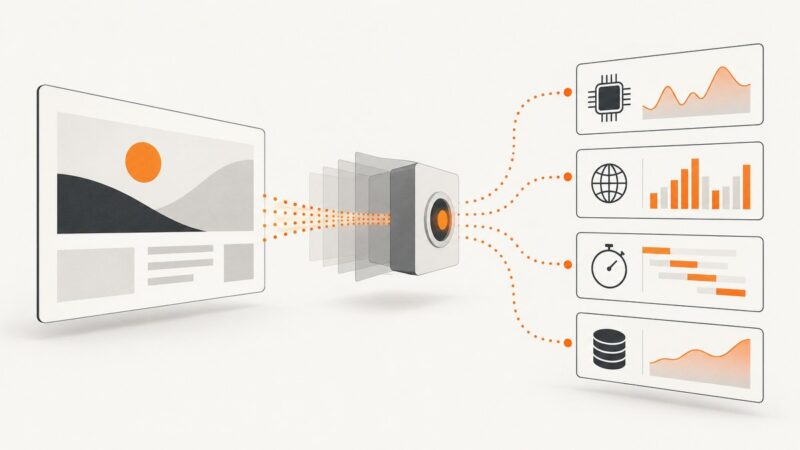
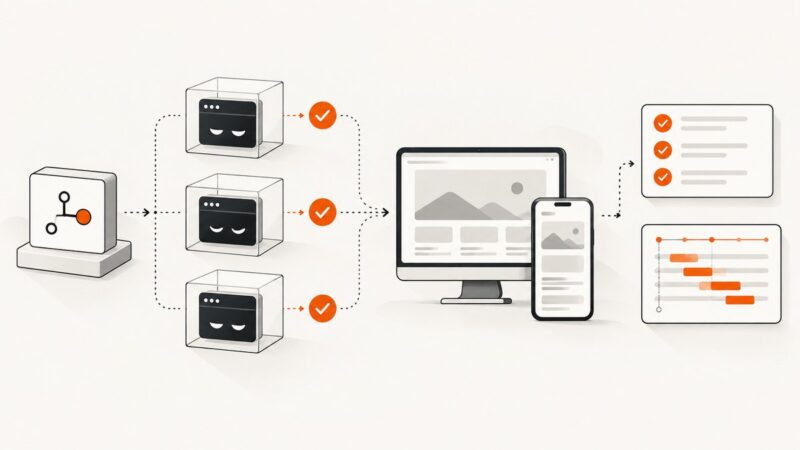
Automation testing is expanding from scripted checks toward AI-assisted test creation, coverage analysis, and increasingly autonomous execution. The practical shift is not simply to run more tests: teams need to check that generated tests assert the right behavior, use representative data, remain maintainable, and catch defects that matter.
For a developer, the useful approach is to let automation accelerate repeatable work while keeping test intent reviewable. Current surveys show growing experimentation and use, but they do not prove that AI automatically improves quality or that human testers are becoming unnecessary.
What are the latest trends in test automation?
The main trends are AI-assisted authoring and analysis, agents that can run and adapt tests, more explicit human review, renewed attention to test data, and measurement of outcomes rather than raw test counts. Browser framework choice remains contextual.
| Trend | What is changing | What to watch |
|---|---|---|
| AI-assisted test creation | AI helps draft test cases and automation scripts. | Whether each test checks intended behavior and adds meaningful coverage. |
| Coverage and result analysis | AI can help identify gaps and summarize outcomes. | Whether suggested gaps map to product risk and requirements. |
| Autonomous execution and adaptation | Agents can run tests and propose changes when a test breaks. | Whether adaptation preserves the original assertion and is reviewable. |
| Human review | People validate generated tests and interpret ambiguous results. | Whether review effort is focused on high-risk changes and behavior. |
| Test-data readiness | Teams invest in secure, repeatable, sometimes synthetic data. | Whether data remains realistic enough to expose relevant failures. |
| Outcome-based measurement | Teams look beyond test count and pass rate. | Escaped defects, severity, flakiness, diagnosis time, and upkeep. |
| Contextual framework choice | Established and newer browser frameworks coexist. | Language, browser needs, team experience, integration, and migration cost. |
How is AI changing software testing?
AI is being used at several points in the testing workflow: proposing cases from requirements, drafting scripts, surfacing potential coverage gaps, summarizing results, and in some systems adapting execution. These tasks have different risks. A generated test is a proposal; an autonomous change to an assertion can alter what the team considers correct.
Applause’s August 2026 functional-testing survey reported that, among 186 respondents who answered its testing-use-case question, 65.1% used AI to create test cases and 62.4% used it to create automation scripts. In that same question, 48.4% reported using AI to identify and address coverage gaps, 43.5% to analyze outcomes and recommend improvements, and 36.6% reported autonomous execution and adaptation. These are results from that survey’s respondents, not universal adoption rates. Applause, The State of Digital Quality in Functional Testing 2026.
Use AI to draft; validate the behavior
For generated tests, review the requirement, setup, action, assertion, and cleanup. Ask whether the test would fail for the defect it is meant to catch. A test that only repeats implementation details or checks that a page rendered may add little protection.
- Give the tool a specific behavior or requirement, including relevant boundary conditions.
- Inspect the generated test and map its assertions back to that behavior.
- Run it against known-good and intentionally failing cases where practical.
- Review selectors, waits, fixtures, and cleanup for brittleness or hidden dependencies.
- Keep ownership, review history, and links to the requirement or defect.
Keep self-healing changes tied to intent
A locator update can be a harmless repair, but changing an assertion can make a failing test pass by weakening what it checks. Applause CTO Tacita Morway cautioned: “Safe self-healing automation has to understand the intent of the test, not just the automated steps.” That is a useful boundary: let tools suggest a patch, show a diff, and require a person to approve changes that affect expected behavior. Applause functional-testing report.
Define policies by change type. A selector repair with unchanged assertions may be eligible for quick review; a changed expected value, removed check, or altered requirement should receive explicit owner approval. Retain the original failure and the proposed change so a green rerun does not erase useful evidence.
Will AI replace software testers?
The available evidence supports a change in testing tasks and workflows, not a conclusion that testers are obsolete. Automation can take on repetitive drafting and execution. People still contribute domain judgment, exploratory testing, usability assessment, risk prioritization, investigation of surprising behavior, and review of whether a test represents the product requirement.
In the Applause report, 86.1% of 202 respondents said human involvement was extremely important in functional testing. SmartBear’s 2026 survey release reported that 84% of its respondents used at least one form of human review to validate AI-generated tests. These are different surveys with different respondents and measures; neither establishes a universal staffing model. Applause and SmartBear.
A practical division is to automate predictable repetition and use tester time where context matters: deciding what risk deserves coverage, exploring paths that were not specified, assessing user impact, and challenging an AI-generated result that appears plausible but is wrong.
Why test data and governance matter
Tests only provide useful evidence when data is safe to use, repeatable, and representative of the cases the product must handle. Capgemini’s World Quality Report 2025–26 says 60% of organizations reported difficulty with secure, scalable test data and 58% cited challenges adopting AI-powered tools. The report also says synthetic test-data use averaged 25% in 2025, up from 14% in 2024. Those report figures indicate implementation concerns; synthetic data is not automatically a substitute for production-like data. Capgemini World Quality Report 2025–26.
Use synthetic data where it improves privacy, repeatability, or coverage, then validate that its distributions and relationships are realistic for the behavior under test. For AI features, define what data can be sent to a provider, who can access prompts and outputs, how generated artifacts are retained, and how changes are reviewed. Apply the same access and retention controls used for other testing data.
Measure quality, not just test volume
A larger suite can still be noisy, duplicative, or disconnected from product risk. Track a small set of measures that helps the team make decisions:
- Risk-weighted coverage: which important user journeys, integrations, and failure modes have meaningful assertions?
- Escaped defects: how many defects reached production, and how severe were they?
- Flaky-test rate: how often does a test fail without a product change, and how long does diagnosis take?
- Maintenance effort: how much work goes to repairing tests versus adding or improving useful coverage?
- Feedback time: how long until a developer receives a trustworthy result?
- Review quality: do generated tests and repairs retain links to requirements and human approvals?
Do not read adoption as proof of impact. Applause reported that 26.4% of 197 respondents had seen both production-defect number and severity decrease after AI entered their SDLC; 19.8% said they did not track those data. The result is specific to that survey and does not establish that AI caused the reported changes. Applause report.
Capgemini’s report says 43% of organizations were experimenting with GenAI in quality engineering and 15% had scaled it enterprise-wide. Experimentation and scaled deployment are distinct states; a pilot is not evidence that an approach is ready for every team or application. Capgemini World Quality Report 2025–26.
How do I choose between Selenium and Playwright?
Choose based on your application, team, and operating constraints rather than a claim that one framework has won. Compare the languages your team uses, browsers and devices in scope, existing test and CI setup, synchronization behavior, maintainability, reporting, and migration cost. Prototype representative flows and measure flakiness and diagnosis time before moving a large suite.
A 2026 survey in Information and Software Technology analyzed 88 complete responses from Selenium practitioners. It found continued Selenium use in regression and functional testing, common complaints around assertability, asynchrony, and brittleness, and Playwright as the most prominent alternative in that sample. The survey is a practitioner snapshot, not a controlled head-to-head benchmark or representative market-share study. It does not establish a universal winner. “Test automation with selenium: A survey,” Information and Software Technology.
| Decision question | Why it matters |
|---|---|
| Which languages and skills does the team already support? | A framework that fits existing expertise can reduce learning and migration overhead. |
| Which browser and device combinations must be covered? | Match actual support commitments, not a generic feature checklist. |
| How are waits, assertions, and failures handled? | Run representative asynchronous flows and compare clarity and diagnosis effort. |
| What is already integrated into CI and reporting? | Replacing working infrastructure has a real cost beyond rewriting test code. |
| Can the team maintain the suite? | Assess ownership, flakiness, fixtures, selector strategy, and review practices. |
For either framework, keep assertions attached to behavior users care about, avoid arbitrary sleeps when a condition can be awaited, isolate test data, and capture enough diagnostics to explain a failure. A migration should demonstrate better outcomes on representative tests before the team commits to it.
Adopting automation trends safely
- Choose a bounded pilot. Pick a workflow with repeatable steps and visible quality pain, not the highest-risk behavior with no fallback.
- Record a baseline. Note current coverage, flake rate, failure diagnosis time, maintenance effort, and escaped defects where tracked.
- Keep generated changes inspectable. Store prompts or inputs as appropriate, generated diffs, run results, and approvals.
- Protect test intent. Require explicit review for changes to assertions, expected outcomes, or requirement-linked behavior.
- Review data handling. Check privacy, access, retention, and synthetic-data realism.
- Evaluate outcomes after the pilot. Continue only if the change improves useful coverage or feedback without unacceptable flakiness or maintenance cost.
Or skip the browser setup
For visual regression workflows, release evidence, or a quick capture of a web page, a screenshot can be a useful artifact alongside functional tests. ScreenshotNeo is a website screenshot API and MCP server for developers, made by Yorker Media. Its one-call API can return a PNG, JPEG, WebP, or PDF; see the ScreenshotNeo API documentation.
curl -G "https://api.screenshotneo.com/v1/shot" -d access_key=YOUR_API_KEY --data-urlencode url=https://stripe.com -o shot.webpimport requests
r = requests.get(
"https://api.screenshotneo.com/v1/shot",
params={"access_key": "YOUR_API_KEY", "url": "https://stripe.com"},
timeout=90,
)
open("shot.webp", "wb").write(r.content)const q = new URLSearchParams({ access_key: 'YOUR_API_KEY', url: 'https://stripe.com' });
const res = await fetch(`https://api.screenshotneo.com/v1/shot?${q}`);
if (!res.ok) throw new Error(`Screenshot request failed: ${res.status}`);
await Bun.write('shot.webp', res);ScreenshotNeo accepts cookie and consent banners like a visitor and removes more than 60 known consent platforms, newsletter popups, and chat widgets before capture; each step can be turned off. Bot checks and CAPTCHAs, blank pages, timeouts, failed loads, and cache hits cost nothing, and response headers identify the page verdict and billing status. Its MCP server gives AI agents tools for screenshots, page information, and PDF capture. The free plan includes 1,000 shots a month with no card; paid plans start at $5 for 3,000 shots. Plans include the product’s features; yearly billing gives two months free. Sign up for 1,000 free screenshots a month, with no card.
Troubleshooting automation programs
| Symptom | Likely cause | Fix |
|---|---|---|
| Generated tests pass but defects escape. | Tests assert superficial rendering or mirror implementation details rather than user-visible behavior. | Trace assertions to requirements, add negative and boundary cases, and review escaped defects by journey. |
| A self-healed test passes after a meaningful failure. | The repair changed or removed an assertion, or accepted a different outcome without approval. | Inspect the diff and original failure; restore the intended assertion and require approval for behavior changes. |
| Tests fail intermittently in CI. | Timing assumptions, shared state, unstable data, or environmental variation. | Wait for explicit conditions, isolate fixtures, remove order dependencies, and retain diagnostics. |
| AI suggestions are hard to review. | Changes lack requirement context, a focused diff, or a record of expected behavior. | Provide bounded inputs, preserve requirement links, and ask for proposed changes in reviewable units. |
| Synthetic-data tests miss real cases. | Generated data does not reflect meaningful distributions, relationships, or edge cases. | Validate data characteristics and add explicit boundary and privacy-safe representative scenarios. |
| Adoption rises but quality is unclear. | The team tracks tool usage or test count without outcome measures. | Establish a baseline for escaped defects, severity, flakiness, maintenance, and feedback time. |
| A framework migration stalls. | Costs in language fit, CI integration, reporting, or test rewriting were underestimated. | Prototype representative flows, compare diagnosis and upkeep, and migrate incrementally if evidence supports it. |
FAQ
Does AI-generated test code need code review?
Yes. Review it as production code, with extra attention to whether its assertions represent the intended behavior and whether its data and dependencies are safe.
Should every team use autonomous testing agents?
No universal recommendation follows from the cited surveys. Start with a bounded, reviewable task and judge it by quality outcomes, maintenance, and risk.
Are Selenium and Playwright directly comparable by survey percentages?
The cited Selenium study surveyed Selenium practitioners and is not a controlled comparison. Use a representative pilot for your own applications and constraints.
What should a team automate first?
Start with repeatable, high-value workflows whose expected behavior is clear and whose failures can be diagnosed. That makes the automation’s contribution easier to assess.