Autonomous Testing: The Next Wave of Test Automation
Autonomous testing adds AI-assisted test creation, selection, execution, evaluation, and maintenance to traditional automation. Learn where it helps, how to govern it, and what to evaluate before adoption.
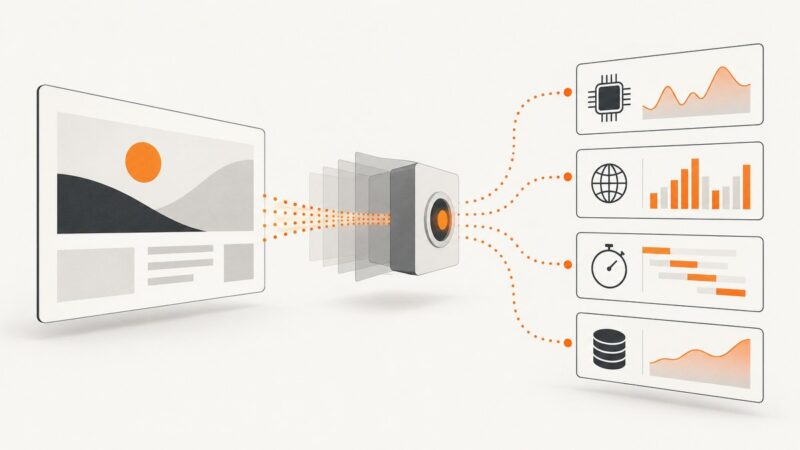
Autonomous testing is an emerging umbrella term for test workflows that use automation and AI to help create or select tests, prepare data, execute tests, evaluate results, and maintain test assets with less manual intervention. Traditional automation usually runs scripts that people have explicitly authored; the newer direction adds assistance around how tests are written, chosen, interpreted, and updated.
It does not mean every test runs without human review, that generated tests are valid by default, or that testers are no longer needed. Treat autonomy as a change in how quality work is performed and supervised. Start with a bounded, measurable workflow and keep people responsible for test intent, risk, and release decisions.
1. What autonomous testing includes
There is no single settled definition that makes every product using the term equivalent. Standards and working groups describe concrete testing practices and requirements. In practice, autonomous testing may combine some of these activities:
- Test design assistance: generate candidate cases from requirements, code, user flows, or observed behavior.
- Test selection: choose a relevant subset for a change, environment, or risk area.
- Data preparation: create or select test data while respecting privacy and environment constraints.
- Execution: run scripts and workflows in local, staging, or CI environments.
- Result evaluation: summarize outcomes, classify failures, or compare observed behavior with an expected result.
- Maintenance: propose updates when an application or interface changes.
- Monitoring: observe a system over time and identify conditions that may warrant additional tests or investigation.
These capabilities are not guaranteed to appear together. A tool might automate execution but require manually authored tests; another might suggest test cases while leaving execution and approval to the team.
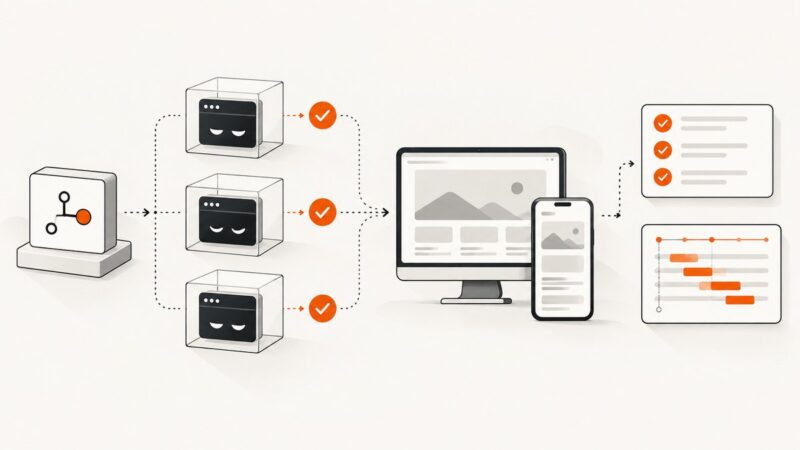
2. How the workflow works
- Set the intent and boundary. Define what behavior matters, which environment is allowed, what data can be used, and what actions are prohibited.
- Produce or select tests. A person, a rule-based system, or an AI-assisted workflow proposes cases. Keep the source requirement, code change, or risk linked to each case.
- Review test meaning. Confirm the expected behavior and assertions. A plausible test can still test the wrong thing or pass without checking the important outcome.
- Prepare controlled data and access. Use least-privilege credentials and data suitable for the environment. Avoid granting an agent broad access simply to make a workflow convenient.
- Execute in a reproducible environment. Record the code revision, configuration, browser or runtime, environment, and relevant dependencies.
- Evaluate results with evidence. Separate product failures from test defects, unavailable dependencies, and environment problems. Keep logs, traces, and artifacts needed to diagnose a run.
- Approve changes and release decisions. Review generated tests and proposed repairs before they become trusted regression coverage. Keep high-impact decisions under explicit human control.
- Measure and improve. Compare the workflow with its prior baseline using coverage of intended behavior, useful failure detection, false alarms, maintenance work, and diagnosis effort.
3. Autonomous testing versus traditional automation
| Area | Traditional test automation | AI-assisted or more autonomous workflow |
|---|---|---|
| Test authoring | People write cases and scripts explicitly. | AI may propose cases or translate other inputs into candidates; people still need to validate intent. |
| Test selection | Suites are commonly chosen through configured rules or manual decisions. | A workflow may recommend tests based on change, risk, or observed behavior; the selection logic needs review. |
| Execution | Scripts run according to configured triggers and environments. | Execution may be scheduled or coordinated automatically; permissions and boundaries matter, especially for agents. |
| Result handling | Assertions and reports provide outcomes, often requiring human diagnosis. | AI may summarize or classify evidence, but its explanation should be checked against logs and artifacts. |
| Maintenance | People update brittle or obsolete tests. | A system may suggest or apply repairs. A passing repaired test does not prove it still checks the intended behavior. |
The practical distinction is where assistance is added, not whether a workflow contains any automation at all. Be specific about which tasks a proposed system performs and which remain review responsibilities.
4. Where it can help—and where it can mislead
Good candidates
- Large repetitive suites where execution and result triage consume substantial attention.
- Frequently changing interfaces where test maintenance proposals can be reviewed against clear user-visible expectations.
- Test planning where a system can suggest cases from existing requirements or code changes for an engineer to assess.
- Workflows that need to collect and summarize repeatable evidence across multiple environments.
Risks to manage
- Wrong or shallow tests: generated cases may miss the requirement, use weak assertions, or confirm only that a page loaded.
- Misleading repair: changing a selector until a test passes can hide a product regression or shift the test to a different element.
- False failure classification: a summary can mistake a timeout, test bug, or unavailable dependency for a product defect.
- Uncontrolled actions: an agent may access data or invoke tools beyond what a test requires unless identity and authorization are constrained.
- Unrepresentative data: generated data can fail to cover important boundaries or can expose sensitive information if controls are weak.
- Automation opacity: if the team cannot trace why a test ran, changed, or passed, debugging and audits become harder.
These are implementation concerns to evaluate, not a claim that every AI testing product has the same failure rate. Require evidence from your own workflow before relying on automatic generation or repair.
5. Testing AI systems and agents
AI can be used to assist testing, and AI systems can themselves be the thing being tested. These are related but distinct problems. For an AI feature, define expected behavior across representative inputs, boundary cases, misuse, and failure conditions. Because outputs can vary, evaluate against an explicit acceptance method rather than assuming exact string equality is always appropriate.
For an autonomous agent, include the tools it can call, identity, authorization, data access, and the effects of actions in the test scope. NIST’s AI Agent Standards Initiative describes work on trusted, interoperable, secure agents, including agent security and identity and authorization; it is an initiative, not a completed binding standard. ITU describes agents in terms that include environment perception, memory management, task planning, and tool execution. These capabilities make permissions and observable action histories part of the quality and safety picture.
ISO/IEC TS 42119-2:2025 gives requirements and guidance for applying the ISO/IEC/IEEE 29119 series to AI-system testing using a risk-based approach. ETSI’s MTS AI work describes AI both as a subject of testing and as a possible aid to test generation, data creation, execution optimization, result evaluation, documentation, and continuous monitoring.
6. Standards and evidence to know
- IEEE 3407-2025: IEEE describes this active standard as establishing minimum requirements for end-to-end software testing automation tools and providing guidance for automated testing in software integration environments. It is a reference for that tool scope, not a blanket certification of every product marketed as autonomous testing. IEEE Standards Association: IEEE 3407-2025.
- ISO/IEC TS 42119-2:2025: guidance and requirements for applying the ISO/IEC/IEEE 29119 series to AI-system testing with a risk-based approach. ISO: ISO/IEC TS 42119-2:2025.
- ETSI MTS AI: work on trustworthy, testable, auditable AI over its lifecycle, and on AI methods that can improve testing and auditing. ETSI MTS AI.
- NIST AI Agent Standards Initiative: current standards work around trusted and interoperable agents, security, identity, and authorization. NIST AI Agent Standards Initiative.
- ITU-T AI Agents: a standards category describing agent capabilities and related work. ITU-T AI Agents.
Standards clarify scope and practices; they do not establish that a specific vendor’s tool improves your outcomes. The available research for this article did not provide a neutral empirical comparison of commercial autonomous-testing platforms. A March 2026 arXiv preprint on SpecOps reports results for a particular framework evaluated across five real-world AI agents; that result should not be generalized into a commercial product ranking. SpecOps preprint.
7. How to evaluate a tool or workflow
| Evaluation area | Questions to ask | Evidence to collect |
|---|---|---|
| Testing scope | Does it cover the end-to-end, API, backend, regression, or AI-agent behavior you need? | Cases mapped to real requirements and risk areas. |
| Authoring and maintenance | How are tests generated, selected, reviewed, updated, and versioned? | Reviewable diffs and traceability from each case to its intent. |
| Execution and evaluation | Can it explain outcomes and distinguish product defects from test or environment failures? | Runs with logs, traces, artifacts, and reproducible failure details. |
| Integration | Does it fit source control, CI/CD, test environments, and reporting? | A pilot through the actual release path, including failure handling. |
| Risk controls | How are credentials, test data, permissions, and agent actions controlled? | Permission review, audit records, data-handling review, and constrained test accounts. |
| Evidence | Are outcome claims independently evaluated and relevant to your systems and baseline? | Results measured on your own representative workload with clear definitions. |
Use the same baseline and definitions when comparing approaches. Track whether important behavior is covered, whether seeded or known defects are detected, how often failures are actionable, how much human time goes into reviewing and maintaining tests, and how long diagnosis takes. A test count alone can rise while meaningful coverage stays flat.
8. A practical adoption plan
- Choose one bounded workflow. For example, test selection for a stable CI suite or candidate tests for one well-specified feature.
- Write down acceptance criteria. Define what the workflow may generate, execute, change, and report, plus what requires approval.
- Establish a baseline. Record current coverage, failure triage time, maintenance effort, and known gaps using consistent definitions.
- Run in observation mode first. Compare suggestions with existing human decisions before allowing changes to affect release gates.
- Review samples deeply. Inspect proposed tests, repairs, data, and classifications for whether they preserve the intended behavior.
- Constrain access. Use scoped accounts, test-only data, and explicit tool permissions. Log agent actions and keep secrets out of prompts and artifacts.
- Expand only on evidence. Keep the workflow if it improves outcomes on representative cases without unacceptable risk or review burden; otherwise adjust or stop it.
9. Screenshot evidence for browser tests
Visual artifacts can help a reviewer inspect a browser test outcome, especially when a failure involves layout, an overlay, or content that is not obvious from an assertion. A screenshot should support the test’s evidence, not replace assertions about behavior or accessibility.
For browser screenshots that your test workflow captures, ScreenshotNeo is a website screenshot API and MCP server for developers. It can return PNG, JPEG, WebP, or PDF from one GET request. Its capture can accept cookie or consent banners and remove more than 60 known consent platforms, newsletter popups, and chat widgets; each step can be turned off. Its response identifies page verdict and billing status, and bot checks, CAPTCHAs, blank pages, timeouts, failed loads, and cache hits are not billed. The service also provides MCP tools for AI clients, including taking a screenshot, getting page information, and capturing a PDF.
It is a capture service for browser evidence, not a test authoring or test evaluation platform. Keep your own test assertions, review process, and artifact retention policy.
Example: capture a page from a test workflow
Use your API key from a secure secret store. The examples request a WebP capture of a representative page; see the ScreenshotNeo API documentation for available parameters and response details.
curl -G "https://api.screenshotneo.com/v1/shot" \
  -d access_key=YOUR_API_KEY \
  --data-urlencode url=https://example.com \
  -o test-evidence.webp
import requests
response = requests.get(
"https://api.screenshotneo.com/v1/shot",
params={"access_key": "YOUR_API_KEY", "url": "https://example.com"},
timeout=90,
)
response.raise_for_status()
with open("test-evidence.webp", "wb") as image_file:
image_file.write(response.content)
print("Page verdict:", response.headers.get("X-Page-Verdict"))
print("Billed:", response.headers.get("X-Billed"))const q = new URLSearchParams({
access_key: process.env.SCREENSHOTNEO_API_KEY,
url: 'https://example.com'
});
const res = await fetch(`https://api.screenshotneo.com/v1/shot?${q}`);
if (!res.ok) throw new Error(`Screenshot request failed: ${res.status}`);
const image = Buffer.from(await res.arrayBuffer());
await import('node:fs/promises').then(fs => fs.writeFile('test-evidence.webp', image));
console.log('Page verdict:', res.headers.get('X-Page-Verdict'));
console.log('Billed:', res.headers.get('X-Billed'));10. Or skip the browser setup
For a screenshot without configuring a browser capture flow, make one GET request. ScreenshotNeo offers full-page captures with lazy images loaded, element capture, device and viewport settings, retina scale, PDF options, custom CSS and JavaScript, selector waits, request blocking, custom headers and cookies, caching, signed links, async jobs, bulk captures, and an MCP server. Consult the API documentation for parameter names and options.
curl -G "https://api.screenshotneo.com/v1/shot" \
  -d access_key=YOUR_API_KEY \
  --data-urlencode url=https://example.com \
  -o shot.webp
import requests
r = requests.get(
"https://api.screenshotneo.com/v1/shot",
params={"access_key": "YOUR_API_KEY", "url": "https://example.com"},
timeout=90,
)
r.raise_for_status()
open("shot.webp", "wb").write(r.content)const q = new URLSearchParams({ access_key: 'YOUR_API_KEY', url: 'https://example.com' });
const res = await fetch(`https://api.screenshotneo.com/v1/shot?${q}`);
if (!res.ok) throw new Error(`Screenshot request failed: ${res.status}`);
await import('node:fs/promises').then(fs => fs.writeFile('shot.webp', Buffer.from(await res.arrayBuffer())));- Cookie banners, popups, and chat widgets are removed before the shot.
- Bot checks, blank pages, and failed loads are never billed.
- An MCP server lets AI agents take screenshots.
- 1,000 screenshots a month are free with no card; paid plans start at $5 for 3,000 screenshots.
Create a free ScreenshotNeo account to get 1,000 screenshots per month with no card.
11. Reliability, performance, and cost
Reliability
- Make test inputs and environments repeatable. Record versions, configuration, and the revision under test.
- Preserve artifacts that explain a failure; do not treat a natural-language summary as the only record.
- Separate application failures from test-runner, network, and dependency failures before changing a test.
- For generated or repaired cases, review the diff and confirm the original assertion still expresses the requirement.
- Keep a human override for release decisions and a rollback path for generated changes.
Performance
Measure the whole workflow, including generation or selection, execution, evaluation, review, and failure diagnosis. More tests can increase coverage but also increase run time and result volume. Consider running a risk-based subset on each change and a broader suite on an appropriate schedule, but verify that selection does not omit critical behavior. Parallel runs can reduce elapsed time while increasing compute and environment contention.
Cost
Compare total operating cost, not just a subscription price or the number of automated cases. Include execution infrastructure, model or service usage where applicable, test data and environment upkeep, human review, flaky-run investigation, and the cost of missed defects. No neutral evidence in the sources establishes a universal cost reduction from autonomous testing.
For ScreenshotNeo specifically, the listed plans are Free: 1,000 shots per month with no card; Starter: $5 for 3,000; Growth: $15 for 15,000; Pro: $39 for 60,000; Scale: $99 for 250,000; and Business: $249 for 1,000,000. Yearly billing gives two months free, and every feature is on every plan. Its stated billing model charges only clean shots; response headers report the page verdict and whether a shot was billed.
12. Troubleshooting checklist
| Symptom | Likely cause | What to do |
|---|---|---|
| Generated test passes but misses a defect | The case or assertion does not encode the important requirement. | Trace the test to an explicit behavior, add meaningful assertions, and review with a known failing case. |
| Self-healed test passes after a UI change | The repair may have found a different element or weakened the check. | Review the selector and assertion change; confirm the repaired test still checks the original user outcome. |
| Many failures appear after a deployment | Could be a product regression, environment issue, shared dependency, or test flakiness. | Use logs, traces, artifacts, and a small reproduction to classify the failure before editing tests. |
| AI summary disagrees with test artifacts | The evaluator may have misread incomplete or ambiguous evidence. | Trust reproducible artifacts and assertions; report the discrepancy and require human classification. |
| Agent attempts an unauthorized action | Tool permissions or credentials are broader than the test needs. | Stop the run, narrow identity and authorization, use a test-only account, and review action logs. |
| Test data exposes sensitive information | Production data or secrets entered an unsafe generation or execution path. | Remove the data from the workflow, rotate exposed credentials as appropriate, and use approved synthetic or sanitized data. |
| Screenshot request is rejected or returns an error | Often an invalid key, malformed URL, or HTTP error. | Check the key and URL, inspect the HTTP status and response, and keep the key out of source control. |
| Screenshot shows an overlay or incomplete content | A consent surface may be unsupported or disabled, or the page may need a wait condition. | Check the page verdict and capture configuration; configure an appropriate wait or use the documented controls for the surface. |
13. Frequently asked questions
Is autonomous testing the same as self-healing testing?
No. Self-healing is one possible maintenance capability. Autonomous testing can also refer to test authoring, selection, data preparation, execution, and result evaluation.
Can a team adopt it without changing its test framework?
Often the first step can be a bounded assistant or workflow around existing tests, but integration depends on the tool and environment. Verify compatibility in a representative pilot.
Does IEEE 3407 certify autonomous-testing vendors?
The standard describes minimum requirements for end-to-end software testing automation tools. Its existence does not by itself certify a vendor or validate every claim made using the term autonomous testing.
Is market growth evidence that the approach works?
No. MarketsandMarkets estimated the AI test automation market at USD 8.81 billion in 2025 and forecast USD 35.96 billion by 2032 at a 22.3% CAGR. That is a commercial market forecast, not observed product effectiveness or evidence of outcomes for a particular team. MarketsandMarkets forecast.
Conclusion
Autonomous testing extends automation into test creation, selection, evaluation, and maintenance, but its value depends on whether those outputs remain tied to real requirements and controlled evidence. Pick a narrow workflow, constrain its access, measure it against a baseline, and review generated tests and repairs before trusting them in release decisions.