BlogScreenshots on your device
Best Browser for Capturing Full-Page Website Screenshots on Desktop
Firefox is the clearest default for a full-page desktop screenshot. Compare Firefox, Chrome, Edge, and Safari, with steps and automation options.
Firefox is the clearest default for capturing a full-page website screenshot on desktop. Its built-in screenshot tool has an explicit Save full page option and saves the result as an image. Chrome can also capture a full page through DevTools. Edge may offer a direct Web capture command, though the available instructions are from a secondary source. Safari’s documented Save As options create a web archive or page source, not a screenshot image.
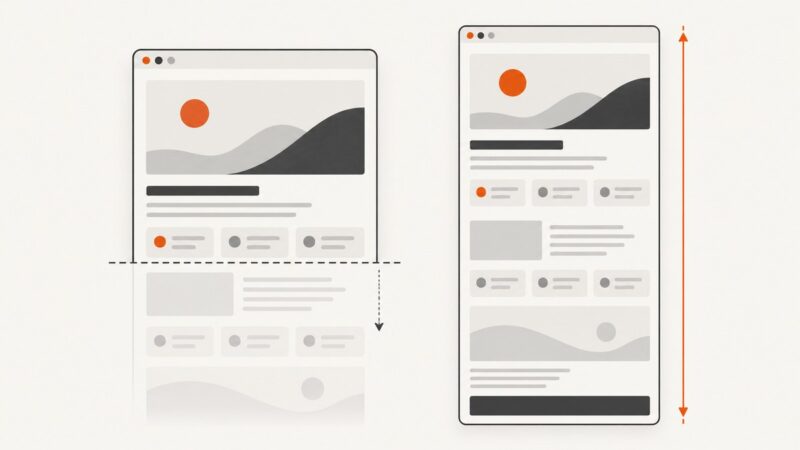
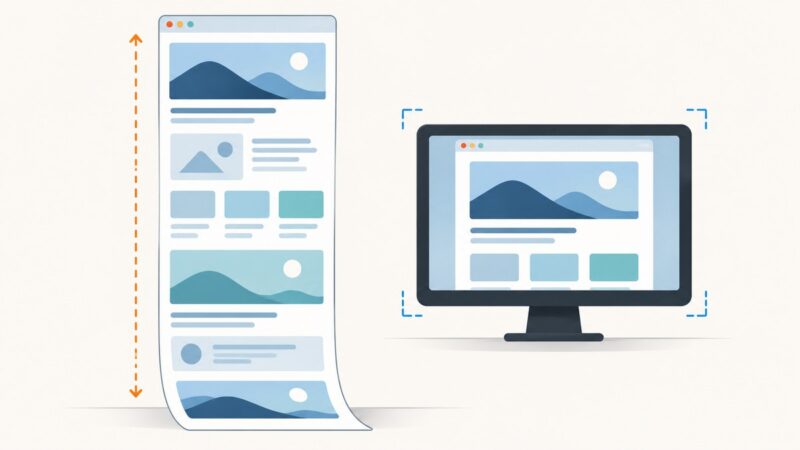
A full-page screenshot includes content below the visible browser window. It is different from a visible-area screenshot, which captures only what is currently on screen. Choose a full-page command when you need the entire page in one image.
Browser comparison
| Browser | Full-page route | Best fit | Evidence and caveat |
|---|---|---|---|
| Firefox | Built-in Take Screenshot, then Save full page | Most straightforward documented option | Mozilla documents the workflow and image output. [Mozilla Support] |
| Chrome | Capture a full-page screenshot in DevTools | Developers already comfortable with DevTools | Chrome for Developers confirms the capability; check the current menu sequence in your release. [Chrome for Developers] |
| Edge | The cited guide reports Web capture and Capture full page | People who want to use Edge’s capture controls | The available source is a secondary guide, not Microsoft documentation. Verify the command in your installed version. [OpenCapture guide] |
| Safari on Mac | File > Save As offers Web Archive or Page Source | Saving page content for later, rather than producing a screenshot image | Apple’s cited guide documents saved-page formats, not a full-page screenshot workflow. [Apple Support] |
This is a feature-based recommendation, not a speed, fidelity, or compatibility test. Browser labels and shortcuts can change by release, operating system, and locale.
Capture a full page in Firefox
- Open the webpage you want to capture.
- Right-click an empty area of the page and choose Take Screenshot. You can also use Ctrl+Shift+S on Windows or Linux, or Command+Shift+S on Mac.
- Choose Save full page. Use Save visible only when you want the current viewport.
- Choose Download to save the screenshot image.
If the context menu is over a link, image, or embedded frame, the screenshot command may not appear where expected. Open the tool with the shortcut or right-click an empty page area instead. Mozilla documents region capture and automatic selection as additional choices; neither is needed for a whole-page image. [Mozilla’s Firefox screenshot instructions]
Capture a full page in Chrome
Chrome DevTools supports full-page screenshot capture, along with node and area screenshots. The Chrome documentation confirms the capability. Because the exact menu sequence can change, use the DevTools command or menu labeled for full-page capture in your installed version and confirm the output before relying on it for a repeatable workflow. [Chrome for Developers: Capture screenshots with DevTools]
If you only need an occasional capture and do not work in DevTools, Firefox has the more clearly documented direct workflow in the sources reviewed here.
What to know about Edge and Safari
Edge
A secondary guide reports that Edge Web Capture can capture a full page and describes opening it with Ctrl+Shift+S or from the right-click menu. Since this is not an authoritative Microsoft source, treat the exact controls as version-dependent: look for Web capture and a full-page option in your current Edge build. [OpenCapture’s Edge guide]
Safari on Mac
Apple’s cited Safari guide explains saving a webpage with File > Save As, including Web Archive and Page Source formats. Those preserve page content or source; they are not full-page screenshot images. The cited page does not establish whether another Safari technique is available. [Apple Support]
Repeat captures with a browser automation script
For a handful of manual captures, use the browser’s built-in feature. If you need repeatable captures in a development workflow, browser automation can save a full-page image. The example below uses Playwright’s Node.js API. Install Playwright and its Chromium browser first, then save the script as screenshot.mjs and run it with Node.js.
npm init -y
npm install playwright
npx playwright install chromium
// screenshot.mjs
import { chromium } from 'playwright';
const target = process.argv[2];
if (!target) {
console.error('Usage: node screenshot.mjs https://example.com');
process.exit(1);
}
const browser = await chromium.launch({ headless: true });
try {
const page = await browser.newPage({ viewport: { width: 1440, height: 900 } });
const response = await page.goto(target, {
waitUntil: 'networkidle',
timeout: 60_000,
});
if (!response || !response.ok()) {
throw new Error(`Navigation did not return a successful response (${response?.status() ?? 'no response'})`);
}
await page.screenshot({ path: 'full-page.png', fullPage: true });
} finally {
await browser.close();
}node screenshot.mjs https://example.comThis script is an automation example, not a claim that all sites reach network idle or render identically. For a site with ongoing network activity, replace networkidle with a site-specific readiness condition such as waiting for a known element, then capture. Browser automation also lets you set viewport dimensions, but a full-page image may be very tall and cumbersome to inspect or share.
Or skip the browser setup
ScreenshotNeo is a website screenshot API and MCP server from ScreenshotNeo. One GET request returns an image or PDF. See the API documentation for options.
curl -G "https://api.screenshotneo.com/v1/shot" -d access_key=YOUR_API_KEY --data-urlencode url=https://stripe.com -o shot.webpimport requests
r = requests.get(
"https://api.screenshotneo.com/v1/shot",
params={"access_key": "YOUR_API_KEY", "url": "https://stripe.com"},
timeout=90,
)
r.raise_for_status()
open("shot.webp", "wb").write(r.content)const q = new URLSearchParams({ access_key: 'YOUR_API_KEY', url: 'https://stripe.com' });
const res = await fetch(`https://api.screenshotneo.com/v1/shot?${q}`);
if (!res.ok) throw new Error(`Screenshot request failed: ${res.status}`);
await Bun.write('shot.webp', res);Cookie banners, popups, and chat widgets are removed before the shot. Bot checks, blank pages, and failed loads are never billed. An MCP server lets AI agents take screenshots. The free plan includes 1,000 screenshots a month with no card; paid plans start at $5 for 3,000. Sign up for 1,000 free screenshots a month, with no card.
Choosing a capture method
- One-off full-page image: use Firefox’s Save full page option.
- Already working in Chrome DevTools: use its full-page screenshot capability.
- Using Edge: check whether your version exposes Web capture with a full-page option.
- Automated repeat captures: use browser automation with an explicit readiness condition suited to the site.
- API, batch, or AI-agent workflow: use a screenshot API such as ScreenshotNeo; its API supports full-page capture and bulk capture of up to 100 URLs per call.
Troubleshooting
| Problem | Likely cause | What to do |
|---|---|---|
| The screenshot contains only what was visible | You chose a visible-area or viewport capture. | Choose Firefox’s Save full page or the browser’s full-page capture command. |
| Take Screenshot is missing from the context menu | The pointer is over a link, image, or other interactive element. | Right-click an empty area, or open Firefox’s screenshot tool with its shortcut. |
| A browser menu or shortcut does not match these steps | Controls vary with release, OS, and locale. | Search the installed browser’s menus for screenshot or capture, and verify the current full-page option. The Firefox steps are documented by Mozilla; the cited Edge steps are secondary. |
| The saved file is a web archive or source code | Safari’s Save As workflow was used. | That workflow saves page content, not a screenshot image. Use a browser screenshot feature or an image capture workflow. |
| An automated capture stops waiting or misses late content | The page did not reach the chosen readiness condition, or content loads after the initial render. | Wait for a page-specific selector or loading condition before taking the full-page capture. Avoid assuming that network idle is suitable for every site. |
| The full-page image is unwieldy | A long page creates a very tall image. | Capture only the section you need, use a PDF workflow, or capture selected elements when your chosen tool supports it. |
Performance, reliability, and cost
The available browser research does not establish comparative capture speed, image fidelity, operating-system coverage beyond the cited instructions, or maximum page length. Choose based on the documented workflow and verify important results in your own browser version. Long pages can create large images; for repeatable work, a fixed viewport and an explicit readiness condition make captures more consistent.
Browser capture itself does not require a screenshot API subscription. Automation adds setup and maintenance for browser binaries and page-specific loading behavior. ScreenshotNeo has a free allowance of 1,000 shots per month without a card. Paid monthly plans are Starter $5 for 3,000, Growth $15 for 15,000, Pro $39 for 60,000, Scale $99 for 250,000, and Business $249 for 1,000,000; yearly billing gives two months free. Every feature is on every plan. Only clean shots are billed; response headers report the page verdict and billing status.
FAQ
Which browser should I choose if I do not want to open developer tools?
Firefox, because Mozilla documents a built-in full-page option in its screenshot tool.
Is a full-page screenshot the same as saving a webpage?
No. A screenshot is an image of the rendered page. A web archive or page source saves page content or code in another format.
Can I capture a full page repeatedly without clicking through a browser?
Yes. Use browser automation for a script-based workflow, or a screenshot API when you need a hosted capture endpoint or batch requests.
Does the research establish which browser produces the most accurate image?
No. It confirms documented capture capabilities, not a controlled comparison of fidelity or performance.