BlogScreenshots on your device
How to Capture a Full-Page Screenshot on a PC
Capture an entire webpage on Windows with Edge or Firefox, understand Snipping Tool limits, and automate full-page screenshots with ScreenshotNeo.
Fastest answer: In Microsoft Edge, open the page, press Ctrl+Shift+S, choose Capture full page, then save or copy the result. In Firefox, open the page, choose Take Screenshot, select Save full page, and download the image. These commands capture content below the visible browser window; a regular desktop screenshot does not.
For a one-off capture, use the browser’s built-in full-page tool. For repeatable captures, authenticated pages, scheduled jobs, or code-driven workflows, use a browser automation script or an API such as ScreenshotNeo.
What “full-page screenshot” means
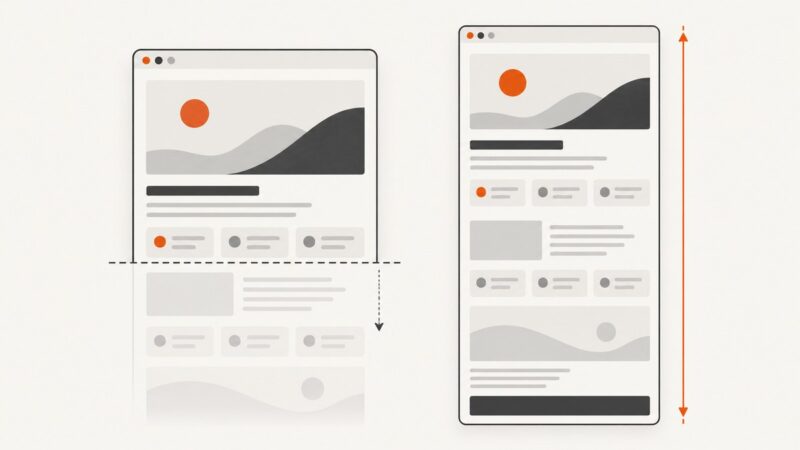
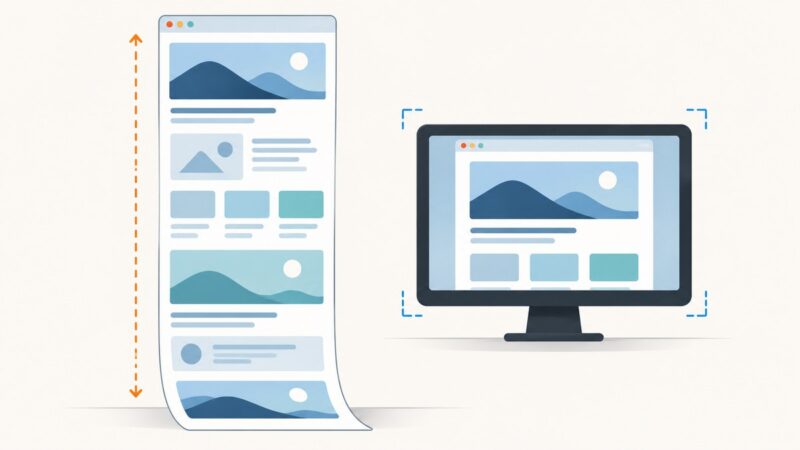
A full-page screenshot stitches the entire scrollable webpage into one image. It includes sections below the fold, so you do not need to take and combine several screen snips manually.
| Method | Captures | Best for |
|---|---|---|
| Browser full-page capture | The webpage from top to bottom | One-off documentation, sharing, bug reports |
| Snipping Tool | The visible screen, window, or selected rectangle | A quick view of what is currently on screen |
| Browser extension | Usually the complete webpage | Chrome users who need an add-on workflow |
| Automation or screenshot API | Programmatic, repeatable captures | Monitoring, archives, reports, and applications |
Microsoft’s Snipping Tool instructions describe screen, window, and rectangular snips; they do not describe automatically scrolling through a webpage. Use a browser feature that explicitly says full page when you need the whole document (Microsoft Snipping Tool documentation).
Capture a full webpage in Microsoft Edge
- Open the webpage in Edge and wait for the content you need to appear.
- Press Ctrl+Shift+S. You can also open Edge’s Screenshot command from the browser controls or page context menu.
- Choose Capture full page.
- Review the resulting image, then use the displayed save or copy control.
Edge documents this feature as a way to capture the full webpage, including content that would otherwise require scrolling. The menu wording and location can change between Edge versions, so look for Screenshot and then Capture full page if the shortcut does not open it (Microsoft Edge Screenshot; Edge learning guide).
If Ctrl+Shift+S does not work
- Click the three-dot menu and look for Screenshot.
- Right-click the page and choose the screenshot command if it is available.
- Update Edge, then retry the command.
- Check that another application or browser extension has not claimed the shortcut.
Capture a full webpage in Mozilla Firefox
- Open the webpage in Firefox.
- Open the page context menu and select Take Screenshot. You can also add the Screenshot button to the toolbar.
- Select Save full page.
- Download the generated image.
Firefox’s built-in screenshot tool provides a documented Save full page option (Mozilla Support: Take screenshots in Firefox).
What about Google Chrome?
Chrome Web Store listings include extensions that capture a full webpage and export an image or PDF. For example, Full Page Screen Capture is one available listing. Treat an extension as software with access to pages you visit: check its publisher, requested permissions, privacy policy, reviews, and maintenance date before installing it.
This guide does not present an unverified Chrome-native sequence as an official standard. If you want a documented built-in route, Edge and Firefox provide the full-page commands above.
Make the capture complete before saving
Dynamic pages can change while the browser is capturing them. Use this checklist:
- Scroll through the page once so lazy-loaded images and sections have had a chance to load.
- Wait for cookie dialogs, newsletter popups, chat bubbles, and other overlays to finish appearing. Close them before capture when possible.
- Make sure the page is at the top before starting.
- For a private or logged-in page, confirm that the browser is using the correct account and that sensitive data will not be shared.
- Inspect the saved image from top to bottom. Look for missing images, repeated sections, blank areas, clipped fixed headers, or an embedded panel that has its own scrollbar.
There is no universal guarantee for exceptionally long pages, lazy-loaded content, nested scroll regions, or authenticated applications. If completeness matters, inspect the output and capture again after the relevant content has loaded.
Snipping Tool versus a full-page capture
Use Snipping Tool when you need a visible screen, a window, or a selected rectangle. Use Edge’s or Firefox’s full-page command when the target extends below the screen. A full-page browser capture is a webpage image, not a picture of your entire monitor.
Save, share, and format the result
- PNG: Good for text, diagrams, and sharp UI details; files can be large.
- JPEG: Smaller files for photographic pages; text may show compression artifacts.
- PDF: Better when the recipient needs selectable text or printing, but page breaks and scaling can differ from the browser view.
Before sharing, check the image dimensions and file size. Very tall images can be difficult to open or send, so a PDF or several focused captures may be more practical for long documents.
Automate a full-page screenshot with Playwright
When captures are part of a build, report, archive, or monitoring job, browser automation gives you repeatability. The example below uses Node.js and Playwright.
import { chromium } from 'playwright';

const browser = await chromium.launch();
const page = await browser.newPage({ viewport: { width: 1440, height: 900 } });
await page.goto('https://example.com', { waitUntil: 'networkidle' });
await page.screenshot({ path: 'full-page.png', fullPage: true });
await browser.close();
Install Playwright with npm install playwright and install its browser binaries according to the project’s setup instructions. Add an explicit wait for a selector when the page renders important content after the initial load:
await page.goto('https://example.com', { waitUntil: 'domcontentloaded' });
await page.waitForSelector('main');
await page.waitForTimeout(1000);
await page.screenshot({ path: 'full-page.png', fullPage: true });
Or skip the browser setup
ScreenshotNeo returns a webpage screenshot from one GET request. Its full-page mode can load lazy images, and it also supports element capture, device presets, custom viewports, dark mode, retina scale, custom CSS and JavaScript, clicks, selector or network-idle waits, blocked ads and trackers, headers, cookies, user agents, authorization, timezone, geolocation, transparent backgrounds, resizing, caching, signed image links, asynchronous jobs, bulk capture, usage reporting, and PDFs. See the ScreenshotNeo API documentation for parameter names and configuration.
curl -G "https://api.screenshotneo.com/v1/shot" -d access_key=YOUR_API_KEY --data-urlencode url=https://stripe.com -o shot.webpimport requests; r = requests.get("https://api.screenshotneo.com/v1/shot", params={"access_key": "YOUR_API_KEY", "url": "https://stripe.com"}, timeout=90); open("shot.webp", "wb").write(r.content)const q = new URLSearchParams({ access_key: 'YOUR_API_KEY', url: 'https://stripe.com' }); const res = await fetch(`https://api.screenshotneo.com/v1/shot?${q}`);Cookie and consent banners are accepted and removed before the shot, along with more than 60 known consent platforms, newsletter popups, and chat widgets; each cleanup step can be turned off. Bot checks or CAPTCHAs, blank pages, timeouts, failed loads, and cache hits are not billed, and the response identifies the result with X-Page-Verdict and X-Billed headers. ScreenshotNeo also provides an MCP server so Claude, Cursor, and other MCP clients can call take_screenshot, get_page_info, and capture_pdf.
The Free plan includes 1,000 screenshots per month without a card. Paid plans start at $5 for 3,000 shots; yearly billing gives two months free. Create a free ScreenshotNeo account.
Troubleshooting
| Problem | Likely cause | Fix |
|---|---|---|
| Only the visible area was saved | A screen snip was used instead of a full-page command | Choose Edge Capture full page or Firefox Save full page. |
| The shortcut does nothing | Browser version, shortcut conflict, or changed interface | Open the browser menu and find Screenshot; update the browser and retry. |
| Images are missing | Lazy loading had not completed | Scroll through the page, wait, and capture again. |
| A cookie banner or chat bubble covers content | An overlay remained open | Dismiss it before capture or use an automated/API workflow that can remove overlays. |
| A nested panel is incomplete | The panel has its own scrollbar | Capture the panel separately or use an automation script that scrolls that element. |
| The image is extremely tall or large | The page contains substantial content | Use PDF, split the page into sections, or resize/compress the output. |
| A private page redirects to login | The capture session has no authentication | Capture while signed in locally, or provide authorized cookies/headers through an appropriate automation or API setup. |
Performance, reliability, and cost considerations
- Browser captures: Free and convenient, but depend on the current page state, browser version, extensions, and loaded content.
- Automation: Repeatable and configurable, but requires browser binaries, maintenance, and handling of waits, authentication, and failures.
- API captures: Easier to run from servers and jobs. Cache repeated URLs when appropriate, choose a wait condition that matches the page, and inspect verdict and billing headers so failed or clean captures are distinguishable.
- Cost: A manual browser capture has no service charge. ScreenshotNeo has 1,000 free shots monthly with no card; paid tiers are $5/3,000, $15/15,000, $39/60,000, $99/250,000, and $249/1,000,000. Every feature is available on every plan.
FAQ
Can I capture an entire webpage with Windows Snipping Tool?
Use Snipping Tool for the visible screen, window, or selected region. For a webpage that extends below the screen, use a browser full-page command.
Which browser has the simplest built-in method?
Edge documents Ctrl+Shift+S → Capture full page. Firefox documents Take Screenshot → Save full page.
Will a full-page screenshot include content hidden behind a scrollable box?
Not necessarily. A nested scroll region is separate from the document scroll, so inspect the result and capture that element separately when needed.
Should I use PNG or JPEG?
Choose PNG for crisp text and interface details; choose JPEG when a smaller file matters more than perfect text edges.
Can a full-page screenshot prove what a page looked like at a specific time?
It records the page state at capture time, but dynamic content, personalization, login state, and network responses can change. Preserve the URL, timestamp, and capture settings with the image when the record matters.