BlogScreenshots on your device
How to Capture a Full Web Page Screenshot in Snagit
Use Snagit’s scrolling capture to save an entire webpage, fix common failures, and automate clean screenshots with ScreenshotNeo.
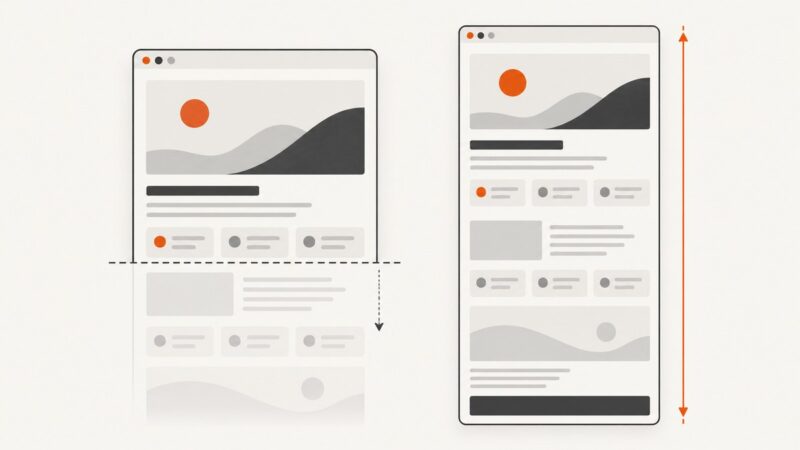
Short answer: In Snagit, choose All-in-One capture, select the webpage, then click the orange scrolling arrow for vertical or horizontal capture. Snagit combines the scroll into one image and opens it in Snagit Editor, where you can crop, annotate, copy or save it. TechSmith documents this workflow and supports both vertical and horizontal scrolling capture.
For a repeatable process, use automatic scrolling first. If the arrows do not appear or the page scrolls incorrectly, use Manual Scrolling Capture and control the movement yourself.
Sources: TechSmith Support: Does Snagit Support Scrolling Capture? and TechSmith’s Screenshot Website guide.
1. Automatic scrolling capture
- Open the webpage in your browser and wait for the content you need to load.
- Open Snagit and select All-in-One capture.
- Start the capture and select the browser window or the page region.
- When the orange scrolling arrows appear, click the arrow pointing down to capture the full page. Use the horizontal arrow for a page that extends sideways.
- Let Snagit scroll until it reaches the end of the selected content. The result opens in Snagit Editor.
- In Editor, crop unwanted edges, add annotations if needed, then copy the image or save it in your required format.
Snagit’s scrolling capture is intended for content beyond the visible screen, including full webpages. The arrows follow the detected page or window, so the selection boundary matters: include the content area but keep browser chrome, floating toolbars and unrelated margins outside the selection when possible.
2. Manual scrolling capture
Manual capture is useful when automatic arrows are missing, when a page has unusual scrolling behavior, or when you need to decide exactly where each scroll occurs.
- Choose All-in-One capture and select the region containing the webpage.
- Choose the scrolling-capture option from the capture toolbar.
- Scroll the page with its scrollbar or mouse wheel in one direction at a steady pace.
- Continue until the final content is visible, then finish the capture.
- Review the assembled image in Snagit Editor and remove any overlap or unwanted margins.
Manual scrolling gives you more control over pages with sticky headers, lazy-loaded sections or nested scroll containers. Keep the browser at 100% zoom while diagnosing alignment problems; you can restore your normal zoom after the capture.
3. Prepare the page for a clean full-page image
- Wait for dynamic content: allow images, charts and fonts to finish loading before starting.
- Use a stable window size: maximize the browser or make it large enough that the page has room to scroll.
- Keep the scrollbar outside the selection: including it can cause alignment or duplicate-edge artifacts.
- Remove distractions: close floating browser panels and move toolbars away from the selected region.
- Scroll smoothly: abrupt direction changes increase the chance of seams or missing content.
- Check sticky elements: fixed navigation bars and chat buttons can repeat on every segment. Hide them temporarily if they obscure content.
- Test the page design: parallax effects and custom scroll animations may not stitch accurately.
TechSmith specifically recommends a larger browser window, 100% application zoom, smooth scrolling and a selection that excludes irrelevant margins. It also notes that parallax websites may not capture accurately. See TechSmith’s scrolling-capture troubleshooting guide.
4. Troubleshooting checklist
| Symptom | Likely cause | Fix |
|---|---|---|
| No orange scrolling arrows | The selected area or application is not recognized for automatic scrolling. | Use Manual Scrolling Capture. Select the page region, choose scrolling capture, then move the scrollbar or mouse wheel yourself. |
| Capture stops before the bottom | The page stopped loading, the wrong scroll container was selected, or a sticky element interrupted detection. | Wait for the page to finish loading, select the actual scrollable content, hide obstructing overlays and retry manually. |
| Repeated or missing sections | Scrolling was too fast, the page uses animated or parallax movement, or the browser zoom is unusual. | Set application zoom to 100%, scroll smoothly in one direction, and retry. Parallax pages may remain inaccurate. |
| Edges do not align | The scrollbar, browser margin or floating toolbar was inside the selection. | Resize the selection so those elements remain outside it, then capture again. |
| Capture fails only in one browser | An extension, browser-specific behavior or unsupported application is interfering. | Try another supported browser or a private browsing window with extensions disabled. |
| Capture fails after a system change | A third-party utility, hardware driver or security product may conflict with Snagit. | Temporarily isolate the conflicting utility or security software while troubleshooting, then turn protection back on. |
| Mac App Store build lacks scrolling capture | TechSmith’s older support article documents reduced functionality in that distribution. | Check the Snagit version and distribution you installed. TechSmith documented dragging a page URL onto Snagit as a workaround for standard HTTP pages, but that method does not support secure-login or dynamic pages; verify current behavior before relying on it. |
The Mac App Store limitation is version-sensitive: the referenced TechSmith article was updated in 2021. Confirm the behavior in your installed release and consult current product support.
5. Review and export in Snagit Editor
After capture, inspect the entire image at several zoom levels. Look for duplicated headers, missing lazy-loaded images, cut-off content and seams where the page changed during scrolling. Use Editor to crop, annotate, copy to the clipboard or save the result. Keep an untouched original when the screenshot will be used as evidence or documentation.
For long pages, choose an image format and dimensions that your documentation system can display comfortably. If a single very tall bitmap is difficult to share, capture logical sections separately or export a PDF through a workflow that supports your required layout.
6. Or skip the browser setup
If you need screenshots in a build, documentation job or backend service, ScreenshotNeo provides a GET endpoint that returns PNG, JPEG, WebP or PDF. See the ScreenshotNeo API documentation for all parameters.
cURL
curl -G "https://api.screenshotneo.com/v1/shot" -d access_key=YOUR_API_KEY --data-urlencode url=https://stripe.com -o shot.webpPython
import requests

r = requests.get(
    "https://api.screenshotneo.com/v1/shot",
    params={"access_key": "YOUR_API_KEY", "url": "https://stripe.com"},
    timeout=90,
)
r.raise_for_status()
open("shot.webp", "wb").write(r.content)
Node.js
const q = new URLSearchParams({ access_key: 'YOUR_API_KEY', url: 'https://stripe.com' });
const res = await fetch(`https://api.screenshotneo.com/v1/shot?${q}`);
if (!res.ok) throw new Error(`Screenshot failed: ${res.status}`);
const fs = await import('node:fs/promises');
await fs.writeFile('shot.webp', Buffer.from(await res.arrayBuffer()));
ScreenshotNeo removes cookie and consent banners, newsletter popups and chat widgets before capture. Bot checks, blank pages, timeouts, failed loads and cache hits are not billed; response headers report the page verdict and whether the shot was billed. It also offers full-page capture with lazy images loaded, element capture by CSS selector, custom CSS and JavaScript, waits, blocking rules, device and viewport controls, PDF options, caching, signed links, asynchronous jobs, bulk capture and an MCP server with take_screenshot, get_page_info and capture_pdf tools.
There is a free allowance of 1,000 screenshots per month with no card. Paid plans start at $5 for 3,000 shots, and every feature is available on every plan. Create a free ScreenshotNeo account.
7. Performance, reliability and cost considerations
- Snagit: capture time depends on page length, browser rendering and how smoothly the page can scroll. Dynamic, animated and parallax layouts are less predictable than ordinary document pages.
- Repeatability: use the same browser, window size, zoom and page state when producing a series of screenshots. Record whether automatic or manual scrolling was used.
- Failure recovery: retry after disabling extensions, changing browsers or switching to manual capture. Preserve the source URL and timestamp with important captures.
- Automation: a screenshot API is easier to run unattended than a desktop capture. Configure explicit waits, viewport or device settings and output format for each job.
- Cost control with ScreenshotNeo: cache results with a TTL when pages do not change frequently, use element capture when a full page is unnecessary and inspect verdict and billing headers for accounting.
8. FAQ
Can Snagit capture horizontally scrolling pages?
Yes. TechSmith documents both vertical and horizontal scrolling capture. Select the arrow that matches the direction of the content.
What should I do when a page has more than one scroll area?
Select the specific scrollable region and use Manual Scrolling Capture. Automatic detection may follow the wrong container.
Why are lazy-loaded images missing?
The images may not have loaded before the capture reached their section. Wait for them to appear, scroll through the page once, then capture again.
Can I capture a page that requires login?
Snagit can capture what is rendered in your logged-in browser session, subject to the browser and Snagit version. The documented Mac App Store URL workaround is different: it does not support secure-login or dynamic content.
When is ScreenshotNeo a better fit?
Use it when screenshots must run from code, CI or an AI agent, when consent overlays need removal, or when you need billing signals for failed and clean captures. Start with the API docs and the free account.