BlogScreenshots on your device
How to Capture a Full Web Page in Windows Without Scrolling
Capture an entire webpage in Windows with Microsoft Edge Screenshot, troubleshoot missing options, and automate full-page images with ScreenshotNeo.
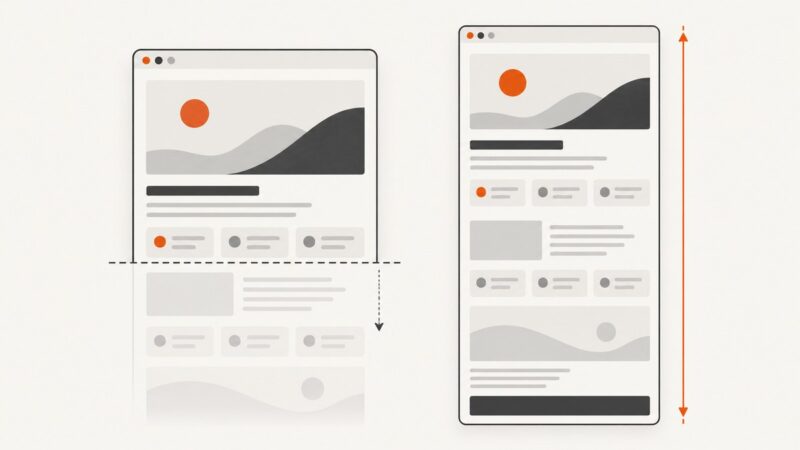
To capture a webpage that extends below the visible screen in Windows, use Microsoft Edge’s built-in Screenshot feature and choose the full-page option. It captures content below the fold without requiring you to scroll and stitch screenshots together.
Open the page in Edge, press Ctrl+Shift+S, select the full-page capture option, then copy or save the result. Microsoft says Screenshot can capture a full webpage or a selected area, including long or moving pages, and lets you mark up the image before copying or saving it. See the Microsoft Edge Screenshot documentation.
Capture a full webpage with Microsoft Edge
- Open the webpage in Microsoft Edge.
- Press Ctrl+Shift+S. You can also right-click the page and choose Screenshot, or open Screenshot from Edge Settings.
- Choose the option to capture the full page. The browser captures content below the current viewport.
- Review the resulting image. Use the markup tools if you need to draw, highlight or crop.
- Choose Copy to place the image on the clipboard, or Save to write it to a file.
The exact menu wording can vary. Older Edge instructions call this feature Web Capture; current Microsoft guidance calls it Screenshot. If you do not see a menu item, try the keyboard shortcut first.
Choose the right capture scope
| Need | Use | What you get |
|---|---|---|
| Everything on the webpage | Edge Screenshot → full page | One tall image containing content below the fold |
| Only part of the page | Edge Screenshot → selected area | A rectangular selection from the page |
| Only what is visible on screen | Windows Snipping Tool | A screen, window or rectangular capture |
Windows Snipping Tool documents freeform, rectangular, window and full-screen image modes, plus video snips. Its documentation does not describe a scrolling-webpage mode, so it is not the directly documented tool for capturing an entire page below the fold. See Microsoft’s Snipping Tool documentation.
Before you capture: make the page complete
- Wait for loading: allow fonts, images and client-rendered content to finish before starting the capture.
- Trigger lazy content: pages that load sections only after scrolling may not show every image or card immediately. Scroll through the page once, wait for new content, then run Screenshot.
- Close obstructing UI: dismiss cookie banners, newsletter dialogs, chat bubbles and sticky video players when possible.
- Set the viewport: maximize Edge and choose the zoom level that gives the text size you need. Browser zoom changes the resulting image dimensions.
- Check responsive layout: resize the window before capture if you need the desktop, tablet or mobile version of the page.
What happens on long, dynamic and unusual pages
Lazy-loaded images
Some pages request images only when their containers approach the viewport. If lower sections are blank, move through the page once to trigger loading, return to the top and capture again. A page that uses an intersection observer may still behave differently during automated or full-page capture.
Sticky headers and floating widgets
Fixed navigation bars, chat controls and consent dialogs can appear repeatedly or cover content. Close them before capture. If the page offers a reader mode or print view, that can produce a cleaner document, but it may change the design.
Very tall pages
A full-page image can become extremely tall. Saving may take longer and image editors may be slow to open it. For a report or document, PDF is often easier to share; for pixel-accurate archiving, keep the original image and consider splitting a copy into sections.
Frames and embedded documents
An embedded frame is a separate document. The outer-page capture may include the frame’s visible area without capturing the frame’s entire internal scroll range. Open the frame’s source URL in a new tab and capture it separately when you need all of its content.
Pages that require a sign-in
Capture only after signing in through the normal Edge session. Never paste passwords or session cookies into screenshots, bug reports or public repositories. Check the image for account numbers, email addresses and private messages before sharing.
Historical terminology: Web Capture versus Screenshot
Microsoft Edge introduced Web Capture in 2020. Older instructions describe dragging a selection toward the bottom of the page so Edge scrolls automatically, and they use Ctrl+Shift+S to open the tool. Current guidance uses the name Screenshot, so old screenshots of the menu may not match your browser.
Troubleshooting
| Symptom | Likely cause | Fix |
|---|---|---|
| Ctrl+Shift+S does nothing | Another application or extension owns the shortcut, or Edge is not focused | Click the page, retry, then use the right-click Screenshot command or Edge Settings. |
| No full-page option appears | Different Edge build, device type, market or feature rollout | Update Edge, retry the shortcut and check Microsoft’s current Screenshot page. Feature availability can vary by device, market and browser version. |
| The bottom of the page is missing | Content is loaded only after scrolling or the page timed out | Scroll through once, wait for images and scripts, then capture again. Disable heavy extensions temporarily. |
| Cookie banner covers the result | The consent dialog was still open | Accept or reject the banner, close it, reload if necessary and capture again. |
| Text is blurry or too small | Browser zoom or display scaling is unsuitable | Adjust Edge zoom and window width before recapturing. Use the original saved image instead of a clipboard thumbnail. |
| Capture contains private information | The page was captured while logged in | Redact the image before sharing, or use a separate browser profile with test data. |
| Only the visible screen is captured | Snipping Tool or a hardware screenshot shortcut was used | Use Edge Screenshot and select full page; Windows screen capture modes do not document webpage scrolling. |
Performance, reliability and file handling
- Performance: capture time grows with page length, image count and script activity. Let the page settle before invoking the tool.
- Reliability: dynamic pages can change while they are being captured. For repeatable evidence, record the URL, date, viewport width and zoom level alongside the image.
- File size: photographs and large backgrounds produce larger files than text-heavy pages. Save the original, then create a compressed copy for email or documentation.
- Repeatability: browser extensions, consent state, geolocation and account state can change the rendered page. Use a clean Edge profile when you need comparable captures.
Or skip the browser setup
If you need repeatable captures in a script, CI job or backend, ScreenshotNeo returns a full-page image from one request. It can load lazy images, wait for a selector, delay or network idle, set a viewport or device preset, use dark mode and retina scale, hide selectors, inject CSS or JavaScript, and capture one element by CSS selector. It also supports PNG, JPEG, WebP and PDF output.
ScreenshotNeo removes cookie and consent banners, newsletter popups and chat widgets before the shot. Bot checks, blank pages, failed loads, timeouts and cache hits are not billed, and the response identifies the page verdict and billing status in headers. Its MCP server provides take_screenshot, get_page_info and capture_pdf for Claude, Cursor and other MCP clients.
See the ScreenshotNeo API documentation for all options. The following request captures the complete page at the target URL:
curl -G "https://api.screenshotneo.com/v1/shot" -d access_key=YOUR_API_KEY --data-urlencode url=https://stripe.com -o shot.webpPython
import requests

r = requests.get(
    "https://api.screenshotneo.com/v1/shot",
    params={"access_key": "YOUR_API_KEY", "url": "https://stripe.com"},
    timeout=90,
)
r.raise_for_status()
open("shot.webp", "wb").write(r.content)
Node.js
const q = new URLSearchParams({
  access_key: 'YOUR_API_KEY',
  url: 'https://stripe.com'
});
const res = await fetch(`https://api.screenshotneo.com/v1/shot?${q}`);
if (!res.ok) throw new Error(`HTTP ${res.status}`);
const fs = await import('node:fs/promises');
await fs.writeFile('shot.webp', Buffer.from(await res.arrayBuffer()));
Useful automation options
| Requirement | ScreenshotNeo capability |
|---|---|
| Capture a specific component | CSS selector element capture |
| Wait for content | Selector wait, delay or network-idle wait |
| Remove page noise | Hide selectors plus consent, popup and chat removal |
| Control access | Custom headers, cookies, user agent and Authorization |
| Match a location | Timezone and geolocation settings |
| Reduce repeated work | Configurable caching TTL |
| Process many URLs | Bulk capture for up to 100 URLs per call |
| Run asynchronously | Async jobs with signed webhooks |
The free plan includes 1,000 shots per month with no card. Paid plans start at $5 for 3,000 shots; every feature is available on every plan. Create a free ScreenshotNeo account.
FAQ
Can Windows capture a whole webpage with the Print Screen key?
Print Screen captures the visible screen. Use Edge Screenshot for content below the fold.
Is Edge Screenshot the same as a scrolling screenshot?
Yes. The full-page option captures the page beyond the current viewport in one image.
Can I capture a full page from Chrome?
This guide covers Microsoft Edge’s documented Screenshot feature. Other browsers may provide their own developer or extension workflows.
Why does the result differ from what I see while scrolling?
Lazy loading, animations, sticky elements and changing account or consent state can alter the rendered page during capture. Let content load and close overlays first.
Can I automate full-page captures?
Yes. Use a browser automation framework for a do-it-yourself workflow, or call ScreenshotNeo’s API when you want a single HTTP request and server-side rendering.