BlogScreenshots on your device
How to Capture a Full Webpage on Windows with Capture de Page
Capture an entire webpage on Windows with Chrome DevTools, Windows shortcuts, extensions, or ScreenshotNeo’s screenshot API.
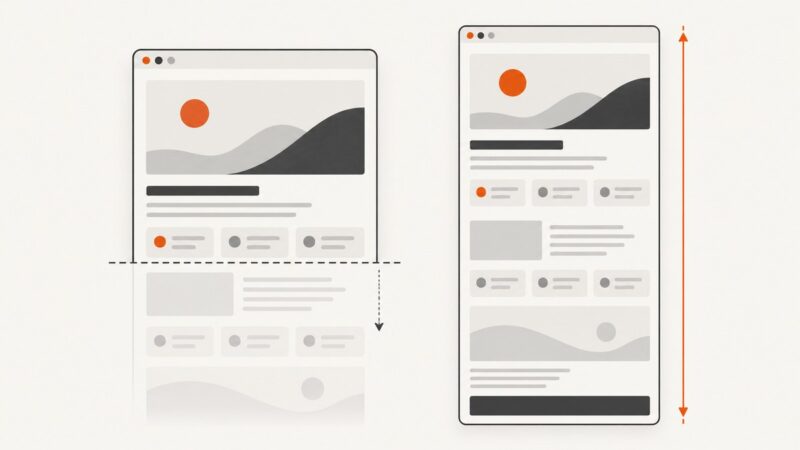
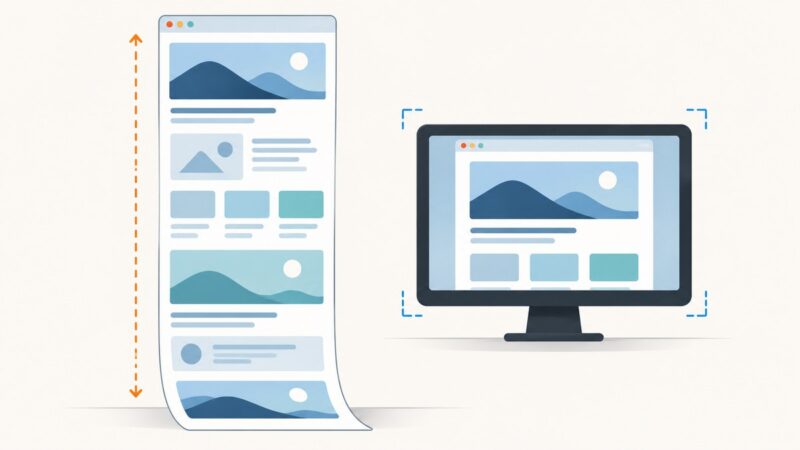
For a free, no-install full-page capture on Windows, use Chrome DevTools: open the page, press F12 or Ctrl+Shift+I, open the command menu with Ctrl+Shift+P, type screenshot, then choose Capture full size screenshot. Chrome saves a PNG, normally in your Downloads folder.
“Capture de Page” can describe a generic full-page capture rather than one specific Windows utility. This guide covers the built-in Chrome method first, Windows screen shortcuts, browser extensions, and an automated ScreenshotNeo option for scripts and AI agents.
1. Capture a full webpage with Chrome DevTools
- Open the webpage in Google Chrome and wait for the page to finish loading.
- Press F12 or Ctrl+Shift+I to open DevTools.
- Press Ctrl+Shift+P to open the DevTools command menu.
- Type
screenshot. - Choose Capture full size screenshot.
- Find the resulting PNG in your Downloads folder.
The command captures the page’s full document height, including content below the visible viewport. Use Capture screenshot instead when you only need the currently visible area.
When the full-size command is missing
- Make sure DevTools has focus before pressing Ctrl+Shift+P.
- Type “screenshot” rather than looking only through the panels.
- Undock DevTools or widen the window if the command menu is clipped.
- Reload the page and wait for scripts and images to finish before capturing.
2. Use Windows shortcuts for visible regions
Windows shortcuts are useful when you need a portion of what is currently on screen. They do not automatically scroll through a webpage.
| Shortcut | What it captures | Best use |
|---|---|---|
| Win+Shift+S | A selected rectangular, window or screen region | Crop a visible part of a page |
| Print Screen | The screen | Quick full-screen reference |
| Alt+Print Screen | The active window | Capture the browser window without other applications |
For an entire scrolling webpage, use Chrome DevTools or an automated capture service instead of a screen-region shortcut.
3. Prepare the page before capturing
- Close overlays: dismiss cookie dialogs, newsletter forms and chat panels if they obscure content.
- Wait for lazy content: scroll through the page once so images and sections load before starting the capture.
- Check the viewport: responsive layouts can change substantially between desktop and mobile widths.
- Pause moving content: carousels, videos and animated banners may appear in different states from one capture to the next.
- Sign in when required: DevTools captures what the current browser session can access.
4. Browser extensions for repeated captures
Extensions can provide a guided full-page workflow, selected-area capture, annotation and additional export formats. The Chrome Web Store listings for Full Page Screen Capture and GetFullPage describe full-page, visible-area and selected-area modes, with PNG, JPEG and PDF export. Their versions and permissions can change, so review the current listing and privacy policy before installing.
| Choose an extension when you need | Check before installing |
|---|---|
| Frequent captures with scrolling and stitching | Requested permissions and privacy policy |
| Annotations or editing after capture | Supported output formats and export limits |
| Multipage PDF or JPEG output | Whether fixed headers, lazy images and embedded frames capture correctly |
Extensions are convenient, but a listing’s stated capabilities do not guarantee identical results on every site. Test pages with sticky navigation, infinite scrolling, cross-origin frames and heavy client-side rendering.
5. Capture pages automatically with ScreenshotNeo
For repeatable captures in scripts, CI jobs or an application, ScreenshotNeo provides a GET request that returns a PNG, JPEG, WebP or PDF. Its capture options include full-page screenshots with lazy images loaded, CSS-selector element capture, dark mode, device presets, custom viewports, retina scale, custom CSS and JavaScript, click actions, hidden selectors, selector or network-idle waits, request blocking, headers, cookies, user agents, authorization, timezone, geolocation, transparency, image resizing, caching, signed links, asynchronous jobs, webhooks, bulk capture and a usage API. The API documentation lists the request parameters.
cURL
curl -G "https://api.screenshotneo.com/v1/shot" -d access_key=YOUR_API_KEY --data-urlencode url=https://stripe.com -o shot.webpPython
import requests

r = requests.get(
    "https://api.screenshotneo.com/v1/shot",
    params={"access_key": "YOUR_API_KEY", "url": "https://stripe.com"},
    timeout=90,
)
r.raise_for_status()
open("shot.webp", "wb").write(r.content)
Node.js
const q = new URLSearchParams({ access_key: 'YOUR_API_KEY', url: 'https://stripe.com' });
const res = await fetch(`https://api.screenshotneo.com/v1/shot?${q}`);
if (!res.ok) throw new Error(`Screenshot failed: ${res.status}`);
const fs = await import('node:fs/promises');
await fs.writeFile('shot.webp', Buffer.from(await res.arrayBuffer()));
Useful capture choices
| Requirement | ScreenshotNeo capability |
|---|---|
| Whole document | Full-page capture with lazy images loaded |
| One component | Capture an element by CSS selector |
| Consistent appearance | Device presets, custom viewport, retina scale, dark mode and timezone |
| Dynamic applications | Wait for a selector, delay or network idle; run custom JavaScript; click an element |
| Privacy or clutter control | Hide selectors; block ads, trackers, requests or resource types |
| Authenticated pages | Custom headers, cookies, user agent and Authorization |
| Documents | PDF paper size, margins, landscape mode and page ranges |
| High volume | Caching with a chosen TTL, asynchronous jobs, signed webhooks and up to 100 URLs per bulk call |
6. Or skip the browser setup
ScreenshotNeo removes cookie and consent banners before capture, along with more than 60 known consent platforms, newsletter popups and chat widgets. Each cleanup step can be turned off. Bot checks, blank pages, timeouts, failed loads and cache hits are not billed, and response headers report the page verdict and whether the request was billed.
An MCP server provides take_screenshot, get_page_info and capture_pdf tools for Claude, Cursor and other MCP clients. The Free plan includes 1,000 shots per month with no card; paid plans start at $5 for 3,000 shots. Create a free ScreenshotNeo account.
7. Troubleshooting full-page captures
| Problem | Likely cause | Fix |
|---|---|---|
| Only the visible viewport is saved | The visible-area command or Windows snipping shortcut was used | Use DevTools’ Capture full size screenshot command. |
| Images are blank or missing | Lazy loading has not triggered | Scroll through the page first, wait, then capture; for automation, use a lazy-image-aware full-page option and an explicit wait. |
| Sticky header appears repeatedly | The browser stitches a fixed element on each viewport | Hide the header with an extension or a custom CSS rule; verify the result at the target viewport. |
| Cookie dialog covers content | The consent layer is still active | Accept or dismiss it manually, hide its selector, or use ScreenshotNeo’s consent cleanup. |
| Page height is wrong | Infinite scrolling or content that loads after interaction | Trigger the required interaction, wait for the final selector, and capture after loading completes. |
| Authenticated content is absent | The capture runs without your browser session | Capture in the logged-in browser or provide the required cookies, headers or authorization to an API. |
| DevTools command menu does not open | Focus is in the page or another application | Click inside DevTools, then press Ctrl+Shift+P. |
| Automated request times out | Slow scripts, blocked resources or an incomplete wait condition | Use a selector or network-idle wait, block unnecessary resources, and set a client timeout long enough for the page. |
8. Quality, performance and reliability checklist
- Use the same viewport, device scale and timezone for comparable screenshots.
- Wait for a deterministic selector instead of relying only on a fixed delay.
- Disable animations or hide dynamic elements when pixel consistency matters.
- Capture after fonts, images and client-rendered data are available.
- Cache unchanged pages when freshness allows it; choose a TTL that matches your update cycle.
- For batches, use asynchronous jobs or bulk capture rather than starting many uncontrolled browser processes.
- Record the output format, URL, viewport, timestamp and page verdict with each artifact.
- Retry transient failures with backoff, but do not retry authentication or invalid-URL errors unchanged.
9. Cost considerations
Manual Chrome and Windows captures have no service charge, but they require a person and are harder to reproduce. Extensions may add export and annotation features, while their permissions and policies should be reviewed before use.
ScreenshotNeo bills only clean shots. Bot checks, blank pages, timeouts, failed loads and cache hits cost nothing, and X-Page-Verdict and X-Billed headers identify the result. Plans are Free with 1,000 shots monthly, Starter $5 for 3,000, Growth $15 for 15,000, Pro $39 for 60,000, Scale $99 for 250,000 and Business $249 for 1,000,000; yearly billing gives two months free and every feature is included on every plan.
10. FAQ
Can Win+Shift+S capture an entire scrolling page?
No. It captures a selected visible region. Use Chrome’s full-size DevTools command or an automated page-capture service for scrolling content.
Does Chrome DevTools add annotations?
No. DevTools provides the capture command but not an annotation editor. Use an image editor or an extension if you need markup.
Should I use PNG, JPEG or WebP?
PNG suits sharp text and diagrams, JPEG suits photographic pages, and WebP often reduces file size. Choose the format required by your publishing or storage pipeline.
Can I capture a page that requires login?
Yes, when the capture runs with the necessary browser session or credentials. For API capture, pass the required cookies, headers or authorization securely.
Why does a full-page image differ between runs?
Dynamic ads, animations, time-dependent data, responsive breakpoints and delayed resources can change the rendered page. Fix the viewport and timezone, wait for stable selectors and hide moving elements where possible.