How to capture screenshots of Indian school and college websites with an AI agent
Capture school and college webpages with an AI agent using Playwright. Choose a viewport, element, or full-page image, and keep a reproducible capture record.
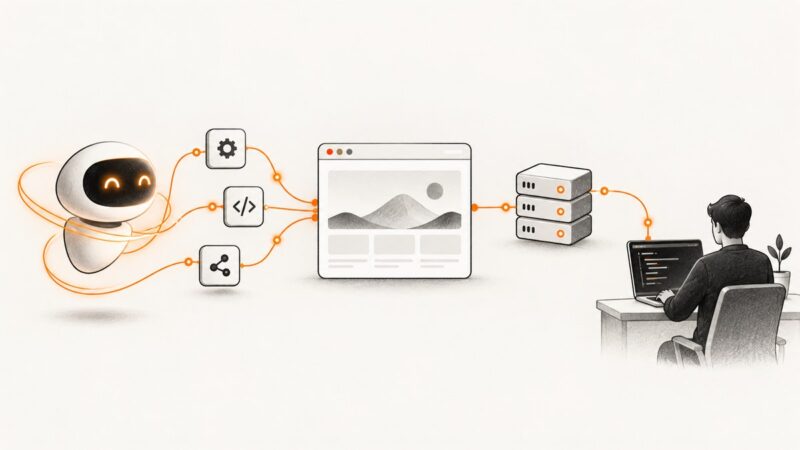
An AI agent can capture a public Indian school or college webpage with browser automation such as Playwright. Choose a viewport, a specific element, or the full scrollable page; save the screenshot with the exact URL and UTC capture time; then inspect it for clipping or missing content. Capture only pages you are authorized to view, and do not ask an agent to bypass a login, CAPTCHA, access control, or other restriction.
This guide uses Playwright with Python for the do-it-yourself workflow, followed by equivalent cURL, Python, and Node.js examples for ScreenshotNeo. A screenshot records visual appearance; it does not establish that you have permission to republish the page or its content.
1. Choose what the agent should capture
| Capture scope | What it records | Use it for | Watch for |
|---|---|---|---|
| Viewport | The visible browser area | Initial appearance or a consistent screen-size comparison | Content below the fold is omitted |
| Element | One selected page element | A notice, menu, banner, or content section | The selector must identify the intended element |
| Full page | The full scrollable document | Reviewing page content below the fold | A long image can be difficult to read; Playwright does not combine full-page capture with a target element |
Use the page structure or accessibility information to find the right element, then use the screenshot to check its rendered appearance. Playwright MCP documentation describes screenshots as visual inspection aids and recommends browser snapshots for interacting with page structure. [Playwright screenshot documentation]
2. Set up a Playwright capture
Install Python and Playwright, then install the browser binary. The following commands use Chromium and are suitable for a local script or an agent’s execution environment:
python -m pip install playwright
python -m playwright install chromium
Save this as capture_school_site.py. It takes a full-page screenshot by default, can capture the current viewport or a CSS-selected element, and records the URL, UTC time, browser, viewport, capture mode, and output filename in a JSON sidecar.
import argparse
import asyncio
import json
from datetime import datetime, timezone
from pathlib import Path
from urllib.parse import urlparse

from playwright.async_api import async_playwright


async def main():
    parser = argparse.ArgumentParser(description="Capture an authorized public webpage")
    parser.add_argument("url", help="Exact public page URL to capture")
    parser.add_argument("--mode", choices=["viewport", "full", "element"], default="full")
    parser.add_argument("--selector", help="CSS selector required for --mode element")
    parser.add_argument("--output", default="school-homepage-full.png")
    parser.add_argument("--width", type=int, default=1440)
    parser.add_argument("--height", type=int, default=1000)
    parser.add_argument("--timeout-ms", type=int, default=30000)
    args = parser.parse_args()

    parsed = urlparse(args.url)
    if parsed.scheme not in ("http", "https") or not parsed.netloc:
        raise SystemExit("URL must be a complete http:// or https:// URL")
    if args.mode == "element" and not args.selector:
        raise SystemExit("--selector is required with --mode element")

    output = Path(args.output)
    output.parent.mkdir(parents=True, exist_ok=True)

    async with async_playwright() as p:
        browser = await p.chromium.launch(headless=True)
        page = await browser.new_page(
            viewport={"width": args.width, "height": args.height},
            device_scale_factor=1,
        )
        response = await page.goto(
            args.url,
            wait_until="domcontentloaded",
            timeout=args.timeout_ms,
        )
        # Give client-side rendering a chance to settle without requiring every
        # third-party request to finish. Use a site-specific readiness signal
        # when the page exposes one.
        await page.wait_for_timeout(1000)

        if args.mode == "element":
            target = page.locator(args.selector).first
            await target.wait_for(state="visible", timeout=args.timeout_ms)
            await target.screenshot(path=str(output))
        else:
            await page.screenshot(
                path=str(output),
                full_page=(args.mode == "full"),
                animations="disabled",
            )

        record = {
            "url": page.url,
            "captured_at_utc": datetime.now(timezone.utc).isoformat(),
            "browser": "Chromium via Playwright",
            "viewport_css_pixels": {"width": args.width, "height": args.height},
            "device_scale_factor": 1,
            "mode": args.mode,
            "selector": args.selector if args.mode == "element" else None,
            "http_status": response.status if response else None,
            "filename": str(output),
        }
        output.with_suffix(output.suffix + ".json").write_text(
            json.dumps(record, indent=2), encoding="utf-8"
        )
        await browser.close()
        print(json.dumps(record, indent=2))


if __name__ == "__main__":
    asyncio.run(main())
Run the script with your authorized target URL:
python capture_school_site.py "https://example.edu.in/" --mode full --output "school-homepage-full.png"
python capture_school_site.py "https://example.edu.in/admissions" --mode viewport --output "admissions-viewport.png"
python capture_school_site.py "https://example.edu.in/" --mode element --selector "main" --output "school-main.png"
example.edu.in is a placeholder; replace it with the exact public page you are permitted to capture. The script does not attempt to solve CAPTCHAs, sign in, or evade restrictions. Check whether a capture actually succeeded by reviewing the saved image and the reported HTTP status; a successful navigation does not guarantee the page rendered all expected content.
3. Make the capture repeatable and readable
- Use the exact page URL. Capture the page you intend to document, rather than relying on a homepage redirect or a search result.
- Fix the viewport. Keep width, height, and device scale factor consistent when comparing pages or recapturing later.
- Wait for meaningful readiness. The example waits for DOM content and a short delay. If the site has a stable heading or content selector, wait for that selector instead. Network idle can be unreliable on pages with analytics, polling, or long-lived connections.
- Choose scope deliberately. Full-page capture is useful for below-the-fold content. For a very long page, use separate viewport captures by section if one tall image is unreadable.
- Inspect the output. Check the top and bottom of a full-page image, sticky headers, lazy-loaded images, overlays, and the element boundaries. Save a new capture if important content is missing.
- Keep the sidecar record. Preserve the URL, capture time, browser and viewport configuration, mode, selector if relevant, and filename with the image.
For different output needs, Playwright supports screenshot output options such as image format and quality settings where applicable, masking locators, and disabling animations. Consult the official API for the exact options supported by your installed Playwright version: screenshots guide and Page screenshot API.
4. Work with an AI agent safely
Give the agent a bounded task: an exact public URL, capture scope, output path, and viewport. Ask it to report the final URL, capture time, HTTP status if available, and any visible failure. Have it use page structure or accessibility information to locate an element, then inspect the screenshot for visual correctness.
- Do not instruct the agent to bypass access controls, log in using someone else’s account, defeat a CAPTCHA, or evade a site’s restrictions.
- Do not capture unnecessary personal information. Avoid retaining unrelated personal data visible on the page, particularly when the image will be shared.
- Keep the original screenshot separate from any edited or annotated derivative so the source record remains clear.
- Limit agent access to the requested page and output location. Review the saved file before sharing it.
Playwright MCP can provide browser tools to an AI agent, but the screenshot remains a visual aid. Use browser snapshots or equivalent page structure information to interact with page content, and the screenshot to confirm visual appearance. See the Playwright MCP project documentation.
5. India-specific privacy and reuse considerations
GIGW 3.0 provides guidance for Indian government websites and applications. Its focus includes usability, user-centricity, accessibility, and security; it is not automatically a compliance standard for every privately operated school or college site. For a government institution, it can be useful context for a review, alongside the site’s own policy. [GIGW guidance]
Check the target institution’s privacy notice and terms for conditions that apply to its site. A screenshot may show personal information or third-party photographs, logos, and embedded material. Capturing a publicly visible page does not itself establish that you may republish those materials.
The National Government Services Portal’s policy is one example of a specific government portal policy: it describes conditions for reproducing featured material, excludes third-party copyrighted material from that permission, and separately permits direct links to its portal. Do not treat that policy as blanket permission for unrelated sites. [National Government Services Portal policies]
The Press Information Bureau states that the Government of India notified the Digital Personal Data Protection Rules, 2025 on 14 November 2025, giving effect to the DPDP Act, 2023. If a screenshot or later processing contains personal data, assess the actual data, purpose, parties, and applicable requirements. The cited announcement alone does not establish that capturing any public webpage is automatically compliant or prohibited. [Press Information Bureau announcement]
6. Troubleshooting
| Symptom | Likely cause | Fix |
|---|---|---|
| Navigation times out | The page is slow, unreachable, or held open by requests | Check the URL and access in a normal browser. Use a suitable navigation wait condition and a realistic timeout. Do not treat a timeout as permission to bypass a restriction. |
| Screenshot is blank or mostly empty | Client-side content has not rendered, navigation failed, or the site returned an interstitial | Inspect the final URL, response status, and page structure. Wait for a meaningful content selector when available, then capture again. |
| Element selector is not found | The selector is wrong, the element is in a frame, or it appears only after interaction | Inspect the page structure, verify the selector, and wait for the intended element. If it is in a frame, use Playwright’s frame locator with the documented frame APIs. |
| Important images are missing | Images load lazily or after scrolling | Use a full-page capture and inspect the result. If necessary, scroll through the page before capture or wait for the specific images to load; avoid adding an unbounded wait. |
| Full-page capture is too tall to read | The document is long | Capture relevant sections as separate viewport images, or capture a specific element. Keep the URL and section details in the capture log. |
| Output differs between runs | Viewport, device scale, page state, dynamic content, or timing changed | Fix viewport and browser settings, record capture time, use a page-specific readiness condition, and note that changing page content can still alter the image. |
| Browser binary or import error | Playwright package or Chromium is missing from the environment | Install the Python package and run python -m playwright install chromium in the same environment used by the agent. |
7. Performance, reliability, and cost
With local Playwright, you provide the browser runtime and compute environment. Browser startup and page loading contribute to capture time; full-page images and high device scale factors can increase memory use and output size. Reuse a browser process for batches of authorized pages, set bounded timeouts, and avoid waiting for every network request when a page has persistent activity. For a reproducible archive, retain capture metadata and consider a checksum in your own workflow.
Playwright itself is software; the actual cost depends on where the agent runs it and the resources that environment consumes. The dossier contains no benchmark or measured cost for capturing school or college pages. Do not infer a speed, reliability, or expense figure without measuring your own workload.
8. Or skip the browser setup
For a one-request screenshot API, ScreenshotNeo returns a PNG, JPEG, WebP, or PDF from a URL. See the ScreenshotNeo API documentation for request options. The basic calls below use the given API pattern and an example public site; replace the target URL with a page you are authorized to capture.
cURL
curl -G "https://api.screenshotneo.com/v1/shot" -d access_key=YOUR_API_KEY --data-urlencode url=https://stripe.com -o shot.webpPython
import requests
r = requests.get("https://api.screenshotneo.com/v1/shot", params={"access_key": "YOUR_API_KEY", "url": "https://stripe.com"}, timeout=90)
open("shot.webp", "wb").write(r.content)
Node.js
const q = new URLSearchParams({ access_key: 'YOUR_API_KEY', url: 'https://stripe.com' });
const res = await fetch(`https://api.screenshotneo.com/v1/shot?${q}`);- Cookie banners, newsletter popups, and chat widgets are removed before the shot; each cleanup step can be turned off.
- Bot checks, blank pages, timeouts, failed loads, and cache hits are not billed; response headers report the page verdict and billing status.
- An MCP server provides
take_screenshot,get_page_info, andcapture_pdftools for AI agents and MCP clients. - The Free plan includes 1,000 screenshots a month without a card. Paid plans start at $5 for 3,000 screenshots; all features are available on every plan.
Sign up for 1,000 free screenshots a month, with no card required.
9. FAQ
Can an AI agent capture a college website without a browser?
A screenshot API can capture a supplied URL without you setting up Playwright locally. The target still needs to be accessible to the service, and you remain responsible for choosing a page you are authorized to capture.
Should I use a full-page image for a very long page?
Only if the resulting tall image remains useful. Separate viewport captures can be easier to inspect and share, provided you record which sections they show.
Does GIGW apply to every Indian school website?
No. The cited GIGW scope is government websites and applications. Private institutions’ own terms and applicable requirements need to be considered separately.
Does a screenshot grant permission to reuse page content?
No. Capture and republication are separate decisions. Check the site’s terms and the rights for visible third-party content before redistribution.