BlogScreenshots on your device
How to Capture a Scrolling Screenshot on a Laptop
Capture an entire webpage on a laptop with Edge, Firefox, Developer Tools, or ScreenshotNeo—including content below the fold.
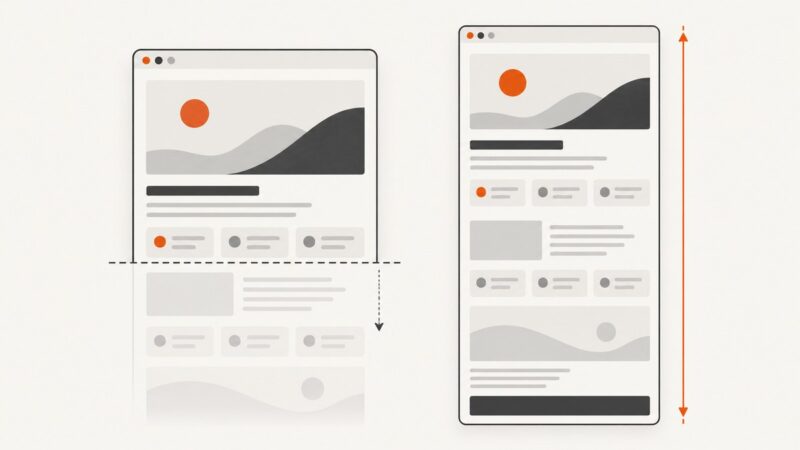
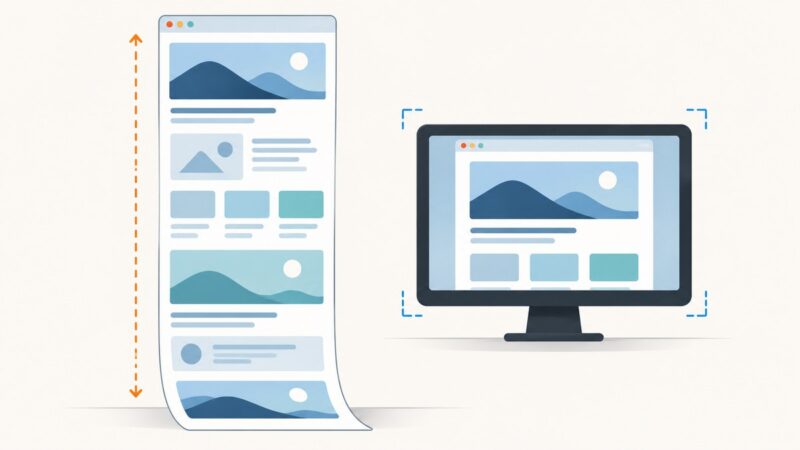
Use your browser’s full-page screenshot feature. A normal screen snip captures only the visible display or a selected region. A scrolling screenshot, also called a full-page screenshot, captures the webpage content below the fold in one image.
On Microsoft Edge, open the page menu and choose Screenshot, or press Ctrl+Shift+S, then select the full-page option. In Firefox, open the page’s Screenshot action and choose Save full page. Firefox can download the image or copy it to the clipboard. The exact menu or shortcut can vary by browser version, device type, market and managed-device policy.
Choose the right method
| Method | Browser or system | Captures below the fold? | Output |
|---|---|---|---|
| Edge Screenshot | Microsoft Edge | Yes, with full-page capture | Copy or save; markup tools are available |
| Firefox Screenshot | Firefox | Yes, with Save full page | Download or copy to clipboard |
| Firefox Developer Tools | Firefox | Yes | PNG saved to Downloads by default |
| Windows Snipping Tool | Windows | No webpage scrolling mode | Freeform, rectangular, window or full-screen snip |
| ScreenshotNeo API | Any laptop or server | Yes, through an API request | PNG, JPEG, WebP or PDF response |
Capture a full webpage in Microsoft Edge
- Open the webpage in Edge and wait for the content you need to appear.
- Open the page menu and select Screenshot, or press Ctrl+Shift+S.
- Choose the option that captures the full page, rather than only the visible area.
- Review the result. Edge lets you mark up the capture, copy it, or save it.
Microsoft describes Edge Screenshot as capturing “a screenshot of a full webpage, even the parts you would have to scroll to see.” See the official Edge Screenshot documentation if your menu labels differ.
If Screenshot is missing in Edge
- Update Edge, then reopen the browser.
- Try the page context menu and the Ctrl+Shift+S shortcut.
- On a work or school laptop, an administrator policy may hide or restrict features.
- Use Firefox’s full-page tool as a browser-independent fallback.
Capture a full webpage in Firefox
- Open the page in Firefox.
- Open the page actions menu and choose Take Screenshot.
- Select Save full page.
- Download the image or copy it to the clipboard.
If you cannot find the Screenshot action, add it from Menu > More Tools > Customize Toolbar. Mozilla documents these steps in Take screenshots in Firefox.
Use Firefox Developer Tools
This route is useful when you need a repeatable developer workflow.
- Open Firefox settings and enable Take a screenshot of the entire page under Available Toolbox Buttons.
- Open Developer Tools and click the screenshot button.
- Choose the full-page capture option. Firefox saves the image to Downloads by default.
You can also open the Web Console and run:
:screenshot --fullpageSee Mozilla’s Developer Tools screenshot documentation for the icon and console workflows.
When Windows Snipping Tool is the right choice
Press Windows+Shift+S to open Snipping Tool. Its documented modes are freeform, rectangular, window and full screen. These modes capture the current display or a selected region; they do not provide a scrolling webpage capture. Use Edge or Firefox when the page continues below the fold. Microsoft lists the modes and shortcut in Use Snipping Tool to capture screenshots.
Make the scrolling capture complete and readable
Wait for content to finish loading
Long pages often load images, charts or comments as you scroll. Wait for the visible page to settle before starting the capture. If the page uses infinite scrolling, a browser capture may stop at the content that has actually loaded.
Handle sticky headers and fixed widgets
Sticky navigation bars can appear repeatedly in a stitched image. Cookie banners, chat bubbles and newsletter popups can also cover content. Dismiss them before capturing, or use a capture tool that can hide selectors or remove known overlays.
Check the result at full size
Zoom out only if you need a shorter image. Otherwise, keep the browser at a comfortable zoom and inspect the saved file for seams, missing lazy-loaded images, clipped elements or repeated headers.
Common errors and fixes
| Problem | Likely cause | Fix |
|---|---|---|
| Only the visible screen is captured | A region or window snip was used | Choose Edge full-page Screenshot or Firefox Save full page. |
| Screenshot command is unavailable | Browser version, device policy or changed toolbar layout | Update the browser, use the menu fallback, or add Firefox Screenshot through Customize Toolbar. |
| Images are blank or missing | Lazy loading, slow network or blocked requests | Wait longer, scroll through the page once, disable blocking extensions temporarily, then capture again. |
| Cookie notice covers the image | Consent dialog was not dismissed | Accept or reject the banner before capture, then verify it is gone. |
| Chat or newsletter popup appears | A timed overlay opened during capture | Close it, wait for timers to settle, or hide the element with a developer-oriented capture tool. |
| Page is cut off | The page is inside an iframe, virtualized list or infinite scroller | Capture the relevant element, use the page’s print view, or use an API that supports element selectors and wait conditions. |
| Capture has visible stitching seams | Animations, sticky elements or layout changes while scrolling | Pause animations, disable motion where possible, close sticky overlays and recapture. |
Performance, reliability and file size
- Very long pages: Full-page images can become large and slow to open. WebP or JPEG usually produces a smaller file than PNG when the workflow allows it.
- Dynamic pages: Capture after network activity and animations have settled. A page that changes while the browser scrolls can produce inconsistent sections.
- Privacy: Check the final image for account data, personal details, internal URLs and consent choices before sharing it.
- Repeatability: For recurring captures, record the browser, viewport size, zoom, login state and capture time. Small environment changes can alter responsive layouts.
Or skip the browser setup
ScreenshotNeo provides a website screenshot API and MCP server. One GET request returns a PNG, JPEG, WebP or PDF. Its full-page capture loads lazy images, and you can also select one element by CSS selector, set a viewport or device preset, use retina scale, wait for a selector, delay or network idle, add custom CSS or JavaScript, hide selectors, block ads or resource types, provide headers, cookies, a user agent or Authorization, set timezone and geolocation, resize images, cache with your chosen TTL, create signed image links, submit async jobs with signed webhooks, capture up to 100 URLs per bulk call and read usage through the API.
Cookie and consent banners are accepted and removed before the shot, along with more than 60 known consent platforms, newsletter popups and chat widgets. Bot checks, blank pages, timeouts, failed loads and cache hits are not billed; response headers identify the page verdict and whether the request was billed. The MCP server exposes take_screenshot, get_page_info and capture_pdf for Claude, Cursor and other MCP clients.
See the ScreenshotNeo API documentation for request options.
cURL
curl -G "https://api.screenshotneo.com/v1/shot" -d access_key=YOUR_API_KEY --data-urlencode url=https://stripe.com -o shot.webpPython
import requests
r = requests.get("https://api.screenshotneo.com/v1/shot", params={"access_key": "YOUR_API_KEY", "url": "https://stripe.com"}, timeout=90)
open("shot.webp", "wb").write(r.content)
Node.js
const q = new URLSearchParams({ access_key: 'YOUR_API_KEY', url: 'https://stripe.com' });
const res = await fetch(`https://api.screenshotneo.com/v1/shot?${q}`);
The Free plan includes 1,000 screenshots each month with no card. Paid plans start at $5 for 3,000 shots; every feature is available on every plan. Create a free ScreenshotNeo account.
FAQ
What is a scrolling screenshot called?
It is usually called a full-page screenshot or full-page capture.
Can I do this without installing software?
Yes. Edge and Firefox include browser tools. Windows Snipping Tool is already installed on supported Windows systems, but it is for visible regions rather than scrolling webpages.
Why does my full-page image look different from the live page?
Responsive breakpoints, lazy loading, animations, login state and content that changes during scrolling can all affect the result.
Can I capture only one part of a long page?
Use a region or element capture when your browser provides it. ScreenshotNeo also supports capturing one element by CSS selector.
Can a scrolling screenshot be a PDF?
Browser screenshot tools generally create an image. For a PDF response, use a browser print workflow or ScreenshotNeo’s PDF capture endpoint.