BlogScreenshots on your device
How to Capture a Scrolling Window Screenshot
Capture an entire webpage or scrolling app window on Edge, Firefox, Android, and Windows, plus reliable fixes for nested scroll areas.
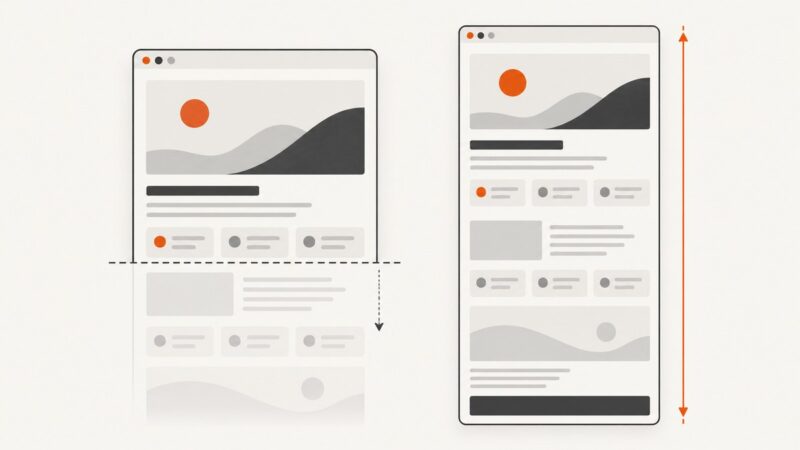
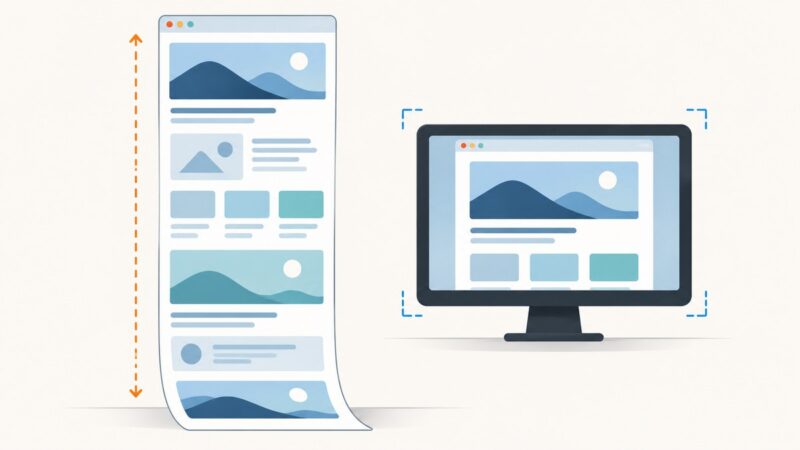
A normal screenshot captures only the visible viewport. A scrolling or full-page screenshot captures the content above and below it in one image.
For a webpage, use the browser’s built-in full-page command:
- Microsoft Edge: press Ctrl+Shift+S, then choose Capture full page.
- Firefox: right-click an empty part of the page, choose Take Screenshot, then Save full page.
- Android 12 and later: take a screenshot, select Capture more or the scrolling control, adjust the range, and save.
- PDFs, spreadsheets, chat panes, and dashboards: use a scrolling-window utility when the content is inside a nested scroll area.
Choose the right capture method
| Target | Best first option | Why |
|---|---|---|
| Ordinary webpage in Edge | Edge Screenshot → Capture full page | Built in and captures the document without manual scrolling. |
| Ordinary webpage in Firefox | Take Screenshot → Save full page | Built in, with a separate visible-viewport option. |
| Scrollable screen on Android | Screenshot → Capture more | Works on Android 12 and later on most screens that allow scrolling. |
| PDF viewer or inner pane | Scrolling-window utility | Browser full-page commands usually follow the main document, not an inner scroll container. |
| Repeatable server-side captures | Screenshot API | Useful for scheduled, bulk, or automated screenshots without keeping a browser open. |
Microsoft Edge: capture the entire webpage
- Open the page and wait for the content you need to appear.
- Press Ctrl+Shift+S, or right-click the page and choose Screenshot.
- Select Capture full page. Edge captures the page without requiring you to scroll manually.
- Use the annotation controls if you need to mark the result, then save or copy it.
Microsoft describes this as capturing everything at once with no scrolling required. See the Microsoft Edge support documentation for the current menu name in your release.
When Edge captures only part of the page
- Confirm that you selected Capture full page, not a selected area.
- Close an open overlay, cookie dialog, or menu that changes the document height.
- Wait for lazy-loaded images and content to finish loading, then repeat the capture.
- If the visible page contains a separately scrolling panel, capture that panel with a scrolling-window utility instead.
Firefox: Save full page
- Right-click an empty part of the webpage.
- Choose Take Screenshot.
- Select Save full page for the entire document, or Save visible for only the current viewport.
- Download the image.
Mozilla’s support and developer documentation describe both the full-document control and the visible-area option. Refer to Mozilla’s screenshot help if your context menu differs.
Android: take a long screenshot
- Open the scrollable page or app screen.
- Take a normal screenshot using your device’s power and volume controls, or its screenshot shortcut.
- On the screenshot toolbar, tap Capture more, Scroll, or a similarly named control.
- Drag the handles to choose how far down the page to include.
- Tap Save.
Google says these steps work on Android 12 and up on most screens that allow scrolling. Manufacturers can use different labels or omit the control for an app that does not expose a scrollable surface. See Google Android Help.
Chrome and other desktop browsers
Chrome desktop can capture a full-size page through DevTools:
- Open DevTools with F12 or Ctrl+Shift+I.
- Open the command menu with Ctrl+Shift+P.
- Search for Capture full size screenshot and run it.
Menu names and availability can change between browser versions. If the command is missing, use the browser’s current screenshot feature or a maintained full-page capture extension after reviewing its permissions and privacy policy.
Capturing a scrolling pane, PDF, or app window
Full-page browser tools normally follow the main document. They may miss content inside an element with its own scrollbar, such as a PDF viewer, spreadsheet grid, chat transcript, or dashboard panel.
On Windows, a scrolling-window utility such as PicPick can capture an arbitrary scrolling window: open Screen Capture → Scrolling Window, select the target window, and let the utility move through the pane and stitch the result. Check the utility’s current version, pricing, accessibility, and privacy terms before installing it. A browser extension such as GoFullPage is another option for webpages, but it does not automatically solve every nested-scroll case.
Nested-scroll checklist
- Click inside the pane before starting the capture so it has focus.
- Move the pointer over the exact element that scrolls.
- Disable sticky headers or floating widgets if they duplicate on every segment.
- Use a shorter capture range when the pane loads more rows only after scrolling.
- If stitching produces overlaps, change the utility’s scroll interval or overlap setting.
Prepare a page for a clean, complete capture
- Set the browser window to the viewport width you want readers to see.
- Wait for fonts, images, charts, and lazy-loaded sections to render.
- Dismiss cookie banners, newsletter dialogs, chat bubbles, and consent overlays.
- Scroll through the page once when lazy loading is important, then return to the top.
- Close menus and hover states that would otherwise be repeated in the stitched image.
- Use a stable network connection and avoid capturing while the page is still changing.
Common problems and fixes
| Symptom | Likely cause | Fix |
|---|---|---|
| Only the visible viewport is saved | Visible-area mode was selected. | Choose Capture full page or Save full page. |
| Bottom sections are blank | Lazy content did not load before capture. | Wait, scroll through the page once, then capture again. |
| A cookie banner covers the result | The consent layer remained open. | Accept or dismiss it before starting, or use a capture service that removes known consent overlays. |
| A PDF or chat pane is truncated | The content is inside a nested scrollbar. | Focus the pane and use a scrolling-window utility. |
| Headers or buttons appear repeatedly | A sticky element was stitched into every segment. | Hide it temporarily, switch capture tools, or crop the repeated area. |
| Images are blurry | The source image is low resolution or the output was scaled down. | Capture at the required viewport scale and avoid enlarging the result afterward. |
| The capture stops partway down | The page timed out, changed layout, or hit a tool size limit. | Capture in sections, reduce animations, or use an automated service with explicit wait and timeout controls. |
Performance, reliability, and output choices
- Long pages: full-page images can be very tall and memory intensive. Split extremely long documents into logical sections when sharing or editing matters more than one file.
- Dynamic pages: animations, carousels, ads, and live feeds can change between segments. Pause them where possible.
- Lazy loading: content that appears only after scrolling may be absent unless you trigger it before capture.
- Image versus PDF: use an image for visual sharing and annotation; use PDF when pagination, paper size, margins, or printing are important.
- Privacy: review extensions and utilities before giving them access to pages containing private data.
Or skip the browser setup
ScreenshotNeo is a website screenshot API and MCP server. One GET request returns a PNG, JPEG, WebP, or PDF. It can capture full pages, load lazy images, wait for a selector, delay, or network idle, and target one element by CSS selector.
Use the API when you need repeatable captures, custom viewport or device settings, dark mode, retina scale, PDF paper and margin controls, custom CSS or JavaScript, hidden selectors, blocked resource types, headers, cookies, user agents, timezones, geolocation, caching, signed links, async jobs, webhooks, bulk capture, or usage reporting. The parameter names used by other screenshot APIs also work, which can simplify migration. Full documentation is at ScreenshotNeo docs.
cURL
curl -G "https://api.screenshotneo.com/v1/shot" -d access_key=YOUR_API_KEY --data-urlencode url=https://stripe.com -o shot.webpPython
import requests

r = requests.get(
    "https://api.screenshotneo.com/v1/shot",
    params={"access_key": "YOUR_API_KEY", "url": "https://stripe.com"},
    timeout=90,
)
r.raise_for_status()
open("shot.webp", "wb").write(r.content)
Node.js
const q = new URLSearchParams({ access_key: 'YOUR_API_KEY', url: 'https://stripe.com' });
const res = await fetch(`https://api.screenshotneo.com/v1/shot?${q}`);
if (!res.ok) throw new Error(`Screenshot failed: ${res.status}`);
const fs = await import('node:fs/promises');
await fs.writeFile('shot.webp', Buffer.from(await res.arrayBuffer()));
Consent banners, newsletter popups, and chat widgets are removed before the shot. Bot checks, blank pages, failed loads, timeouts, and cache hits are not billed, and response headers identify the page verdict and whether it was billed. Its MCP server lets Claude, Cursor, and other MCP clients use take_screenshot, get_page_info, and capture_pdf.
The Free plan includes 1,000 screenshots per month with no card. Paid plans start at $5 for 3,000 screenshots; every feature is included on every plan. Start with the free ScreenshotNeo account.
Short FAQ
Does a scrolling screenshot include content above the current position?
Yes. Full-page and Save full page modes capture the document from its top through its bottom, while visible-area modes capture only the current viewport.
Why does my browser miss a panel inside the page?
That panel probably has its own scrollbar. Focus it and use a scrolling-window capture tool, or capture the panel’s contents in sections.
Can Android capture every app?
No. Android 12 and later support scrolling capture on most screens that allow scrolling, but an app can omit or disable the control.
Should I use PNG, JPEG, WebP, or PDF?
Choose PNG for crisp text and annotation, JPEG for smaller photographic files, WebP for efficient web delivery, and PDF when page layout or printing matters.