BlogScreenshots on your device
How to Capture a Web Page Screenshot on Mac
Use Mac shortcuts for screen, window, and selection captures, then capture an entire scrolling webpage with Chrome, Safari, Firefox, or an API.
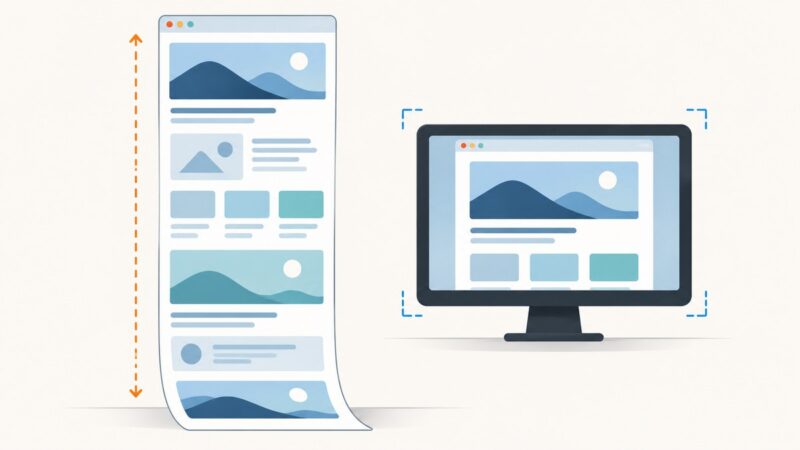
Quick answer: Press Shift-Command-3 to capture the entire Mac screen, Shift-Command-4 to select an area, or Shift-Command-4 followed by Space to capture a window or menu. For an entire scrolling webpage, use your browser’s full-page capture workflow: Chrome DevTools can export a full-size screenshot, while Safari and Firefox provide browser-specific inspector or full-page options.
1. Choose the right capture method
| Goal | Best method | Output |
|---|---|---|
| Everything visible on your display | Shift-Command-3 | Image saved to the desktop by default |
| A rectangular region | Shift-Command-4 | Image |
| One window or menu | Shift-Command-4, then Space | Image |
| A long webpage from top to bottom | Browser full-page capture | Long image or PDF |
| Repeatable captures in code | ScreenshotNeo API | PNG, JPEG, WebP, or PDF |
2. Capture the entire Mac screen
- Press and release Shift-Command-3.
- macOS saves the image to the desktop by default.
- If a thumbnail appears in the corner, click it to mark up or edit the capture, or wait for it to save.
To place the capture on the clipboard instead, hold Control too: Control-Shift-Command-3. Apple describes the built-in tool this way: “You can capture the entire screen, a window or just a portion of the screen.”
3. Capture part of the screen
- Press Shift-Command-4. The pointer becomes a crosshair.
- Drag over the area you want.
- Release the pointer to capture it.
Press Esc before releasing to cancel. Hold Space while dragging to move the selection without changing its dimensions. Add Control to copy the result to the clipboard.
4. Capture a window or menu
- Open the window or menu.
- Press Shift-Command-4, then press Space. The pointer changes to a camera.
- Click the window or menu.
Hold Option while clicking if you want to exclude the window shadow. This method captures the selected window even when other windows overlap it.
5. Use the Screenshot app
Press Shift-Command-5, or open Applications > Utilities > Screenshot. The control bar provides whole-screen, window, selected-portion, and screen-recording controls.
Open Options to choose:
- A timer
- A different save location
- Whether a floating thumbnail appears
- Whether the pointer is visible
- On supported macOS Tahoe 26 or later hardware, SDR PNG or HDR HEIF capture
6. Capture a full webpage in Chrome
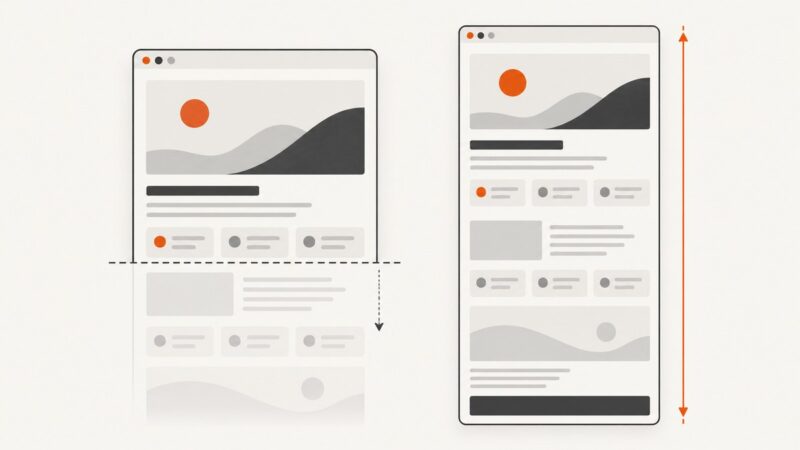
A normal shortcut captures only the visible browser viewport. Use Chrome DevTools for a page-length image:
- Open the webpage and wait for its initial content to load.
- Press Command-Option-I to open DevTools.
- Press Command-Shift-P to open the command menu.
- Search for Capture full size screenshot.
- Run that command. Chrome creates an image containing the full page.
For pages with lazy-loaded images, scroll through the page first, pause while images appear, then run the command again. Otherwise sections that were never rendered can be missing or blank.
7. Capture a full webpage in Safari
Safari’s Web Inspector is available from Develop > Show Web Inspector or with Option-Command-I. If the Develop menu is hidden, enable it in Safari settings first.
- Open the page.
- Use Safari’s full-page or Web Inspector capture command when available in your version.
- If you need a document rather than an image, choose File > Print and save as PDF.
Safari’s exact commands vary by macOS and Safari release. When an image export is unavailable, PDF export is the dependable built-in fallback.
8. Capture a full webpage in Firefox
- Open the page in Firefox.
- Use Firefox’s page-actions or developer tools menu to choose its full-page screenshot command.
- Save the resulting image, or print the page to PDF if you need a document.
If the page uses lazy loading, scroll from top to bottom before capturing so deferred images have a chance to render.
9. Save a webpage as an image or PDF
Image
Use Chrome’s Capture full size screenshot, the corresponding Safari or Firefox full-page command, or a dedicated utility such as FireShot. FireShot’s Mac App Store listing describes full-page, visible-part, and custom-selection webpage captures with local saving and sharing.
- Open the page in your browser.
- Press Command-P.
- Choose Save as PDF.
- Set paper size, orientation, margins, and page range as needed.
PDF is usually better for printing or archiving. A full-page image is better for a visual reference, thumbnail, or design review.
10. Common problems and fixes
| Problem | Cause | Fix |
|---|---|---|
| The screenshot includes only the visible viewport | A normal screen capture was used | Use the browser’s full-page command or print to PDF |
| Images are missing in a full-page capture | Lazy loading had not triggered | Scroll through the page, wait for images, then capture again |
| The file is not on the desktop | Screenshot app save location was changed | Press Shift-Command-5 and check Options |
| The selection is wrong | The drag ended at the wrong position | Hold Space while dragging to reposition; press Esc to cancel and retry |
| A window shadow appears | Window capture includes the default shadow | Hold Option while clicking the window |
| Clipboard paste does not work | Control was omitted from the shortcut | Use Control-Shift-Command-3 or Control-Shift-Command-4 |
| A protected app refuses capture | Some apps restrict screenshots | Use an allowed view or export option; Apple lists Apple TV as an example |
| The page changes while capturing | Animations, ads, or live data are still updating | Wait for the page to settle, disable motion where possible, and recapture |
11. A repeatable option for developers
Manual shortcuts are ideal for one-off work. For documentation, visual regression checks, content pipelines, or many URLs, an API avoids keeping a Mac browser session open. ScreenshotNeo accepts one GET request and returns a PNG, JPEG, WebP, or PDF. It supports full-page capture with lazy images loaded, element capture by CSS selector, custom CSS and JavaScript, device presets, retina scale, waits, request blocking, cookies, headers, geolocation, caching, asynchronous jobs, bulk capture, and PDF settings.
12. Or skip the browser setup
See the ScreenshotNeo API documentation for all options. Replace YOUR_API_KEY with your key and change the URL parameter.
cURL
curl -G "https://api.screenshotneo.com/v1/shot" -d access_key=YOUR_API_KEY --data-urlencode url=https://stripe.com -o shot.webpPython
import requests
r = requests.get("https://api.screenshotneo.com/v1/shot", params={"access_key": "YOUR_API_KEY", "url": "https://stripe.com"}, timeout=90)
open("shot.webp", "wb").write(r.content)
Node.js
const q = new URLSearchParams({ access_key: 'YOUR_API_KEY', url: 'https://stripe.com' });
const res = await fetch(`https://api.screenshotneo.com/v1/shot?${q}`);
ScreenshotNeo accepts cookie and consent banners like a visitor, then removes more than 60 known consent platforms along with newsletter popups and chat widgets; each step can be disabled. Bot checks, CAPTCHAs, blank pages, timeouts, failed loads, and cache hits cost nothing, and response headers identify the page verdict and whether the request was billed. Its MCP server provides take_screenshot, get_page_info, and capture_pdf tools for Claude, Cursor, and other MCP clients. The Free plan includes 1,000 screenshots per month with no card; paid plans start at $5 for 3,000 shots. Create a free ScreenshotNeo account.
13. Performance, reliability, and cost notes
- Speed: A local shortcut is fastest for a single visible screen. Full-page browser captures take longer on long or script-heavy pages.
- Completeness: Allow lazy images, fonts, ads, and client-rendered sections to finish before capturing.
- Repeatability: Use a fixed viewport, device scale, wait condition, and URL state when comparing captures.
- Privacy: Check whether the page contains private information before saving to the desktop, clipboard, or a remote service.
- API cost: ScreenshotNeo bills only clean shots; failed loads, bot checks, blank pages, timeouts, and cache hits are not billed. Choose a cache TTL when repeated captures do not need fresh content.
14. Checklist
- Decide whether you need the visible screen, a window, a selection, a full webpage, or a PDF.
- For a webpage, let the page load and trigger lazy content by scrolling.
- Use Shift-Command-5 to verify the save location and pointer settings.
- Use browser full-page capture for a one-off long page.
- Use an API for repeatable or high-volume captures.
15. FAQ
What is the Mac shortcut for a screenshot?
Shift-Command-3 captures the whole screen. Shift-Command-4 captures a selected area. Add Space after Shift-Command-4 to capture a window or menu.
How do I take a scrolling screenshot on Mac?
Use your browser’s full-page screenshot command, such as Chrome DevTools’ Capture full size screenshot. A normal macOS screen shortcut does not capture an entire scrolling webpage.
Can I capture a webpage without installing an app?
Yes. Chrome, Safari, and Firefox provide browser workflows, and macOS can print any page to PDF.
Should I save a webpage as PNG, WebP, or PDF?
Choose PNG or WebP for visual sharing and image processing. Choose PDF for printing, page ranges, and archival documents.