CI/CD Pipelines: How They Streamline Software Development
Learn how CI/CD pipelines build, test, and deliver software, how continuous delivery differs from deployment, and how to add practical safety controls.
CI/CD pipelines streamline software development by automating the repeatable steps between a code change and a release: building the application, running checks, packaging an artifact, and optionally deploying it. The main benefit is a consistent workflow with earlier feedback when a configured check fails. Automation does not guarantee that tests are complete or that a release is safe; those outcomes depend on the checks and safeguards the team designs.
CI means continuous integration: developers integrate changes into a shared codebase frequently and validate them as they arrive. CD can mean either continuous delivery or continuous deployment. With continuous delivery, qualifying software is kept ready to release and production deployment is available when the team chooses. With continuous deployment, qualifying changes are automatically released to users after configured checks pass. GitLab describes this distinction in its CI/CD pipeline overview.
What is a CI/CD pipeline?
A CI/CD pipeline is an automated workflow that runs code through configured jobs, such as building, testing, packaging, and deployment. A pipeline commonly starts on a commit or pull/merge request, though platforms can also support schedules, manual runs, and other events.
The terms vary by platform. In GitLab, a pipeline is configured in .gitlab-ci.yml, contains jobs executed by runners, and can group jobs into stages. Stages run sequentially by default, while jobs within a stage can run in parallel. GitLab also supports dependency-based execution with needs, which can let a job start as soon as its prerequisites finish rather than waiting for an entire earlier stage. See the GitLab pipeline documentation.
GitHub Actions expresses automation as workflows containing jobs and steps. Jobs run on virtual-machine or container runners; a job’s steps run in sequence by default. Workflows can respond to repository events, schedules, manual input, or external events. See GitHub’s workflow and runner guide. Jenkins Pipeline represents the workflow in a source-controlled Jenkinsfile; its model can cover build, test, and deployment stages. See the Jenkins Pipeline documentation.
How a pipeline moves a change toward release
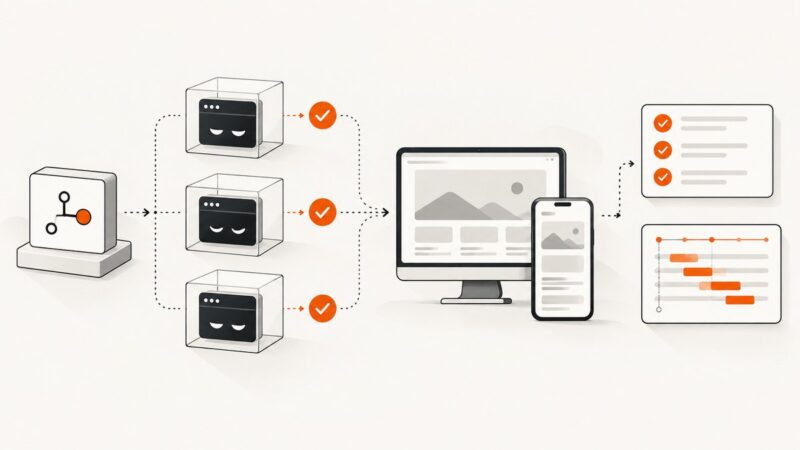
A simple path might look like this:
- Change submitted: a developer pushes a commit or opens a pull/merge request.
- Build: a runner installs required dependencies and creates a build.
- Validate: automated tests and configured checks run. A failed required check can stop downstream jobs and signal that the change needs attention.
- Package: the pipeline creates a versioned artifact that can be promoted through environments.
- Deploy to a test environment: the artifact is deployed for further checks or review, if the application needs this stage.
- Release: continuous delivery can leave production deployment to an authorized person; continuous deployment can release automatically when configured conditions pass.
- Observe and recover: monitoring and a rollback or recovery procedure help the team respond to production problems.
This is an example, not a universal sequence. A library, a web application, and a regulated service may need different stages and release controls. Keep jobs small enough that failures are understandable, and make the artifact promoted to production the same artifact that passed earlier checks.
Jobs, stages, runners, and gates
- Job: a unit of work, such as compiling code or running a test suite.
- Stage: a grouping used to order work. In a simple stage model, later stages wait for earlier stages to succeed.
- Runner: the machine or execution environment that runs jobs. Teams may use hosted or self-managed runners depending on platform and infrastructure needs.
- Gate: a condition that must be met before later work proceeds, such as successful tests, an approval, or a branch rule.
Independent jobs can run concurrently to reduce waiting. Dependencies can express a more precise order than a strict stage-by-stage sequence. Parallelism helps only when jobs are genuinely independent and the available runners can execute them.
What CI/CD streamlines—and what it cannot guarantee
Automation removes repeated manual steps and can return build or test feedback before a change reaches users. Running the same configured workflow for each eligible change makes the process more repeatable. Frequent, smaller changes can also be easier to diagnose than a large batch, provided the checks give useful signals. GitLab’s explanations of continuous integration and delivery discuss frequent validation and feedback.
These are capabilities, not guaranteed outcomes. A green pipeline means the configured jobs passed; it does not prove that every defect was tested for, that the build is secure, or that production will behave as expected. Weak or flaky tests can create false confidence or slow teams with noisy failures. Release safeguards such as access controls, staged rollout, monitoring, and recovery procedures address risks that automated tests alone do not.
Release controls and security boundaries
Separate checks that validate code from controls that authorize and constrain release. For production, consider which branches may deploy, who can approve an environment, which jobs can access deployment credentials, and how concurrent deployments are handled. GitHub Actions environments, for example, can require approval, restrict deployment branches, and limit access to environment secrets; GitHub also documents concurrency controls and OpenID Connect for supported cloud providers. Exact setup depends on the platform and target infrastructure. Consult GitHub’s continuous deployment documentation.
- Give jobs only the permissions and secrets they need, and avoid exposing production credentials to untrusted pull-request code.
- Use explicit production approval or branch restrictions when automatic deployment is not appropriate.
- Prefer short-lived identity mechanisms such as OIDC where your cloud provider and CI platform support them, rather than storing long-lived credentials, following the platform’s current setup guidance.
- Limit simultaneous production deployments when overlapping releases could conflict.
- Define how to detect a bad release and how to roll back or otherwise recover.
These are design considerations, not a complete security checklist. Review the current documentation for the chosen platform, runner model, and deployment target.
Choosing a CI/CD platform
There is no universally best platform in the reviewed documentation. Compare the way it fits your repository, hosting, runner requirements, workflow model, integrations, deployment targets, security controls, and the effort your team can spend operating it. Current prices and plan limits are not established here, so check providers’ current terms before deciding.
| Platform | Documented model | Questions to evaluate |
|---|---|---|
| GitHub Actions | Repository workflows composed of jobs and steps, running on VM or container runners; includes reusable actions and deployment environments. | Is the code hosted on GitHub? Which runners and deployment integrations are needed? What approval, branch, and secret controls should apply? |
| GitLab CI/CD | .gitlab-ci.yml configuration with jobs, runners, stages, and dependency-aware execution. |
Does the team want GitLab’s integrated repository and pipeline model? How will runners be hosted and secured? Which stages and dependencies fit the build? |
| Jenkins Pipeline | A pipeline represented in a source-controlled Jenkinsfile, covering build through test and deployment workflows. |
Does the organization need Jenkins’ pipeline model? What infrastructure, integrations, and ongoing administration will it require? |
Compare these options using a small representative workflow before committing: include a real build, the checks that matter, a deployment target, and the permissions it needs. That exercise reveals runner and integration requirements more reliably than a feature list alone.
A practical way to introduce a pipeline
- Map the current release path. Write down the manual commands and decisions between a change and a release.
- Automate one reliable path first. Start with the build and a focused set of checks that can run consistently.
- Make results visible. Ensure contributors can see which job failed and how to reproduce or diagnose it.
- Control deployment access. Add environment approvals, branch restrictions, and narrowly scoped credentials where needed.
- Add parallelism and more checks deliberately. Keep dependencies explicit, and investigate flaky or slow jobs rather than accumulating retries.
- Extend release automation gradually. Decide whether production is manually deployable (continuous delivery) or automatically deployed (continuous deployment), then add monitoring and a recovery procedure suited to the service.
Or skip the browser setup
If a CI job needs a website screenshot for a visual check, you can launch and maintain a browser yourself, or use ScreenshotNeo, a website screenshot API and MCP server for developers. One GET request returns a PNG, JPEG, WebP, or PDF. See the ScreenshotNeo API documentation.
curl -G "https://api.screenshotneo.com/v1/shot" -d access_key=YOUR_API_KEY --data-urlencode url=https://stripe.com -o shot.webpimport requests
r = requests.get(
"https://api.screenshotneo.com/v1/shot",
params={"access_key": "YOUR_API_KEY", "url": "https://stripe.com"},
timeout=90,
)
open("shot.webp", "wb").write(r.content)const q = new URLSearchParams({ access_key: 'YOUR_API_KEY', url: 'https://stripe.com' });
const res = await fetch(`https://api.screenshotneo.com/v1/shot?${q}`);
if (!res.ok) throw new Error(`Screenshot request failed: ${res.status}`);
await Bun.write('shot.webp', res);- Cookie banners are accepted and removed before capture; more than 60 known consent platforms, newsletter popups, and chat widgets can be removed, and each step can be turned off.
- Bot checks, blank pages, timeouts, failed loads, and cache hits cost nothing. Response headers identify the page verdict and billing status.
- An MCP server gives AI agents tools for screenshots, page information, and PDF capture.
- The free plan includes 1,000 screenshots per month with no card; paid plans start at $5 for 3,000 screenshots.
Create a free ScreenshotNeo account for 1,000 screenshots a month, with no card.
Troubleshooting common pipeline failures
| Symptom | Likely cause | What to do |
|---|---|---|
| A job fails before running its commands | The runner is unavailable, the job requests an unsupported environment, or the workflow configuration is invalid. | Read the platform’s configuration and runner error, check runner availability and labels, and validate the job’s declared environment against what is installed. |
| A test passes locally but fails in CI | Different dependency versions, environment variables, operating system, timezone, or external service state. | Pin dependencies where appropriate, make required configuration explicit, and reproduce the runner environment locally or in a matching container. |
| Later jobs never start | A required earlier job failed, was skipped, or a dependency rule excludes the later job. | Inspect the job graph and failure logs; correct the failed check or adjust the dependency/condition only if skipping is intended. |
| Builds are slow or queued | Long serial stages, limited runner capacity, redundant work, or oversized setup steps. | Measure which jobs consume time, parallelize independent work, use dependency-aware execution where supported, and review runner capacity and caching configuration. |
| Deploy job cannot access credentials | Secrets are scoped to a different environment, the branch is not permitted, approval is pending, or permissions are insufficient. | Check environment rules, branch restrictions, approval status, job permissions, and the credential mechanism using the platform’s current documentation. |
| Deployment overlaps another release | Multiple workflow runs can deploy to the same target concurrently. | Use the platform’s deployment concurrency controls or an equivalent lock, and define whether a new run queues or cancels an older one. |
| Pipeline is green but production is broken | The checks do not cover the failing behavior, or deployment/runtime conditions differ from validation. | Improve checks for the missed behavior, monitor the release, and use the documented recovery or rollback process. A passing pipeline is not proof of production correctness. |
Performance, reliability, and cost considerations
Pipeline time is the sum of setup, execution, queueing, and any required serial waits. Run independent jobs concurrently when runner capacity allows; use dependency-aware scheduling when supported; and avoid repeating expensive setup unnecessarily. Caches can reduce setup work, but stale or incorrect cache keys can produce confusing results, so cache dependencies should be invalidated when their inputs change.
Reliability depends on stable runners, reproducible dependencies, useful checks, and clear failure handling. Treat flaky tests as defects in the feedback system: retries may help distinguish intermittent infrastructure problems, but should not hide recurring application failures. A deployment can fail after all CI checks pass, so plan for monitoring and recovery.
Cost depends on the selected provider, runner hosting, workload, and current plan terms. The reviewed sources do not establish comparable current prices or limits. Estimate from actual job duration, frequency, parallel runner demand, storage, and any self-managed infrastructure or administration; verify provider terms before choosing.
FAQ
What is a CI/CD pipeline?
It is an automated workflow that runs code through configured work such as building, testing, packaging, and deployment.
What are the main benefits of implementing CI/CD practices for development teams?
They can reduce repeated manual release work and provide earlier, more consistent feedback on configured checks. The benefit depends on check quality and workflow maintenance; automation alone does not eliminate defects.
Does every CI/CD pipeline deploy automatically to production?
No. Continuous delivery keeps a release ready for deployment, which may be triggered by a person. Continuous deployment automatically releases qualifying changes after configured checks.
Do teams need a separate staging stage?
Not universally. Include an environment when it supports a meaningful test or review step for the application and its release risks.
Which platform should a team choose?
Choose based on repository and hosting context, runner needs, workflow model, integrations, deployment controls, and the operating effort the team can support. The available sources do not establish a universal winner.