Cloud-Based Test Environments: Benefits and Future Trends
Cloud test environments make capacity and automation easier to obtain, but reliable results still depend on fidelity, repeatability, isolation, and cost controls.
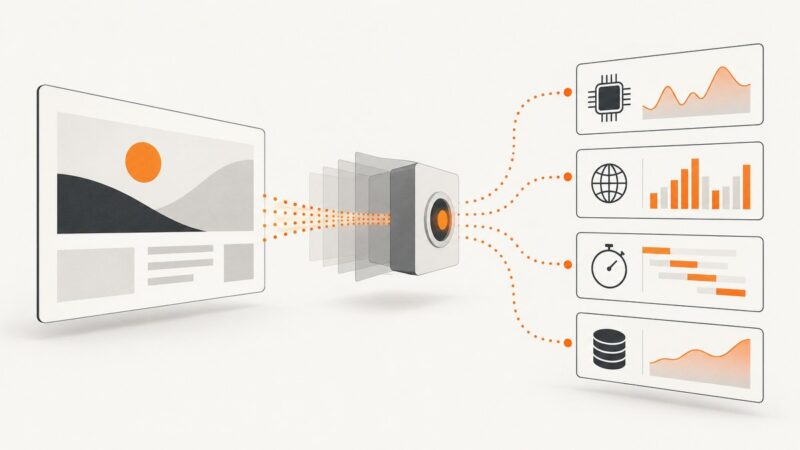
Cloud-based test environments let teams provision infrastructure when they need it, automate setup and teardown, and run tests at different scales without keeping every resource available all the time. They can reduce environment contention and make repeatable test runs easier. They do not automatically make testing cheaper, secure, production-like, or valid: those outcomes depend on infrastructure fidelity, configuration and data control, isolation, observation, and cleanup.
Choose an environment to match the question the test is meant to answer. Use lightweight environments and mocks for fast checks where they are sufficient. Use more representative dependencies and capacity when evaluating performance, reliability, or security. For hybrid systems, explicitly account for differences between cloud test infrastructure and production before interpreting results.
How do cloud test environments work?
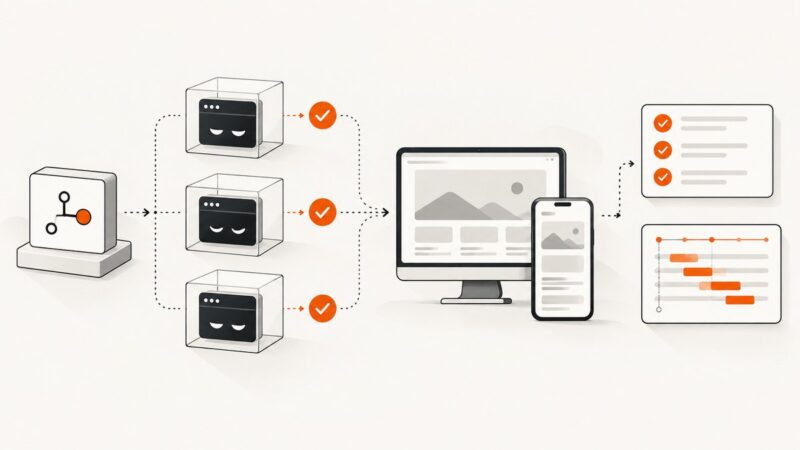
A cloud test environment is a set of compute, storage, networking, services, application versions, and test data assembled to run a defined test. It may be persistent, created temporarily for a pull request or test run, or combined with on-premises systems in a hybrid arrangement. A typical automated workflow is:
- Define infrastructure and configuration as versioned code or reusable templates.
- Provision isolated resources for the test and initialize known, approved data.
- Deploy a known application build and its required dependencies.
- Run the intended checks, collecting both test results and environment telemetry.
- Publish results and preserve the configuration details needed to reproduce failures.
- Destroy short-lived resources or shut down persistent lower environments when idle.
AWS describes cloud resources as useful for test workloads that need infrastructure for limited windows, and recommends repeatable templates and known data. Microsoft advises matching environments to test, infrastructure, data, and security needs. These are provider recommendations, not guarantees of setup time or savings. AWS testing guidance and Microsoft testing practices provide implementation context.
Benefits of cloud-based test environments
Elastic capacity for intermittent demand
Teams can request more or different resources for a test window, then release them when the work ends. This is useful for load tests, large datasets, and parallel suites whose peak demand would be wasteful to keep provisioned continuously. Actual cost depends on resource type, runtime, storage, data transfer, and whether teardown succeeds.
Less contention between teams and changes
Separate development, test, and staging environments let teams work in parallel without overwriting shared state. An isolated environment per change can also help identify which change introduced a regression. AWS Well-Architected recommends multiple environments and warns against risky load tests against production.
Repeatable setup and easier regression investigation
Infrastructure as code, pinned versions, controlled configuration, and seeded datasets make it easier to rerun a test under known conditions. Keep environment definitions with application code where practical, and record the build, configuration revision, data fixture version, and test parameters with results. Microsoft recommends checking deployed configuration for drift from infrastructure definitions; AWS discusses templates and consistent database starting points.
More ways to test scale and variation
Cloud capacity can support concurrent runs, varied instance types, and test datasets without maintaining peak capacity full-time. Scaling infrastructure alone does not make a load test representative. The topology, dependencies, traffic shape, data, and bottlenecks must fit the question being tested.
Persistent, ephemeral, managed, or hybrid?
| Approach | Useful when | Costs and limits to plan for |
|---|---|---|
| Persistent shared environment | A team needs a stable integration or staging target, or setup is costly. | Idle spend, configuration drift, contention, and unclear ownership. Schedule shutdown where possible and track owners. |
| Ephemeral environment | Changes or test runs need isolated, short-lived infrastructure. | Requires reliable templates, data setup, delivery automation, and cleanup. Provisioning each time can add latency and operational work. |
| Managed deployment environment | A platform team wants a governed self-service path based on reusable templates. | Assess supported infrastructure, permissions, policy controls, CI/CD integration, and how much customization teams need. |
| Hybrid environment | Production includes on-premises systems or constraints that cloud alone cannot represent. | Network paths, latency, dependencies, security boundaries, and differences in underlying infrastructure can affect results. |
Ephemeral environments can reduce idle resource time and maintenance, but they are not automatically cheaper. Count provisioning and teardown, storage, network and data transfer, runtime, failed cleanup, and the engineering effort to maintain templates. Google Cloud describes per-commit or pull-request environments as a pattern; Microsoft recommends removing short-lived environments after use.
How close should a test environment be to production?
Fidelity is a test design choice. A small environment with mocks may be enough to check a unit, API contract, or fast regression. A performance test needs sufficiently representative capacity, topology, data shape, and dependencies to support the conclusion being drawn. Reliability and security tests likewise need the relevant failure modes, controls, and trust boundaries.
For hybrid deployments, functional equivalence does not imply matching performance. Google Cloud cautions that performance load testing across non-identical underlying environments may not produce valid conclusions. Document material differences, such as database service, network route, storage class, instance family, autoscaling policy, and third-party dependencies. If a result depends on one of those differences, test that part in a representative environment or narrow the conclusion.
Security, isolation, and test data
- Separate environments: Use appropriate accounts, projects, subscriptions, networks, or other boundaries for development, testing, staging, and production. Restrict cross-environment communication to what the test requires.
- Apply least privilege: Give test automation only the permissions and secrets it needs, with short-lived credentials where available. Keep production credentials out of ordinary test jobs.
- Choose data deliberately: Prefer synthetic or sanitized data when real personal or sensitive data is unnecessary. Define who may use data, where it may be copied, and when it must be removed.
- Protect transport and storage: Use approved encryption and network controls, and check that logs and artifacts do not expose secrets or sensitive records.
- Make teardown part of the boundary: Ensure temporary resources, test accounts, snapshots, and copied datasets expire or are explicitly removed.
A cloud provider supplies infrastructure controls, but hosting a test environment in the cloud does not by itself establish safe data handling. AWS discusses isolated resource environments; Google Cloud’s hybrid environment guidance covers governance, controlled communication, and encryption in transit.
How to build a repeatable environment workflow
- Write down the test objective. State whether the run checks behavior, compatibility, performance, resilience, or security. Define what the result can and cannot establish.
- Choose fidelity deliberately. List which production services and constraints must be represented and where mocks or smaller resources are acceptable.
- Version the environment. Store infrastructure definitions, application artifact references, configuration, and test scripts in controlled source. Avoid mutable dependencies where they undermine reproducibility.
- Control test data. Start from a known fixture, snapshot, or generation procedure. Record its version and apply access and retention rules.
- Automate lifecycle and guardrails. Provision on demand where useful, apply environment-specific policies, tag ownership and expiry, and ensure cleanup runs after failures as well as success.
- Capture evidence. Save test output, logs, timings, failure rates, resource settings, and relevant telemetry alongside the run identifier.
- Review drift and cost. Compare deployed configuration with the definition, alert on budget or expiry conditions, and inspect orphaned resources regularly.
In hybrid or multi-cloud systems, promoting the same binaries, packages, or containers across environments can reduce one source of variation. Kubernetes may offer a common runtime layer where it fits, but portability adds design and operations work; use it where business constraints justify it. Google Cloud’s environment hybrid pattern discusses these trade-offs.
Future trends in cloud-based testing
- Change-specific temporary environments: Per-pull-request and per-commit environments are an established pattern. Expect continued engineering investment in making their creation, governance, and cleanup routine; adoption and savings vary by organization.
- Reusable platform templates: Platform teams are standardizing self-service environments with approved defaults, policy, and CI/CD hooks. This can reduce repeated setup work while keeping boundaries consistent.
- Hybrid fidelity planning: As systems span cloud and on-premises infrastructure, teams need clearer records of which environmental differences matter to each test and how to validate them.
- Observability integrated with delivery: Test output increasingly needs to be correlated with logs, traces, metrics, configuration, and deployment identity. CNCF describes the added complexity of observability in dynamic and hybrid or multi-cloud systems, with OpenTelemetry among the ecosystem directions.
- Security and policy in the pipeline: Access controls, policy-as-code, and security checks are being incorporated into environment creation and test execution, rather than handled only after deployment.
- Resource and sustainability visibility: Teams are paying more attention to resource usage and energy estimates alongside financial cost. Treat these as operational concerns to measure, not as guaranteed savings from moving tests to the cloud.
These are areas of practice and investment, not promises that every team will adopt the same architecture. The useful direction is more repeatable automation with stronger visibility into configuration, risk, and resource use. See the CNCF discussion of cloud native ecosystem trends.
Performance, reliability, and cost checklist
- Does the environment represent the bottlenecks and dependencies relevant to this test?
- Are capacity, concurrency, data volume, and network paths recorded with the result?
- Can the same code, configuration, and data setup be recreated?
- Are parallel tests isolated enough to avoid resource contention or shared-state interference?
- Do test jobs retry only transient failures, and are retries visible so they do not hide flaky behavior?
- Does cleanup execute after cancellation, timeout, or deployment failure?
- Are owners, expiry times, budgets, and alerts attached to resources?
- Are logs and test artifacts useful for diagnosis without leaking secrets or sensitive data?
Cloud environments can improve availability of test capacity, but they also introduce provider dependencies, quotas, network variability, and service-specific behavior. Define timeouts and failure handling, distinguish application failures from provisioning failures, and retain enough run metadata to explain a result. Do not interpret a test against a materially different environment as a production performance forecast.
Or skip the browser setup
For website visual checks, ScreenshotNeo can capture a URL as PNG, JPEG, WebP, or PDF with one GET request. The cookie consent, newsletter, and chat cleanup steps can be disabled individually when needed.
ScreenshotNeo API documentation
curl -G "https://api.screenshotneo.com/v1/shot" -d access_key=YOUR_API_KEY --data-urlencode url=https://stripe.com -o shot.webpimport requests
r = requests.get("https://api.screenshotneo.com/v1/shot", params={"access_key": "YOUR_API_KEY", "url": "https://stripe.com"}, timeout=90)
open("shot.webp", "wb").write(r.content)const q = new URLSearchParams({ access_key: 'YOUR_API_KEY', url: 'https://stripe.com' });
const res = await fetch(`https://api.screenshotneo.com/v1/shot?${q}`);- Cookie banners, popups, and chat widgets are removed before the shot.
- Bot checks, blank pages, and failed loads are never billed; response headers identify the page verdict and billing status.
- An MCP server provides
take_screenshot,get_page_info, andcapture_pdftools for AI agents. - 1,000 screenshots a month are free with no card; paid plans start at $5 for 3,000.
Create a free ScreenshotNeo account.
Troubleshooting cloud test environments
| Symptom | Likely cause | What to do |
|---|---|---|
| Tests pass locally but fail in cloud | Different dependency versions, environment variables, network access, locale, or data. | Record and compare configuration; pin dependencies and use the same versioned fixtures where appropriate. |
| Performance result varies between runs | Shared capacity, variable network paths, autoscaling, noisy neighbors, or non-representative test data. | Isolate the run, record capacity and topology, repeat under controlled conditions, and state the limits of the environment. |
| Environment creation is slow or flaky | Unpinned services, quota limits, unavailable regions, race conditions, or fragile setup scripts. | Pin versions, make provisioning steps idempotent, inspect provider events, and handle quotas and transient failures explicitly. |
| Cloud bill remains high after tests | Resources, disks, snapshots, addresses, or copied data were not removed; persistent environments stayed idle. | Use expiry tags and automated teardown, review orphaned resources, and schedule shutdown for lower environments. |
| Test data appears in logs or artifacts | Fixtures contain sensitive fields or diagnostic output is too broad. | Replace with synthetic or sanitized data where possible, redact output, restrict artifact access, and shorten retention. |
| Load test says production is slow, but production disagrees | Test infrastructure or dependencies differ materially from production, or traffic shape is unrealistic. | Compare architecture and workload assumptions; rerun in a representative setup before making a production claim. |
| Parallel jobs interfere with one another | Shared database state, queues, accounts, or fixed resource names. | Namespace or isolate test resources and data per run, then verify cleanup. |
Frequently asked questions
Are cloud test environments cheaper?
Sometimes. They can avoid keeping peak capacity idle, but total cost includes runtime, storage, transfer, cleanup failures, and automation work. Measure the full lifecycle against the alternative.
Should every pull request get its own environment?
No. It is useful when isolation or integration fidelity makes the extra provisioning worthwhile. Fast unit checks may not need a full environment.
Can a cloud test environment replace staging?
It can serve as a staging environment if its fidelity, access controls, data governance, and operational purpose fit. Temporary test environments and release staging have different lifecycle needs in many teams.
Does using the same container guarantee production parity?
No. The container helps keep application artifacts consistent, but host resources, network paths, managed services, configuration, and data can still differ.
What should be retained after an ephemeral environment is deleted?
Keep the test result, environment and application revisions, relevant configuration, data fixture identifier, and diagnostic logs needed for audit or reproduction, subject to retention and data policies.
Cloud test environments are most useful when teams treat them as versioned, isolated, observable resources with a defined lifecycle. Elastic capacity and temporary environments make more test setups possible; fidelity, safe data, repeatability, and disciplined teardown determine whether the results are trustworthy and the cost is controlled.