BlogScreenshots on your device
How to Compare Screenshots Captured with Java Robot
Capture the same region with Java Robot, then compare dimensions and pixels with exact or tolerance-based rules that fit your test.
Robot.createScreenCapture(Rectangle) captures pixels from a screen rectangle. To compare two captures, use the same rectangle and application state, verify that both images have identical dimensions, then compare corresponding pixels. Exact ARGB equality is appropriate when the display environment is controlled. If rendering can vary slightly, compare color channels with a documented tolerance and an allowed changed-pixel count.
The Java API does not define a universal visual-diff threshold. Your test suite must choose the policy that matches its risk.
1. Capture and compare a screenshot with Java Robot
The following program loads a baseline image, captures the same screen region, checks dimensions, and fails when any pixel differs. Save it as RobotScreenshotAssert.java.
import java.awt.AWTException;
import java.awt.Rectangle;
import java.awt.Robot;
import java.awt.image.BufferedImage;
import java.io.File;
import java.io.IOException;
import javax.imageio.ImageIO;

public final class RobotScreenshotAssert {
    private RobotScreenshotAssert() {}

    public static void main(String[] args) throws AWTException, IOException {
        if (args.length != 5) {
            System.err.println("Usage: java RobotScreenshotAssert baseline.png x y width height");
            System.exit(2);
        }

        File baselineFile = new File(args[0]);
        int x = Integer.parseInt(args[1]);
        int y = Integer.parseInt(args[2]);
        int width = Integer.parseInt(args[3]);
        int height = Integer.parseInt(args[4]);

        if (width <= 0 || height <= 0) {
            throw new IllegalArgumentException("Capture width and height must be greater than zero");
        }

        BufferedImage expected = ImageIO.read(baselineFile);
        if (expected == null) {
            throw new IOException("Unsupported or empty baseline image: " + baselineFile);
        }

        Robot robot = new Robot();
        BufferedImage actual = robot.createScreenCapture(
                new Rectangle(x, y, width, height));

        if (expected.getWidth() != actual.getWidth()
                || expected.getHeight() != actual.getHeight()) {
            throw new AssertionError(String.format(
                    "Screenshot dimensions differ: expected %dx%d, got %dx%d",
                    expected.getWidth(), expected.getHeight(),
                    actual.getWidth(), actual.getHeight()));
        }

        long differingPixels = 0;
        for (int py = 0; py < expected.getHeight(); py++) {
            for (int px = 0; px < expected.getWidth(); px++) {
                if (expected.getRGB(px, py) != actual.getRGB(px, py)) {
                    differingPixels++;
                }
            }
        }

        if (differingPixels != 0) {
            throw new AssertionError("Found " + differingPixels
                    + " differing pixels");
        }

        System.out.println("Screenshots match exactly");
    }
}
Compile and run it on a desktop session:
javac RobotScreenshotAssert.java
java RobotScreenshotAssert baseline.png 0 0 1440 900
ImageIO.read(File) decodes supported image formats into a BufferedImage; the available formats depend on registered image readers. Handle a null result or IOException rather than treating an unreadable baseline as a match. See the ImageIO API.
2. Keep capture conditions identical
Pixel comparison only means something when both images represent the same region at the same scale.
- Use the same
Rectanglecoordinates, width, and height for every run. - Put the application in a known state before capture: same route, data, scroll position, window size, zoom, fonts, theme, and animation state.
- Keep operating-system display scaling and Java’s user-space-to-device-space mapping stable.
- Wait for the UI to finish rendering. A fixed delay can work, but a state-based synchronization point is usually more reliable.
- Define masks for intentionally dynamic areas such as clocks, rotating ads, timestamps, cursors, or video frames.
- Run capture outside the AWT Event Dispatch Thread. Oracle warns that screen capture can take time and should not block that thread.
Robot uses screen coordinates. Multi-monitor layouts can expose a shared virtual coordinate space or device-specific coordinates depending on the platform configuration. Test the chosen rectangle on every supported desktop layout.
3. Choose an image comparison policy
| Policy | Use it when | Trade-off |
|---|---|---|
| Exact pixel equality | Rendering, fonts, scale, and state are controlled; every changed pixel matters | Fails on tiny anti-aliasing or color changes |
| Per-channel tolerance | Small RGB variations are expected | Requires a justified channel delta |
| Changed-pixel count or percentage | A known amount of noise is acceptable | Requires an explicit allowed count or ratio |
| Perceptual metric | Visual similarity matters more than raster identity | Needs an additional algorithm or library and a calibrated threshold |
Document the rule next to the test. Do not copy an unexplained threshold between projects.
Tolerance-based comparison
BufferedImage.getRGB(x, y) returns a default ARGB value in sRGB form, with 8 bits of precision per component. The helper below treats a pixel as changed when any RGB channel exceeds channelDelta; it ignores alpha. Decide separately whether alpha is meaningful for your baseline.
static long countChangedPixels(BufferedImage expected,
                               BufferedImage actual,
                               int channelDelta) {
    if (expected.getWidth() != actual.getWidth()
            || expected.getHeight() != actual.getHeight()) {
        throw new IllegalArgumentException("Image dimensions differ");
    }
    long changed = 0;
    for (int y = 0; y < expected.getHeight(); y++) {
        for (int x = 0; x < expected.getWidth(); x++) {
            int a = expected.getRGB(x, y);
            int b = actual.getRGB(x, y);
            int dr = Math.abs(((a >>> 16) & 0xff) - ((b >>> 16) & 0xff));
            int dg = Math.abs(((a >>> 8) & 0xff) - ((b >>> 8) & 0xff));
            int db = Math.abs((a & 0xff) - (b & 0xff));
            if (dr > channelDelta || dg > channelDelta || db > channelDelta) {
                changed++;
            }
        }
    }
    return changed;
}
For a percentage rule, divide the changed count by width * height and compare it with a project-owned maximum. Report both the count and coordinates of representative failures so a developer can distinguish a one-pixel shift from a missing panel.
4. High-DPI and multi-resolution displays
On a scaled display, the logical rectangle and native device pixels may have different sizes. Java provides createMultiResolutionScreenCapture, whose result can contain a base image and a native-resolution variant. Compare images at the same resolution and ensure the rectangle’s edge placement is identical. Comparing a logical-resolution baseline with a native-resolution capture will produce a dimension mismatch or widespread differences.
The ordinary screen capture does not include the mouse cursor, according to the Oracle Robot API.
5. Common failures and fixes
| Symptom | Cause | Fix |
|---|---|---|
IllegalArgumentException |
Rectangle width or height is zero or negative | Validate dimensions before calling createScreenCapture. |
SecurityException or blank/undefined pixels |
Desktop capture permission or platform security restriction | Grant the process screen-recording/desktop-capture permission and run in an interactive desktop session. |
| Images have different dimensions | Changed rectangle, display scale, monitor, or capture variant | Fail clearly; restore the same geometry and compare like resolutions. Normalize deliberately only when that is part of the test design. |
| Thousands of changed pixels after a window move | Screen coordinates no longer point to the same content | Anchor the window and monitor arrangement, or capture a stable application region. |
| Intermittent differences | Animation, asynchronous data, fonts, timing, or network content | Wait for a deterministic state, disable animation, freeze data, or mask the dynamic region. |
| Baseline cannot be decoded | Unsupported format, corrupt file, or empty file | Check ImageIO.read for null, use a supported reader, and fail the test with the file path. |
| Only text edges differ | Font availability, hinting, anti-aliasing, or scale differs | Use the same OS image and fonts, or adopt a documented tolerance/perceptual policy. |
| Capture freezes the UI | Capture runs on the AWT Event Dispatch Thread | Run capture in a worker thread and synchronize with the UI before taking the image. |
6. Diagnostics that make failures actionable
- Save the actual capture whenever a comparison fails.
- Write a diff image that marks changed pixels and include the changed count and percentage in the test report.
- Log rectangle coordinates, display scale, screen device, Java version, operating system, and test state.
- Keep baselines in a versioned directory and review intentional visual changes as code changes.
- Compare alpha deliberately. A PNG baseline and a desktop capture can use different alpha conventions even when the visible colors match.
7. Performance, reliability, and cost
The comparison loop is linear in the number of pixels: a region with width w and height h performs w × h pixel checks. Smaller, targeted regions reduce work and make failures easier to diagnose. Capture itself can block long enough to affect UI timing, so schedule it away from the event-dispatch thread.
Reliability comes from controlling state more than from selecting a clever metric. Keep the same machine image, display scale, fonts, window placement, data, and synchronization point. Use exact equality for deterministic environments; use tolerance only when you can explain why the variation is harmless.
Java Robot and the image APIs used here are part of the desktop Java platform, so this method has no per-capture service charge. You still pay the operational cost of maintaining a headed desktop session, permissions, monitor geometry, baseline files, and synchronization.
8. Or skip the browser setup
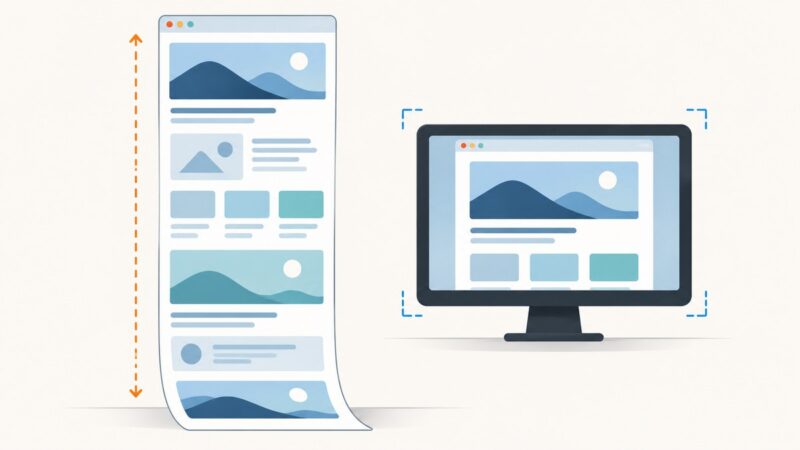
If the thing you need is a web-page image rather than a desktop application’s pixels, ScreenshotNeo provides a GET endpoint that returns PNG, JPEG, WebP, or PDF. It handles browser setup and can capture full pages or a CSS-selected element.
See the ScreenshotNeo documentation for the request options.
curl -G "https://api.screenshotneo.com/v1/shot" -d access_key=YOUR_API_KEY --data-urlencode url=https://stripe.com -o shot.webpimport requests
r = requests.get("https://api.screenshotneo.com/v1/shot", params={"access_key": "YOUR_API_KEY", "url": "https://stripe.com"}, timeout=90)
open("shot.webp", "wb").write(r.content)const q = new URLSearchParams({ access_key: 'YOUR_API_KEY', url: 'https://stripe.com' });
const res = await fetch(`https://api.screenshotneo.com/v1/shot?${q}`);Cookie and consent banners, newsletter popups, and chat widgets are removed before the shot. Bot checks, blank pages, failed loads, timeouts, and cache hits are not billed, and response headers report the page verdict and billing status. An MCP server provides take_screenshot, get_page_info, and capture_pdf tools for Claude, Cursor, and other MCP clients. The free plan includes 1,000 screenshots per month with no card; paid plans start at $5 for 3,000 shots.
Create a free ScreenshotNeo account.
9. FAQ
Does Robot compare screenshots automatically?
No. Robot captures the pixels; your code must compare dimensions and pixel values or use another image-diff library.
Should I compare PNG files byte-for-byte?
Usually no. Encoding metadata and compression can differ even when decoded pixels are identical. Compare decoded BufferedImage pixels.
Should alpha be included?
Include it when transparency is part of the visual contract. Otherwise compare RGB channels and document that choice.
Can Robot capture a browser tab without capturing the desktop?
Robot captures a screen rectangle. Position and size the browser window, or use a browser automation or screenshot service when you need page-level capture independent of desktop geometry.
What threshold should every project use?
None is universal. Calibrate a channel delta or changed-pixel allowance against known rendering variation in your own supported environments.