Component Library Visual Testing: How to Catch Regressions
Catch unintended component changes with stable screenshot baselines, useful state coverage, and pull-request review. Includes Storybook and Playwright examples.
To catch visual regressions in a component library, render representative component states, compare their screenshots with reviewed baselines in a consistent browser environment, and inspect changed pixels in pull requests. Storybook stories make a useful state inventory; Playwright can capture and compare screenshots in tests. A diff is a review signal, not proof of a defect. Keep behavior and accessibility checks alongside visual tests.
1. What visual regression testing catches
A visual test records rendered pixels for a known state and compares a later render with that baseline. It can surface changes in spacing, typography, color, alignment, borders, overflow, and layout. That makes appearance changes visible and reviewable.
Visual tests do not establish that a button works, that a form handles invalid input, that keyboard navigation is correct, or that a page meets accessibility requirements. Pair screenshot checks with interaction tests and accessibility checks. Storybook describes visual testing and accessibility testing as distinct capabilities, and notes that automated accessibility checks are a first line of QA rather than a complete accessibility guarantee (Storybook visual testing, Storybook accessibility testing).
2. Choose component states that reveal changes
A default story rarely represents every way consumers use a component. Treat the story gallery as a practical inventory, then prioritize states likely to reveal meaningful layout or styling changes. For example:
- Variants: primary, secondary, quiet, destructive, and other supported appearances.
- Sizes and density: compact and large controls, plus spacing-sensitive compositions.
- Interaction states: hover, focus, active, disabled, loading, selected, and expanded states where they are part of the component contract.
- Validation states: error, warning, success, and helper text.
- Content extremes: long labels, wrapped text, missing optional content, and unusually long values.
- Responsive contexts: widths where content wraps, a layout changes, or controls move.
- Complex composition: components with icons, nested content, overlays, or fixed positioning.
Keep each capture deterministic. Use fixed sample data and explicit state, and avoid timestamps, random values, live network responses, or animation when those are not the behavior being tested. Do not mask away real content simply to make diffs disappear.
3. Pick a capture and review workflow
| Approach | Good fit | Baseline and review | Considerations |
|---|---|---|---|
| Storybook with hosted visual review | A component library whose stories already describe supported states | Story screenshots are compared and changes can be reviewed in the Storybook and CI pull-request workflow | Fits story-centered component review; hosted service configuration and workflow become part of the team setup |
| Playwright screenshot assertions | A team that wants screenshot references alongside its tests, or needs browser-driven component and page checks | Playwright creates references initially and compares later runs; accepted image updates can be reviewed in version control | Requires a controlled browser environment and deliberate management of image references |
These are documented capabilities, not a benchmark showing one option to be faster or more accurate. Compare the capture unit (stories or end-to-end pages), baseline ownership, execution environment, diff review loop, existing stack fit, and whether you need component-only or whole-flow coverage. Storybook documents a Chromatic integration and pull-request feedback; Playwright documents screenshot comparison and real-browser component testing (Storybook visual tests, Playwright visual comparisons, Playwright component testing). Hosted visual review can coexist with Playwright or Cypress end-to-end checks (Chromatic: combine stories and E2E).
4. Run visual tests with Storybook
- Write stories for important component variants and states, using fixed props and data.
- Connect the Storybook project to a visual review workflow such as the one described in Storybook’s Visual Tests documentation.
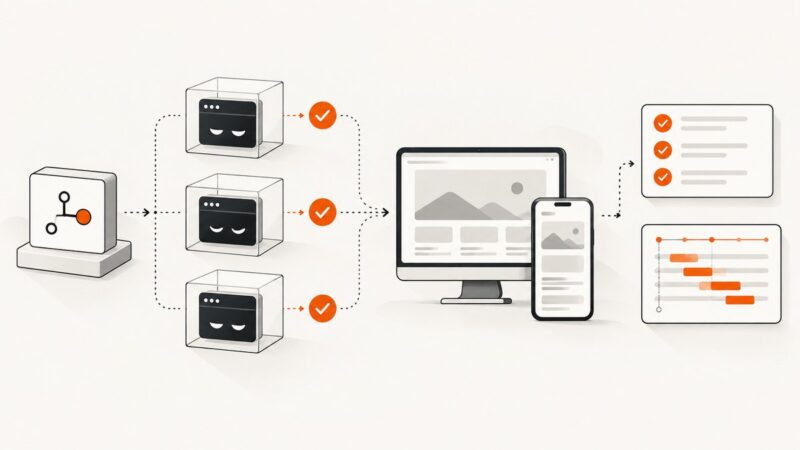
- Run the visual checks in CI for pull requests and surface the resulting changes to reviewers.
- Inspect each changed state in context. Determine whether it reflects an intended design change, an unintended regression, or an unstable capture.
- After approving an intentional change, update the reference through the workflow and include the baseline change in the same reviewed change set.
Storybook’s documentation describes connecting stories to Chromatic and reviewing changes through Storybook and CI. Use the current setup instructions for your Storybook version rather than copying configuration from a different major version (Storybook visual testing).
5. Run screenshot assertions with Playwright
The following JavaScript example is a runnable Playwright Test spec for a page that renders a component. It navigates to the app, waits for a component selector, and compares the rendered element to its reference image. On its first run, Playwright writes a reference; later runs compare against it. Adjust the URL and selector to match your app.
import { test, expect } from '@playwright/test';

test('primary button matches its reviewed appearance', async ({ page }) => {
  await page.goto('http://127.0.0.1:6006/iframe.html?id=button--primary');
  const button = page.getByRole('button', { name: 'Save changes' });
  await expect(button).toBeVisible();
  await expect(button).toHaveScreenshot('button-primary.png', {
    animations: 'disabled',
  });
});
Install Playwright Test and its browser using the official setup for your project (Playwright getting started). A minimal test script can be added to package.json:
{
  "scripts": {
    "test:visual": "playwright test"
  }
}
Run the test with npm run test:visual. When an appearance change is intentional, inspect the resulting diff and update references deliberately with Playwright’s snapshot update option, for example npx playwright test --update-snapshots. Review the generated image changes like code changes; do not update all references automatically just to make a failing run green. The reference screenshots should be committed and reviewed with the test changes. See the official Playwright screenshot assertion documentation for assertion and update details.
6. Stabilize screenshot output
Screenshot output depends on more than the component code. Playwright warns: “Browser rendering can vary based on the host OS, version, settings, hardware, power source (battery vs. power adapter), headless mode, and other factors.” Create and compare references in the same controlled environment, including a consistent browser version and operating system where practical (Playwright visual comparisons).
- Pin browser versions in the project or CI image and use the same capture environment for baseline updates and ordinary runs.
- Set viewport and device scale consistently; use the same fonts and ensure they are available before capture.
- Use fixed fixtures and deterministic component props. Freeze time or replace random values if they are irrelevant to the visual contract.
- Wait for the relevant component to be visible and ready. Avoid arbitrary long sleeps if a selector or explicit readiness condition is available.
- Disable animations when they create incidental frame differences. Keep animation enabled in tests specifically intended to verify animated appearance.
- Stub unstable external data where appropriate. Keep meaningful content and states visible rather than masking them indiscriminately.
7. Review diffs and update baselines deliberately
When a check reports a difference, inspect the changed component and nearby layout at the tested viewport. Ask whether the change was intended, whether it affects other variants, and whether the screenshot itself was captured in the expected state. If intentional, update only the relevant baselines and include the image changes for review. If not, fix the code or stabilize the capture condition, then rerun.
A baseline is the accepted visual reference for future runs. Updating one changes what later runs consider normal, so baseline updates deserve the same review as source changes. Storybook’s visual testing workflow surfaces detected changes for review; Playwright stores screenshot references with tests (Storybook visual tests, Playwright visual comparisons).
8. Pull-request workflow and ownership
- Run visual checks on pull requests that change shared components, styles, tokens, or relevant dependencies.
- Publish diffs where code reviewers can see them as part of the normal review loop.
- Ask the author to explain intentional visual changes and check affected variants, responsive states, and consumers.
- Keep the accepted reference update attached to the change that caused it, so reviewers can see implementation and appearance together.
- For baseline-only updates, record why the accepted appearance changed and which states were reviewed.
- Keep interaction and accessibility checks in the same CI strategy, while treating them as separate coverage.
9. Performance, reliability, and cost
Visual checks add browser rendering and image comparison to CI. Keep the suite focused on high-value states, avoid redundant captures, and run tests with stable fixtures. Parallel execution may reduce elapsed time, but it consumes more CI resources and does not fix nondeterministic rendering. Review the impact in your own pipeline; the sources here establish workflows and capabilities, not comparative performance or savings figures.
Reliability comes chiefly from reproducible inputs and capture environments. A noisy suite trains reviewers to ignore diffs, while aggressive masking can conceal genuine regressions. Prefer a smaller set of deterministic, representative captures over broad coverage that cannot be trusted. Hosted review and repository-managed screenshots each have setup and maintenance costs; choose based on your existing stack and how your team wants to review and own baselines.
10. Troubleshooting common problems
| Symptom | Likely cause | Fix |
|---|---|---|
| Many pixels differ after a harmless code change | Browser, OS, fonts, device scale, or headless settings differ from the baseline environment | Run baseline creation and comparisons in the same pinned environment; check viewport, fonts, and browser version. |
| Repeated differences in timestamps, avatars, or remote content | Dynamic input or an uncontrolled network response | Use fixed fixtures, deterministic values, or a controlled response. Mask only content that is truly outside the visual contract. |
| Capture contains an animation at a different frame | Screenshot timing differs between runs | Disable animations for this assertion or wait for a stable state. Keep animation in scope when it is what the test is meant to check. |
| Screenshot is blank or missing the component | Navigation failed, selector did not identify the component, or capture happened before it was ready | Check the test URL and browser errors, assert visibility, and wait on the component’s actual readiness condition. |
| Baseline update causes a large unexplained diff | References were updated without reviewing the affected states, or a shared style change had broad impact | Inspect the diff by state and viewport, identify the source change, and revert unrelated reference updates. |
| Local run passes but CI fails | Capture environments or available fonts differ, or CI data is not deterministic | Use the same browser build and dependencies; compare environment settings and replace live or random inputs. |
| Visual test passes while a control is broken | A screenshot verifies appearance, not event handling or keyboard behavior | Add interaction assertions and accessibility checks for the behavior and DOM properties that matter. |
| Too many failures make the suite hard to review | Too many low-value states, unstable captures, or unrelated baselines changed together | Prioritize representative states, stabilize fixtures, and keep baseline updates scoped to reviewed changes. |
11. Or skip the browser setup
If you need screenshots of rendered web pages for review or documentation, ScreenshotNeo provides a screenshot API and MCP server. Its API is a one-call option for capturing a page; it does not replace a deterministic component test suite or reviewed component baselines. Read the ScreenshotNeo API documentation for request options and setup.
curl -G "https://api.screenshotneo.com/v1/shot" -d access_key=YOUR_API_KEY --data-urlencode url=https://stripe.com -o shot.webpimport requests
r = requests.get("https://api.screenshotneo.com/v1/shot", params={"access_key": "YOUR_API_KEY", "url": "https://stripe.com"}, timeout=90)
open("shot.webp", "wb").write(r.content)const q = new URLSearchParams({ access_key: 'YOUR_API_KEY', url: 'https://stripe.com' });
const res = await fetch(`https://api.screenshotneo.com/v1/shot?${q}`);- Cookie banners, popups, and chat widgets are removed before the shot; each cleanup step can be turned off.
- Bot checks, blank pages, failed loads, timeouts, and cache hits are not billed. Response headers report the page verdict and billing status.
- An MCP server offers
take_screenshot,get_page_info, andcapture_pdftools for AI agents and MCP clients. - The free plan includes 1,000 screenshots a month with no card. Paid plans start at $5 for 3,000 screenshots; all features are available on every plan.
Sign up for 1,000 free screenshots a month, with no card required.
12. Frequently asked questions
Should every story have a visual test?
Start with states that represent important variants and are likely to expose layout changes. Expand when the cost of missing a change justifies another stable capture.
Does a visual diff mean the change is wrong?
No. It means rendered output changed. Reviewers decide whether that change is intended and acceptable.
Can screenshot tests replace accessibility tests?
No. Pixels cannot establish keyboard access or full accessibility conformance. Keep accessibility checks and manual review where needed.
Should I store baselines in the repository?
That is a fit decision. Playwright supports repository-managed references; Storybook’s documented hosted review path provides a different baseline review workflow. Choose the ownership and review loop your team can maintain.