How Continuous Testing Helps Reduce Technical Debt
Continuous testing makes regressions and quality problems visible sooner. Learn how to build fast, reliable checks into delivery—and where testing alone falls short.
Continuous testing can help reduce technical debt by shortening the time between a change and evidence about its behavior. When a regression or quality problem appears while a change is still small, it is often easier to locate and correct. Reliable tests can also make debt checks part of routine delivery. Testing supports debt management; it does not remove existing debt by itself.
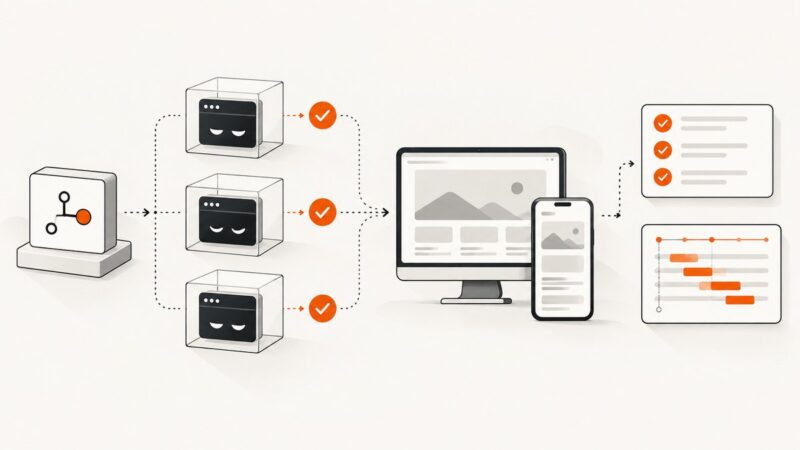
In practice, continuous testing means checking software throughout the delivery lifecycle instead of leaving validation until development is finished. A useful starting point is a small, dependable suite of automated checks for important behavior, with results visible to the people changing the code. Add broader checks where they provide value, keep test maintenance on the team’s work list, and make a deliberate plan for existing debt.
This guide explains the mechanisms, gives a practical CI example, and covers the limits: tests can catch only the problems they are designed to reveal. They do not replace refactoring, architectural work, documentation, or debt prioritization. DORA describes continuous testing as testing throughout the software delivery lifecycle and recommends fast feedback and ongoing test-suite improvement. DORA’s continuous delivery guidance
What continuous testing means for technical debt
Technical debt is the future cost associated with imperfect or incomplete decisions in software and its surrounding artifacts. It can exist in code, tests, documentation, architecture, configuration, and other parts of a system. Delivery pressure can encourage shortcuts, but debt can also result from changing requirements, incomplete knowledge, or decisions that were reasonable at the time.
Continuous testing is a way to get evidence about a change as development proceeds. It includes automated checks, but it is broader than automation alone: manual exploratory, usability, and acceptance testing may also be appropriate throughout delivery. DORA’s test automation guidance
The debt-reduction connection is indirect. Earlier feedback may reduce the cost of diagnosing and correcting some defects, prevent some avoidable rework, and make quality constraints visible before a change becomes harder to unwind. It does not prove that a system is maintainable or that all forms of debt have been addressed.
How continuous testing can help reduce debt
- It shortens the feedback loop. A check that runs close to the change can help the author connect a failure with the code that introduced it. As more work accumulates on top, diagnosis can become less direct.
- It makes behavior explicit. Tests record selected expectations about the system. That can help developers change code with more confidence and make some accidental behavior changes easier to detect.
- It makes quality checks routine. A pipeline can run tests and selected static or architectural checks on ordinary changes. This gives the team a regular place to see and discuss findings.
- It encourages smaller changes. Continuous integration works best when code is integrated in small batches and checks return quickly. Smaller changes are generally easier to review and investigate when a check fails. DORA’s continuous integration guidance
- It can make refactoring safer. Tests around valuable behavior can reveal whether a refactor changed that behavior. Tests do not establish that the new design is good; review and architectural judgment are still needed.
These are mechanisms, not a guaranteed reduction in debt. A test suite that is slow, brittle, or poorly matched to real risks can itself become a maintenance burden.
Build a continuous testing practice step by step
- Choose a few high-value behaviors. Start with behavior whose failure would matter to users or operations: for example, a key API contract, a payment flow, or a critical data transformation. Prefer meaningful behavior over a large count of low-value assertions.
- Add checks at the right level. Use unit tests for isolated logic, integration tests for important boundaries, and acceptance tests for end-to-end outcomes where needed. Avoid testing every detail at the slowest level.
- Run quick checks on each change. Trigger the fast suite on a pull request or commit. Keep the result easy to find and give failures enough context to reproduce locally.
- Keep broader checks in the pipeline. Run longer integration, performance, security, or broader acceptance checks at an appropriate stage. Do not let these hide the fast signal developers need first.
- Agree how failures are handled. Assign an owner, fix or revert changes that break important checks, and make exceptions visible and time-limited. A red pipeline that is routinely ignored stops providing useful feedback.
- Review the suite as the system changes. Remove duplicate or obsolete tests, improve unclear failures, and investigate flaky tests. Treat test code as production code that needs maintenance.
- Connect findings to debt work. Record recurring problems and checks that expose structural risks. Prioritize debt by impact, likelihood, and the cost of delay; schedule repayment alongside product work.
- Keep human testing where it adds value. Use exploratory, usability, and acceptance testing to examine behavior that is difficult to specify completely in automated checks.
DORA recommends that developers receive automated-test feedback in less than ten minutes and says CI tests should return in a few minutes where practical. Treat those figures as guidance, not universal service guarantees: suite size, system architecture, and infrastructure affect what is achievable. DORA test automation · DORA continuous integration
A runnable CI example
This GitHub Actions workflow runs a Python project’s fast test suite on pushes and pull requests. It assumes the repository has a requirements.txt file and that pytest is installed there. Save it as .github/workflows/tests.yml, then adapt the Python version and install steps to the project.
name: Tests

on:
  push:
  pull_request:

jobs:
  fast-tests:
    runs-on: ubuntu-latest
    timeout-minutes: 10
    steps:
      - name: Check out repository
        uses: actions/checkout@v4
      - name: Set up Python
        uses: actions/setup-python@v5
        with:
          python-version: "3.12"
      - name: Install dependencies
        run: |
          python -m pip install --upgrade pip
          python -m pip install -r requirements.txt
      - name: Run fast tests
        run: python -m pytest -q
The workflow’s timeout is a guard against an indefinitely stuck job, not a claim that a suite should take ten minutes. Keep the first feedback stage short enough to be useful. Add separate jobs or later pipeline stages for checks that need services, browsers, larger test data, or more time. Protecting a branch from merging when required checks fail is a repository policy choice, not something this workflow configures by itself.
What to measure and review
Do not treat line coverage or test count as a direct measure of debt reduction. Use measures to find friction and guide discussion, then inspect examples and trends in context.
| Signal | What it can tell you | What it cannot prove |
|---|---|---|
| Time from change to test result | Whether developers get feedback quickly enough to act on it | Whether the checks cover the important risks |
| Flaky-test rate and reruns | Whether the suite is becoming unreliable or wasting team time | Whether a passing run means the product is defect-free |
| Failures caught before release | Examples of regressions detected by the pipeline | How many defects the suite missed |
| Test maintenance effort | Whether test complexity is becoming a burden | Whether deleting tests would be safe without reviewing their purpose |
| Repeated static or architecture findings | Areas where a debt check may help identify accumulating issues | Whether every finding is important enough to fix immediately |
| Age and ownership of known debt items | Whether debt is visible, prioritized, and acted on | A single objective score for the system’s total debt |
Review whether failures are reproducible, whether checks are finding meaningful problems, and whether teams respond to the results. A pipeline full of ignored warnings is not effective debt management.
Where to put technical-debt checks
CI/CD can host checks that fit automated evaluation, such as tests, static analysis, dependency checks, or selected architectural rules. Make findings actionable: identify the rule, the affected code, and an owner or next step. Decide in advance which findings block a change and which are reported for later prioritization.
There is no universal template for adding every debt-management tool to a pipeline. A 2026 study mining Travis CI configuration files and supporting scripts identified pipelines containing technical-debt management tools, while also describing integration and feedback practices as an area where patterns remain imperfect. The related research review characterizes technical-debt management in continuous software engineering as an emerging area, with important questions still open. University of Groningen research record · 2026 review in the Journal of Software: Evolution and Process
Use checks to inform decisions, not to outsource them. A static-analysis warning may be a false positive or low priority; a team may consciously accept a trade-off. Keep exceptions recorded and revisit them when the risk or surrounding code changes.
Keep the tests from becoming debt
- Favor stable interfaces. Tests coupled to implementation details often break during harmless refactors.
- Make failures diagnosable. Include useful assertion messages and logs. Reproduction should work in a developer’s local environment where practical.
- Control test data and dependencies. Use deterministic fixtures and isolate external systems when the test’s purpose does not require a live dependency.
- Investigate flakiness. Repeated reruns can mask race conditions or environment problems and teach the team to distrust results.
- Retire tests deliberately. Remove tests only after checking the behavior they protect and whether another check covers it.
- Review test-suite value and cost. DORA recommends ongoing review to improve defect-finding value and keep complexity under control. DORA test automation guidance
Limits: continuous testing does not pay down all debt
Tests can expose some failures and protect chosen behavior. They do not automatically improve architecture, simplify tangled modules, update stale documentation, or remove a known workaround. Teams still need to decide which debt matters, allocate time to repay it, and check whether the change improves the system.
Tests also reflect the assumptions their authors encode. A suite can pass while requirements are misunderstood, important cases are absent, or system boundaries are poorly designed. Code coverage is one signal about execution, not proof of correctness or maintainability.
Finally, increasing deployment frequency without improving process and architecture can add pressure rather than reduce it. DORA discusses the risk of pursuing speed without the practices that support reliable delivery. DORA continuous delivery guidance
Performance, reliability, and cost
- Performance: Split quick checks from slower suites, parallelize independent work where it helps, and avoid repeating expensive setup unnecessarily. Measure queue time as well as execution time; a fast test job can still provide slow feedback if it waits for a runner.
- Reliability: Keep test environments close enough to production to make results meaningful, while making local reproduction practical. Track flaky failures separately from product failures and fix the source instead of normalizing retries.
- Engineering cost: Tests require implementation and ongoing maintenance. Balance that cost against the impact of the behavior being protected and the cost of finding a defect later.
- Pipeline cost: More checks consume compute and developer attention. Run checks at the stage where their information is useful, and avoid blocking every change on low-value or poorly maintained rules.
- Debt repayment: Reserve capacity for refactoring and remediation. A test that reveals a problem but never leads to a decision does not repay the debt.
Or skip the browser setup
For visual checks of a web page, a team can run a browser in its own environment and capture a screenshot as part of a workflow. That approach gives control over the browser setup, but the team must maintain it. ScreenshotNeo offers a screenshot API and MCP server for developers. Its options include full-page captures, element captures, device and viewport settings, and custom waits; see the ScreenshotNeo API documentation.
curl -G "https://api.screenshotneo.com/v1/shot" -d access_key=YOUR_API_KEY --data-urlencode url=https://stripe.com -o shot.webpimport requests
r = requests.get("https://api.screenshotneo.com/v1/shot", params={"access_key": "YOUR_API_KEY", "url": "https://stripe.com"}, timeout=90)
open("shot.webp", "wb").write(r.content)const q = new URLSearchParams({ access_key: 'YOUR_API_KEY', url: 'https://stripe.com' });
const res = await fetch(`https://api.screenshotneo.com/v1/shot?${q}`);ScreenshotNeo removes known cookie and consent banners, newsletter popups, and chat widgets before capture; each cleanup step can be turned off. Bot checks, blank pages, timeouts, failed loads, and cache hits are not billed, and response headers report the page verdict and billing status. Its MCP server provides screenshot and page-information tools for AI agents. The free plan includes 1,000 screenshots per month with no card; paid plans start at $5 for 3,000. These captures can provide visual artifacts in a workflow, but a screenshot alone is not a test assertion: compare it or inspect it using a process appropriate to your application.
Sign up for 1,000 free screenshots a month, with no card required.
Common problems and fixes
| Problem | Likely cause | Practical fix |
|---|---|---|
| CI passes locally but fails in the pipeline | Different runtime, dependencies, environment variables, timezone, or test data | Pin the runtime and dependency versions where appropriate; reproduce with the same command and configuration used by CI. |
| Tests fail intermittently | Timing assumptions, shared state, nondeterministic data, or external dependencies | Capture logs and failure context, isolate shared resources, use deterministic fixtures, and fix the cause before relying on retries. |
| Feedback takes too long | The fast suite includes slow setup or broad end-to-end checks | Separate quick checks from slower stages and remove unnecessary repeated work. |
| Failures are ignored | Too many noisy warnings, unclear ownership, or a backlog of broken tests | Reduce noise, assign owners, and set a time-bounded plan to restore trust in the checks. |
| Coverage rises but regressions continue | Coverage is being optimized instead of meaningful behavior and risk | Review which important scenarios are tested and add assertions that would fail for realistic regressions. |
| Debt findings overwhelm the team | Every finding is treated as equally urgent or the rules are too noisy | Prioritize by impact and likelihood, tune low-value rules, and distinguish blocking findings from tracked work. |
| Refactoring breaks many tests | Tests may be coupled to implementation details | Move appropriate checks toward stable behavior or interface boundaries while preserving the behavior the tests were meant to protect. |
FAQ
Is continuous testing the same as test-driven development?
No. Test-driven development is one development practice in which tests guide implementation. Continuous testing is the broader practice of testing throughout delivery. TDD can support testable design, but teams can apply continuous testing without using TDD for every change.
Does continuous testing mean every test must run on every commit?
No. Run fast, relevant checks close to changes and place broader or slower checks at suitable later stages. The goal is useful feedback throughout delivery, not identical execution of every check at every point.
Should a team block merges on every technical-debt warning?
Usually the policy should distinguish critical, actionable rules from findings that need review or prioritization. Blocking on noisy checks can undermine trust; ignoring all findings makes the checks ineffective.
Can a team start without a large test suite?
Yes. Start with a small set of reliable tests around important behavior, then expand based on risk and observed failures. A small trusted suite can be more useful than a large suite nobody maintains.