BlogScreenshots on your device
How to Take a Full-Page Screenshot in Microsoft Edge with a Keyboard Shortcut
Press Ctrl+Shift+S in Microsoft Edge, choose Capture full page, then review, copy, or save the entire webpage image.
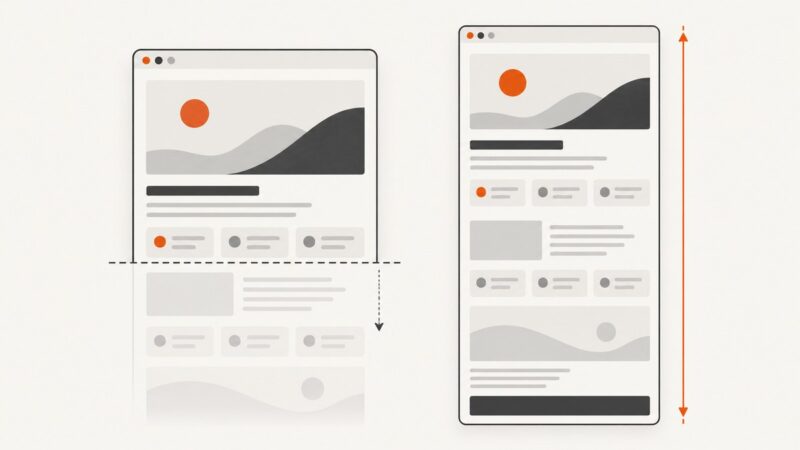
In Microsoft Edge, open the webpage and press Ctrl+Shift+S. In the Screenshot overlay, choose Capture full page. Edge captures the page beyond the visible viewport in one image, then lets you review, mark up, copy, or save it.
This is Edge’s current Screenshot feature, previously called Web capture. The same command is available from the page’s context menu and the Settings and more (…) menu. Microsoft’s feature description says it can capture an entire webpage, including content that extends beyond your screen. Microsoft Edge: Web capture and Screenshot
Take a full-page screenshot in Edge with the keyboard shortcut
- Open the webpage in Microsoft Edge.
- Press Ctrl+Shift+S.
- When the Screenshot overlay opens, select Capture full page. Do not select Capture area; that option captures only a selected region.
- Wait for Edge to assemble the complete page, including content below the fold.
- Review the result. Use the drawing or markup tools if you need to annotate it.
- Choose the command to copy the image or save it to a file.
For a page that loads content as you scroll, wait until the page has finished loading before opening Screenshot. Some sites add images or sections asynchronously, so capturing too early can leave those sections out.
What the Capture full page option includes
Capture full page creates one tall webpage image rather than a picture of only the current viewport. It is suitable for documentation, bug reports, archiving a page, and sharing a complete visual reference.
| Edge command | What it captures | Best for |
|---|---|---|
| Capture full page | The page from top to bottom, including content outside the viewport | Complete webpage references and long pages |
| Capture area | Only the rectangle you select | A paragraph, image, or region of a page |
| DevTools: Capture a full size screenshot | A full-size rendering from Chromium DevTools | Developer workflows and debugging |
Edge’s Screenshot overlay also provides review and markup controls before you copy or save the result. The output is an image, so very long pages can create large files; saving as a compressed image format can reduce storage and transfer size.
Other ways to open Screenshot in Edge
Use the page context menu
- Right-click on the webpage.
- Select Screenshot (or Web capture in an older Edge build).
- Choose Capture full page.
Use Settings and more
- Open the Settings and more (…) menu in the upper-right corner.
- Select Screenshot or Web capture.
- Choose Capture full page.
These menu names can change slightly between Edge releases, but the full-page command remains the one that captures content outside the visible window.
Developer fallback: Capture a full-size screenshot in DevTools
Edge DevTools has a separate native route for developers:
- Open DevTools with F12 or Ctrl+Shift+I.
- Open the DevTools More options (…) menu.
- Choose Capture a full size screenshot.
This command captures content that is not currently visible in the viewport. It is useful when you are already inspecting HTML, CSS, network requests, or console errors. See Microsoft’s full-page screenshot guidance for DevTools.
Why Ctrl+Shift+S may not work
| Symptom | Likely cause | Fix |
|---|---|---|
| Nothing opens | The shortcut is intercepted by another application, keyboard utility, or remote-desktop layer. | Try the right-click Screenshot command or the Settings and more (…) menu. |
| Only a region is captured | Capture area was selected. | Open Screenshot again and choose Capture full page. |
| Screenshot is missing from every menu | The browser is managed by an organization, the feature is disabled by policy, or the Edge build exposes a different menu label. | Ask your administrator whether the WebCaptureEnabled policy is enabled or not configured, then update Edge if permitted. |
| New content is absent | The page had not finished loading or uses lazy loading. | Wait for the page to settle, scroll through important sections once, and capture again. |
| The result is extremely tall or slow to save | Long pages require more memory and produce larger image files. | Capture only the needed area, reduce page content, or use a developer or API workflow that can target a specific element. |
| Cookie banners, chat bubbles, or popups cover content | The site displays overlays as part of its normal page. | Close each overlay before capture, use the site’s reader or print view when available, or use an automated screenshot service with overlay removal. |
Microsoft’s policy documentation states that when WebCaptureEnabled is enabled or not configured, Screenshot appears in the context menu, the Settings and more menu, and the Ctrl+Shift+S shortcut. WebCaptureEnabled policy documentation
Capture quality, reliability, and file-size considerations
- Wait for dynamic content: dashboards, feeds, and image-heavy pages can continue changing after the first paint.
- Check sticky elements: fixed headers and floating controls may appear repeatedly or obscure content in a long capture.
- Review before sharing: inspect the top, middle, and bottom of the image for clipped sections, missing images, or overlays.
- Mind sensitive data: a full-page image can include content that is below the fold, including personal or account information.
- Plan for large outputs: a long, high-resolution page creates a larger file and may take longer to copy or save than a viewport screenshot.
Or skip the browser setup
If you need repeatable captures in a script, CI job, or AI workflow, ScreenshotNeo provides a website screenshot API and MCP server. It accepts one GET request and returns a PNG, JPEG, WebP, or PDF. Full-page capture can load lazy images, and you can also target one element with a CSS selector, set a viewport or device preset, use dark mode, add custom CSS or JavaScript, wait for a selector, delay, or network idle, and hide selected elements.
ScreenshotNeo removes cookie and consent banners, newsletter popups, and chat widgets before the capture. Bot checks, blank pages, timeouts, failed loads, and cache hits are not billed, and response headers identify the page verdict and whether the request was billed. It also provides an MCP server for Claude, Cursor, and other MCP clients with take_screenshot, get_page_info, and capture_pdf tools.
See the ScreenshotNeo API documentation for all options.
cURL
curl -G "https://api.screenshotneo.com/v1/shot" -d access_key=YOUR_API_KEY --data-urlencode url=https://stripe.com -o shot.webpPython
import requests

r = requests.get(
    "https://api.screenshotneo.com/v1/shot",
    params={"access_key": "YOUR_API_KEY", "url": "https://stripe.com"},
    timeout=90,
)
r.raise_for_status()
open("shot.webp", "wb").write(r.content)
Node.js
const q = new URLSearchParams({ access_key: 'YOUR_API_KEY', url: 'https://stripe.com' });
const res = await fetch(`https://api.screenshotneo.com/v1/shot?${q}`);
if (!res.ok) throw new Error(`Screenshot failed: ${res.status}`);
const fs = await import('node:fs/promises');
await fs.writeFile('shot.webp', Buffer.from(await res.arrayBuffer()));
The free plan includes 1,000 screenshots per month with no card. Paid plans start at $5 for 3,000 screenshots; every feature is available on every plan. Create a free ScreenshotNeo account.
Frequently asked questions
What is the Edge full-page screenshot shortcut?
Press Ctrl+Shift+S, then choose Capture full page.
Does Edge capture content below the fold?
Yes. Capture full page includes content outside the visible viewport in one webpage image.
Can I annotate the screenshot?
Yes. Review the image in the Screenshot overlay and use its markup tools before copying or saving.
Is there a Mac shortcut?
The shortcut covered here is the Windows Edge command. On other platforms, open Screenshot from the context menu or the Settings and more menu.
What should I use for automated screenshots?
Use a browser automation workflow or an API such as ScreenshotNeo when you need repeatable captures, custom waits, overlay removal, element targeting, or server-side execution.