Essential Components of Continuous Testing
Continuous testing brings fast automated checks, human testing, and operational feedback into the delivery lifecycle. Learn what to run at each stage and how to build a dependable CI/CD feedback loop.
Continuous testing means testing throughout the software delivery lifecycle, rather than treating testing as a separate phase after development is complete. It combines automated checks, exploratory and usability testing, shared team ownership, dependable environments and test data, security analysis, and learning from production. In a CI/CD pipeline, the practical goal is to put the fastest useful checks closest to a change, then add broader checks where they can inform delivery decisions without hiding quick feedback.
There is no universal checklist or fixed test ratio. Choose what to test, when to test it, and how much evidence to require according to the risks of your system and the decisions your team needs to make. This guide turns that principle into a stage model, an example CI workflow, and a troubleshooting approach.
1. What continuous testing includes
DORA defines continuous testing as “Testing throughout the software delivery lifecycle rather than as a separate phase after dev complete.” Its guidance connects this capability to quick test feedback, developers and testers working side by side, and ongoing test-suite improvement. [DORA: Continuous delivery]
Think of continuous testing as a system of feedback, not a synonym for automating every test. Automated tests are important, but the system also needs people who can explore behavior, suitable data and environments, visible results, and a way to learn from incidents and defects.
| Component | What it contributes | Useful question |
|---|---|---|
| Shared ownership | Developers build and maintain tests; testers contribute throughout delivery through exploration, usability work, acceptance perspectives, and test-suite curation. | Who can improve the test or diagnose a failure? |
| Repeatable change triggers | Changes trigger a consistent build and an initial set of fast checks. | Does every relevant change produce a visible result? |
| Fast, dependable automation | Checks return actionable signals quickly and fail for meaningful reasons. | Can an engineer reproduce and understand the failure? |
| Risk-based coverage | Unit, integration, acceptance, end-to-end, performance, and security checks are placed where they address real risks. | Which failure modes matter, and what is the fastest suitable check? |
| Available data and environments | Teams can run tests without waiting on scarce or unsuitable fixtures and environments. | Can the test run when the change needs feedback? |
| Security and configuration checks | Analysis of source, dependencies, secrets, infrastructure, and images can join the delivery flow. | Which checks fit the system’s threats and deployment model? |
| Visibility and learning | Results inform merge, release, and operational decisions; production learning improves future checks. | What happened, who can act, and what should change? |
ISO/IEC/IEEE 29119-1 describes a risk-based approach to test strategy and prioritization, and covers test levels, test types, and test techniques. It also recognizes that exhaustive testing is impractical. Use a risk model to decide where to spend test effort rather than adopting a fixed pyramid or percentage as a rule. [ISO/IEC/IEEE 29119-1:2022 overview]
2. Place checks where their feedback is useful
A pipeline may be linear or run checks in parallel. The important property is that people receive clear evidence at the decision points where they need it. This stage model is a starting point, not a mandatory sequence.
| Stage | Typical checks | Decision supported |
|---|---|---|
| Developer change | Build, formatting or lint checks, unit tests, and inexpensive static checks. | Is this change worth sending for broader integration? |
| Pull request or integration | Integration tests, relevant security analysis, dependency checks, configuration validation, and a build artifact. | Is there enough evidence to merge and keep the shared build healthy? |
| Deployed test environment | Acceptance tests, critical end-to-end journeys, and risk-relevant performance or vulnerability testing. | Does the built software work in a representative running system? |
| Pre-release | Exploratory testing, usability evaluation, and review of remaining risk and test evidence. | Is the release ready for its intended users and operating conditions? |
| After deployment | Operational monitoring, user-experience signals, incident review, and follow-up tests for defects. | What did real operation reveal, and what feedback should return to development? |
DORA advises that developers should receive automated test feedback in less than ten minutes. Treat that as guidance, not a universal service-level guarantee: the right target depends on the system and the checks. DORA’s CI guidance also says the quickest unit checks should take a few minutes or less where possible. If broad suites exceed the useful feedback window, keep quick checks early and split or parallelize slower suites where that improves diagnosis. [DORA: Test automation] [DORA: Continuous integration]
3. Build a practical CI/CD feedback loop
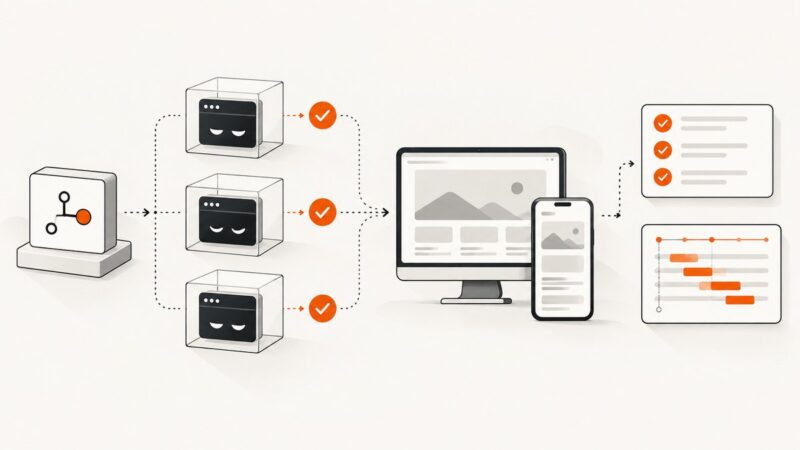
- Make changes trigger repeatable work. Define which branches, pull requests, or commits start the pipeline. Build the same artifact that will move downstream when practical, and make the result visible to the team.
- Run quick checks first. Start with build validation, unit tests, and low-cost analysis. Fail early with logs that identify the failing command and relevant output.
- Add integration and risk-specific checks. Validate interactions with dependencies and check risks such as unsafe inputs, data migrations, authorization boundaries, or supported configurations.
- Deploy an artifact to a suitable environment. Run acceptance and end-to-end checks against the running software. Use a production-like environment when the behavior under test depends on deployment configuration or infrastructure.
- Keep results actionable. Show pass/fail status, logs, and ownership in the normal development workflow. Assign responsibility for promptly repairing a broken shared build.
- Use human testing and production feedback. Make testable builds available for exploratory and usability work. Monitor production, review defects and incidents, and add or improve checks when they reveal a useful regression signal.
Here is a minimal GitHub Actions workflow showing the trigger-and-feedback shape. Replace the placeholder commands with the build and test commands for your project. It assumes the repository has a working Node.js package with npm ci, npm run build, and npm test scripts.
name: continuous-testing

on:
  pull_request:
  push:
    branches: [main]

permissions:
  contents: read

jobs:
  quick-checks:
    runs-on: ubuntu-latest
    steps:
      - uses: actions/checkout@v4
      - uses: actions/setup-node@v4
        with:
          node-version: 22
          cache: npm
      - run: npm ci
      - run: npm run build
      - run: npm test
This is an illustrative starter, not a complete policy for every repository. Pin third-party actions according to your organization’s supply-chain policy, choose a supported runtime version, and add integration, security, deployment, or end-to-end jobs that match your risks. Keep credentials in the CI platform’s secret store rather than committing them.
4. Make test coverage risk-based
Choose a test level based on the failure you want to catch and the speed and reliability of the available signal. Many defects can be caught by a small, focused check; some risks only become visible across service boundaries or in a deployed environment.
| Check type | Good fit | Watch for |
|---|---|---|
| Unit | Local rules, calculations, and edge cases in a small unit of behavior. | Excessive mocking can make a test pass while real interactions fail. |
| Integration | Contracts and interactions among components, storage, queues, or APIs. | Shared dependencies and data can create contention or inconsistent results. |
| Acceptance | Business behavior or API outcomes from a user or consumer perspective. | Keep the scenario focused so a failure points to a useful cause. |
| End-to-end | A limited set of critical user journeys through a running system. | Browser, network, timing, and environment variability can make failures harder to diagnose. |
| Performance | Known latency, throughput, or resource risks under defined conditions. | A result is meaningful only with a stated workload and environment context. |
| Security | Source, dependency, secret, infrastructure, container, and runtime risks appropriate to the system. | Scanning is evidence to triage, not proof that a system has no vulnerabilities. |
| Exploratory and usability | Unexpected behavior, confusing flows, and questions that are hard to encode in assertions. | Record context and findings so learning can become an actionable change. |
NIST’s notional DevSecOps reference model includes checks such as static analysis, software composition analysis, secret scanning, infrastructure-as-code scanning, and container-image scanning in CI. Treat those as examples to consider and tailor to your threats, architecture, and operating constraints. [NIST NCCoE: Notional DevSecOps reference model]
5. Treat data, environments, and people as pipeline components
- Make test data reproducible. Prefer fixtures, factories, or resettable datasets over dependence on manually prepared state. Avoid real sensitive production data unless it is explicitly permitted and appropriately protected.
- Control state between runs. Tests that share mutable accounts, records, queues, or databases can interfere with one another. Isolate, namespace, reset, or serialize state when needed.
- Make environments discoverable and representative enough. Document required services, configuration, and data. Use environment parity where it matters to the risk being tested; do not assume every test needs a full production copy.
- Include testers throughout delivery. Developers can own automated checks while testers contribute a testing perspective through exploration, usability work, acceptance criteria, and suite curation. This need not mean every team has a separate full-time tester role.
- Protect secrets and access. Use scoped credentials and managed secrets, and avoid printing tokens or private data in logs.
DORA’s test-automation guidance emphasizes that test data should be readily available and that developers should be able to reproduce failures in their own environments. [DORA: Test automation]
6. Measure feedback quality, not just test count
A large suite can still provide poor feedback if it is slow, flaky, hard to reproduce, or disconnected from release decisions. Review a small set of measures that help locate friction:
- Trigger coverage: do relevant changes start the expected build and checks?
- Time to actionable feedback: how long before a developer can understand and act on a result?
- Broken-build recovery: how long do shared branches or builds remain broken?
- Failure signal quality: can the team distinguish a product defect from an infrastructure or test problem?
- Test maintenance burden: which tests are flaky, redundant, or expensive to maintain?
- Operational reach: do production defects and incidents lead to useful improvements in tests or pipeline configuration?
Use measures to find bottlenecks, not to reward a high test count or coverage percentage in isolation. A coverage number does not establish that important risks have meaningful tests.
7. Troubleshooting common continuous-testing problems
| Symptom | Likely cause | Practical fix |
|---|---|---|
| Feedback arrives too late to guide the change | Slow checks block the earliest signal, or jobs run serially without need. | Put fast, high-value checks first; parallelize independent jobs; move broad suites to a later decision point while retaining required release evidence. |
| Tests fail intermittently | Timing assumptions, shared state, unstable dependencies, or environment variation. | Capture logs and artifacts; isolate state; replace arbitrary sleeps with condition-based waits; stabilize dependencies. Track flaky tests and fix or quarantine them with a clear owner and review date. |
| CI fails but local runs pass | Runtime, configuration, dependency, locale, or data differs between environments. | Record runtime and dependency versions; reproduce with the CI command; align configuration and provide a local reproduction path. |
| Failures are hard to diagnose | Assertions, logs, or reports omit the input and failing step. | Report the failed scenario, expected and actual outcome, relevant identifiers, and sanitized logs. Preserve useful CI artifacts. |
| Tests compete over data or services | Parallel jobs mutate shared fixtures or rely on a constrained service. | Isolate data per run, reset state, provide dedicated test resources, or limit concurrency for the constrained dependency. |
| Security checks overwhelm reviewers | Findings lack ownership, prioritization, or a route to triage. | Choose checks for the threat context, route findings to responsible owners, establish severity and remediation policy, and tune noisy rules based on evidence. |
| Human testing happens only at the end | Builds are not available or test work is treated as a separate phase. | Publish usable builds earlier and involve testers in refining risks and scenarios during development. |
| Production incidents do not change the suite | Operational review lacks a path back to engineering work. | Include a test or monitoring improvement in incident follow-up when it would prevent, detect, or clarify a repeat issue. |
8. Performance, reliability, and cost trade-offs
Keep the fast path small and useful
Every check adds execution time and maintenance. Put checks with fast, dependable signals early. Run slower or environment-heavy checks in parallel or at a later stage if the merge or release decision still has the required evidence. DORA’s less-than-ten-minute feedback guidance is a useful target to discuss with a team, not a promise that every pipeline or test must meet identically.
Optimize for trustworthy results
Flaky tests waste attention and can teach people to ignore failures. Prefer deterministic inputs, isolated state, explicit readiness conditions, and diagnostic output. Do not silently retry every failure until it passes: retries can hide real instability. If a test must be temporarily quarantined, retain visibility, ownership, and a plan to restore it.
Spend test effort in proportion to risk
More environments, devices, data, and parallel workers can increase infrastructure and maintenance costs. Apply expensive checks to risks and release decisions that justify them. Consider whether a small contract test, focused acceptance test, or production monitor can provide a clearer signal than a broad end-to-end scenario.
Separate pipeline cost from failure cost
A short pipeline is not automatically economical if it misses important failures; a comprehensive pipeline is not automatically useful if people cannot interpret it. Review execution time, infrastructure use, maintenance, defect discovery, and the cost of delayed feedback together. The appropriate balance depends on the system and consequences of failure.
9. Add browser evidence when visual changes matter
For a web product, a screenshot can provide a visual artifact for reviewing a page or a critical journey during a release process. It is one input to review and testing; it does not replace assertions about behavior, accessibility checks, or human exploration. Keep the captured URL, viewport, and relevant build or commit identifier with the artifact so reviewers know what they are looking at.
A DIY browser-capture step needs a browser runtime, a target environment reachable from the runner, and handling for readiness, cookies, and artifacts. Keep credentials out of URLs and logs, and capture only environments and pages your team is authorized to access. Screenshot tooling can also be a source of flaky results when pages load external content, animate, or depend on unstable data; use controlled test data and wait for the state the review actually needs.
10. Or skip the browser setup
ScreenshotNeo is a website screenshot API and MCP server for developers. One GET request can return a PNG, JPEG, WebP, or PDF; its API can provide a screenshot artifact without setting up a browser in a CI runner. See the ScreenshotNeo API documentation for request options.
curl -G "https://api.screenshotneo.com/v1/shot" -d access_key=YOUR_API_KEY --data-urlencode url=https://stripe.com -o shot.webpimport requests
r = requests.get(
"https://api.screenshotneo.com/v1/shot",
params={"access_key": "YOUR_API_KEY", "url": "https://stripe.com"},
timeout=90,
)
open("shot.webp", "wb").write(r.content)const q = new URLSearchParams({ access_key: 'YOUR_API_KEY', url: 'https://stripe.com' });
const res = await fetch(`https://api.screenshotneo.com/v1/shot?${q}`);
if (!res.ok) throw new Error(`Screenshot request failed: ${res.status}`);
await Bun.write('shot.webp', res);Use your own authorized target URL and keep the API key in your CI secret store. ScreenshotNeo accepts cookie or consent banners like a visitor and removes more than 60 known consent platforms, newsletter popups, and chat widgets before capture; each of those steps can be turned off. Bot checks or CAPTCHAs, blank pages, timeouts, failed loads, and cache hits cost nothing. Responses indicate the page verdict and billing status in X-Page-Verdict and X-Billed headers. Its MCP server offers take_screenshot, get_page_info, and capture_pdf for AI agents and MCP clients.
The free plan includes 1,000 screenshots per month with no card. Paid plans start at $5 for 3,000 screenshots; all features are on every plan. Treat screenshots as review artifacts, and retain your CI checks for functional and security behavior.
Sign up for ScreenshotNeo and get 1,000 screenshots a month free with no card.
11. A concise adoption checklist
- List the highest-impact failure modes and the evidence needed to manage them.
- Ensure each relevant change triggers a repeatable build and visible quick checks.
- Keep the fast feedback path dependable and easy to reproduce.
- Add integration, acceptance, end-to-end, performance, and security checks according to risk.
- Make data, environments, credentials, and ownership part of the design.
- Provide builds for exploratory and usability testing throughout delivery.
- Monitor production and turn meaningful incidents into pipeline or test improvements.
- Review feedback time, broken-build recovery, reliability, and maintenance burden regularly.
12. FAQ
Does continuous testing mean every test must run on every commit?
No. Run the checks that provide useful, timely feedback for that change. Place broader or slower checks at the integration, deployment, or release decision where their results are needed.
Does automation remove the need for testers?
No. Exploratory, usability, and acceptance work can reveal issues that scripted checks do not. Testing is a team responsibility, and a tester’s perspective can be involved throughout delivery.
Is the testing pyramid required?
No universal test ratio is established by the cited guidance. Use test levels and types that address your risks and produce trustworthy signals.
Should teams block releases on every security finding?
That depends on the finding, the system’s risk, and the team’s policy. Define how findings are prioritized, assigned, and resolved so scans inform a decision rather than becoming an unowned report.