BlogScreenshots on your device
Full-Page Screenshot in Chrome on Windows 10
Capture an entire webpage in Chrome on Windows 10 with DevTools, troubleshoot common failures, and automate screenshots when needed.
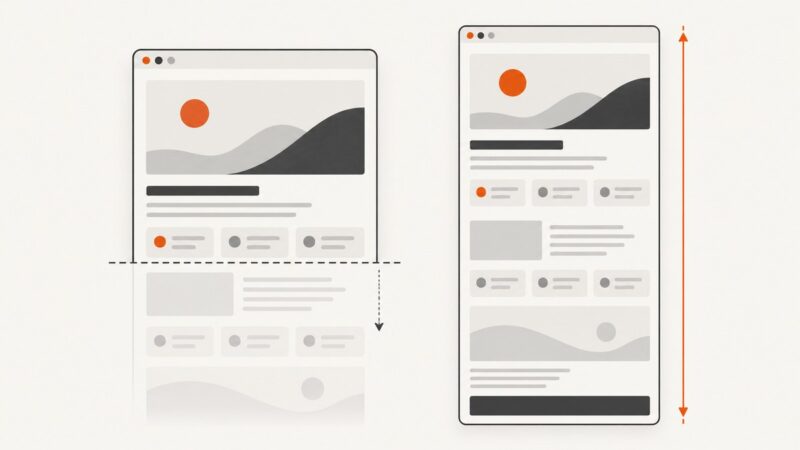
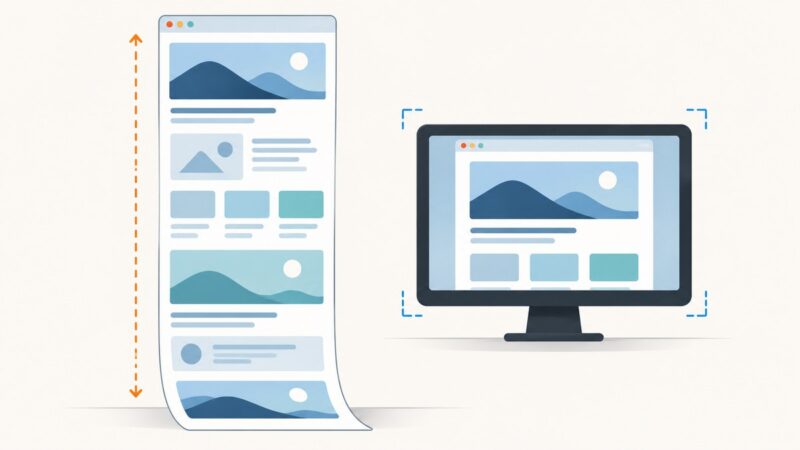
Fast answer: Open the page in Chrome, press F12, open the DevTools three-dot menu, choose Run command, type screenshot, and select Capture full size screenshot. Chrome downloads a PNG containing the document beyond the visible viewport. Chrome’s documentation describes this command as capturing the whole page, including content that is not currently visible in the viewport (Chrome DevTools documentation).
Capture an entire webpage in Chrome on Windows 10
- Open the webpage in Google Chrome.
- Press F12, or right-click the page and select Inspect.
- In DevTools, select the three-dot menu.
- Choose Run command.
- Type
screenshot. - Select Capture full size screenshot.
- Find the downloaded
.pngin your Downloads folder, then rename or move it.
This captures the full document rather than only the area currently visible in the Chrome window. The resulting image can be very tall on long pages.
Choose the right Chrome capture command
| Command | What it captures | Use it when |
|---|---|---|
| Capture screenshot | The current DevTools viewport | You need only the visible area. |
| Capture full size screenshot | The complete page, including content below the viewport | You need a scrolling or full-page image. |
| Capture node screenshot | A selected page element | You need one component or section; select the element first and confirm the exact DevTools flow in your Chrome version. |
For a full webpage, use Capture full size screenshot, not the ordinary viewport command.
What to check before saving the PNG
- Lazy-loaded content: Scroll through the page once before capturing if images or sections appear only after entering the viewport.
- Fixed headers and chat buttons: These may repeat or cover content in a full-document image.
- Animations: Pause videos, carousels, and animated banners when a consistent frame matters.
- Responsive layout: Resize the Chrome window or use DevTools device emulation if you need a specific width.
- Frames and embedded documents: Cross-origin iframes can behave differently from the parent document.
- Very long pages: Inspect the downloaded file; extremely tall images can be difficult to open or share.
Windows 10 alternatives
Snipping Tool
Press Windows+Shift+S to open Snipping Tool. Choose a region or window, then open the notification to edit and save the capture. This is suitable for the visible Chrome window or a selected region; it is not the documented whole-document DevTools workflow.
Chrome extensions
An extension can add a toolbar button, editing controls, and additional export formats. GoFullPage’s Chrome Web Store listing reports release 8.9 (2026) and notes fixes involving Chromium 153 URL requirements, dialogs, scrollbars, and capture behavior. Those release notes are vendor-reported and do not establish a universal success rate. Check the extension’s current permissions and compatibility before installing it.
Troubleshooting full-page screenshots
| Problem | Likely cause | Fix |
|---|---|---|
| No “Run command” option | DevTools is in a restricted or undocked state, or the menu was opened in the page instead of DevTools. | Open DevTools with F12, then open the three-dot menu inside the DevTools panel. |
| Only the visible area is saved | Capture screenshot was selected. | Run the command again and choose Capture full size screenshot. |
| Images are missing | Images load lazily or require scrolling. | Scroll through the page once, wait for images to appear, and capture again. |
| Content is covered by a sticky header or chat widget | Fixed-position elements remain active during capture. | Close the widget, disable the overlay if the site permits it, or use an automated capture tool that can hide selectors. |
| Capture fails on a browser-internal page | Chrome restricts access to some internal or protected URLs. | Capture a normal web URL, or use an approved workflow for that page type. |
| Text or sections are cut off | Responsive breakpoints, oversized elements, or rendering changes during capture. | Set a stable viewport width, wait for layout to settle, disable animations, and retry. |
| The PNG is too large to open | The document is exceptionally long or contains many large images. | Capture sections separately, reduce image dimensions after capture, or export through an automated service. |
| A login-only page is blank | The session expired or the page requires authentication. | Sign in again, verify the page is visible in the tab, and recapture without closing the session. |
Performance, reliability, and file handling
- Full-page capture takes longer than a viewport capture because Chrome must render content outside the current viewport.
- Network speed, JavaScript, fonts, videos, ads, and lazy-loading behavior affect when the page is ready.
- For repeatable results, use the same Chrome version, window width, zoom level, login state, and page state.
- PNG preserves sharp text and transparency but can be large. Convert a copy to JPEG or WebP when smaller files matter.
- There is no documented success rate that applies to every site. Frames, fixed elements, animations, restricted URLs, and heavily scripted pages can produce different results.
Or skip the browser setup
For code, scheduled jobs, or many URLs, ScreenshotNeo provides a website screenshot API and MCP server. One GET request returns a PNG, JPEG, WebP, or PDF. The API can load lazy images, capture a CSS-selected element, set a viewport or device preset, use retina scale, apply dark mode, wait for a selector, delay, or network idle, hide selectors, run custom CSS or JavaScript, click an element, block ads or requests, set headers, cookies, user agents, authorization, timezone, and geolocation, resize images, cache with a chosen TTL, create signed image links, submit async jobs with signed webhooks, capture up to 100 URLs per call, and expose usage data. See the ScreenshotNeo API documentation for parameter details.
Cookie and consent banners are accepted and removed before capture, along with more than 60 known consent platforms, newsletter popups, and chat widgets; each cleanup step can be disabled. Bot checks, blank pages, timeouts, failed loads, and cache hits are not billed, and the response reports the result in X-Page-Verdict and X-Billed headers. ScreenshotNeo also includes an MCP server with take_screenshot, get_page_info, and capture_pdf tools for Claude, Cursor, and other MCP clients.
cURL
curl -G "https://api.screenshotneo.com/v1/shot" -d access_key=YOUR_API_KEY --data-urlencode url=https://stripe.com -o shot.webpPython
import requests
r = requests.get("https://api.screenshotneo.com/v1/shot", params={"access_key": "YOUR_API_KEY", "url": "https://stripe.com"}, timeout=90)
open("shot.webp", "wb").write(r.content)
Node.js
const q = new URLSearchParams({ access_key: 'YOUR_API_KEY', url: 'https://stripe.com' });
const res = await fetch(`https://api.screenshotneo.com/v1/shot?${q}`);
The free plan includes 1,000 screenshots each month with no card. Paid plans start at $5 for 3,000 shots; yearly billing gives two months free, and every feature is available on every plan. Create a free ScreenshotNeo account.
FAQ
Does Chrome save a full-page screenshot as a PDF?
No. The DevTools command saves a PNG. Use Chrome’s print dialog for a PDF, or use an API that supports PDF output.
Can I capture only one element?
Yes. DevTools has a Capture node screenshot concept for a selected element, but the exact click path can vary by Chrome version. ScreenshotNeo supports CSS-selector element capture through its API.
Will the method work on every website?
No method is guaranteed for every page. Protected URLs, cross-origin frames, animations, fixed elements, and pages that render content only after interaction can change the result.
Where is the downloaded file?
Unless Chrome’s download settings were changed, look in the Windows Downloads folder. The default file is a PNG that you can rename or move.
Can I automate this from a script?
DevTools is primarily an interactive workflow. For repeatable automation, use a browser automation framework or a screenshot API such as ScreenshotNeo.