BlogScreenshots on your device
How to Take a Full-Page Screenshot on a Computer
Capture an entire webpage below the fold with Edge, Firefox, Chrome DevTools, or ScreenshotNeo, plus fixes for dynamic and difficult pages.
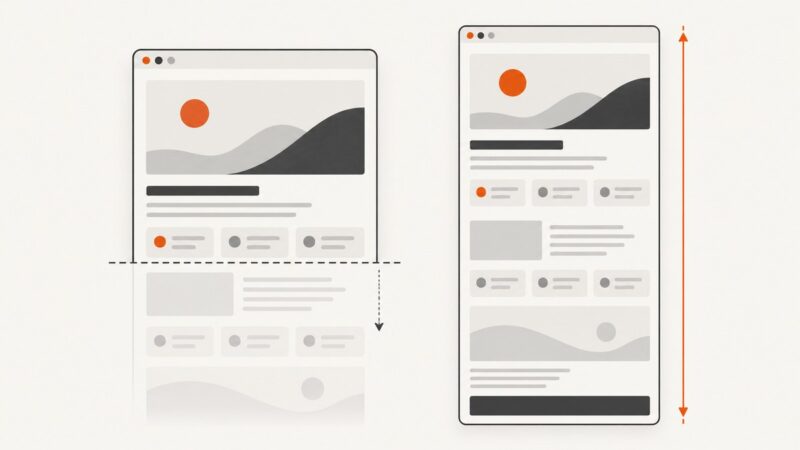
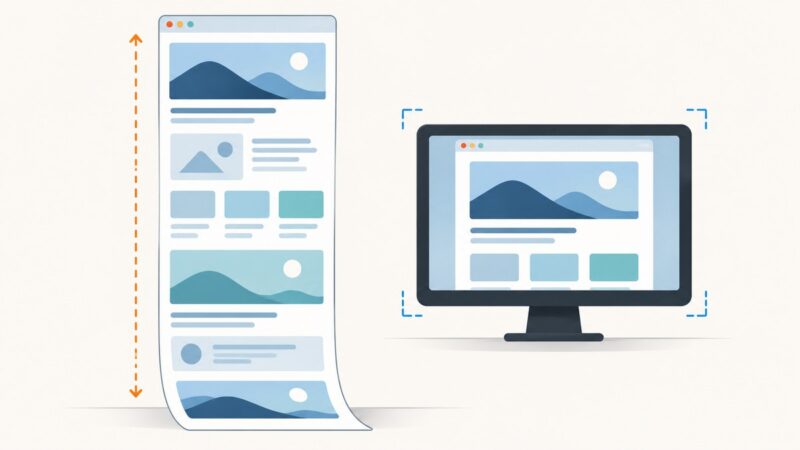
To capture an entire webpage, use a full-page browser capture rather than a normal operating-system screenshot. In Microsoft Edge, press Ctrl+Shift+S and choose Capture full page. In Firefox, open Take Screenshot and choose Save full page. In Chrome, open DevTools, enable Device mode, open the device toolbar menu, and select Capture a full size screenshot. These options include content below the visible screen; a regular desktop screenshot normally captures only the current screen or a selected region.
Choose the right method
| Need | Best route | Why |
|---|---|---|
| Fastest built-in workflow | Edge Screenshot | One shortcut opens the capture tool. |
| Built-in capture without DevTools | Firefox Save full page | The option is available in the normal screenshot tool. |
| You work in Chrome | Chrome DevTools | Device mode includes a full-size page command. |
| Only the visible screen, a window, or a region | Operating-system capture | This is a different task from capturing a webpage below the fold. |
| Repeatable automation or an API | ScreenshotNeo | It captures pages by URL and can handle page-state options without maintaining your own browser. |
Microsoft Edge: Capture full page
- Open the webpage you want to save.
- Press Ctrl+Shift+S (on macOS, use the Screenshot command shown by your Edge version).
- Choose Capture full page.
- Review the resulting overlay, then copy or save the image.
Microsoft describes this feature as capturing an entire webpage, including content beyond the screen. Availability and behavior can vary by device, market, and browser version. See the Microsoft Edge Screenshot documentation if the command is missing.
Firefox: Save full page
- Open the page in Firefox.
- Open the page actions menu or right-click and choose Take Screenshot.
- Select Save full page.
- Choose where to save the generated image.
Mozilla documents the user-facing workflow in Take screenshots in Firefox. Firefox Developer Tools also provide a screenshot workflow when you need developer-oriented controls; see Mozilla’s developer documentation.
Chrome: Capture a full-size screenshot with DevTools
- Open the webpage in Chrome.
- Open DevTools with F12, Ctrl+Shift+I (Windows/Linux), or Cmd+Option+I (macOS).
- Turn on Device mode by selecting the phone/tablet icon, or press Ctrl+Shift+M / Cmd+Shift+M.
- Open the device toolbar’s More options menu.
- Choose Capture a full size screenshot.
Chrome’s documented Device mode route captures the whole page, including content outside the viewport. The Chrome Device mode documentation explains the current interface; Chrome also describes several DevTools screenshot routes in its screenshot tips.
What “full page” does—and does not—capture
A full-page webpage capture stitches or renders the document beyond the visible viewport. It is different from a desktop screenshot, which usually records only what is currently visible. Browser tools do not guarantee perfect results for every page structure. Infinite feeds, nested scrolling panels, sticky elements, animations, and content that appears only after interaction can require a different approach.
Pages that need extra care
- Infinite scroll: Scroll through the feed first so additional content loads, then capture. There may be no finite “whole page.”
- Nested scroll areas: A browser full-page command may capture the document but not every independently scrolling panel. Capture the panel separately if needed.
- Lazy-loaded images: Images may appear only after they approach the viewport. Scroll through the page first or use an automated capture that waits for loading.
- Sticky headers and floating widgets: They can repeat down a stitched image or cover content. Temporarily hide them with site controls or browser developer tools.
- Animations and videos: The captured frame depends on timing. Pause media and wait for the desired state.
- Access-controlled pages: Sign in before capture and confirm that the resulting file does not expose private information.
Or skip the browser setup
ScreenshotNeo is a website screenshot API and MCP server. One GET request returns a PNG, JPEG, WebP, or PDF. Full-page capture can load lazy images, and you can add waits, custom CSS or JavaScript, cookies, headers, device settings, blocking rules, and other capture options. The ScreenshotNeo documentation lists the request parameters.
cURL
curl -G "https://api.screenshotneo.com/v1/shot" \
  -d access_key=YOUR_API_KEY \
  --data-urlencode url=https://example.com \
  -o shot.webp
Python
import requests

r = requests.get(
    "https://api.screenshotneo.com/v1/shot",
    params={"access_key": "YOUR_API_KEY", "url": "https://example.com"},
    timeout=90,
)
r.raise_for_status()
open("shot.webp", "wb").write(r.content)
Node.js
const q = new URLSearchParams({
  access_key: 'YOUR_API_KEY',
  url: 'https://example.com'
});
const res = await fetch(`https://api.screenshotneo.com/v1/shot?${q}`);
if (!res.ok) throw new Error(`Screenshot failed: ${res.status}`);
const fs = await import('node:fs/promises');
await fs.writeFile('shot.webp', Buffer.from(await res.arrayBuffer()));
Before capture, ScreenshotNeo can accept consent banners and remove more than 60 known consent platforms, newsletter popups, and chat widgets; each step can be turned off. Bot checks or CAPTCHAs, blank pages, timeouts, failed loads, and cache hits are not billed. Response headers identify the page verdict and whether the request was billed. An MCP server provides take_screenshot, get_page_info, and capture_pdf tools for Claude, Cursor, and other MCP clients. The free plan includes 1,000 screenshots each month without a card; paid plans start at $5 for 3,000. Create a free ScreenshotNeo account.
Useful capture options for automated jobs
| Requirement | Option to use |
|---|---|
| Entire document | Full-page capture with lazy-image loading. |
| One component | Capture an element by CSS selector. |
| Responsive checks | Device presets, custom viewport, and retina scale. |
| Dark-theme page | Dark mode. |
| Dynamic content | Wait for a selector, a delay, or network idle; optionally click an element first. |
| Clean output | Hide selectors, block ads/trackers/requests/resource types, custom CSS, and custom JavaScript. |
| Authenticated page | Custom headers, cookies, user agent, and Authorization. |
| Regional rendering | Timezone and geolocation. |
| Design assets | Transparent background and image resizing. |
| Documents | PDF paper size, margins, landscape mode, and page ranges. |
| Public embeds | Signed links for public <img> tags. |
| Large jobs | Async jobs with signed webhooks or bulk capture of up to 100 URLs per call. |
| Repeat requests | A cache with a TTL you choose and the usage API for accounting. |
Troubleshooting
| Symptom | Likely cause | Fix |
|---|---|---|
| No full-page option | Browser version or interface differs. | Update the browser, search its screenshot command, or use the documented DevTools route. |
| Only the visible viewport is saved | A normal desktop capture was used. | Use Edge Capture full page, Firefox Save full page, or Chrome Capture a full size screenshot. |
| Images are missing | Lazy loading had not triggered. | Scroll through the page first, wait for images, or use a capture wait condition. |
| Content is cut off | Nested scrolling, an infinite feed, or complex layout. | Capture the relevant scroll panel separately or divide the page into sections. |
| Cookie banner covers content | The banner was still active at capture time. | Accept or dismiss it manually, hide its selector, or use ScreenshotNeo’s consent handling. |
| Page is blank or times out in automation | Slow resources, bot checks, or a failed navigation. | Increase the client timeout, wait for a selector or network idle, inspect the page verdict, and retry only when appropriate. |
| Capture is unexpectedly billed | The request produced a clean shot rather than a failed or cached response. | Read the X-Page-Verdict and X-Billed headers and use caching where repeated output is acceptable. |
Performance, reliability, and cost notes
- For a one-off page, a built-in browser tool is usually the shortest path.
- For repeated URLs, set a cache TTL and avoid recapturing unchanged pages.
- Wait only for the condition you need. Network-idle waits can be longer on pages with continuing analytics requests; a specific selector or short delay can be more predictable.
- Block unnecessary ads, trackers, requests, or resource types to reduce page work, while checking that blocked resources are not required for the content.
- Use async jobs and signed webhooks for large batches instead of holding one request open for every URL.
- Bulk capture supports up to 100 URLs per call. The usage API helps reconcile consumption.
- ScreenshotNeo bills only clean shots. Bot checks/CAPTCHAs, blank pages, timeouts, failed loads, and cache hits cost nothing, and the response states the verdict and billing status.
- Plans include every feature: Free offers 1,000 shots per month with no card; Starter is $5 for 3,000; Growth $15 for 15,000; Pro $39 for 60,000; Scale $99 for 250,000; Business $249 for 1,000,000. Yearly billing gives two months free.
Checklist before saving
- Confirm you need the whole webpage, not just the visible desktop.
- Close or handle consent banners, popups, and chat widgets.
- Let lazy images and fonts finish loading.
- Check sticky headers, nested panels, and infinite-scroll behavior.
- Review the bottom and top of the resulting image for clipping or repeated elements.
- For automated work, define waits, viewport, authentication, output format, caching, and retry behavior.
FAQ
Can I take a full-page screenshot without installing software?
Yes. Edge and Firefox include built-in full-page commands, and Chrome provides one through DevTools.
Does a full-page screenshot include content below the fold?
That is its purpose: it captures webpage content outside the visible viewport. Results can vary for infinite feeds, nested scroll areas, and highly dynamic pages.
Why is my operating-system screenshot not long enough?
Operating-system tools generally capture the current screen, window, or selection. Use the browser’s full-page feature for a webpage that continues below the fold.
Can I capture a full page as a PDF?
Yes. Browser print-to-PDF is one option; ScreenshotNeo also provides PDF capture with paper size, margins, landscape mode, and page ranges.
What should I use for scheduled screenshots?
Use an automated capture service with explicit waits, authentication controls, caching, and retry handling. ScreenshotNeo provides those controls, async jobs, webhooks, bulk capture, and an MCP server for AI-agent workflows.