How to Improve Functional Testing with Cloud Test Execution
Improve functional testing with cloud execution by choosing a risk-based test matrix, parallelizing safely, integrating CI, and keeping useful failure evidence.
Cloud test execution can make functional testing easier to scale and maintain. The practical approach is to select browser and device combinations based on user and release risk, distribute only independent tests, connect execution to CI/CD, and retain enough evidence to diagnose failures. A cloud grid does not automatically make tests faster or more reliable: suite setup, queue time, concurrency limits, network access, and flaky tests still affect feedback.
1. Find the bottleneck before moving tests
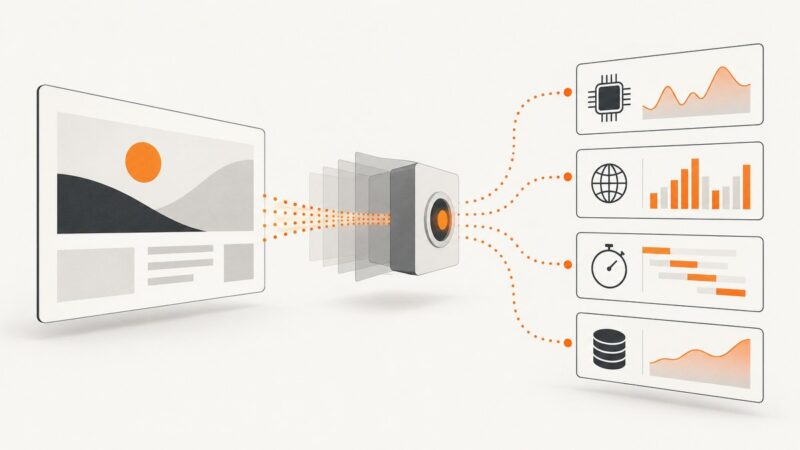
Use your own CI history to establish a baseline. Record suite wall-clock duration, queue time, failure and rerun rates, diagnosis time, infrastructure maintenance, coverage, and execution cost. Separate time spent waiting for capacity from time spent running tests; cloud execution can reduce host provisioning work, but a queue or slow setup can still delay results.
Define what should improve. For example, a team might target faster pull-request feedback while retaining a broader scheduled matrix. Treat that as a design pattern, not a vendor requirement. Do not assume a universal percentage reduction in runtime or cost.
2. Choose a risk-based browser and device matrix
Build the matrix from customer analytics, support incidents, product requirements, and release risk. Consider browser, operating system, browser version, device type, and network conditions when they affect the application. Verify that the chosen service supports the exact combinations and capabilities your tests need.
| Test group | Typical purpose | Execution pattern |
|---|---|---|
| Pull-request smoke | Catch critical workflow regressions quickly | Small set of high-value combinations |
| Scheduled matrix | Find compatibility issues across more combinations | Broader browser or device set |
| Pre-release checks | Exercise release-specific risk | Targeted combinations and critical user journeys |
The matrix should be large enough to represent meaningful user risk and small enough to maintain. Revisit it when analytics, supported platforms, incidents, or product requirements change.
3. Check service fit before migrating
Compare services against the actual suite, not just a headline device or browser count. AWS Device Farm documents Selenium sessions on hosted desktop browsers, as well as mobile application testing with frameworks including Appium, Android Instrumentation, XCTest, and XCTest UI. Its desktop browser documentation lists Chrome, Firefox, and Chromium-based Edge on Windows; it supports latest, latest-1, or latest-2 browser versions and notes that not all W3C WebDriver capabilities are implemented. Web application testing on mobile uses Appium according to its documentation. See the AWS desktop browser testing guide and AWS capability and project documentation.
BrowserStack documents Selenium browser and device execution and a secure tunnel for internally hosted applications. Its service descriptions are vendor claims, so verify the combinations, account limits, and commercial terms that apply to your account. See BrowserStack Automate documentation.
- Confirm framework, protocol, browser, operating system, and device support.
- Check parallel session limits, queue behavior, and whether devices are physical or virtual where that distinction matters.
- Prove private-app connectivity with a representative test before migrating a suite.
- Review CI integration, supported regions, access controls, artifact retention, and data handling.
- Confirm how execution is billed and how concurrency affects total cost.
4. Make tests safe to distribute
Parallelism helps only when tests can run independently and the service has capacity. Before increasing concurrency:
- Give each test or worker isolated data and avoid shared mutable accounts or records.
- Make setup and cleanup repeatable, including cleanup after a test fails.
- Identify ordering dependencies and shared state; remove them or keep those tests in a serial group.
- Set explicit timeouts for navigation and test actions so a stalled test does not occupy a session indefinitely.
- Track retries and intermittent failures as diagnostic signals. Retries can expose instability; they should not conceal it.
Estimate runtime with the suite’s actual setup and service limits. Dividing test count by concurrency gives only a rough lower bound: session startup, queueing, test duration variance, data setup, and serial dependencies add time.
5. Integrate cloud execution into CI/CD
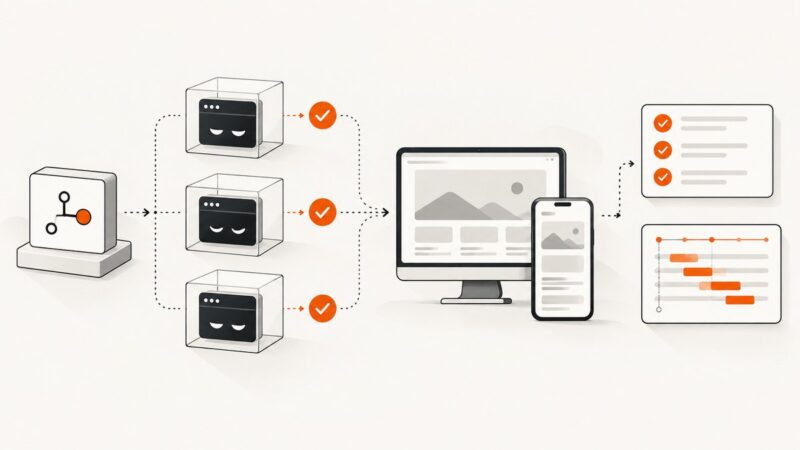
Trigger cloud runs at the stage where their feedback is useful. A small smoke set may gate a pull request, while a wider matrix may run on a schedule or before release. Label each run with the build and commit identifiers, return a clear pass/fail status to the pipeline, and make it possible to find the matching report and artifacts later.
- Verify the provider supports the suite’s runner and required WebDriver or mobile capabilities.
- Decide how the test runner will reach the application, especially for private environments; configure the provider’s documented tunnel or network connection if required.
- Store credentials in the CI secret store and grant only the access needed to launch tests.
- Pass a unique build identifier into the run and preserve it in reports and artifact names.
- Set sensible timeouts and failure behavior so a provider outage or unreachable endpoint produces an actionable pipeline result.
- Start with a representative subset, then expand after validating parallel safety and artifact collection.
For provider-specific setup and supported connection methods, follow the provider’s current CI and private-network documentation; capabilities and commercial limits can change.
6. Preserve evidence that makes failures actionable
Keep test reports and the context needed to reproduce a failure. Useful evidence can include video, browser or WebDriver logs, console and action logs, and screenshots. AWS and BrowserStack document diagnostic artifacts for their respective services: see the AWS guide and BrowserStack documentation.
Set retention according to security and data-retention policy. Test artifacts may contain customer-like data, internal URLs, or credentials if the test is poorly designed. Mask sensitive values and avoid placing secrets in URLs, names, screenshots, or logs.
7. Compare cloud execution options carefully
| Evaluation area | Questions to answer |
|---|---|
| Coverage fit | Does the service offer the exact required browser, OS, version, and device combinations? |
| Execution support | Does it support your framework, protocol, capabilities, and CI runner? |
| Capacity | What are the concurrency limits, queue behavior, and session startup costs? |
| Private application access | Can tests reach internal environments securely, and what setup is required? |
| Diagnostics | Which videos, logs, screenshots, and reports are available, and for how long? |
| Security and operations | What regions, access controls, data handling, and retention settings apply? |
| Total cost | How are minutes, parallel capacity, or device use charged at your expected volume? |
AWS says desktop browser testing is billed per minute; check the current AWS Device Farm pricing and limits before budgeting. BrowserStack’s supported combinations and scale descriptions are vendor statements, not an independent head-to-head test. Confirm current plan terms and account limits directly with each provider.
8. Measure whether the change helped
After adoption, compare the same measures collected before migration: wall-clock feedback time, queue time, infrastructure maintenance, diagnosis time, flaky-test rate, coverage achieved, and total cost. Include time to maintain tunnels, test data, and CI configuration. A useful outcome is not simply more parallel sessions; it is faster or more useful feedback at an acceptable cost without weakening the test signal.
9. Troubleshooting common problems
| Symptom | Likely cause | What to do |
|---|---|---|
| Runs are no faster after adding parallel sessions | Queueing, session startup, serial dependencies, or slow setup dominates | Measure queue and setup separately; isolate independent work and check account concurrency. |
| Tests fail only in parallel | Shared accounts, records, or mutable state | Allocate isolated data per worker and make cleanup reliable. |
| Session creation or capability errors | Unsupported browser, version, or WebDriver capability | Compare requested capabilities with the provider’s current implementation; simplify or select a supported combination. |
| Hosted runner cannot open the app | Private endpoint, firewall, DNS, or tunnel configuration | Verify reachability from the provider’s runner and configure the documented tunnel or network path. |
| Intermittent timeouts | Unstable app readiness, network variance, or overly short timeouts | Wait for a meaningful application condition, inspect video and logs, and set bounded timeouts. Do not mask persistent flakiness with retries. |
| Failure is hard to reproduce | Missing build identity, logs, video, or test data context | Attach run identifiers and retain the report and relevant artifacts under the team’s retention policy. |
| Unexpected bill or exhausted capacity | Minute-based billing, parallel usage, or plan limits misunderstood | Review actual session usage and current plan terms; cap concurrency and run broad matrices only at intended stages. |
10. Capture screenshots for visual diagnosis
Functional test evidence can include screenshots of a failed state. If you need a screenshot as a separate artifact, a local browser capture is one option. For example, with Playwright’s Python API, install Playwright and its browser binaries, then run this script:
from pathlib import Path
from playwright.sync_api import sync_playwright

url = "https://example.com"

with sync_playwright() as p:
    browser = p.chromium.launch(headless=True)
    page = browser.new_page(viewport={"width": 1440, "height": 900})
    page.goto(url, wait_until="networkidle", timeout=30_000)
    page.screenshot(path="page.png", full_page=True)
    browser.close()
Install with python -m pip install playwright and playwright install chromium. In a real test, capture the page at the failure point, using a stable application state and a sanitized test URL. A screenshot is diagnostic evidence; it does not replace assertions that verify the expected behavior.
Or skip the browser setup
For standalone website screenshots, ScreenshotNeo provides a one-request screenshot API. The code below requests a WebP capture of Stripe. See the ScreenshotNeo API documentation for request options.
curl -G "https://api.screenshotneo.com/v1/shot" -d access_key=YOUR_API_KEY --data-urlencode url=https://stripe.com -o shot.webpimport requests
r = requests.get("https://api.screenshotneo.com/v1/shot", params={"access_key": "YOUR_API_KEY", "url": "https://stripe.com"}, timeout=90)
open("shot.webp", "wb").write(r.content)const q = new URLSearchParams({ access_key: 'YOUR_API_KEY', url: 'https://stripe.com' });
const res = await fetch(`https://api.screenshotneo.com/v1/shot?${q}`);
if (!res.ok) throw new Error(`Screenshot request failed: ${res.status}`);
await Bun.write('shot.webp', res);ScreenshotNeo removes cookie and consent banners, newsletter popups, and chat widgets before capture. Bot checks, blank pages, failed loads, timeouts, and cache hits are not billed. Its MCP server lets AI agents use take_screenshot, get_page_info, and capture_pdf. The free plan includes 1,000 screenshots a month with no card; paid plans start at $5 for 3,000. These website screenshots complement test-runner evidence; use your functional test service for browser and device test execution. Learn more at ScreenshotNeo, or sign up free for 1,000 screenshots a month, with no card.
Frequently asked questions
Does cloud execution improve test coverage by itself?
No. Coverage depends on the scenarios and combinations selected and on whether tests exercise meaningful behavior. Cloud capacity makes it possible to execute selected combinations without provisioning every host yourself.
Should every test run in parallel?
No. Parallelize tests that are independent and safe to distribute. Keep tests with unavoidable ordering or shared state in a controlled serial group until they can be isolated.
Can cloud browser execution test a private staging site?
Often, but the runner needs a permitted network path. Check the provider’s documented tunnel or network connection options and validate access before migrating the suite.
How much faster will the suite become?
There is no universal improvement figure. Measure queue, setup, execution, and reporting time on your own suite at the concurrency you can actually use.